
The Porsche 911 GT1 is one of the most extreme Porsches ever made. In the mid-1990s, Porsche set its sights on reclaiming endurance racing glory. But to do it under GT1 class rules, they had to play by the book: build a road car. The result wasn’t just a workaround. It was a revelation.
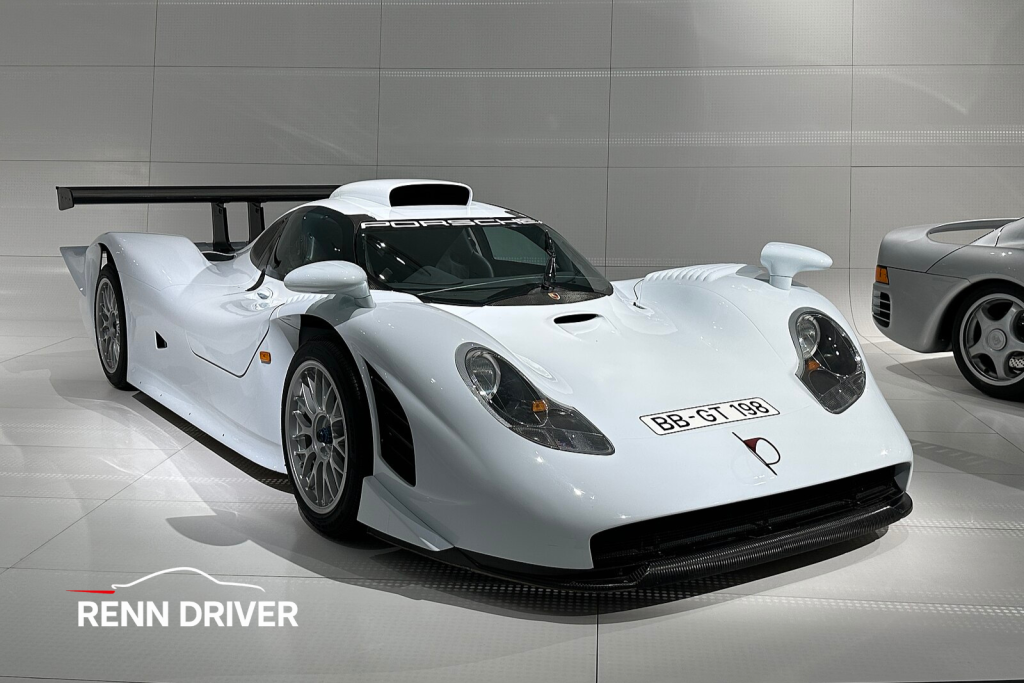
Born in the pits, bred on the Mulsanne straight, and unleashed on public roads. It represents a rare moment where pure racing DNA escaped regulation and landed in private garages.
In this article, we’ll explore how the 911 GT1 came to life, what made it a motorsport icon, and why it remains one of the most coveted collector cars in the world.
Contents
- 1 History: Built to Beat the Best
- 2 Design and Aerodynamics: Street Car in Racewear
- 3 Engine and Performance: Turbocharged Violence
- 4 Interior and Driving Experience: Minimal and Mechanical
- 5 Motorsport Legacy: Born for Le Mans
- 6 Collectibility and Value: Unicorn Territory
- 7 Specs Table
- 8 Fun Facts About Porsche 911 GT1
- 9 Frequently Asked Questions (FAQs)
- 10 Final Thoughts
Quick Summary
- Production Years: 1996–1998
- Engine: 3.2L twin-turbo flat-six
- Power Output: 544 hp (road version), 600+ hp (race spec)
- Transmission: 6-speed manual
- Top Speed: 310 km/h (192 mph)
- Layout: rear-weight-biased engine placement
- Units Produced: 25 street-legal versions
- Legacy: Homologation special with Le Mans pedigree
History: Built to Beat the Best
The GT1 wasn’t a normal 911. It didn’t even share the usual rear-engine layout. Porsche AG developed the GT1 as both a marketing showcase and a racing weapon, blurring the line between road car and prototype.
To stay competitive with rivals like the McLaren F1 GTR and Mercedes CLK GTR, Porsche flipped the formula. They pushed the engine forward for better balance. Then they wrapped it in lightweight carbon fiber and shaped it with enough downforce to pin the car to the tarmac.
Its debut came in 1996, built to compete in the BPR Global GT Series and the newly formed FIA GT Championship. The GT1 was technically homologated as a production car, though it had far more in common with its racing counterpart than with road-going 911s. For 1997, Porsche upped the performance with revised aerodynamics and improved cooling. This kept the GT1 competitive against increasingly fierce rivals.
It quickly made a mark, winning races and setting blistering lap times. Porsche continued to evolve the car, releasing versions for 1996, 1997, and the 1998 GT1-98, which finally secured overall victory in 1998.
That victory cemented the GT1’s place in Porsche history.

Design and Aerodynamics: Street Car in Racewear
Visually, the GT1 looks like a 911 from an alternate timeline. The headlights might remind you of the 993, but the body is lower, longer, and far more aggressive. The massive rear wing is pure motorsport. So is the deep front splitter and the sprawling air intakes along the flanks.
Everything was shaped with speed in mind. Even the doors were sculpted to allow airflow to the engine. The car rides incredibly low, and its stance screams performance even at a standstill.
The road-legal model retains much of the race car’s exterior. It has mirrors, indicators, and license plates. But make no mistake, this is no Carrera with a body kit.
Engine and Performance: Turbocharged Violence
At the heart of the GT1 is a 3.2-liter twin-turbocharged flat-six, derived from Porsche’s dominant 962 Group C race car. It makes 544 horsepower in the street-legal version and over 600 horsepower in race trim.
That power goes to the rear wheels through a six-speed manual gearbox. Launching it is an event. The car also featured push rod suspension, borrowed straight from prototype racers, giving it unmatched cornering stability. Turbo lag feels like a pause before release, but once boost builds, the car rockets forward with brutal urgency.
Top speed? About 310 km/h. But the real magic is in the acceleration and high-speed stability. This car was built to spend hours at triple-digit speeds, and it feels like it.

Interior and Driving Experience: Minimal and Mechanical
Inside, the GT1 is a reminder of its racing roots. You get basic materials, bucket seats, and exposed hardware. There’s some light padding and basic gauges, but it’s stripped-down by Porsche standards.
Driving it is loud. The clutch is heavy. The gearbox is mechanical and rewards precision. It’s not comfortable, but it’s rewarding in the way only raw, analog machines can be.
The street version includes minimal concessions to road use such as AC, basic trim, and a slightly more forgiving suspension. But make no mistake, this is a machine that just happens to have registration.
Motorsport Legacy: Born for Le Mans
The GT1 didn’t just show up, it delivered. In its first years, it won several rounds in the FIA GT and BPR series. Porsche kept refining it with each iteration.
In 1998, everything came together. The GT1-98, with a new carbon monocoque chassis, swept the podium in endurance racing’s biggest test. First and second place. It was Porsche’s 16th overall win, and the final one before a long hiatus. That version also incorporated refined aerodynamics and push rod suspension, elevating its handling to prototype levels.
The GT1’s motorsport story ended on a high note. Few homologation cars can say they were developed to win Le Mans and actually did it.

Collectibility and Value: Unicorn Territory
Only 25 street-legal versions of the Porsche 911 GT1 were built, including two prototypes. Each one is essentially a hand-crafted homologation special. As a result, prices have skyrocketed over the years.
Estimates today place the GT1 between $5 million and $10 million. This depends on the car’s provenance, mileage, and originality. One recently sold at auction for over $6 million. These cars are rarely seen outside private collections. Most are in private collections, sealed away like museum artifacts that happen to be road legal.
Specs Table
| Specification | Detail |
|---|---|
| Production Years | 1996–1999 |
| Engine | 3.2L twin-turbo flat-six |
| Power (road version) | 544 hp |
| Transmission | 6-speed manual |
| Layout | Mid-engine, rear-wheel drive |
| Top Speed | 310 km/h (192 mph) |
| 0–100 km/h | ~3.7 seconds |
| Units Built (road) | 25 |
Fun Facts About Porsche 911 GT1
- It shares roots with the Porsche 962 – The GT1’s engine is based on the same one that powered Porsche’s Group C domination in the ‘80s.
- It flipped the 911 layout – This is the only “911” with a mid-engine setup.
- Its headlights previewed the 996 – The GT1’s unique headlamp design was later used in the first water-cooled 911.
- One GT1 was destroyed at Le Mans… twice – The 1997 version famously flipped during practice and again during the race. Both drivers survived.
- The street version was built to meet just one rule – To race in GT1, you had to build at least one road car. Porsche built 20, just to be safe.
Frequently Asked Questions (FAQs)
Is the Porsche 911 GT1 street legal?
Yes, the Porsche 911 GT1 is street legal. Porsche built 20 road-legal versions to comply with FIA GT1 homologation rules. These cars are fully street legal, though far from practical.
What’s the difference between the race and road versions?
The street version has slightly detuned power, softer suspension, and minimal road equipment. Otherwise, it’s largely the same as the track version.
How many Porsche 911 GT1s were made?
A total of 25 street-legal units were made, including prototypes. This was done to comply with the FIA’s homologation rules for the GT1 class. Several race-spec versions were also built for FIA GT and Le Mans.
Is the 911 GT1 mid-engined or rear-engined?
Unlike other 911s, the GT1 is mid-engined. The engine sits ahead of the rear axle for better weight distribution and balance.
Did the Porsche 911 GT1 win Le Mans?
Yes. The 911 GT1-98 won Le Mans overall in 1998, securing Porsche’s 16th victory at the famous race.
Final Thoughts
The Porsche 911 GT1 was a loophole car. It existed because the rules demanded a road car, and Porsche responded with a contender disguised as a street machine.
It’s not just a car, it’s a statement. Compared to other cars of its time, the GT1 stood apart as both a regulation loophole and a masterpiece of engineering. It was a symbol of Porsche’s determination to win on its terms, and a rare example of racing purity carried into the real world.
Which other Porsche legends should we explore next?
Photo credit: GerdeeX, CC BY-SA 4.0, via Wikimedia Commons, Sicnag, CC BY 2.0, via Wikimedia Commons, MrWalkr, CC BY-SA 4.0, via Wikimedia Commons, Martin Lee from London, UK, CC BY-SA 2.0, via Wikimedia Commons