
The Porsche 911 GT2 RS is a car that doesn’t make compromises. It’s the most powerful 911 Porsche has ever built for the road, with track performance that rivals pure race machines. From the moment it was announced, it carried a reputation as a no-nonsense, turbocharged monster that rewards skilled drivers and punishes the careless.
What makes this car so special isn’t just the power figure or the lap times. It’s the way it combines Porsche’s race engineering with aggressive styling, advanced aerodynamics, and old-school driving excitement. It’s fast, rare, and raw, and that’s exactly how Porsche fans want it.
Even Porsche Cars North America highlighted the GT2 RS as one of the most extreme vehicles ever offered to customers.
Quick Summary
- Production Years: 2010 (997 GT2 RS), 2017–2019 (991.2 GT2 RS)
- Engine: 3.8L twin-turbo flat-six (700 hp, 553 lb-ft)
- Transmission: 7-speed dual-clutch (PDK)
- Top Speed: 340 km/h (211 mph)
- 0–100 km/h: 2.7 seconds
- Drive Layout: Rear-engine, rear-wheel drive
- Notable Features: Carbon construction, rear-axle steering, Weissach package
- Legacy: Nürburgring record holder, Porsche’s ultimate street-legal track car
Contents
- 1 Quick Summary
- 2 History of the Porsche GT2 and GT2 RS
- 3 Legacy Redefined by Manthey Racing
- 4 Exterior Design and Aerodynamics
- 5 Lightweight Construction and Materials
- 6 Wheels, Tires, and Braking System
- 7 Rear Axle Steering and Chassis Control
- 8 Transmission and Gears
- 9 A Deeper Dive into the Driving Experience
- 10 Interior and Driver Focus
- 11 Track Performance and Racing Features
- 12 Porsche 911 GT2 RS Specs
- 13 GT2 RS vs GT3 RS vs Turbo S
- 14 Unique Features of the GT2 RS
- 15 Buying Guide: Price, Collectibility, and Ownership
- 16 Fun Facts
- 17 Frequently Asked Questions (FAQs)
- 18 Final Thoughts
History of the Porsche GT2 and GT2 RS
The GT2 name first appeared on the 993 generation in the mid-1990s. Porsche needed a turbocharged, rear-wheel-drive 911 for homologation, and the original GT2 was born. Stripped of weight, loaded with power, and wearing big wings, it quickly earned a nickname: the Widowmaker.
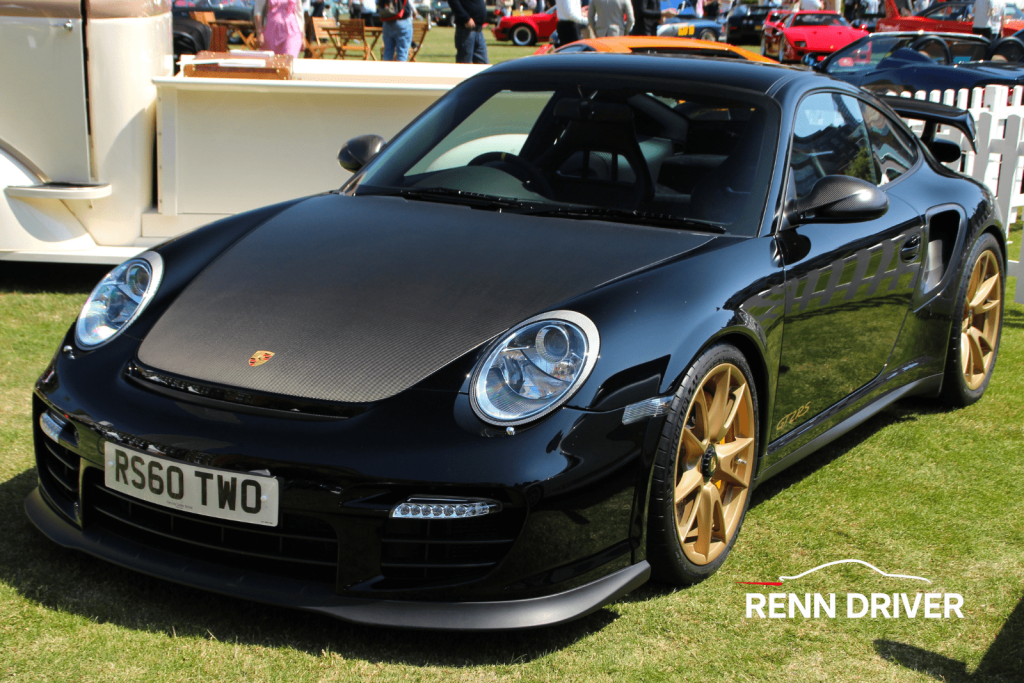
In 2010, the 997 GT2 RS became the first “RS” version of the GT2. It had 620 horsepower and was limited to just 500 units. This model laid the groundwork for the 991.2 GT2 RS, which arrived in 2017 with 700 horsepower and a new focus on balance and control.
It wasn’t just fast, it was the fastest. Porsche took it to the Nürburgring and set a 6:47.3 lap time, beating hypercars and cementing its legacy as the most extreme 911 ever made.
Legacy Redefined by Manthey Racing
The GT2 RS’s initial legacy was cemented by its stunning 6:47.3 Nürburgring lap time. However, its story didn’t end there. In a remarkable display of continuous improvement, Porsche partnered with Manthey Racing, a company now majority-owned by Porsche that specializes in optimizing their track cars. The result was the Manthey Performance Kit.
This kit, offered through official Porsche Centers, transforms the already extreme GT2 RS into a true track weapon. It includes:
- Aerodynamics: A suite of carbon fiber parts, including a modified front splitter, an enhanced rear diffuser, and a new rear wing with larger endplates, significantly increasing downforce without adding drag. At 124 mph (200 km/h), the kit increases front downforce from 108 lbs to 154 lbs and rear downforce from 205 lbs to 440 lbs.
- Suspension: A track-focused, three- or four-way adjustable coilover suspension with revised spring rates, allowing for fine-tuning based on track conditions.
- Brakes: Upgraded brake pads and steel-braided brake lines provide more direct pedal feel and improved thermal stability.
- Cooling: An additional water tank for the intercooler spray system, extending its effective use during long track sessions.
In June 2021, a GT2 RS equipped with this kit returned to the Nürburgring and set a new benchmark, completing the 20.8 km Nordschleife in a breathtaking 6:43.300 minutes. This achievement cemented the GT2 RS’s status as a legend, proving it was a car with even more potential than originally thought.
Exterior Design and Aerodynamics
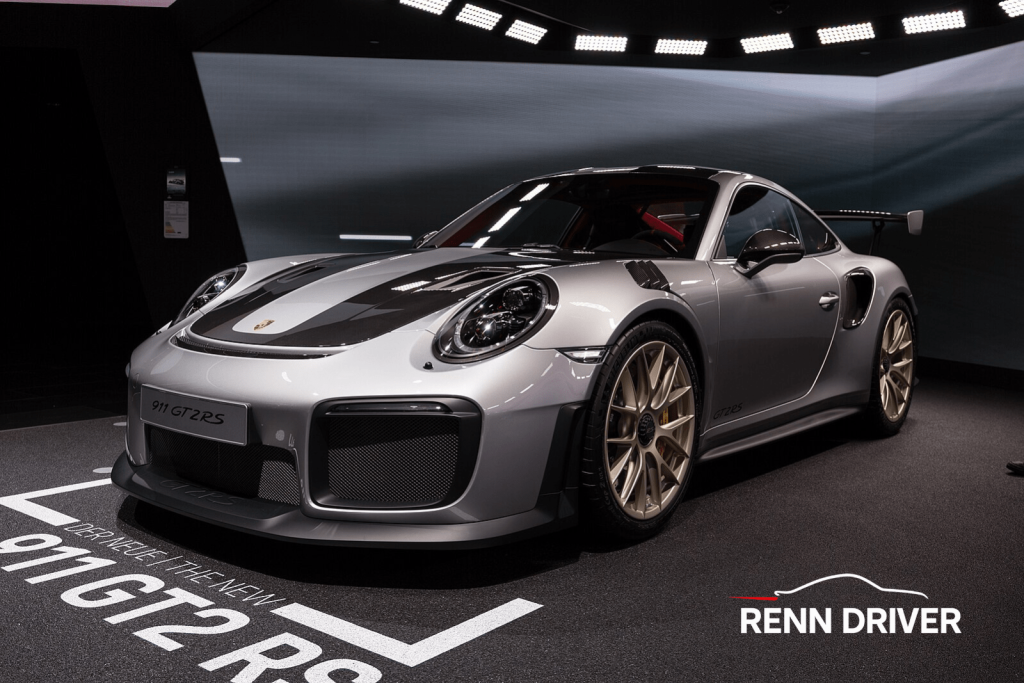
The 911 GT2 RS doesn’t just look fast. It is. The entire design is driven by airflow and function. It combines classic Porsche styling with modern aerodynamics. Functional elements like the Porsche dynamic light system improve visibility. Lightweight exterior mirrors and a sculpted rear lid serve both form and function. Optional colors such as white gold metallic further enhance its presence.
Carbon fiber reinforced plastic is used in the hood, roof, mirrors, and rear wing. Optional magnesium wheels come with the Weissach Package, which also includes a carbon roof and lightweight anti-roll bars. The result is a car that slices through the air but stays firmly planted to the ground.
Even the air intakes, side vents, and cooling ducts are shaped to serve a purpose. This isn’t styling for show. Every line and vent is part of the car’s mission to go fast and stay sharp on the track.
Lightweight Construction and Materials
Weight is always the enemy of performance, and the GT2 RS tackles that challenge head-on. Weight-saving was everywhere: titanium rear silencers, carbon composites for the body, and magnesium wheels in the Weissach package. Customers could even specify matte carbon fiber details or a larger extended range fuel tank for long-distance track events.
The hood, fenders, mirror caps, rear engine lid, and interior trim all make use of lightweight composite materials. Titanium is used in the exhaust system and even the roll cage in the Weissach-spec cars.
This focus on weight reduction gives the GT2 RS a power-to-weight ratio of 2.58 kg/kW, or about 4.63 pounds per horsepower. That’s better than many exotic supercars, and it shows in how quickly the car accelerates and corners.
Wheels, Tires, and Braking System
The GT2 RS uses semi-slick Michelin Pilot Sport Cup 2s, aided by Porsche Ceramic Composite Brakes. These are semi-slick tires designed for track use, and they help the car maintain incredible grip under hard acceleration and fast cornering.
Porsche’s Ceramic Composite Brakes (PCCB) come standard. The brake discs are massive, fade-resistant, and able to handle lap after lap without complaint. Combined with the sticky tires and wide wheel setup, the braking performance is just as impressive as the straight-line speed.
Even the design details carry weight. The recessed “GT2 RS” logo on the rims is subtle but adds to the car’s identity.
Rear Axle Steering and Chassis Control
Rear-axle steering is one of the unsung heroes of the GT2 RS. At low speeds, the rear wheels turn in the opposite direction from the front wheels to help with maneuverability. At high speeds, they steer in the same direction, adding stability during quick lane changes and fast corners.
The system works with Porsche’s PASM adaptive dampers and PDCC active roll control to keep the chassis composed even when the car is pushed to its limits. It gives the GT2 RS an edge in both agility and confidence. That’s something especially useful when managing 700 horsepower through the rear wheels alone.
Transmission and Gears
Porsche made one bold decision with the 991.2 GT2 RS: no manual transmission. Instead, it’s paired with a rigidly mounted 7-speed dual-clutch PDK gearbox.
That might disappoint purists, but it works. The shifts are instant, precise, and deliver maximum performance. The gear ratios are optimized for track driving, with short gears for rapid acceleration and a longer seventh gear to stretch the legs on high-speed straights.
It’s not the old-school analog feel of a stick shift, but it’s faster and more effective in the environment this car was built for.

A Deeper Dive into the Driving Experience
The GT2 RS is often called a “no-compromise” machine, but what does that truly feel like from behind the wheel? The driving experience of the GT2 RS is a visceral one, defined by a constant battle between traction and brute force. The car is not forgiving; it demands respect and a skilled hand, especially with its twin-turbo torque.
- On the road: The GT2 RS is stiff, loud, and constantly alive. The suspension, even in its softest setting, transmits every imperfection from the road surface. Tire roar from the semi-slicks is significant, and the mechanical clatter from the engine and drivetrain is a constant reminder of its racing pedigree. It is street-legal, but its true home is the racetrack.
- On the track: This is where the car comes alive. Every one of its features—from the aggressive aero to the rear-axle steering—works in harmony to deliver a razor-sharp, focused experience. The monumental acceleration is matched by the incredible stopping power of the PCCB brakes. The PDK transmission, while lacking the sensory feedback of a manual, delivers instant and precise shifts, allowing the driver to focus on the racing line. When pushed to its limit, the GT2 RS will slide and protest, but it communicates its intentions clearly, rewarding a confident and skilled driver who can manage its immense power. It’s a pure, unadulterated driving experience that few modern cars can replicate.
Interior and Driver Focus
Step inside the GT2 RS and you’re met with a cockpit that means business. Inside, leather interior finishes mix with Alcantara. Owners could choose interior trim inlays, GT silver stitching, or a full interior package with upgraded interior components.
For those seeking racing flair, adaptive sport seats, lightweight buckets, or a black cabriolet roof (on rare conversions) were available. Exclusive options included a sport exhaust system and an independent exhaust system. It also included an authorized Porsche center-installed Sport Chrono package. Some packages even featured a GT Sport steering wheel and a custom interior package with IndiGO Auto Group exclusives.
In Weissach Package models, the roll cage is titanium. Door pulls are replaced with fabric straps. Even the air conditioning and infotainment system can be deleted for extra weight savings.
Still, Porsche offers enough comfort for street use. Navigation, premium audio, and climate control are all optional, but most owners leave them in for the occasional weekend drive or road trip.
Track Performance and Racing Features
This car was built for the racetrack. Porsche developed the GT2 RS with motorsport DNA, using lessons from their Cup and RSR programs. The chassis tuning, aerodynamics, and cooling systems are all designed to withstand extreme use.
With the Clubsport or Weissach Package, the car includes a six-point harness, fire extinguisher system, and provisions for track regulations. The most famous proof of its ability is the 6:47.3 Nürburgring lap time; a number that made the car a legend from the moment it was announced.
For serious enthusiasts and privateer racers, the GT2 RS is the ultimate weekend weapon.
Porsche 911 GT2 RS Specs
- Engine displacement: 3,800 cc
- Power: 700 hp at 7,000 rpm
- Torque: 553 lb-ft between 2,500–4,500 rpm
- Transmission: 7-speed dual-clutch PDK
- Drive layout: Rear-engine, rear-wheel drive
- 0–100 km/h: 2.7 seconds
- Top speed: 340 km/h
- Weight: ~1,470 kg (with Weissach Package)
- Tires: Michelin Pilot Sport Cup 2
- Brakes: Porsche Ceramic Composite Brakes (PCCB)
GT2 RS vs GT3 RS vs Turbo S
The GT2 RS sits at the top of the 911 food chain. It has more power than the Turbo S and feels more raw than the GT3 RS.
The GT3 RS focuses on precision and high-revving, naturally aspirated performance. It’s lighter, with less straight-line power but arguably more balance for most drivers.
The Turbo S is the daily weapon. It’s brutally fast in a straight line, but comes with all-wheel drive and more comfort for everyday use.
The GT2 RS is the most extreme. It’s the hardest to master, the fastest on track, and the most likely to be remembered in Porsche history.
Unique Features of the GT2 RS
From its titanium rear exhaust system to its carbon fiber air ducts, the GT2 RS is packed with special features. The Weissach Package adds lightweight components like a carbon roof and magnesium wheels.
There’s also a unique VIN badge inside the cabin, marking each car as part of the limited production run. The recessed GT2 RS logo on the wheels is subtle but distinctive.
Inside, you’ll find minimal distractions, just the essentials, finished in Porsche’s signature racing materials. It’s not flashy, but it feels serious, in the best way.
Buying Guide: Price, Collectibility, and Ownership
When new, the 991.2 GT2 RS had an MSRP of around $293,000 USD. Today, depending on mileage, condition, and options, resale prices range between $400,000 and $600,000.
Limited production makes it a collector’s favorite. Weissach-equipped cars typically sell at a premium. Maintenance is expensive, especially if the car has seen track time. Brakes, tires, and service costs add up, but buyers in this range usually know what they’re getting into.
If you’re in the market, check for full service records, crash history, and factory options. A clean, well-maintained car with low mileage is likely to hold or even appreciate in value.
Fun Facts
- The GT2 RS used water-spray intercoolers to manage intake temperatures under load
- Titanium rear silencers were used in the exhaust and roll cage to reduce weight
- It beat hypercars like the McLaren P1 and Ferrari LaFerrari on the Nürburgring
- Porsche originally had no plans to build it until the GT division pushed for it
- It’s one of the only modern 911s banned from some racing classes, too fast to balance
Frequently Asked Questions (FAQs)
How fast is the Porsche 911 GT2 RS?
The Porsche 911 GT2 RS reaches 100 km/h in 2.7 seconds and tops out at 340 km/h.
What’s the difference between the GT2 RS and GT3 RS?
The difference between the GT2 RS and GT3 RS is that the GT2 RS is turbocharged and more powerful. The GT3 RS is naturally aspirated and more focused on handling balance.
Is the GT2 RS street legal?
Yes, despite its racecar feel, it’s fully road legal.
How much does a GT2 RS cost today?
Prices for a GT2 RS typically range from $400,000 to $600,000, depending on condition and options.
How rare is the Porsche 911 GT2 RS?
Porsche 911 GT2 RS is very rare, with fewer than 2,000 units made worldwide.
Final Thoughts
The 911 GT2 RS isn’t built for everyone. It’s challenging, loud, and unapologetically extreme. But for the right driver, it’s everything a performance car should be. It’s not just the fastest 911 ever made, it’s a final statement in what a combustion-powered sports car can do when Porsche goes all in.
Want to learn how it stacks up to the GT3 RS? Check out our full breakdown next.
Photo credit: MrWalkr, CC BY-SA 4.0, via Wikimedia Commons, Matti Blume, CC BY-SA 4.0, via Wikimedia Commons, Charles from Port Chester, New York, CC BY 2.0, via Wikimedia Commons