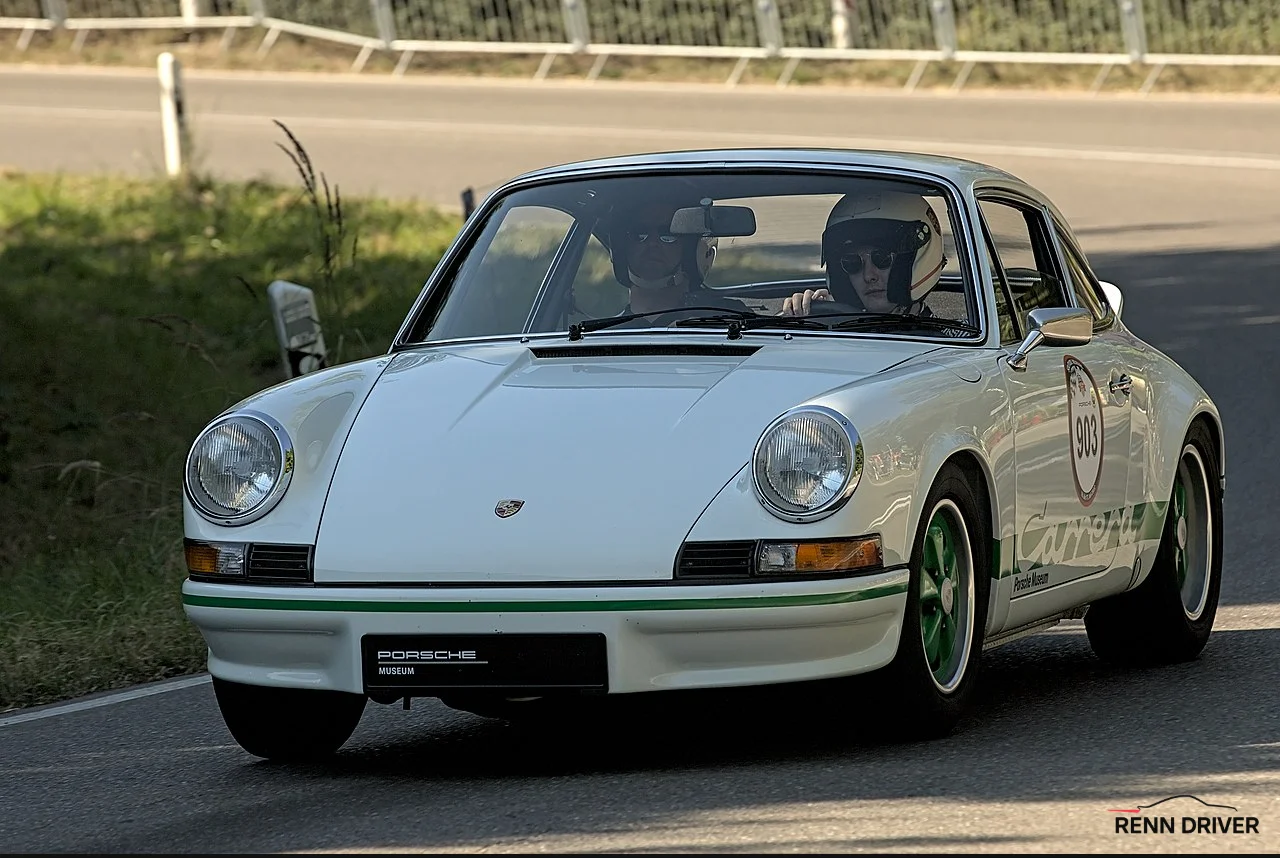
The 1973 Porsche 911 Carrera RS 2.7 is the original RS. It produces 210 hp from a 2.7L naturally aspirated flat-six, features thinner steel body panels, thinner glass, and the iconic ducktail rear spoiler, which was the first fixed rear spoiler ever fitted to a production car. Porsche built 1,580 units across Homologation (Sport), Touring, and RSR variants. Current values range from $500,000 to over $1.5 million depending on variant and provenance.
Contents
- 1 Quick Summary
- 2 History: How the RS Was Born
- 3 The Ducktail Spoiler
- 4 Engine and Performance
- 5 Lightweight Construction
- 6 Homologation vs Touring vs RSR
- 7 Design Details
- 8 Legacy and Influence
- 9 Market Values
- 10 Renn Driver's Take
- 11 FAQs
- 12 Final Thoughts
The full guide below covers all the details.
Quick Summary
- Production year: 1973
- Engine: 2.7L naturally aspirated flat-six
- Power: 210 hp (DIN)
- Torque: 188 lb-ft
- Transmission: 5-speed manual (Type 915)
- Weight (Homologation): ~2,116 lbs (960 kg)
- Weight (Touring): ~2,370 lbs (1,075 kg)
- Top speed: 152 mph (245 km/h)
- 0 to 60 mph: ~5.8 seconds
- Total production: 1,580 units
- Homologation (Sport): 200 units
- Touring: 1,308 units
- RSR: 49 units (plus additional customer race cars)
History: How the RS Was Born
The RS exists because of motorsport regulations. In the early 1970s, FIA Group 4 (Special GT) racing required manufacturers to produce at least 500 road-legal examples of a car before it could be homologated for competition. Porsche needed a lightweight, more powerful 911 that could compete against the growing threat from Ferrari, Ford, and BMW on the European racing circuit.
Ernst Fuhrmann, then head of Porsche's development division, championed the project. The plan was to build exactly 500 cars, which was the minimum required for homologation. The sales department was skeptical. They believed 500 lightweight, stripped-down 911s would be difficult to sell.
They were wrong. The initial run of 500 cars sold out before production began. Porsche extended production to 1,000 units, then further to 1,580. Demand outstripped supply at every stage.
The RS designation stands for Rennsport, which translates to "racing sport" in German. It would become the most coveted suffix in Porsche's model hierarchy, applied to the most focused, lightweight, and track-oriented variants across every subsequent 911 generation.
The Ducktail Spoiler
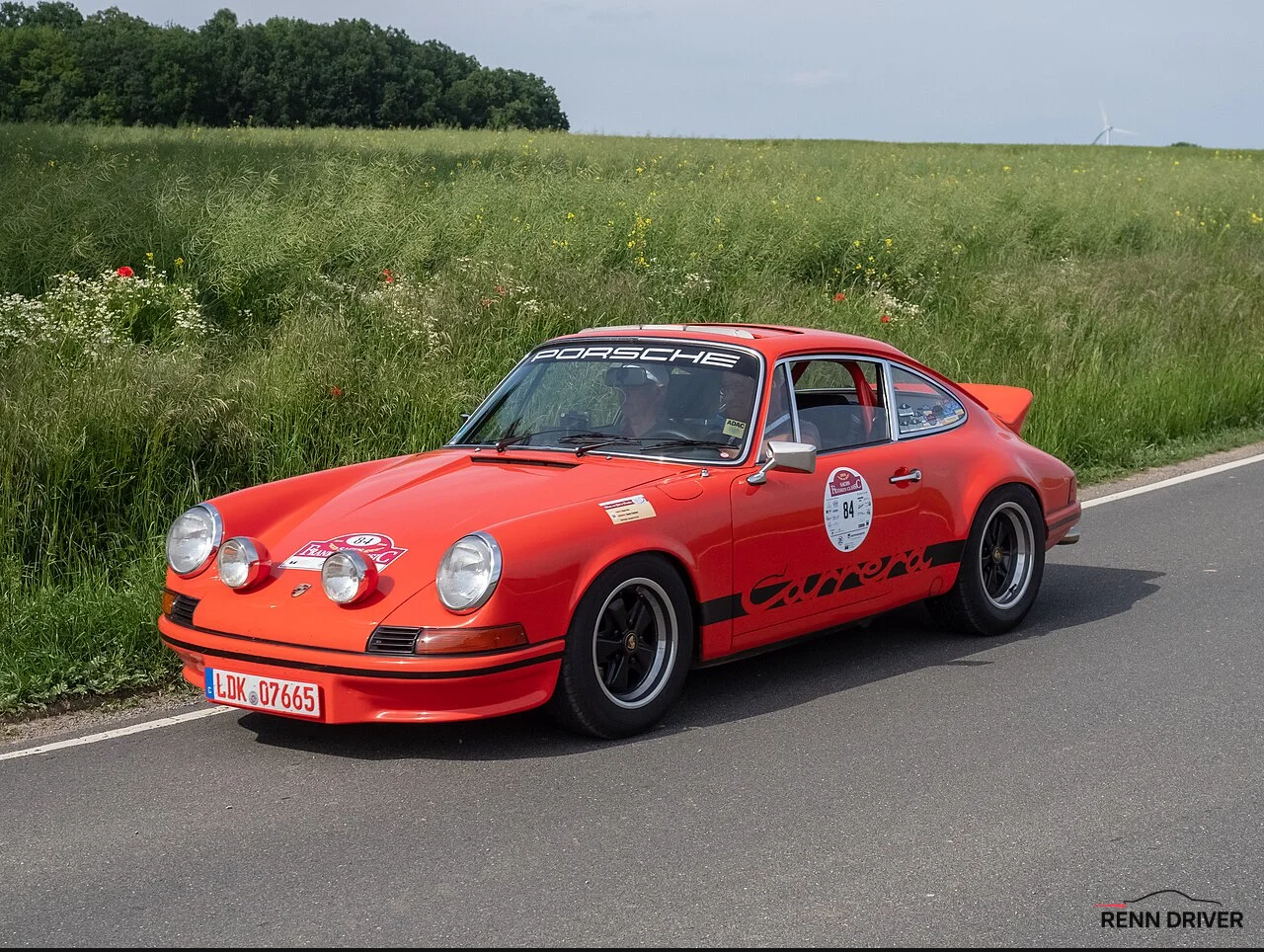
The ducktail rear spoiler on the Carrera RS 2.7 was the first fixed rear spoiler ever fitted to a production car. Today, every performance car on the road with a rear wing owes something to this design.
Porsche's engineers discovered during wind tunnel testing that a small lip spoiler at the trailing edge of the rear decklid significantly reduced aerodynamic lift at the rear axle. At 150 mph, the standard 911's rear end generated enough lift to reduce traction noticeably. The ducktail eliminated that problem.
The spoiler is relatively modest by modern standards. It curves upward from the rear engine cover and terminates in a sharp trailing edge that disrupts airflow cleanly. The shape was not chosen for aesthetics. It was purely functional. But it became one of the most recognizable design elements in automotive history.
The name "ducktail" came from the press. Porsche called it the "Bürzel," which loosely translates to "rump" in German. The press preferred the more descriptive term, and it stuck.
Engine and Performance
The Carrera RS 2.7 uses a 2,687cc (2.7L) naturally aspirated flat-six engine developed from the standard 911 S's 2.4L unit. Porsche increased the bore from 84mm to 90mm while retaining the 70.4mm stroke. The result was 210 hp (DIN) at 6,300 rpm and 188 lb-ft of torque at 5,100 rpm.
The engine uses Bosch mechanical fuel injection, an improved oil system for better cooling during sustained high-speed driving, and a revised exhaust system. The compression ratio is 8.5:1, which was high for the era.
The transmission is Porsche's Type 915 five-speed manual. It has a distinctive shift pattern with first gear to the left and down, in a dogleg position. The gearbox is robust and well suited to the engine's power output, though the shift feel is noticeably more mechanical than modern transmissions.
Performance by today's standards is modest. 0 to 60 mph takes roughly 5.8 seconds, and the top speed is 152 mph. But in 1973, those numbers were exceptional for a production car. The RS was faster than nearly everything on European roads.
Lightweight Construction
Weight reduction is the defining engineering principle of the Carrera RS 2.7. Porsche approached it with a thoroughness that set the template for every RS model that followed.
The body uses thinner gauge steel for the doors, hood, and roof panels. The rear quarter windows and rear windscreen are thinner glass. The bumpers are fiberglass instead of steel. Sound deadening material was removed. The standard Touring version weighed approximately 2,370 lbs, which was already lighter than the base 911. The Homologation (Sport) version went further, stripping out the rear seats, glove box, clock, coat hooks, and armrests to reach approximately 2,116 lbs.
The weight savings were not dramatic in absolute terms, but every pound mattered. The lightweight Homologation cars had a power-to-weight ratio that was competitive with cars producing significantly more horsepower. On the racetrack, this translated directly to faster lap times and better tire life.
The RS also used wider rear fenders to accommodate 7-inch rear wheels (up from 6 inches on the standard 911). The wider rear track improved traction and handling balance. These flared fenders became another signature visual element of the car.
Homologation vs Touring vs RSR
Porsche produced the Carrera RS 2.7 in three distinct variants, each serving a different purpose.
Homologation (Sport) M471
The Homologation version is the lightweight, race-ready car that fulfilled the FIA Group 4 production requirement. Porsche built approximately 200 of these. They feature the full lightweight package: thin-gauge body panels, deletion of comfort equipment, no rear seats, spartan interior, and the lightest possible specification.
These are the rarest and most valuable road-going RS 2.7 cars. They were built to be as close to race cars as road legality would allow.
Touring M472
The Touring is the more civilized version. It retains standard-thickness steel panels, full interior trim, rear seats, carpet, and comfort features like a passenger-side mirror and clock. It weighs approximately 250 lbs more than the Homologation version.
Porsche built 1,308 Touring models, making it the most common variant. Despite being the "comfortable" RS, it still uses the same 210 hp engine, Type 915 gearbox, and wider rear fenders as the Homologation car. The performance difference between the two comes down to weight.
RSR
The RSR is the full racing version. It uses a 2.8L engine producing approximately 300 hp (later versions reached 330 hp and beyond), wider fenders, larger brakes, and a full roll cage. Porsche built 49 RSR cars for customer racing teams, with additional cars built as factory entries.
The RSR competed in the World Championship for Makes, winning the Targa Florio in 1973 and finishing second overall at Le Mans. It also won the 24 Hours of Daytona in 1973. The RSR established the 911's reputation as a successful endurance racing platform, a legacy that continues today.
RSR values are in a category of their own. Documented race history cars with significant competition provenance have sold for $5 million to $10 million or more at auction.
| Homologation (Sport) | Touring | RSR | |
|---|---|---|---|
| Production | ~200 | 1,308 | 49 |
| Engine | 2.7L, 210 hp | 2.7L, 210 hp | 2.8L, ~300 hp |
| Weight | ~2,116 lbs | ~2,370 lbs | ~2,050 lbs |
| Rear seats | No | Yes | No |
| Purpose | Homologation special | Road-going GT | Race car |
| Approximate value | $800K to $1.5M+ | $500K to $900K | $5M to $10M+ |
Design Details
The Carrera RS 2.7 is immediately identifiable by several visual cues that set it apart from the standard early 911.
The most prominent is the ducktail rear spoiler. But the wider rear fenders are equally important. They flare outward to cover the 7-inch rear wheels, giving the car a more aggressive rear stance than any 911 before it.
The side body script is another signature element. "Carrera" is written in large, flowing script along the lower body sides, typically in a contrasting color. The most famous color combinations are Grand Prix White with blue or green script, but Porsche offered the car in a range of colors including Light Yellow, Tangerine, Viper Green, and Signal Orange.
The front end is standard 911 fare: long hood, round headlights, and the distinctive Porsche front fender line. There is no front spoiler on the road cars. The RSR added a deep front air dam for additional downforce, but the road-going RS relied on the ducktail alone for aerodynamic balance.
Legacy and Influence
The Carrera RS 2.7 is the foundation of every RS model that followed. The car that Ferry Porsche originally envisioned was already a capable sports car, but the RS established the formula that Porsche's motorsport division has repeated for over fifty years: take the standard car, reduce weight, increase power, and tune the chassis for the track.
Every subsequent RS has followed this template. The 964 RS. The 993 RS. The 996 GT3 RS. The 997 GT3 RS. The 991 GT3 RS. The 992 GT3 RS. All trace their lineage directly to the 1973 Carrera RS 2.7.
The ducktail spoiler reappeared on the 911 Sport Classic as a deliberate tribute. The side body script has been referenced on numerous special editions. The RS philosophy of "less weight equals more performance" remains the core engineering principle of Porsche's GT division.
Beyond Porsche, the RS 2.7 influenced an entire generation of lightweight performance cars. The concept of a homologation special, a road car built to enable racing, became a template that manufacturers across the industry adopted.
Market Values
The Carrera RS 2.7 is one of the most valuable production Porsches ever made. Values have climbed steadily for decades and show no signs of declining.
- Touring (M472): $500,000 to $900,000 for clean, documented examples. Color, matching numbers, and provenance drive values within this range
- Homologation (Sport, M471): $800,000 to $1.5 million or more. Lightweight cars with documented history and original specification command the highest prices
- RSR: $5 million to $10 million or more at major auctions. Race provenance, specifically wins or podiums in significant events, pushes values to the upper end
Matching numbers (original engine and transmission) is critical to value. A Carrera RS 2.7 with a replacement engine can lose 20% to 40% of its value compared to a matching-numbers car. Originality of color, interior, and specification also matters significantly.
The market for RS 2.7 cars is global. European, American, and Asian collectors compete at auction, keeping prices strong regardless of regional economic conditions. The car's status as the original RS gives it a historical significance that transcends market trends.
Renn Driver's Take
I have not driven this car yet, but I will update this section once I do.
Frequently Asked Questions
How many Porsche 911 Carrera RS 2.7 were made?
Porsche produced 1,580 units of the 911 Carrera RS 2.7 in total. This includes approximately 200 Homologation (Sport) models, 1,308 Touring models, and 49 RSR race cars.
How much is a Porsche 911 Carrera RS 2.7 worth?
A Porsche 911 Carrera RS 2.7 Touring is worth $500,000 to $900,000. The Homologation (Sport) version sells for $800,000 to $1.5 million or more. RSR race cars command $5 million to $10 million depending on provenance.
What does RS stand for on a Porsche?
RS stands for Rennsport, which means "racing sport" in German. The Porsche 911 Carrera RS 2.7 was the first model to carry the RS designation, and it has been used on Porsche's most track-focused production cars ever since.
What is the ducktail spoiler on the Carrera RS 2.7?
The ducktail spoiler on the Porsche 911 Carrera RS 2.7 is a small, fixed rear lip spoiler integrated into the engine cover. It was the first fixed rear spoiler ever fitted to a production car and was designed to reduce rear-axle lift at high speeds.
What is the difference between the Carrera RS 2.7 Homologation and Touring?
The Homologation (Sport) version of the Porsche 911 Carrera RS 2.7 uses thinner body panels, deletes rear seats and comfort equipment, and weighs approximately 250 lbs less than the Touring version. The Touring retains standard interior trim, rear seats, and heavier body panels.
How much horsepower does the Carrera RS 2.7 have?
The Porsche 911 Carrera RS 2.7 produces 210 hp (DIN) from its 2.7L naturally aspirated flat-six engine.
Was the Carrera RS 2.7 a race car?
No, the road-going Porsche 911 Carrera RS 2.7 was a production car built to homologate the RSR for racing. The RSR variant was a dedicated race car that won events including the Targa Florio, 24 Hours of Daytona, and finished second overall at Le Mans.
Final Thoughts
The Porsche 911 Carrera RS 2.7 is where the RS story begins. Before the turbocharged GT2, before the screaming GT3, before the carbon fiber and ceramic brakes, there was a lightweight 911 with a ducktail spoiler and 210 hp that changed everything.
It proved that Porsche could build a car for the racetrack that was also magnificent on the road. It established the RS formula that the company has followed for over fifty years. And it created a collector's market that has only grown stronger with each passing decade.
Every modern Porsche GT car, from the early 911 lineage through the entire 911 lineage up to today, carries the DNA of the Carrera RS 2.7. It is not just a great Porsche. It is the Porsche that defined what RS means.
Images by: Contributors, licensed under CC BY-SA 2.0 and CC BY-SA 4.0, via Wikimedia Commons