The Porsche 996 Turbo arrived at the start of a new century, and it was every bit the statement piece Stuttgart needed. This was the first with a new water cooled engine and an electronically managed all wheel drive system. It was also the car that proved Porsche could carry its turbocharged icon into the future without losing its soul.
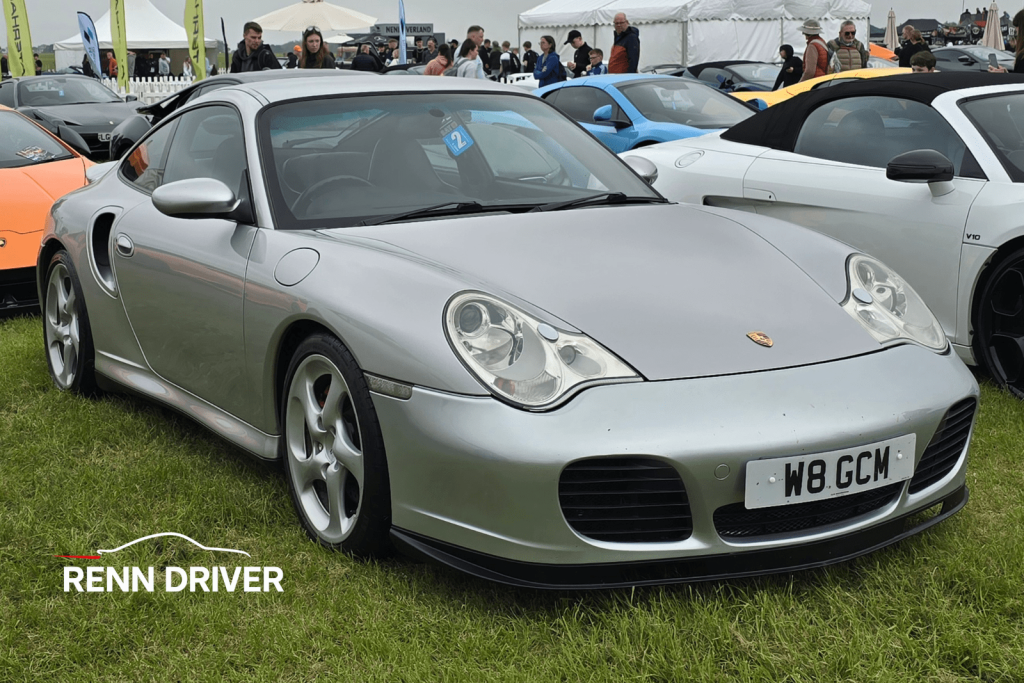
Unveiled in July 2000 for the 2001 model year, the 996 Turbo marked the end of the air-cooled era and the rise of a new platform. Under its body sat a 3.6 litre flat 6 derived from the Le Mans–winning GT1 race car. With twin turbochargers, it made 420 hp and 415 lb ft of torque, good for a factory-claimed 0–62 mph in 4.2 seconds and a top speed just shy of 190 mph.
This wasn’t just a numbers game. The 996 Turbo delivered visceral thrills, mechanical joy, and the kind of broad usability that made it both a track weapon and a daily companion. Over time, it’s become one of the most interesting 911s in Porsche history. It was misunderstood when new, but now recognized as a modern classic worth chasing.
Contents
Quick Summary
- Production Years: 2000–2005
- Engine: 3.6 L twin-turbo flat-six (Mezger) engine capacity
- Power: 420 hp / 415 lb-ft
- Top Speed: 190 mph
- 0–62 mph: 4.2 seconds
- Layout: Rear-engine, all-wheel drive
- Transmission: 6-speed manual / 5-speed Tiptronic
- Nickname: First water-cooled 911 Turbo
History & Model Context
When Porsche introduced the 996 Turbo to replace the air-cooled 993 Turbo, it marked the high point of Porsche’s analog era. When the 996 series launched in 1998, enthusiasts were skeptical. Its “fried-egg” headlights and softer lines were a big departure from classic 911 styling. But the Turbo was different. It needed to carry the 911 name forward with credibility, and Porsche realised the only way to do that was to root it in motorsport.
The result was the Mezger engine, a 3.6 litre flat 6 directly derived from the 911 GT1 that won Le Mans. Unlike the standard Carrera’s engine,the Mezger had a dry sump lubrication system, separate head and crankcase designsf, and thicker internals. It’s all meant to handle endurance racing conditions for many hours at a time.
From its debut in Germany, the 996 Turbo was offered as both coupé and turbo cabriolet. This gave buyers the choice between hardtop precision and open-air drama. Roughly 20,000 units were produced over its five-year run, making it rarer than later Turbo generations. For enthusiasts who wanted speed, reliability, and pedigree, it was the best vehicle Porsche could offer at the time.

Design & Features
The 996 Turbo’s design split opinions in-period and still does today. Its oval headlights, shared with the Carrera, were a bold break from tradition. But look closer, and you see a car designed with intent:
- A raked windscreen and smoother bodyshell to improve aerodynamics.
- 18-inch Turbo Twist wheels filling flared arches.
- Fixed rear spoiler and subtle side skirts to increase stability.
- Open the rear engine cover and you’ll find the intercooler and fan assembly dominating the view, a reminder of its motorsport DNA.
- Wider tracks front and rear (38mm wider at the front and 65mm wider at the rear), giving it a planted stance

Inside, the interior was purposeful. Buyers could spec sports seats with hard backs or comfort setups with leather trim. Everything was angled toward the driver, the simple dials, analog gauges, and a shifter that clicked confidently into each gear. While not luxurious by today’s standards, it delivered refinement where it mattered.
Options included Bose sound, aluminum trim, and navigation. Later models could also be fitted with rain-sensing wipers, a feature that added daily convenience. But most buyers cared about the equipment that mattered most: six-speed manual, race-bred suspension, and optional Tiptronic for those who wanted automatic convenience.
Performance & Driving Experience
The numbers only tell half the story. Driving a 996 Turbo is all about how it delivers that power.
Engine & Acceleration
The Mezger engine produced 420 hp and 415 lb-ft of torque, fed by two intercoolers that kept intake temps under control. Its reinforced engine block and racing-derived internals gave it strength that few rivals could match. On boost, the car would rocket to 60 in 4.2 seconds, blistering for its era. Its acceleration felt unrelenting, each gear pulling hard until the next.
Yes, there was still a hint of classic turbo lag. Push the throttle, wait that tiny bit, and then the car surged forward like a slingshot. For many, that was the charm, the drama before the storm.
Handling & Ride
With a wheel drive layout based on the Carrera 4, the 996 Turbo delivered new levels of stability. The system was equipped with viscous coupling, sending most power to the rear wheels but shuffling it forward as needed. This gave it balance through corners and confidence when accelerating hard out of a course section.
The suspension was firm but livable, soaking up bumps while keeping the car flat through high-speed turns. Combined with massive brakes and precise steering, the 996 Turbo gave drivers the confidence to push hard without fear.
Everyday Joy
Unlike earlier Turbos, this one wasn’t intimidating. You could commute, cruise, or track it. Owners often describe it as a reliable friend: tame when you wanted, ferocious when you asked. Every turn of the wheel, every input of hand and foot, brought a sense of mechanical honesty.
Comparison to Other Porsche Models
| Model | Cooling | Power | Driving Feel |
|---|---|---|---|
| 993 Turbo | Air cooled | 402 hp | Heavy, analog, raw |
| 996 Turbo | Water cooled | 420 hp | Balanced, visceral, controllable |
| 997 Turbo | Water cooled | 473 hp | More refined, less lag, tech-heavy |
| Carrera GT | Water cooled | 605 hp | Exotic, mid-engine hypercar vibes |
The 996 Turbo struck a balance. Rawer and more involving than the 997 Turbo, but far more approachable than the air-cooled 930 or 964. It was Porsche’s answer to critics who feared that refinement meant losing the 911 Turbo’s soul.
Ownership & Maintenance Notes
Owning a 996 Turbo is easier than most supercars, but not without quirks.
Pros
- Mezger engine is famously reliable and motorsport-tested.
- AWD system provides year-round usability.
- Less complex electronics than newer generations.
Watch Outs
- Turbo seals and actuators wear with age.
- Clutches and gearbox synchros can suffer on heavily tracked cars.
- Suspension rebuilds are costly.
- Regular oil changes and preventive care save money over the long run.
Because these cars were sold during the early 2000s, many examples now show their age. A specialist inspection is essential before you buy. Look for full-service records, especially for Tiptronic models, which can be expensive to repair.
Collectibility & Market Value
For years, the 996 Turbo was undervalued. Its styling scared purists, and its replacement 997 seemed like a more obvious pick. But in the past decade, its reputation has risen dramatically.
- Clean 6-speed manual transmission cars trade well above $80k.
- Cabriolet and rare factory colors command premiums.
- The later Turbo S, with increased power (450 hp) and carbon-ceramic brakes, is especially desirable.

With only 20,000 produced, this model is far rarer than later Turbos. Prices are firmly on the rise, and collectors have begun snapping up the best examples. For many, this is the sweet spot: analog joy with modern usability.
Fun Facts
- The 996 Turbo’s engine was derived from the GT1 that won Le Mans.
- It was the first time a production 911 Turbo cracked 190 mph.
- Actor Ben Affleck famously drove a black 996 Turbo around Los Angeles.
- The 996 Turbo introduced hollow-spoke wheels to reduce weight.
- Porsche experimented with matte (matt) paint finishes on a handful of press cars.
Final Thoughts
The Porsche 996 Turbo wasn’t perfect. It carried the weight of a controversial design, and its transition to water-cooled technology left many nostalgic for the past. But with hindsight, it’s clear: this car struck the perfect balance of development, refinement, and raw performance.
It combined history with progress. A vehicle that could be tracked on a course in the morning, then driven home efficiently at night. A car that delivered both brute power and everyday livability.
For those who buy one today, the 996 Turbo represents more than just a used 911 Turbo. It’s Porsche’s brave step into the new millennium. It’s a modern classic with a logo and bodyshell that told the world the 911 was evolving.
The joy it delivers behind the wheel, the drama of its boost, and the way it makes you feel like you’ve gained a lifelong friend. These are the reasons it deserves its place among the greats.
Photo credit: Calreyn88, CC BY-SA 4.0, via Wikimedia Commons, Alexandre Prévot from Nancy, France, CC BY-SA 2.0, via Wikimedia Commons, Abehn, Public domain, via Wikimedia Commons