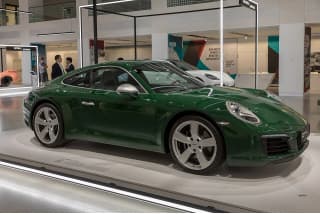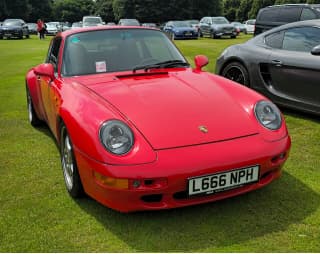
The Porsche 911 is a rear-engine 2+2 starting at around $120,000 with 389 to 701 hp. The Porsche 718 Cayman is a mid-engine two-seater starting at around $69,000 with 300 to 493 hp. The Cayman is lighter, more balanced, and cheaper. The 911 is faster, more practical, and carries decades of heritage. Both are exceptional driver’s cars.
In this article, we’ll compare the Porsche Cayman and 911 on the qualities buyers care about most. We’ll cover engine, handling, pricing, and resale value.
Contents
Quick Summary
| Spec | 718 Cayman GTS 4.0 | 911 Carrera (992) |
|---|---|---|
| Engine | 4.0L NA flat-six | 3.0L twin-turbo flat-six |
| Power | 394 hp | 389 hp |
| Torque | 309 lb-ft | 332 lb-ft |
| 0 to 60 mph | 4.0 sec | 4.0 sec |
| Top Speed | 182 mph | 183 mph |
| Weight | 3,153 lbs | 3,318 lbs |
| Layout | Mid-engine, RWD | Rear-engine, RWD |
| Starting Price | ~$96,000 | ~$120,000 |
What Are These Cars?
The Cayman and the 911 sit at the heart of one of the longest-running debates in the car world: is the mid-engine Porsche actually the better driver’s car? Porsche engineers have reportedly had to be careful about making the Cayman too good, because the 911 is the company’s flagship and must remain on top of the lineup.
The 911 has been Porsche’s identity since 1964. Its rear-engine layout is unique among modern sports cars, and the model line spans from comfortable grand touring to full track weapons. The current 992 generation is the most capable 911 ever built.
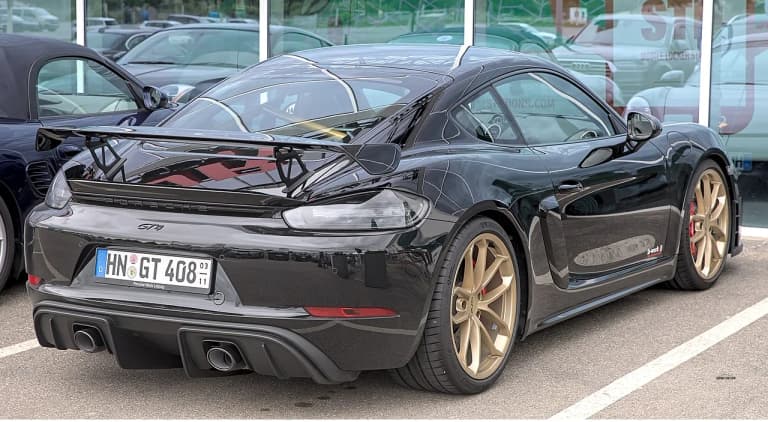
The Cayman arrived in 2005 as a hardtop version of the Boxster. In its current 718 generation, it uses a turbocharged four-cylinder as the base engine. The GTS 4.0 and GT4 variants get a naturally aspirated 4.0-liter flat-six derived from the 911 GT3’s engine. These high-revving six-cylinder Caymans are the ones that make the comparison with the 911 most interesting.
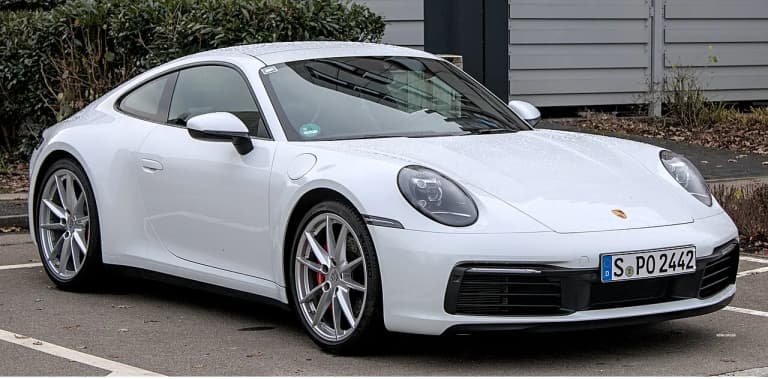
The mid-engine layout gives the Cayman textbook weight distribution and a lower polar moment of inertia than the 911. Physics says the Cayman should handle better. The question is whether Porsche lets it.
Engine and Powertrain
718 Cayman Engines
The base 718 Cayman and Cayman S use a 2.0-liter and 2.5-liter turbocharged four-cylinder, making 300 hp and 350 hp respectively. These engines are competent but lack the character that Porsche enthusiasts expect. The exhaust note is muted, the throttle response is dulled by turbo lag, and the four-cylinder soundtrack is a far cry from the flat-six Porsche is famous for.
The Cayman GTS 4.0 changes everything. It uses a 4.0-liter naturally aspirated flat-six producing 394 hp at 7,000 rpm and revving to 7,800 rpm. This engine is derived from the 911 GT3’s powerplant, detuned slightly for the mid-engine application. It responds instantly to throttle inputs, sounds magnificent at high rpm, and delivers power with a linearity that turbocharged engines cannot match.
The Cayman GT4 uses the same 4.0-liter flat-six making 414 hp, with a 7-speed PDK or 6-speed manual. The GT4 RS pushes output to 493 hp with titanium connecting rods, individual throttle bodies, and a 9,000 rpm redline. The GT4 RS engine is essentially the GT3 engine in full form, just mounted in the middle of the car instead of the back.
911 Engines
The base 992 Carrera uses a 3.0-liter twin-turbocharged flat-six producing 389 hp. The Carrera S makes 473 hp from the same displacement. These engines are smooth, powerful, and refined, with a wide torque band that makes them effortless at any speed. But they are turbocharged, and that means they lack the razor-sharp throttle response of the Cayman GTS 4.0’s naturally aspirated engine.
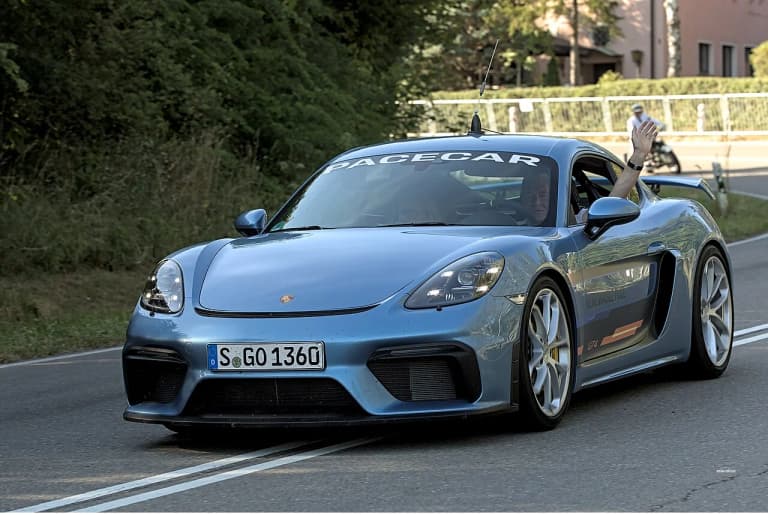
The 911 GT3 uses a 4.0-liter naturally aspirated flat-six making 503 hp at 8,400 rpm with a 9,000 rpm redline. This is the engine the GT4 RS borrows from, and in the heavier 911, it delivers a different but equally addictive experience.
How They Compare
If you buy the base four-cylinder Cayman, the 911’s turbocharged flat-six is in a completely different league. But compare the Cayman GTS 4.0 to the base 911 Carrera and the engine story flips. The Cayman GTS 4.0 has a naturally aspirated flat-six with 394 hp, a 7,800 rpm redline, and no turbo lag. The base 911 Carrera has a turbocharged flat-six with 389 hp and a less dramatic character. The Cayman’s engine is arguably more engaging to wring out, despite making similar power.
Performance and Specs
The numbers are closer than you might expect. The Cayman GTS 4.0 hits 60 mph in about 4.0 seconds with the PDK transmission. The base 911 Carrera matches that at 4.0 seconds. The Carrera S pulls ahead at 3.3 seconds with the Sport Chrono package.
Top speed tells a similar story. The Cayman GTS 4.0 reaches 182 mph. The Carrera hits 183 mph. The Carrera S extends that to 191 mph. Move up to the GT models, and the GT4 RS hits 196 mph while the GT3 reaches 198 mph.
| Model | Power | 0 to 60 | Top Speed | Weight | Price |
|---|---|---|---|---|---|
| 718 Cayman | 300 hp | 4.9 sec | 170 mph | 3,032 lbs | ~$69,000 |
| 718 Cayman GTS 4.0 | 394 hp | 4.0 sec | 182 mph | 3,153 lbs | ~$96,000 |
| 718 Cayman GT4 | 414 hp | 3.8 sec | 188 mph | 3,230 lbs | ~$105,000 |
| 718 Cayman GT4 RS | 493 hp | 3.2 sec | 196 mph | 3,227 lbs | ~$145,000 |
| 911 Carrera | 389 hp | 4.0 sec | 183 mph | 3,318 lbs | ~$120,000 |
| 911 Carrera S | 473 hp | 3.3 sec | 191 mph | 3,340 lbs | ~$148,000 |
| 911 GT3 | 503 hp | 3.2 sec | 198 mph | 3,164 lbs | ~$195,000 |
The Cayman GT4 RS posted a 7:04.5 at the Nurburgring Nordschleife. The 911 GT3 posted 6:55.3. That is a meaningful gap, but consider that the GT4 RS costs roughly $50,000 less than the GT3 and makes 10 fewer horsepower. On a dollar-per-second basis, the Cayman is the better value.
Handling and Driving Feel
This is the core of the debate, and it is where the Cayman makes its strongest case.
The mid-engine layout places the engine ahead of the rear axle, between the cabin and the rear wheels. This gives the Cayman a lower polar moment of inertia than the 911, meaning it changes direction faster and with less resistance. The weight distribution is closer to 50/50, and the car rotates around its center with a precision that the rear-heavy 911 cannot quite replicate.
The result is a car that feels lighter on its feet. Turn-in is immediate. The rear end follows the front with minimal delay. Mid-corner adjustments with the throttle are intuitive: lift and the nose tucks in, apply power and the car pushes wide. The feedback through the steering wheel and the seat is clear and honest.
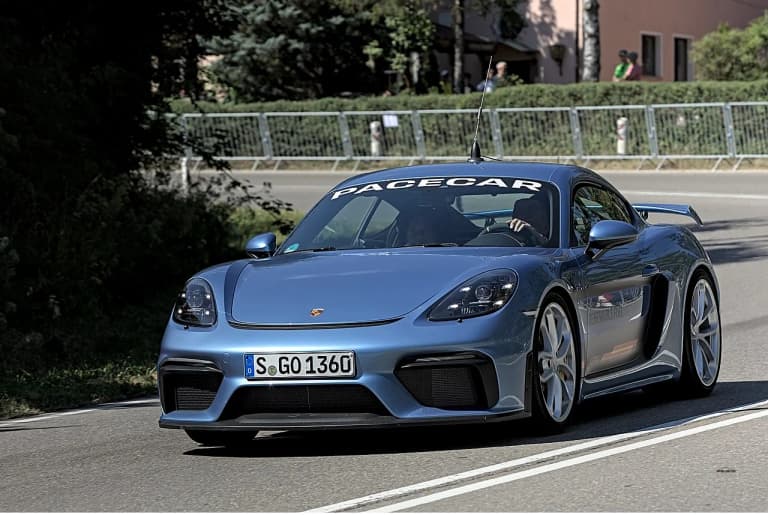
The 911 handles differently because of its rear-engine layout. The weight over the rear axle gives it exceptional traction out of corners, and the car has a unique rotation point that experienced drivers learn to exploit. But the 911 is always fighting its own physics. The pendulum effect of the rear-mounted engine means the car requires more anticipation and commitment in high-speed corners.
Many professional drivers and automotive journalists have said, off the record, that the Cayman is the better-balanced car. Walter Rohrl, Porsche’s own test driver, reportedly prefers the mid-engine layout for pure driving pleasure. The 911 is the faster car in most configurations, but the Cayman communicates more transparently with the driver.
For a first-time track day driver, the Cayman is more approachable. Its limits are higher and more progressive. The 911 rewards experience and punishes mistakes more severely, particularly in the rear-drive models.
Interior and Practicality
The 911 wins on practicality. It has rear seats (small, but they exist), a front trunk, and a small rear storage area. You can carry two bags for a weekend trip without leaving anything behind. The 911 also has better noise insulation, making it a more comfortable long-distance car.
The Cayman is a strict two-seater. There are no rear seats. You get a front trunk (larger than the 911’s) and a rear trunk behind the engine (about 150 liters). Combined cargo space is actually competitive with the 911, but the lack of rear seats means you cannot carry even the smallest passengers.
Both cars share the same Porsche interior design language. The dashboard layout, infotainment system, and gauge cluster are virtually identical. Material quality is comparable at each price point. The Cayman’s cabin is slightly narrower and feels more intimate, which some drivers prefer.
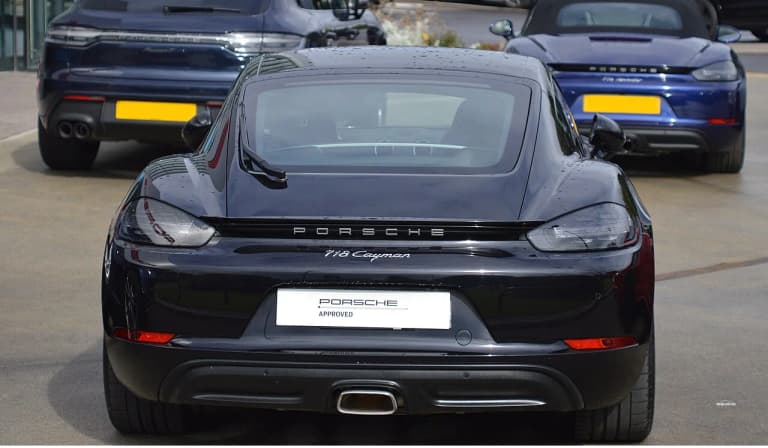
The driving position in both cars is excellent, but the Cayman places you slightly lower and more centered in the chassis. In the GT4 and GT4 RS, the combination of low seating, tight cabin, and mechanical noise creates a more immersive cockpit experience than any 911 short of the GT3.
Design and Styling
The 911 silhouette is one of the most recognizable shapes in automotive history. Sixty years of evolution have refined it without ever losing the essential character: the sloping roofline, the round headlights, the wide rear haunches.
The Cayman is a different kind of beautiful. The mid-engine proportions create a more balanced shape with a lower roofline and a longer hood than the 911. From the side, the Cayman looks more like a traditional sports car. It is sleeker, more wedge-shaped, and arguably more elegant. The GT4’s fixed rear wing and large intakes add aggression without compromising the basic proportions.
The 911 carries more visual gravitas. People who know cars recognize a 911 instantly. The Cayman is less immediately identifiable to casual observers, which can be an advantage or a disadvantage depending on how much attention you want.
Pricing and Value
The Cayman is the value play in the Porsche lineup. A base 718 Cayman starts at around $69,000. The Cayman GTS 4.0, which is the one most enthusiasts recommend, starts at around $96,000. The GT4 starts at around $105,000. For the same money as a base 911 Carrera ($120,000), you can have a well-optioned Cayman GT4 with a naturally aspirated flat-six, manual transmission, and track-focused suspension.
Want the numbers side by side? Open Porsche Compare to put a manual Cayman GTS 4.0 against a 911 Carrera T.
| Cayman Model | MSRP | 911 Model | MSRP |
|---|---|---|---|
| 718 Cayman | ~$69,000 | 911 Carrera | ~$120,000 |
| 718 Cayman GTS 4.0 | ~$96,000 | 911 Carrera S | ~$148,000 |
| 718 Cayman GT4 | ~$105,000 | 911 GT3 | ~$195,000 |
| 718 Cayman GT4 RS | ~$145,000 | 911 GT3 RS | ~$229,900 |
At every tier, the Cayman costs $25,000 to $85,000 less than the equivalent 911. That gap buys a lot of options, track days, or tires. If your budget is fixed, the Cayman delivers more driving experience per dollar.
Ownership and Running Costs
Both cars are built by Porsche and share service intervals, parts quality, and dealer networks. Maintenance costs are similar: oil changes run $300 to $500, brake jobs cost $1,000 to $2,500, and tires are comparable depending on the specific fitment.
The Cayman is slightly cheaper to insure due to its lower replacement cost. Fuel economy is similar in real-world driving, with both cars returning 20 to 25 mpg in mixed use. The Cayman GTS 4.0 and GT4 use premium fuel, as does the 911.
Porsche reliability is strong across both model lines. The 718 and 992 share many mechanical components, and both have solid track records. The four-cylinder Cayman engines have had some reports of premature bore scoring, though Porsche extended the warranty to address this. The flat-six GTS 4.0 and GT4 engines have been more robust.
On the Track
Both cars are excellent track day machines, but they behave differently under pressure.
The Cayman GT4 and GT4 RS are among the best track cars you can buy at any price. The mid-engine balance makes them forgiving at the limit. The car communicates clearly when grip is running out, and corrections are intuitive. The naturally aspirated engine delivers predictable power, making it easier to place the car exactly where you want it on corner exit.
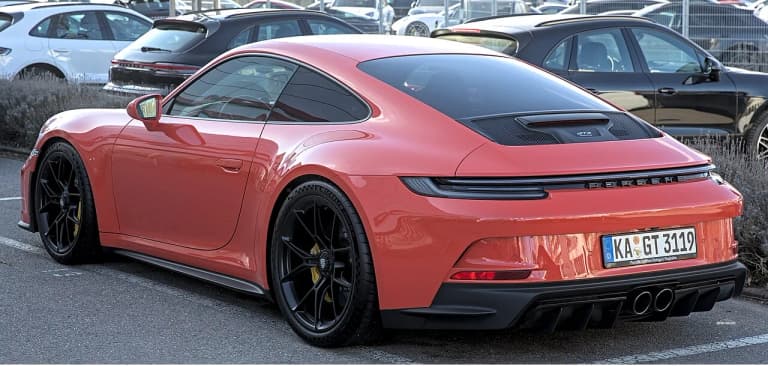
The 911 GT3 is faster on most circuits, but it requires more skill to extract that speed. The rear-engine layout rewards committed driving and punishes hesitation. Trail braking into corners while managing the rear weight requires experience. On the other hand, the GT3’s traction advantage out of slow corners is unmatched. Where the GT4 RS runs out of rear grip, the GT3’s rear-mounted engine keeps the tires loaded.
For tire wear and brake costs, the Cayman is kinder. Lighter weight means less brake material consumed per lap and lower tire loads. If you plan to do 10+ track days per year, the running cost difference adds up.
Resale Value
The 911 holds its value better than the Cayman in most cases. After three years, a 911 typically retains 75% to 85% of its value. The Cayman retains 65% to 75%. Special models are the exception: the GT4 RS and GT4 hold their value extremely well due to limited production and high demand.
The base four-cylinder Cayman depreciates fastest in the Porsche lineup. If resale matters, the GTS 4.0 and GT4 are much better bets. The GT4 RS has traded above MSRP since launch and shows no sign of dropping.
Frequently Asked Questions
Is the Porsche Cayman as good as the 911?
The Cayman is a different kind of good. Its mid-engine layout gives it better weight distribution and more intuitive handling than the rear-engine 911. Many driving purists consider the Cayman GT4 the best-handling car Porsche makes. The 911 is faster, more practical, and carries more prestige, but the Cayman delivers a purer mid-engine driving experience at a lower price.
Why is the Porsche Cayman cheaper than the 911?
Porsche positions the Cayman below the 911 in its model hierarchy. The 911 is the brand’s flagship and carries a price premium that reflects its heritage, broader model range, and cultural significance. The Cayman uses a smaller platform, has no rear seats, and in base form uses a less expensive four-cylinder engine. At the GT4 level, the price gap narrows considerably.
Can you daily drive a Porsche Cayman?
The Cayman is an excellent daily driver. It is comfortable on the highway, quiet enough for long trips (especially the turbocharged four-cylinder models), and has reasonable cargo space with both a front and rear trunk. The only limitation is the lack of rear seats. If you need to carry passengers occasionally, the 911 is the better daily choice. If it is just you or you and one passenger, the Cayman works perfectly.
Is the Cayman GT4 RS faster than the 911 GT3?
The 911 GT3 is faster on most circuits. At the Nurburgring, the GT3 lapped in 6:55.3 compared to the GT4 RS at 7:04.5. The GT3 has more power (503 hp vs 493 hp), a longer wheelbase for high-speed stability, and the traction advantage of its rear-engine layout. The GT4 RS is remarkably close, though, and costs roughly $50,000 less.
Does Porsche deliberately make the Cayman slower than the 911?
Porsche has never confirmed this publicly, but the evidence suggests they carefully manage the Cayman’s performance ceiling. The base Cayman uses a four-cylinder while the base 911 gets a flat-six. The Cayman GTS 4.0 makes similar power to the base 911 at a lower price, but the 911 always has a higher-performance variant available. The GT4 RS comes closest to the GT3 but does not quite match it. Whether this is deliberate product positioning or a natural result of the different platforms is a matter of ongoing debate.
Images: Porsche 718 Cayman GT4 by Alexander Migl, CC BY-SA 4.0. Porsche 992 Carrera S coupe by Alexander Migl, CC BY-SA 4.0. Porsche 718 Cayman GT4 Solitude Revival 2022 by Alexander Migl, CC BY-SA 4.0. Porsche 718 Cayman GT4 Solitude Revival 2022 by Alexander Migl, CC BY-SA 4.0. 2018 Porsche 718 Cayman by 多多123, CC BY 4.0. Porsche 992 GT3 with touring package by Alexander Migl, CC BY-SA 4.0. Via Wikimedia Commons.