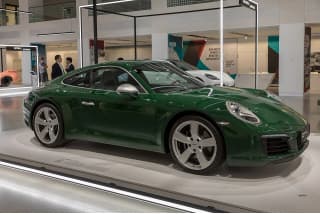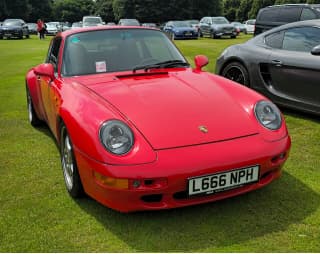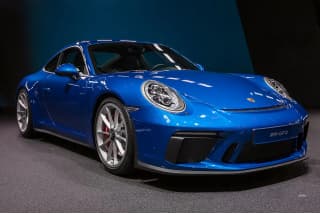
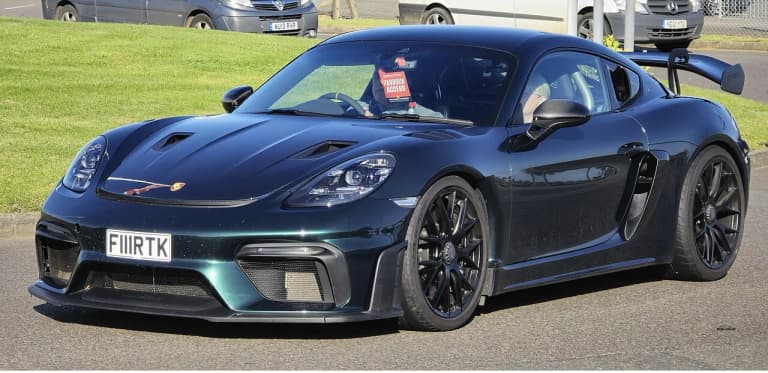
The Porsche 911 GT3 RS is a rear-engine, rear-drive track weapon with 518 hp, active aerodynamics, and a 6:44 Nurburgring lap time. The Porsche 718 Cayman GT4 RS is a mid-engine coupe with 493 hp, a 9,000-rpm flat-six, and a 7:04 Nurburgring time. The GT3 RS is the faster, more extreme car. The GT4 RS is the more accessible, more engaging driver’s car at $85,000 less.
In this article, we’ll compare the Porsche GT4 RS and GT3 RS to find the better track car. We’ll cover engine, aerodynamics, handling, and pricing.
Contents
Quick Summary
| Spec | 718 Cayman GT4 RS | 911 GT3 RS (992) |
|---|---|---|
| Engine | 4.0L NA flat-six | 4.0L NA flat-six |
| Power | 493 hp @ 8,300 rpm | 518 hp @ 8,500 rpm |
| Torque | 331 lb-ft | 343 lb-ft |
| Redline | 9,000 rpm | 9,000 rpm |
| 0 to 60 mph | 3.2 sec | 3.0 sec |
| Nurburgring | 7:04.5 | 6:44.8 |
| Weight | 3,227 lbs | 3,268 lbs |
| Drivetrain | Mid-engine, RWD | Rear-engine, RWD |
| Transmission | 7-speed PDK | 7-speed PDK |
| Starting MSRP | ~$145,000 | ~$229,900 |
What Are These Cars?
The GT4 RS and GT3 RS represent the sharpest edges of Porsche’s road car lineup. Both are track-focused machines derived from their respective platforms (718 Cayman and 992 911), stripped of weight, fitted with race-derived components, and tuned to deliver the most performance Porsche can extract from a street-legal car.
The GT3 RS is the more extreme machine. Its 992 generation introduced a DRS-style rear wing with active aerodynamics, generating up to 903 pounds of downforce at 177 mph. The car was engineered with a single-minded focus on lap time, and it shows in every detail, from the centrally mounted radiator to the carbon fiber body panels.
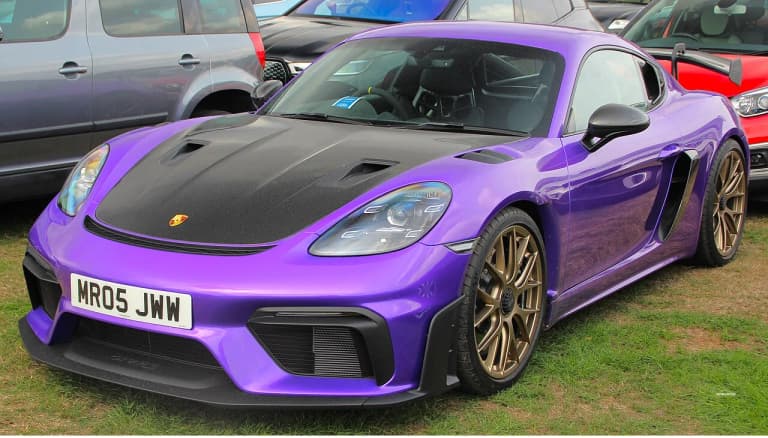
The GT4 RS arrived in 2022 as the first RS-badged Cayman. It takes the GT4’s naturally aspirated flat-six, fits it with individual throttle bodies and race-spec internals from the GT3 engine, and wraps it in a stripped-out chassis with fixed bucket seats and no rear storage. The GT4 RS is, by any measure, a genuine race car for the road.
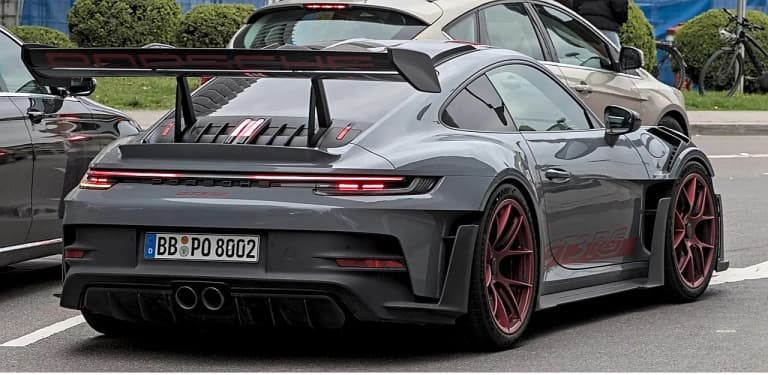
These two cars share an engine family, a philosophy, and a badge. They differ in layout, price, and how they deploy their performance. The GT3 RS is faster. The GT4 RS is more approachable. Both will redefine your understanding of what a road car can do on a circuit.
The Engine: Same Family, Different Application
Both cars use Porsche’s 4.0-liter naturally aspirated flat-six, but the installations are different.
The GT4 RS engine produces 493 hp at 8,300 rpm. It uses individual throttle bodies (ITBs), titanium connecting rods, and a dry-sump lubrication system. The ITBs are the key upgrade over the standard GT4’s engine. They eliminate the single throttle body’s restriction, allowing the engine to breathe more freely at high rpm and respond to throttle inputs with zero perceptible lag. The redline sits at 9,000 rpm.
The GT3 RS engine makes 518 hp at 8,500 rpm. It shares the same basic architecture, ITBs, and titanium internals, but produces 25 more horsepower through detail optimization: revised intake geometry, different cam timing, and exhaust tuning calibrated for the 911’s rear-engine packaging. Torque is 343 lb-ft versus the GT4 RS’s 331 lb-ft.
In practice, both engines feel remarkably similar. The throttle response is instantaneous. The power builds in a linear, unrelenting climb from 4,000 rpm to the 9,000-rpm redline. The mechanical intensity of the intake howl at full song is one of the best sounds in modern motoring. The only meaningful difference is that the GT3 RS has a bit more punch in the upper reaches of the rev range.
Performance, Aero, Handling, and Sound
The GT3 RS is faster in every measurable metric, but the margins are tighter than the $85,000 price gap suggests.
The GT3 RS reaches 60 mph in 3.0 seconds. The GT4 RS does it in 3.2 seconds. That 0.2-second gap is almost imperceptible in real-world driving. Top speed is 184 mph for the GT3 RS (limited by the massive wing’s drag) and 196 mph for the GT4 RS, which has less downforce and therefore less drag.
The Nurburgring tells the real story. The GT3 RS posted a 6:44.8. The GT4 RS posted a 7:04.5. That is a 20-second gap, which is enormous at this level. Most of it comes from the GT3 RS’s active aerodynamics, which let it carry significantly more speed through the high-speed sections of the Nordschleife where downforce matters most.
| Metric | GT4 RS | GT3 RS |
|---|---|---|
| Power | 493 hp | 518 hp |
| Weight | 3,227 lbs | 3,268 lbs |
| Power to weight | 6.55 lbs/hp | 6.31 lbs/hp |
| 0 to 60 mph | 3.2 sec | 3.0 sec |
| Top speed | 196 mph | 184 mph |
| Nurburgring | 7:04.5 | 6:44.8 |
| Max downforce | ~285 lbs | ~903 lbs |
On smaller, slower circuits where downforce matters less, the gap shrinks dramatically. At tracks with lots of low-speed corners and short straights, the GT4 RS’s lighter weight and mid-engine agility can close the gap to a few seconds per lap.
Aerodynamics
This is the single biggest difference between the two cars.
The 992 GT3 RS has an active aerodynamics system that no other Porsche road car has matched. The rear wing has a DRS (Drag Reduction System) function: under braking, the wing flap adjusts to increase downforce and stability. On straights, it can reduce drag. The front has active underbody elements and a massive splitter. At 177 mph, the GT3 RS generates 903 pounds of downforce. That is roughly three times the downforce of the previous 991.2 GT3 RS.
The GT4 RS has a fixed rear wing and a front splitter. Its aero package is effective but conventional. Maximum downforce is approximately 285 pounds, less than a third of the GT3 RS. The GT4 RS relies more on mechanical grip and driver skill to go fast, rather than aerodynamic force pushing the car into the pavement.
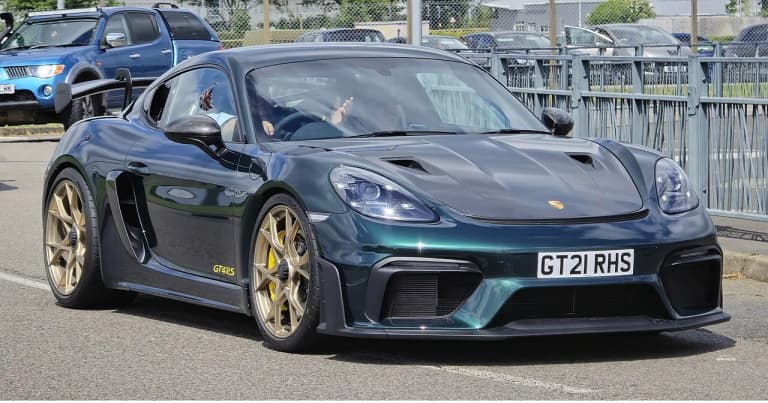
For most track day drivers at most circuits, the GT4 RS’s aero is sufficient. The GT3 RS’s active aero system shines at higher speeds and on circuits with long, fast corners. If you are driving on tracks where you regularly exceed 120 mph in corners, the GT3 RS’s downforce advantage is transformative. Below that speed, mechanical grip dominates, and the difference is smaller.
Handling and Chassis
The mid-engine GT4 RS and rear-engine GT3 RS handle differently, and each layout has distinct advantages on track.
The GT4 RS’s mid-engine layout gives it a lower polar moment of inertia. It changes direction faster and with less resistance. Turn-in is razor-sharp. The car rotates willingly around its center of mass, and mid-corner adjustments with the throttle are precise and predictable. When the rear starts to slide, the progression is gradual and recoverable. The GT4 RS inspires confidence at the limit because it communicates its grip levels clearly and without drama.
The GT3 RS has the 911’s characteristic rear-engine handling, amplified by its massive downforce. The weight over the rear axle gives it extraordinary traction on corner exit. Where the GT4 RS might run out of rear grip under hard acceleration, the GT3 RS hooks up and fires out of corners with relentless force. The front end is loaded by the splitter and underbody aero, so turn-in at speed is equally sharp despite the unfavorable weight distribution.
Both cars use Porsche’s double-wishbone front and multi-link rear suspension, rose-jointed in the RS versions. Both have adjustable ride height and anti-roll bars. The GT3 RS also offers a track alignment option from the factory that adds negative camber and reduces toe for circuit use.
The driving experience is different in character. The GT4 RS feels like a scalpel. The GT3 RS feels like a weapon. The GT4 RS flatters the driver. The GT3 RS challenges the driver to keep up with what the car can do.
Sound
Both cars use the same engine family, but they sound different because of their packaging.
The GT4 RS is the louder car inside the cabin. Porsche fitted intake pipes that route engine induction noise directly behind the driver’s head, through openings where the rear side windows would normally be. The result is visceral. At 8,000+ rpm, the cabin fills with a metallic, mechanical scream that borders on overwhelming. It is one of the most intense auditory experiences in any production car.
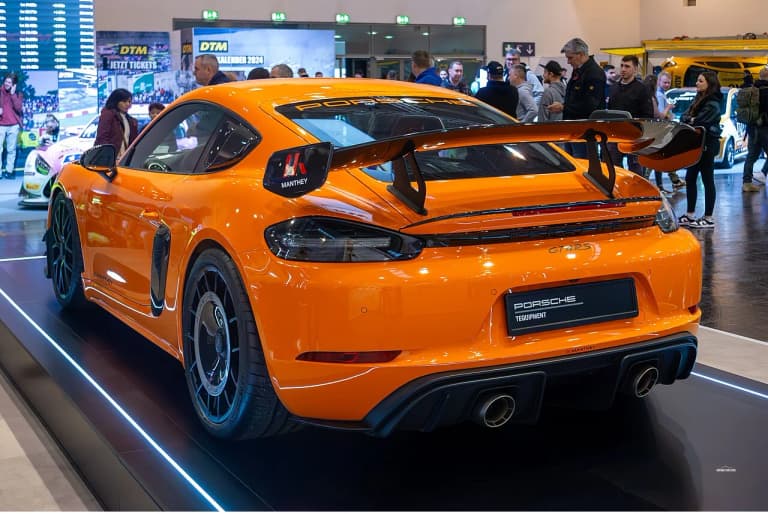
The GT3 RS is quieter inside because the engine sits behind the cabin rather than next to it. The sound is still magnificent: a high-revving flat-six howl that builds from a hard bark at 5,000 rpm to a full scream at 9,000 rpm. But it is more distant, more refined. From outside the car, both sound extraordinary. From inside, the GT4 RS is the more immersive experience.
If sound is part of why you buy a track car, the GT4 RS delivers a more intense sensation. Multiple automotive journalists have called it the best-sounding car currently in production.
Interior and Weight Savings
Both cars strip out comfort features in pursuit of lap time, but neither is a stripped shell.
The GT4 RS comes standard with carbon fiber full bucket seats (CFRP), no rear storage shelf, lightweight door pulls instead of handles, and reduced sound insulation. Air conditioning and the PCM infotainment system are standard. The Weissach Package adds carbon fiber wheels, titanium roll cage, and additional carbon fiber trim, saving approximately 50 pounds.
The GT3 RS takes a similar approach. Carbon fiber bucket seats, lightweight glass, deleted rear seats, and a focus on reducing unsprung mass. The Weissach Package on the GT3 RS adds carbon fiber anti-roll bars, magnesium wheels, and a carbon fiber roof, saving roughly 40 pounds.
Curb weight is remarkably close: 3,227 pounds for the GT4 RS versus 3,268 pounds for the GT3 RS. The mid-engine car is 41 pounds lighter despite having a smaller platform. Both are heavy by track car standards (a Lotus Emira weighs 3,200 pounds with much less power), but both carry their weight low and manage it well through suspension tuning.
Street Usability
Neither car is a comfortable daily driver, but both are fully street legal and usable for short commutes, weekend drives, and trips to the track.
The GT4 RS rides firmer than a standard Cayman but is not punishing. The fixed bucket seats are supportive but narrow. Visibility is good. The car works in city traffic without drama. The main limitation is noise: above 4,000 rpm, the intake pipes fill the cabin, and long highway trips can be fatiguing.
The GT3 RS is less livable on the street. Its massive rear wing generates attention (and occasionally adverse reactions from law enforcement). The ride is very firm, and the front splitter sits low enough that speed bumps and driveway ramps require careful navigation. The aero elements create more wind noise at highway speeds. The GT3 RS is a car you drive to the track, not a car you drive to the office.
If you want an RS Porsche that also works as a weekend sports car, the GT4 RS is the better choice. If you are buying a dedicated track tool that happens to be road legal, the GT3 RS makes no apologies for its compromises.
Pricing and Allocation
The MSRP gap is significant. The GT4 RS starts at roughly $145,000. The GT3 RS starts at $229,900. Add the Weissach Package to either car and the prices climb to approximately $175,000 and $290,000 respectively.
| Model | MSRP | With Weissach |
|---|---|---|
| 718 Cayman GT4 RS | ~$145,000 | ~$175,000 |
| 911 GT3 RS | ~$229,900 | ~$290,000 |
Both cars are subject to Porsche’s allocation system. You typically need an existing relationship with a dealer and a purchase history to get an allocation at MSRP. On the secondary market, both trade above sticker. The GT3 RS commands premiums of $50,000 to $100,000+ over MSRP. The GT4 RS trades at smaller premiums, making it more accessible.
For the $85,000 saved by choosing the GT4 RS, you could fund several years of track days, tires, brake pads, and fuel. The GT4 RS is the better value for someone who actually uses their car on track.
Track Day Running Costs
Both cars are expensive to run on track, but the GT4 RS is cheaper over time.
Tires are the biggest ongoing expense. Both cars run Michelin Pilot Sport Cup 2 or Cup 2 R tires. A set costs $2,000 to $2,500 and lasts two to four track days depending on driving style and circuit abrasiveness. The GT3 RS uses wider rear tires (325-section versus the GT4 RS’s 295-section), which cost more and wear faster under the higher loads generated by its greater downforce.
Brake pad replacements cost $1,500 to $3,000 per axle depending on whether you have iron or carbon ceramic rotors. Carbon ceramics last longer on track but cost substantially more to replace when they do wear out ($8,000+ for a set of rotors). The GT4 RS’s lighter weight puts less thermal load on the brakes, extending pad and rotor life compared to the GT3 RS.
Insurance is lower on the GT4 RS because of its lower replacement value. Fuel consumption is similar: both cars drink premium fuel at a rate of 8 to 12 mpg on track.
Frequently Asked Questions
Is the GT4 RS faster than the GT3 RS?
No. The GT3 RS is faster at every circuit where both have been timed. At the Nurburgring, the GT3 RS posted a 6:44.8 versus the GT4 RS at 7:04.5, a gap of nearly 20 seconds. The GT3 RS has more power (518 hp vs 493 hp), vastly more downforce (903 lbs vs ~285 lbs), and the traction advantage of its rear-engine layout. The GT4 RS is remarkably fast for its price, but it does not match the GT3 RS on pace.
Do the GT4 RS and GT3 RS use the same engine?
They use engines from the same family. Both are 4.0-liter naturally aspirated flat-six engines with individual throttle bodies, titanium connecting rods, and a 9,000-rpm redline. The GT3 RS version produces 518 hp versus the GT4 RS’s 493 hp, achieved through revised intake geometry, cam timing, and exhaust tuning specific to the 911’s rear-engine packaging.
Is the GT4 RS better value than the GT3 RS?
For most track day drivers, yes. The GT4 RS costs roughly $85,000 less than the GT3 RS, produces similar lap times on slower circuits, has lower running costs (lighter weight means less tire and brake wear), and is more usable on the street. The GT3 RS justifies its premium for drivers who compete in time attack, drive at the highest level, or frequently use circuits with high-speed sections where its aerodynamic advantage is decisive.
Which is more fun to drive, the GT4 RS or GT3 RS?
This depends on what you mean by fun. The GT4 RS is more engaging at everyday speeds because its mid-engine layout provides sharper turn-in, more rotation, and a more connected driving feel. The GT3 RS is more thrilling at higher speeds because its active aero and rear-engine traction allow you to corner at forces that feel physically impossible. Many journalists have said the GT4 RS is the more enjoyable car on a B-road and the GT3 RS is the more impressive car on a fast circuit.
Can you get a GT4 RS or GT3 RS at MSRP?
Both cars are allocated by Porsche dealers, meaning you typically need an existing relationship and purchase history with a dealer to buy one at the manufacturer’s suggested retail price. Walk-in buyers are unlikely to find either car at MSRP. On the secondary market, both trade above sticker, with the GT3 RS commanding larger premiums. Building a relationship with a Porsche dealer through previous purchases (even non-RS models) is the standard path to an allocation.
Images: 2022 Porsche 718 Cayman GT4 RS by MrWalkr, CC BY-SA 4.0. Porsche 911 GT3 RS by Alexander-93, CC BY-SA 4.0. 2022 Porsche 718 Cayman GT4 RS Weissach by MrWalkr, CC BY-SA 4.0. 2024 Porsche 718 Cayman GT4 RS by MrWalkr, CC BY-SA 4.0. Manthey Porsche GT4 RS, EMS 23, Essen (P1160647-RR) by Matti Blume, CC BY-SA 4.0. Via Wikimedia Commons.