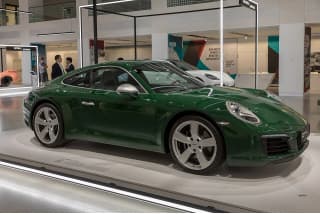
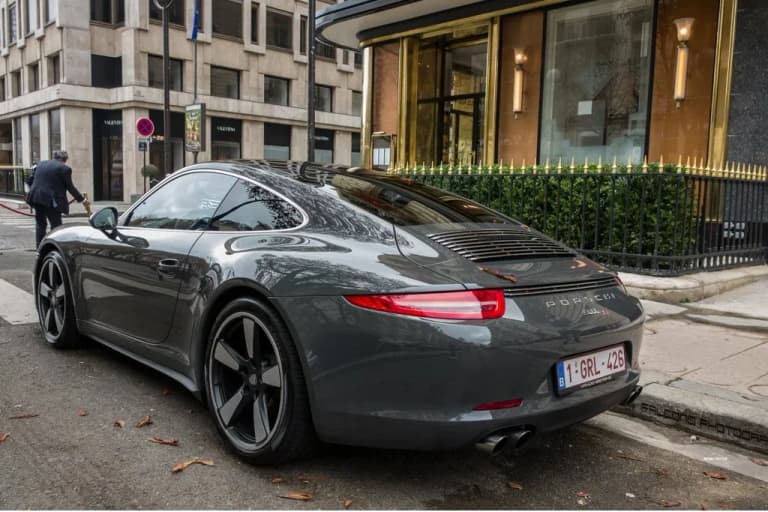
The Porsche 911 50th Anniversary Edition is a limited-run 2014 model based on the 991 Carrera S with the wider Carrera 4S body, chrome trim, retro houndstooth interior, and Fuchs-style wheels. Porsche built exactly 1,963 units to celebrate 50 years of the 911, each individually numbered.
In this article, we’ll explain the Porsche 911 50th Anniversary Edition, a limited-run 991 Carrera S. We’ll cover design, interior details, colors, and values.
Contents
- 1 Quick Summary
- 2 What Is the 911 50th Anniversary Edition
- 3 Why 1,963 Units
- 4 Powertrain, Performance, and Chassis
- 4.1 Performance and Specs
- 4.2 Chassis and Handling
- 5 Design
- 6 Interior and Details
- 7 Color Options
- 8 Pricing and Market Values
- 9 50th Anniversary vs Standard Carrera S
- 10 Frequently Asked Questions
Quick Summary
| Spec | Detail |
|---|---|
| Year | 2014 (991.1 generation) |
| Engine | 3.8L naturally aspirated flat-six |
| Power | 400 hp (430 hp with optional Powerkit) |
| Torque | 325 lb-ft |
| 0 to 60 mph | 4.2 seconds (manual), 3.8 seconds (PDK) |
| Top Speed | 186 mph |
| Weight | 3,153 lbs (1,430 kg) |
| Layout | Rear engine, rear-wheel drive |
| Production | 1,963 units worldwide |
| Starting Price | \u20ac121,119 / \u00a392,257 |
What Is the 911 50th Anniversary Edition
In 2013, Porsche celebrated five decades of the 911 by revealing a special edition at the Frankfurt Motor Show. The car went on sale as a 2014 model year, built on the 991.1 platform. It was mechanically based on the Carrera S but wore the wider rear body of the Carrera 4S, giving it a more muscular stance without adding all-wheel drive.
The 50th Anniversary Edition was only made available to existing Porsche owners. Each car carried a numbered plaque above the glove box, running from 1 of 1,963 through to 1,963 of 1,963. That number was not random. It referenced the year the original 911 debuted at the Frankfurt Motor Show in September 1963.
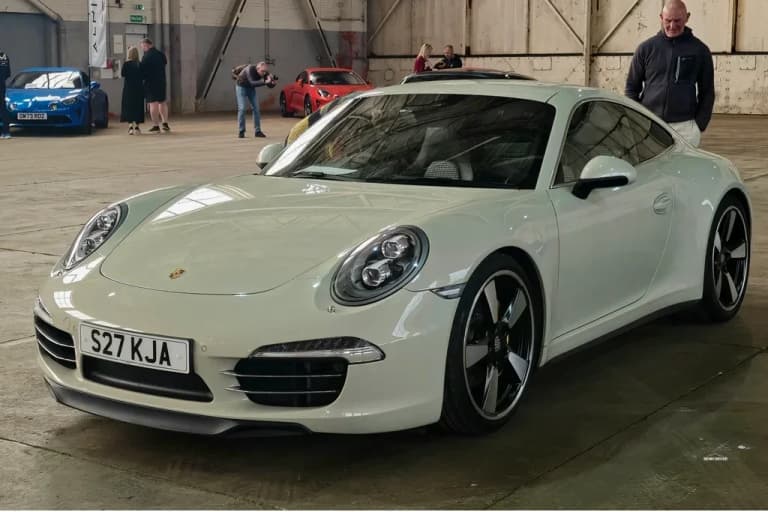
Porsche positioned this car as a bridge between classic 911 design cues and the modern 991 platform. It was not a stripped-out track special or a power upgrade. Instead, the emphasis was on visual and tactile details that connected the car to half a century of 911 heritage.
Why 1,963 Units
The production number is a direct nod to 1963, the year Ferdinand “Butzi” Porsche’s design was first shown to the public. The car was originally called the Porsche 901, using Porsche’s internal project number. Peugeot objected, claiming trademark rights over three-digit model numbers with a zero in the middle in France. Rather than using a different name for the French market alone, Porsche renamed the car the 911 across all markets.
Only 82 cars were ever badged as the 901 before the change took effect. Production of the renamed 911 began in September 1964, with the first cars reaching American buyers in February 1965. By its 50th anniversary in 2013, the 911 had become one of the longest-running sports car nameplates in history.
Powertrain, Performance, and Chassis
The 50th Anniversary Edition uses the same 3.8-liter naturally aspirated flat-six as the standard 991.1 Carrera S. Output is 400 hp with 325 lb-ft of torque. Buyers could choose between a 7-speed manual transmission and Porsche’s 7-speed PDK dual-clutch automatic.
An optional Powerkit raised output to 430 hp. This was the same kit available on the regular Carrera S, adding a modified intake system and revised engine mapping. With the Powerkit and PDK, the car could reach 60 mph in roughly 3.6 seconds.
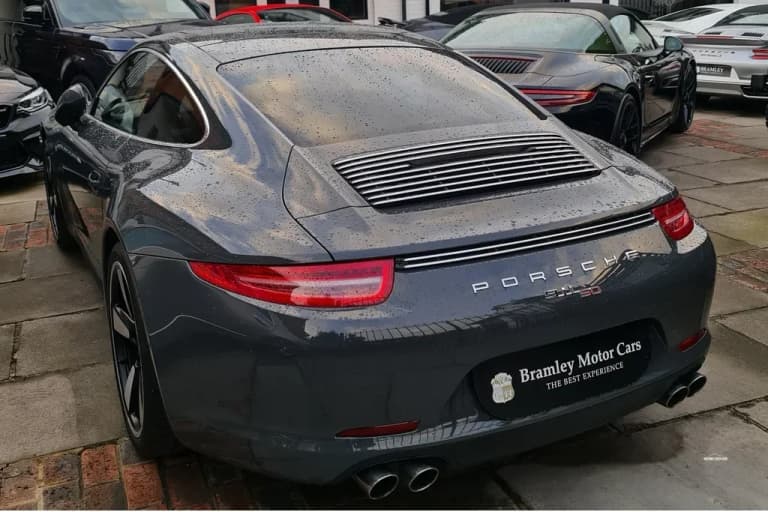
The engine is the last generation of naturally aspirated flat-six in a standard Carrera model. Starting with the 991.2 facelift in 2016, Porsche switched to twin-turbo engines across the Carrera range. That makes the 50th Anniversary Edition one of the final naturally aspirated Carrera S models Porsche ever built, which adds to its appeal among collectors who prefer the linear throttle response of a non-turbo engine.
Performance and Specs
With the 7-speed manual, Porsche quoted a 0 to 60 mph time of 4.2 seconds. PDK dropped that to 3.8 seconds. The optional Sport Chrono package shaved another 0.2 seconds off the PDK time by optimizing launch control.
Top speed was rated at 186 mph (299 km/h) with the standard engine and manual transmission. The Powerkit version was marginally quicker in a straight line but the top speed stayed the same.
These numbers matched the regular Carrera S exactly. Porsche did not tune the 50th Anniversary Edition for more speed. The wider body added a small amount of aerodynamic drag, but the performance difference was negligible in real-world driving.
Chassis and Handling
The suspension was lowered by 10mm compared to the standard Carrera S. Porsche Active Suspension Management (PASM) was standard equipment, giving the driver switchable damper settings for comfort and sport modes.
Porsche Torque Vectoring (PTV) was also included as standard. This system uses targeted braking on the inside rear wheel during cornering to sharpen turn-in and reduce understeer. On the regular Carrera S, PTV was an option.
The wider Carrera 4S body means the rear track is 44mm wider than a standard Carrera S. Combined with the lower ride height and standard PTV, the 50th Anniversary Edition had a slightly more planted feel through corners than the narrow-body car it was based on. The brakes were the same 340mm front and 330mm rear steel discs from the Carrera S, with optional PCCB ceramic brakes available.
Design
The exterior details are what set this car apart from every other 991.1. Chrome trim runs along the window surrounds, the air intake grille, and the side vent trims. The standard Carrera S uses black or body-color trim in those areas, so the chrome immediately identifies the 50th Anniversary car.

The wheels are a standout feature. Porsche designed 20-inch alloys that reference the classic Fuchs wheels from the 1960s and 1970s. The five-spoke pattern has the same basic geometry as the original Fuchs design, updated to fit the 991 platform. They are finished in a polished and matte black combination.
SportDesign side mirrors were fitted as standard. A “911 50” badge sits on the rear decklid between the taillights. The overall effect is restrained. Porsche did not add a body kit, a fixed wing, or any aggressive aero. The car looks like a well-dressed 911 rather than a special edition shouting for attention.
Interior and Details
The cabin is where the 50th Anniversary Edition makes its strongest case. The seats feature a retro houndstooth fabric insert, a pattern Porsche calls Pepita. This was a common upholstery choice on early 911s from the 1960s and 1970s, and seeing it on a modern car is an immediate visual link to the original.
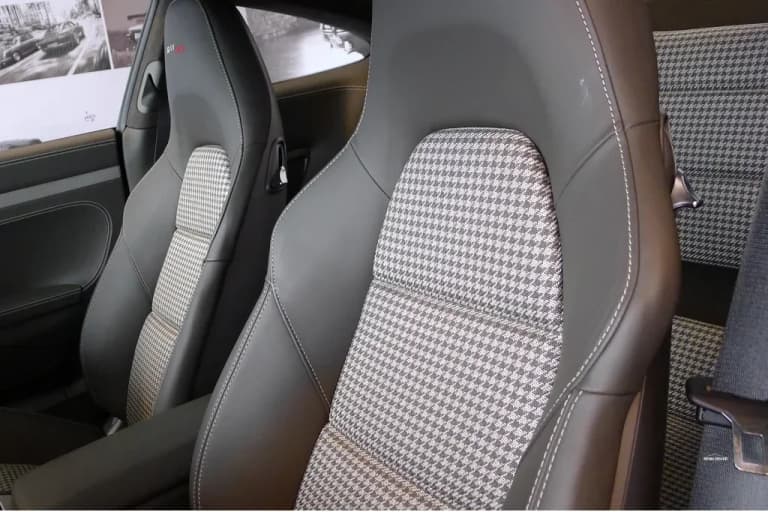
The instrument dials use a vintage-style green background with white needles. The standard Carrera S has white dials with silver needles, so this change is subtle but noticeable. The numbered plaque above the glove box shows the car’s individual production number out of 1,963.
The rest of the interior follows the standard Carrera S layout. The steering wheel, center console, and infotainment system are all 991.1 specification. Porsche did not change the dashboard architecture or add any unique switchgear beyond the visual trim changes.
Color Options
Porsche offered three exterior colors for the 50th Anniversary Edition. Geyser Gray Metallic was the signature color and the most popular choice. It is a light, almost silver gray with a slight blue undertone that changes character in different lighting conditions.
Graphite Gray Metallic was the second option, a darker and more conventional gray. The third choice was a black monochrome finish. All three colors paired with the chrome exterior trim and polished Fuchs-style wheels.
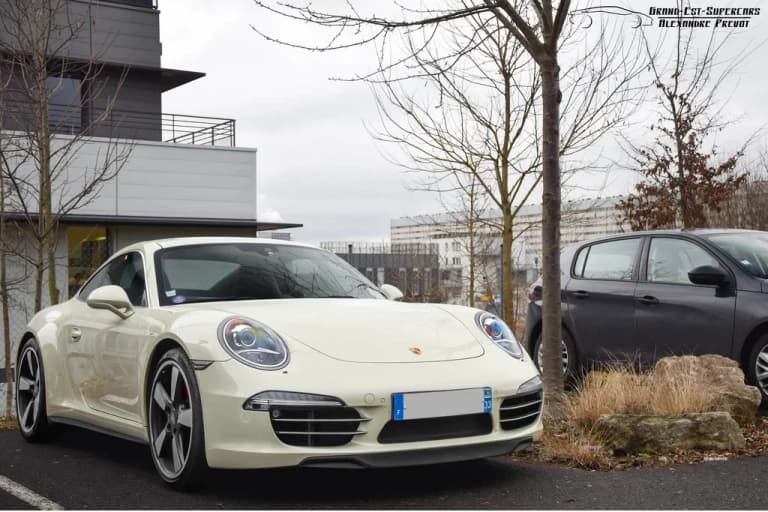
Geyser Gray is the color most closely associated with the 50th Anniversary Edition and tends to command a small premium on the used market. It was not available on any other 991 model, making it an immediate visual identifier for this special edition.
Pricing and Market Values
When new, the 50th Anniversary Edition started at \u20ac121,119 including VAT in Europe and \u00a392,257 in the UK. In the United States, pricing was approximately $118,000 before options. That represented a premium of roughly $15,000 to $20,000 over a comparably equipped Carrera S.
On the used market, values have held well. The combination of limited production, naturally aspirated engine, and anniversary significance keeps demand steady. Clean examples with reasonable mileage trade between $90,000 and $130,000 depending on specification and condition. Geyser Gray cars with the 7-speed manual and low miles sit at the top of that range.
As the collector market continues to favor naturally aspirated 991.1 models, the 50th Anniversary Edition is positioned to appreciate. It shares that naturally aspirated appeal with cars like the 991 GT3 and 911 R, though at a much lower price point.
50th Anniversary vs Standard Carrera S
| Feature | Carrera S | 50th Anniversary |
|---|---|---|
| Body width | Standard (narrow) | Carrera 4S (wide) |
| Suspension | Standard height | Lowered 10mm |
| PASM | Optional | Standard |
| PTV | Optional | Standard |
| Wheels | Standard 20-inch | Fuchs-style 20-inch |
| Trim | Black / body color | Chrome throughout |
| Interior | Standard leather | Houndstooth inserts |
| Instruments | White dials | Green dials |
| Production | Unlimited | 1,963 units |
The mechanical differences are modest. The wider body, lowered suspension, standard PASM, and standard PTV give the 50th Anniversary Edition a slightly more composed driving character than a base-spec Carrera S. But the real distinction is in the details. The Fuchs-style wheels, chrome accents, houndstooth seats, and green gauges create a car that feels connected to the 911’s history in a way no amount of options ticking on a standard Carrera S can replicate.
Frequently Asked Questions
How many Porsche 911 50th Anniversary Edition cars were made?
Porsche produced exactly 1,963 units of the 911 50th Anniversary Edition worldwide. The number references 1963, the year the original Porsche 901 was first shown at the Frankfurt Motor Show.
What engine does the Porsche 911 50th Anniversary Edition have?
It uses a 3.8-liter naturally aspirated flat-six producing 400 hp and 325 lb-ft of torque. An optional Powerkit raised output to 430 hp. This is the same engine found in the standard 991.1 Carrera S.
Is the 911 50th Anniversary Edition rear-wheel drive or all-wheel drive?
It is rear-wheel drive only. Although it wears the wider Carrera 4S body, the drivetrain is pure rear-wheel drive from the Carrera S. The wider body was chosen for its stance, not for packaging an all-wheel-drive system.
What colors were available on the 911 50th Anniversary Edition?
Porsche offered three colors: Geyser Gray Metallic (the signature color, exclusive to this model), Graphite Gray Metallic, and black monochrome. Geyser Gray is the most common and the most sought-after on the used market.
How much is a Porsche 911 50th Anniversary Edition worth?
As of 2026, clean examples trade between $90,000 and $130,000 depending on mileage, color, and transmission. Geyser Gray manual cars with low miles command the highest prices. Values have been trending upward as collectors seek naturally aspirated 991.1 models.
Could only existing Porsche owners buy the 50th Anniversary Edition?
Yes. Porsche restricted sales of the 50th Anniversary Edition to existing Porsche owners. This was an early example of the allocation-based sales approach that Porsche has since expanded to other limited-run models like the 911 S/T and Sport Classic.
Images via Wikimedia Commons: Falcon\u00ae Photography, CC BY-SA 2.0; Calreyn88, CC BY-SA 4.0; MrWalkr, CC BY-SA 4.0; Alexandre Pr\u00e9vot, CC BY-SA 2.0; Ross, CC BY-SA 2.0.