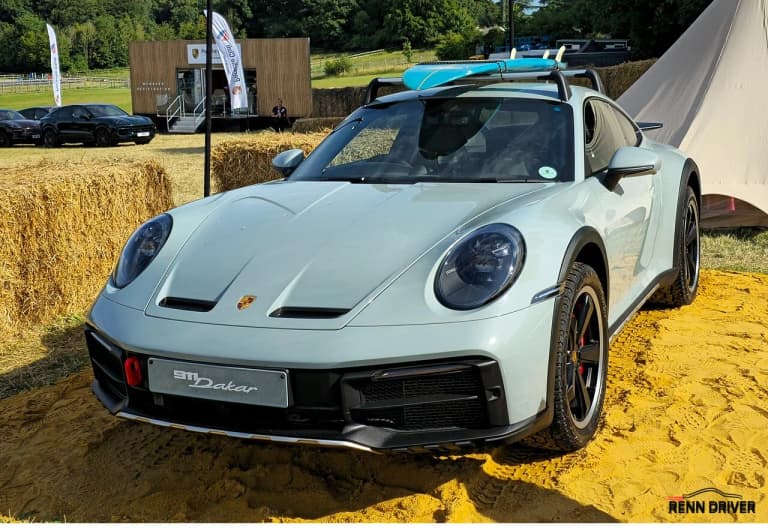
Porsche took a 480hp sports car, raised it 50mm, strapped all-terrain tires to it, and told you to go find some gravel. Then they made exactly 2,500 of them and stopped. The 911 Dakar is either the most brilliantly absurd car Porsche has ever built, or the most purely Porsche thing they have ever done, depending on how you look at it.
Quick Answer: The Porsche 911 Dakar is a lifted, limited-production 911 designed for rougher surfaces and inspired by Porsche rally history. It combines all-terrain hardware with contemporary 911 performance.
In this article, we’ll explain the 911 Dakar, Porsche's lifted all-terrain 992. We’ll cover the 1984 Dakar win, the off-road modes, used prices, and how it copes with Thai roads.
Contents
- 1 Quick Specs
- 2 The 1984 Paris-Dakar Story
- 3 What Makes It Different: Engine and Off-Road Hardware
- 3.1 Engine and Performance
- 3.2 The Off-Road Hardware in Real Terms
- 4 Rallye and Off-Road Modes
- 5 Rallye Design Package
- 6 Dakar vs. Safari
- 7 Who Should Buy One
- 8 The Used Market Today
- 9 The Thailand Angle
- 10 Final Thoughts
Quick Specs
| Spec | 911 Dakar (992.1) |
|---|---|
| Engine | 3.0L twin-turbo flat-six |
| Power | 480 hp @ 6,500 rpm |
| Torque | 420 lb-ft @ 2,300–5,000 rpm |
| Transmission | 8-speed PDK only |
| Drivetrain | All-wheel drive (PTM) |
| 0–60 mph | 3.2 seconds |
| Top Speed | 150 mph (all-terrain tires) / 190 mph (road tires) |
| Curb Weight | 3,552 lbs (1,611 kg) |
| Ground Clearance (standard) | 161mm |
| Ground Clearance (lift engaged) | 191mm |
| Front Tires | 245/45 ZR 19 Pirelli Scorpion AT Plus |
| Rear Tires | 295/40 ZR 20 Pirelli Scorpion AT Plus |
| Suspension | PDCC + rear-axle steering (standard) |
| Production | 2,500 units worldwide |
| Production Years | 2023–2024 |
| MSRP | $222,000 (excl. delivery) |
The 1984 Paris-Dakar Story
The name is not marketing gloss. Porsche actually did this.
In 1984, Jacky Ickx convinced the company to enter a modified 911 in the Paris-Dakar Rally, a 7,500-mile race across North Africa from Paris to Dakar, Senegal. The car, known internally as the 953, ran a 3.2-liter flat-six with around 300 hp, a prototype all-wheel-drive system with a 31:69 front-to-rear power split, and 270mm of suspension travel. It also carried 270 liters of fuel because there was nowhere to refuel in the Sahara.
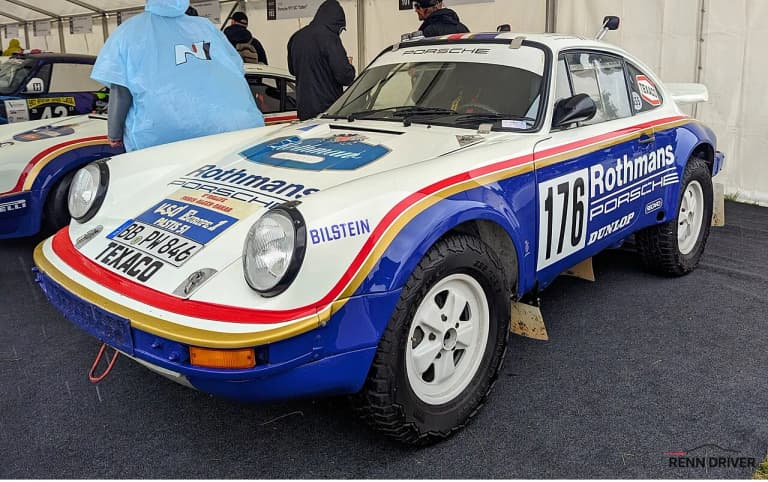
René Metge and co-driver Dominique Lemoyne drove it to an outright win. First overall. Not first in class, not a moral victory. The 953 beat everything across 7,500 miles of sand, rock, and heat.
That all-wheel-drive technology from the 953 program directly fed into the Porsche 959, which won Paris-Dakar again in 1986. The lineage is real. When Porsche named the modern 2023 car the Dakar, they were pointing at something specific that actually happened, not inventing a heritage story.
That matters for understanding the car. The Dakar is not a lifestyle crossover with a 911 badge. It is Porsche's attempt to build a modern car that captures what that 953 actually was: a sports car that could win in conditions a sports car has no business being in.
What Makes It Different: Engine and Off-Road Hardware
The easy summary is that the Dakar is a 992 with a lift kit and chunky tires. That summary is wrong.
Porsche rebuilt the suspension geometry from scratch for the raised ride height. The engine mounts are sourced from the GT3. The CFRP hood, with its large extraction openings, also comes from the GT3. The rear seats are deleted. The glazing uses a lightweight specification. Every panel that needed to change for the higher stance was redesigned, not adapted.
Standard equipment on the Dakar includes items that are options on other 911 variants: Porsche Dynamic Chassis Control (PDCC), rear-axle steering, and Porsche Traction Management all-wheel drive. They are standard here because the car needs all three to function properly across dirt, gravel, sand, and tarmac. You cannot spec a Dakar without them because a Dakar without them would not be a Dakar.
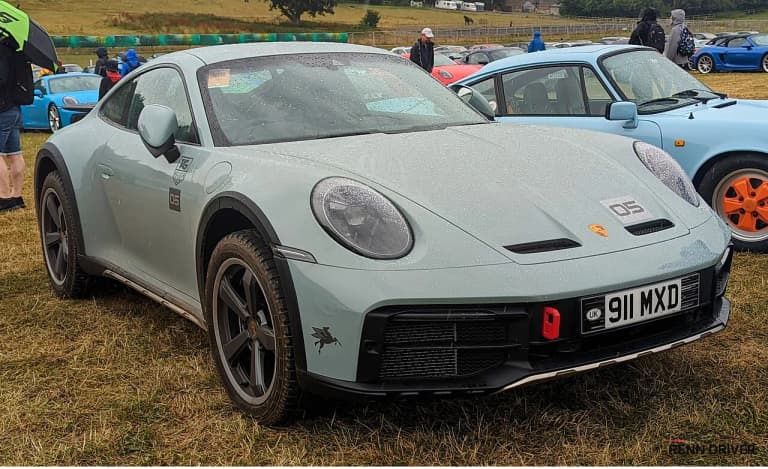
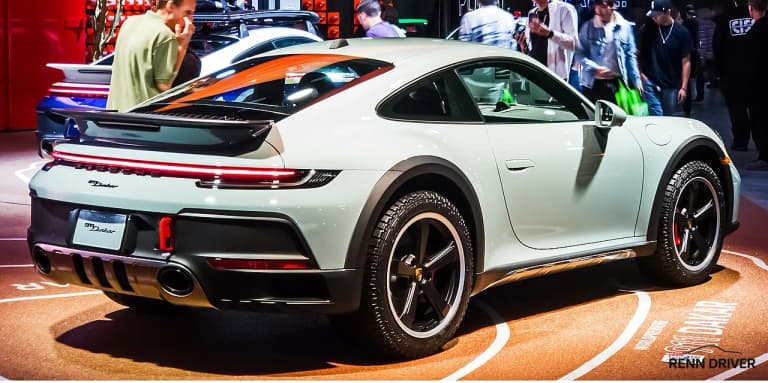
Underbody protection covers the front fascia, side sills, and rocker panels in stainless steel. The front intakes are covered with fine mesh grilles to deflect stone damage. Red forged aluminum tow hooks are mounted front and rear and are structural, not decorative. The wheel arches are extended to cover the wider track that comes with the suspension changes.
The top speed cap at 150 mph is worth explaining. The Pirelli Scorpion all-terrain sidewalls cannot safely handle the heat and stress of sustained high-speed running the way a summer performance tire can. Fit road tires and the limiter rises to 190 mph. The cap is a tire spec limitation, not a power limitation. The engine could push further. The tires cannot.
Engine and Performance
The Dakar shares its engine with the 992 Carrera 4 GTS: a 3.0-liter twin-turbo flat-six producing 480 hp and 420 lb-ft of torque. It sends power through an 8-speed PDK to all four wheels.
There is no manual transmission and there never was going to be one. The PDK is specifically calibrated for the Dakar's off-road modes, managing torque delivery between axles in ways a manual driver cannot replicate on loose surfaces. This is not a manual-vs-PDK debate. A manual Dakar would not work as well as a PDK Dakar off-road. That is the reason, full stop.
The 0-60 time of 3.2 seconds deserves some context. That is faster than most sports cars on the road, achieved while riding on all-terrain tires at a ride height 50mm above a standard 911. The Dakar is not slow by any reasonable standard. It is genuinely quick, and it achieves that with a setup optimized for gravel rather than tarmac.
For reference: a standard 992 Carrera on summer tires in similar tune hits 60 mph in around 3.5 seconds. The Dakar is faster off the line because PTM all-wheel drive launches harder than rear-wheel drive in the same power range. On a racetrack, the 911 GT3 or Turbo S would pull away from it quickly. On anything other than a racetrack, the Dakar's performance is more than you will ever use.
The Off-Road Hardware in Real Terms
The headline number is 50mm of additional ride height over a standard 911 with sport suspension. Engage the PASM lift system and you get another 30mm on top of that, for 191mm total ground clearance. To put that in context: a stock Toyota Hilux sits at around 240mm of clearance. The Dakar is not competing with proper off-roaders for ground clearance. But 191mm is enough to clear the terrain it was actually designed for: gravel tracks, rutted dirt roads, sand, and dry riverbeds. Not rock crawling. Not river fording. Not the Dakar Rally itself, where the 953 ran 270mm of travel and a fuel tank the size of a bathtub.
The lift system works at speeds up to 105 mph. That is well beyond what any normal sports car lift system handles, and it means you can enter a rough section at speed without having to slow down to raise the car first.
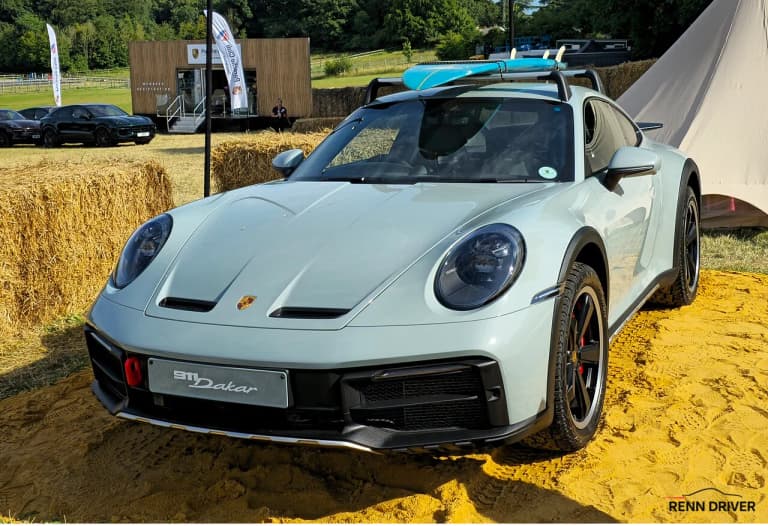
The Pirelli Scorpion All Terrain Plus tires are doing a lot of work here. They carry 9mm of tread depth, dual-carcass reinforced sidewalls that resist punctures on sharp rocks, and a compound that stays effective across a wide temperature range. The staggered sizing (245/45 ZR 19 front, 295/40 ZR 20 rear) keeps the rear-weight bias that makes a 911 handle the way a 911 does, even with the lifted suspension.
PDCC (Porsche Dynamic Chassis Control) is the active anti-roll bar system. In regular driving, it reduces body roll to near-sports-car levels. On uneven terrain, it lets the suspension work more independently wheel-to-wheel, keeping more tire in contact with the ground. Rear-axle steering shortens the turning circle and improves stability at speed. Both are included standard because they are not luxury features on the Dakar. They are load-bearing components of how the car works off-road.
The underbody protection is genuine, not cosmetic. Stainless steel skid plates protect the front fascia and running gear. The rocker panel covers are heavy enough to take a hit from a rock at speed without deforming.
Rallye and Off-Road Modes
No other 911 has these two modes. They are the Dakar's most distinctive features from a driving perspective.
Rallye Mode is for gravel, dirt, and loose surfaces where you want the car to rotate with the throttle. It sends more torque rearward, loosens the stability control substantially, and adjusts the differential behavior to allow controlled oversteer. Rallye Launch Control lets up to 20% wheel spin off the line to find maximum traction on loose surfaces rather than trying to grip and launch like it would on tarmac. In practice, the car slides around in a way that is immediately familiar if you have driven rally cars or FWD hot hatches in the wet. You point with the throttle, catch it with the steering, and flow through corners rather than carving them. It is a genuinely different driving experience to a standard 911.
Off-Road Mode is the mode you use when Rallye Mode is too aggressive for the surface: deep sand, heavily rutted roads, boulder fields. It automatically engages the full lift height, tightens the torque distribution for maximum traction at low speed, and adjusts the stability systems to intervene as late as possible without letting the car dig in. Think of it as the mode where the car is trying to keep you moving rather than letting you have fun.
Both modes stack on top of the normal 911 driving modes. You still have Normal, Sport, and Sport Plus for road driving, with Rallye and Off-Road as additional options for when the road ends.
Rallye Design Package
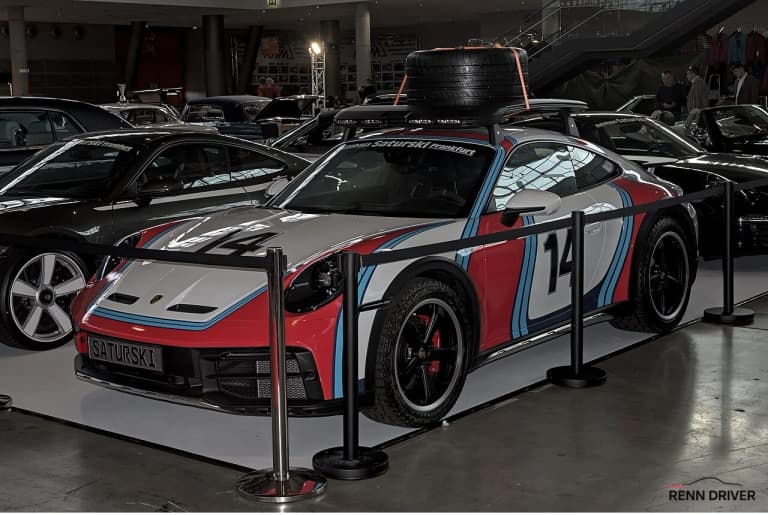
Porsche Exclusive Manufaktur offered the Rallye Design Package as the Dakar's standout visual option. It applies a two-tone paint scheme in White and Gentian Blue Metallic, directly referencing the Rothmans livery on the 953 and 959 Paris-Dakar cars. Optional racing start numbers from 0 to 999 go on the doors, making each car a unique unit.
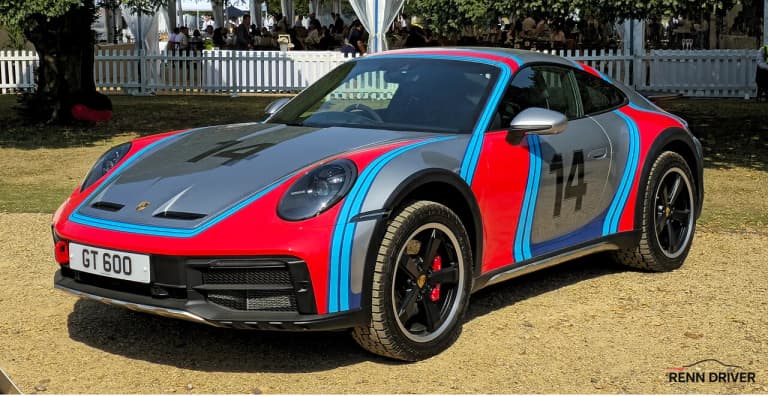
This was the first time Porsche combined two-tone paint with a decorative racing livery on a production car. If you know what the 953 looked like, the reference lands immediately. If you do not, it is still one of the better-looking 911 color schemes of the 992 generation.
Beyond the Rallye package, Shade Green was an exclusive Dakar-only color not available on any other 911. It looks better in person than in photographs, especially in direct sunlight.
Optional on the car is an aluminum roof basket rated to 42 kg, a 12-volt roof-mounted power socket for auxiliary lights, and a fold-out two-person roof tent with ladder, mattress, and storm cover. The roof tent is not a joke option. People ordered it. The car is sturdy enough to sleep on.
Dakar vs. Safari: What Is Actually Different
The 911 Safari gets compared to the Dakar constantly because they occupy the same conceptual space: raised 911, off-road intent. But they are meaningfully different cars built on different philosophies.
The Safari originated with Singer Vehicle Design building one-off bespoke restorations of air-cooled 911s with lifted suspension for safari-style overland travel. Each car is hand-built, unique, and costs north of $1 million. The Dakar is a factory production car at $222,000 that sold 2,500 units.
If you are comparing the factory Porsche Safari program (the limited 992-based Safari units Porsche themselves built in tribute), those were customer racing cars built for closed-course use, not road-legal production vehicles. They are not direct competitors in the used market.
The meaningful comparison is capability and character. The Singer Safari is a bespoke, analog, air-cooled experience aimed at collectors and people who want something irreplaceable and singular. The Dakar is a modern, turbocharged, electronics-heavy performance car that happens to work on dirt. The Singer is more romantic. The Dakar is more capable and more usable.
If you want a raised 911 you can drive hard on mixed surfaces daily, the Dakar. If you want a conversation piece and collectible that also happens to have lifted suspension, the Safari. The overlap in buyer profile is real, but the cars answer different questions.
Who Should Actually Buy One
The Dakar makes most sense for three types of buyers.
The first is someone who wants a 911 and drives somewhere with genuinely variable road surfaces. Not necessarily extreme off-road, but places where a standard 911 with 100mm of ground clearance would scrape, hesitate, or make you anxious about where you are pointing it. The Dakar removes that anxiety without removing anything meaningful about the 911 experience on pavement.
The second is someone who wants to tour: load a car, drive a long distance through changing terrain, camp if needed. The Dakar is one of the only sports cars ever built with a factory roof tent option. It is genuinely set up to go somewhere remote and stay there overnight.
The third is a collector who wants the specific intersection of limited production, factory provenance, and 992 generation significance. This is a 992-generation special edition with a 2,500-unit cap, real motorsport heritage, and no successor yet confirmed at the same production volume. It is a cleaner long-term bet than most limited Porsche special editions.
Who should not buy one: anyone who will run it exclusively on smooth urban roads and never use the lift system. For that use case, a 992 Carrera 4 GTS is a better car at a lower price. The Dakar's premium is for capability you have to use to justify.
The Used Market Today
All 2,500 units sold before production began. Early cars traded at $280,000–$320,000 on the secondary market as dealer markups and speculator premiums kicked in. As of mid-2026, the market has calmed. Clean, low-mileage examples from the 2023 and 2024 model years are moving at $235,000–$260,000 for standard-specification cars, with Rallye Design Package examples and Shade Green cars commanding $15,000–$30,000 premiums on top of that.
The used case for buying now rather than new is straightforward: production is over. There is no new 992.1 Dakar to order. The next Dakar will be a 992.2 with a T-Hybrid powertrain, an electric motor in the drivetrain, and an estimated $250,000 base price. Whether Porsche limits that production run similarly is unknown. If they do, the 992.1 Dakar gains additional collectibility as the first and pure-combustion version of the model.
Things to check on a used Dakar: tire condition (the Pirelli Scorpions are expensive to replace), whether the lift system has been tested and functions correctly at speed, any underbody damage from actual off-road use, and whether the car has original Dakar-specific documentation. Cars used hard off-road are not necessarily worse buys, but you want to know the history.
One thing the Dakar does not have is a cheap maintenance path. The Pirelli Scorpion AT Plus tires in those sizes are not commodity rubber. Budget accordingly if you plan to drive it seriously.
The Thailand Angle
This is the section I wanted to write honestly rather than optimistically.
Thailand does not have the terrain the Dakar was primarily designed for. The country does not have endless gravel washboard roads, Saharan sand, or rocky mountain passes that require 191mm of clearance and Rallye Mode. The overwhelming majority of Thai road surface is tarmac, some of it excellent, some of it genuinely terrible in terms of potholes and subsidence, but tarmac nonetheless.
That said, there are real scenarios where a Dakar makes sense in Thailand.
The northern region changes things. Chiang Mai province and the surrounding highlands have a mix of sealed and unsealed roads, particularly once you get into areas around Doi Inthanon, the Mae Hong Son loop, or the routes into Shan State border territory. These are not extreme off-road routes, but they are exactly the kind of mixed-surface roads where a standard 911 becomes uncomfortable and anxious. The Dakar's additional ride height and all-terrain tires handle that terrain without stress.
The Isan plateau in the northeast has sections of laterite (red clay) roads, especially in and around national park areas. Again, not extreme, but variable enough that ground clearance and all-terrain tires matter. If you are using a car to get to events, track days, and driving destinations across Thailand, and some of those destinations involve unsealed access roads or rural sections, the Dakar is more practical than any standard 911.
Thai speed bumps are also a serious case. They are enormous, ubiquitous, and unmarked. A standard 911 with sport suspension and 100mm of ground clearance will scrape on Thai speed bumps regularly, especially at any speed above a crawl. The Dakar at 161mm standard, or 191mm with the lift engaged, solves this entirely. It sounds trivial until you have owned a low car in Thailand. It is not trivial.
There are Porsche events in Thailand where the Dakar's character would shine. Check the Thailand car events calendar for driving experiences and meets where bringing something this unusual makes an impression. The Dakar is rarer in Southeast Asia than almost anywhere else, simply because the terrain does not obviously call for it. That rarity works in its favor at events.
The honest summary for Thailand: the Dakar is not necessary here in the way it would be for someone based in Morocco or South Africa. But it is genuinely more practical than a standard 911 in Thai conditions, meaningfully so in the north and northeast, and the speed bump situation alone makes it worth considering if you plan to use the car as a daily driver or long-distance touring car across the country.
Final Thoughts
The 911 Dakar is one of the few truly differentiated special editions Porsche has produced in the modern era. The Sport Classic is a styling exercise. The S/T is a track weight-reduction program. The Dakar is neither of those things. It is an engineering argument that the 911 platform can do things nobody expected it to do, made real at production scale and backed by a heritage story that is 100% genuine.
The 2,500-unit cap and the fact that every car sold before production started tells you the market agrees. The question now is whether you agree enough to pay the premium over a standard Carrera 4 GTS, which gives you the same engine and similar all-weather performance for significantly less money.
The answer depends entirely on whether you will use what the Dakar offers. If you will drive on mixed surfaces, tour long distances on changing terrain, or simply want a 992 that can be pointed at a dirt road without hesitation, the premium is justified. If you are going to drive it exclusively on smooth pavement and never engage Off-Road mode, you are paying $40,000 over GTS prices for tires and a roof tent option. That is your call to make, not mine.
For collectors: the 992.1 Dakar, produced over two model years in a 2,500-unit run, with a genuine motorsport lineage and no direct predecessor in the production lineup, is a reasonable long-term bet. Not a guaranteed one. But the fundamentals are there.
Images: M 93, CC BY-SA 3.0 DE; Calreyn88, CC BY-SA 4.0; Alexander-93, CC BY-SA 4.0, via Wikimedia Commons