The 2016 Porsche 911 R is a 991-generation 911 built for driving purists. It combines the 500 hp 4.0L naturally aspirated flat-six from the GT3 RS with a 6-speed manual transmission, rear-wheel drive, no fixed rear wing, and no roll cage. Porsche produced exactly 991 units. The car triggered a speculation frenzy that pushed prices above $1.3 million at its peak. Current market values have settled between $400,000 and $700,000.
Contents
Quick Summary
- Production year: 2016
- Generation: 991.1
- Engine: 4.0L naturally aspirated flat-six (from GT3 RS)
- Power: 500 hp at 8,250 rpm
- Torque: 338 lb-ft at 6,250 rpm
- Transmission: 6-speed manual (only)
- Drive: Rear-wheel drive
- Weight: 3,021 lbs (1,370 kg)
- Top speed: 200 mph (323 km/h)
- 0 to 60 mph: ~3.7 seconds
- Production total: 991 units
- MSRP: $184,900 (US)
Why the 911 R Was Special
To understand the 911 R, you need to understand the problem it solved. By 2016, Porsche's GT3 had moved to a PDK-only transmission. The GT3 RS was even more extreme: PDK only, massive rear wing, roll cage, and a focus on lap times above all else. Both were extraordinary track cars. Neither offered a manual transmission.
A vocal segment of Porsche enthusiasts wanted the GT3 RS's engine and chassis without the wing, without the cage, and with a proper manual gearbox. They wanted a car built for road driving, not circuit racing. A car you could use on a mountain pass without the visual drama of a GT3 RS.
Porsche's GT department, led by Andreas Preuninger, listened. The 911 R took the GT3 RS engine and dropped it into a lighter, cleaner body with the six-speed manual from the previous-generation GT3. No fixed wing. No roll cage. No PDK option. The result was the most focused road-going 911 since the original Carrera RS 2.7.
The name itself carried weight. The original 911 R was a 1967 lightweight race car built by Porsche's competition department. Only 20 were made, and they were among the rarest and most valuable 911s in existence. Reviving the R badge signaled that this was not just another limited edition. It was a statement of intent.
Engine and Drivetrain
The 911 R uses the same 4.0L (3,996cc) naturally aspirated flat-six as the 991.1 GT3 RS. This engine produces 500 hp at 8,250 rpm and 338 lb-ft of torque at 6,250 rpm. The redline is 8,800 rpm.
Key engine specifications include titanium connecting rods, forged aluminum pistons, dry-sump lubrication, and individual throttle bodies. The engine breathes through a tuned intake system designed for maximum airflow at high rpm. It is, in every meaningful sense, a race engine installed in a street car.
The transmission is the critical differentiator. Porsche fitted the 6-speed manual gearbox from the 997.2 GT3, updated for the 991 platform. It includes a dual-mass flywheel and an auto-blip rev-matching function (which can be turned off). The manual shifts are precise and mechanical, with a shorter throw than the standard Carrera manual.
The rear differential is a mechanical limited-slip unit with torque vectoring (PTV). Rear-wheel drive only. No all-wheel-drive option existed.
Design and Weight Savings
The 911 R weighs 3,021 lbs (1,370 kg), which is 110 lbs lighter than the GT3 RS and 176 lbs lighter than the standard GT3. Porsche achieved this through a combination of material choices and deletion of unnecessary equipment.
The roof is carbon fiber. The front fenders, front trunk lid, and rear decklid are also carbon fiber reinforced plastic. The rear windscreen and rear side windows are lightweight polycarbonate. Sound insulation is reduced throughout. Air conditioning and the audio system are standard but could not be deleted for further weight savings.
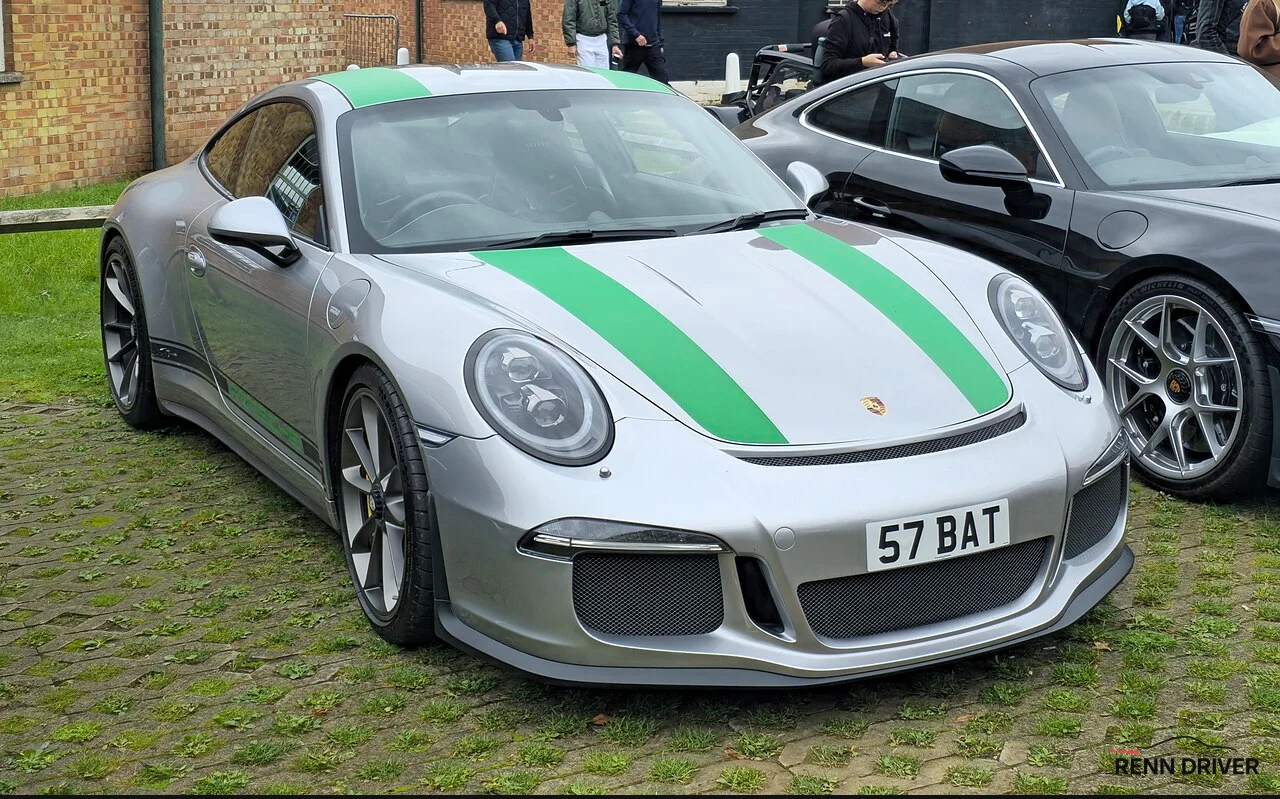
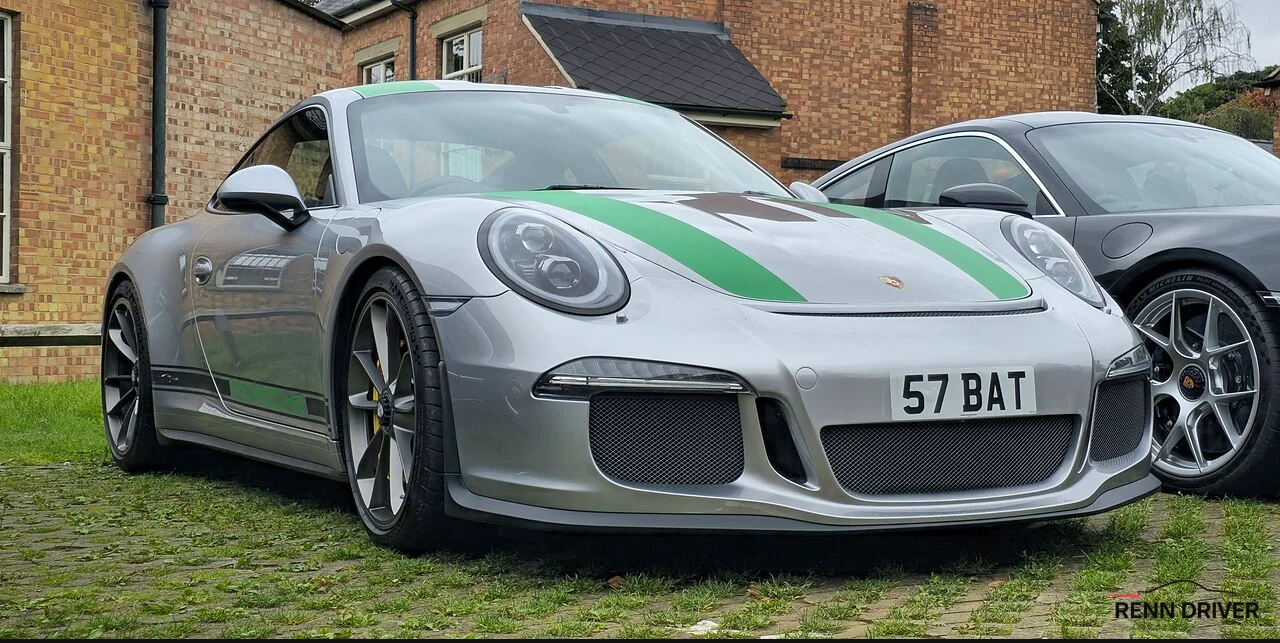
Visually, the 911 R is defined by what it does not have. There is no fixed rear wing. Instead, it uses a deployable rear spoiler that raises automatically at speed, similar to the standard Carrera. The front end is shared with the GT3 RS, including the aggressive front bumper and wider front fenders. The rear end is clean and unadorned.
The signature design element is the green or red side stripes that run the length of the body. These are a direct reference to the original 1967 911 R. Most cars were ordered in white with green stripes, echoing the classic livery, though Porsche offered the full range of 911 colors.
Fuchs-style center-lock wheels are fitted as standard, another nod to classic 911 design. They measure 20 inches and are shod with 245/35 front and 305/30 rear tires.
Driving Experience
Every journalist who drove the 911 R at launch said essentially the same thing: this is what a modern 911 should feel like.
The 4.0L engine is the star. It pulls cleanly from 2,000 rpm and comes fully alive above 5,000 rpm, where it produces a high-pitched, hard-edged wail that builds intensity all the way to the 8,800 rpm redline. The sound is more aggressive than a standard GT3 because there is no rear windscreen insulation to muffle it.
The manual gearbox transforms the driving experience compared to the PDK-equipped GT3. Each gear change is a deliberate act that requires the driver's full attention. The clutch pedal has good weight and a progressive engagement point. The shift action is precise but not overly light. Heel-toe downshifts at the limit of the engine's rev range are deeply satisfying.
Without the GT3 RS's massive rear wing, the 911 R generates less downforce at track speeds. On the road, this makes no practical difference. The car is perfectly balanced, with the mechanical grip of the rear tires and the limited-slip differential providing more than enough traction for any road situation.
The ride quality is firm but not punishing. The PASM (Porsche Active Suspension Management) adaptive dampers are well calibrated for road use, and the absence of a roll cage means the cabin is quieter and more comfortable than a GT3 RS.
The Speculation Bubble
The 911 R's market history is one of the most dramatic examples of automotive speculation in recent memory.
Porsche priced the 911 R at $184,900 in the United States. Allocation went to existing GT customers with established purchase histories at their local Porsche dealers. Many of those customers never intended to keep the car.
Within weeks of the first deliveries, 911 R cars were appearing at dealers and auction houses with asking prices of $500,000 to $700,000. By late 2016 and into 2017, prices had climbed past $1 million. The most extreme recorded transaction was approximately $1.3 million for a delivery-mileage example.
The speculation was driven by the car's limited production (991 units), the perception that it was the "last great naturally aspirated manual 911," and the broader collector car market bubble of the mid-2010s. Many buyers had no intention of driving the car. Some reportedly took delivery, covered it, and listed it for sale within days.
The bubble burst when Porsche announced the GT3 Touring for the 991.2 generation. The wingless GT3 variant offered essentially the same concept: manual transmission, no wing, naturally aspirated flat-six. It was not limited in production and was available at a fraction of the 911 R's secondary market price. The 911 R's value dropped significantly as the scarcity premium evaporated.
The bubble taught the Porsche community a valuable lesson about the difference between a great car and a great investment. The 911 R is an outstanding driving machine regardless of its market price. The buyers who overpaid during the frenzy were buying scarcity, not driving experience.
Current Market Values
As of early 2026, the 911 R market has stabilized at levels that still represent a significant premium over MSRP but far below the peak.
- Low-mileage, collector-quality examples: $550,000 to $700,000
- Driver-quality cars with moderate mileage (under 10,000 miles): $450,000 to $550,000
- Higher-mileage examples (10,000+ miles): $400,000 to $475,000
The cars that command the highest prices are delivery-mileage examples in white with green stripes, the iconic color combination. Less common configurations (dark colors, red stripes) can bring premiums or discounts depending on buyer preference.
Values are expected to remain relatively stable. The 911 R occupies a unique position in Porsche history as the car that directly led to the GT3 Touring, and it will always be the first modern 911 to combine a GT3 RS engine with a manual gearbox. That historical significance has lasting value beyond speculation.
911 R vs GT3 vs GT3 Touring
| 911 R | GT3 (991.1) | GT3 Touring (991.2) | |
|---|---|---|---|
| Engine | 4.0L NA | 3.8L NA | 4.0L NA |
| Power | 500 hp | 475 hp | 500 hp |
| Transmission | 6-speed manual only | PDK only | 6-speed manual (PDK optional) |
| Wing | No (retractable spoiler) | Yes (fixed) | No (retractable spoiler) |
| Roll cage | No | Optional | No |
| Weight | 3,021 lbs | 3,153 lbs | 3,160 lbs |
| Production | 991 units | Unlimited | Unlimited |
| MSRP | $184,900 | $130,400 | $143,600 |
The GT3 Touring is the 911 R's spiritual successor, available to anyone willing to pay MSRP rather than a speculator's premium. The 911 R remains the more exclusive car, but the driving experience is remarkably similar. The 911 R's weight advantage of approximately 140 lbs is noticeable but not transformative.
Renn Driver's Take
I have not driven this car yet, but I will update this section once I do.
Frequently Asked Questions
How many Porsche 911 R were made?
Porsche produced exactly 991 units of the 911 R, a deliberate nod to the 991 generation platform on which it is based.
How much is a Porsche 911 R worth today?
A Porsche 911 R is worth between $400,000 and $700,000 as of 2026, depending on mileage and specification. Peak values during the 2016 to 2017 speculation bubble exceeded $1.3 million.
What engine does the Porsche 911 R have?
The Porsche 911 R uses a 4.0L (3,996cc) naturally aspirated flat-six engine from the 991.1-generation GT3 RS, producing 500 hp at 8,250 rpm and 338 lb-ft of torque at 6,250 rpm.
Is the Porsche 911 R manual only?
Yes, the Porsche 911 R is available exclusively with a 6-speed manual transmission. No PDK option was offered. This was a central part of its identity as a purist's 911.
What is the difference between the 911 R and the Sport Classic?
The Porsche 911 R uses the 500 hp GT3 RS engine and a 6-speed manual in a lightweight body without a wing. The 911 Sport Classic (992) uses a 543 hp twin-turbo 3.7L flat-six with a 7-speed manual, rear-wheel drive, ducktail spoiler, and wider body. The Sport Classic is heavier and more of a grand tourer, while the 911 R is a track-focused road car.
Why did the Porsche 911 R lose value?
The Porsche 911 R lost value from its speculative peak because Porsche introduced the GT3 Touring, which offered a similar concept (manual, no wing, NA flat-six) without production limitations. The scarcity premium that had driven prices above $1 million was no longer justified when buyers could get a comparable experience for a fraction of the price.
Final Thoughts
The Porsche 911 R is a genuinely great car that became temporarily overshadowed by its own market narrative. Strip away the speculation, the flipping, and the million-dollar transactions, and what remains is a 991-generation 911 with the best naturally aspirated engine Porsche has ever built in a production car, mated to a manual gearbox, in a lightweight body without visual excess.
It proved to Porsche that enthusiasts would pay a premium for simplicity and driver engagement. The Touring package that followed exists because the 911 R existed first. In that sense, the 911 R's legacy extends far beyond the 991 cars that bear its name. It changed what Porsche was willing to build.
Images by: Renn Driver and Contributors, licensed under CC BY-SA 2.0, via Wikimedia Commons