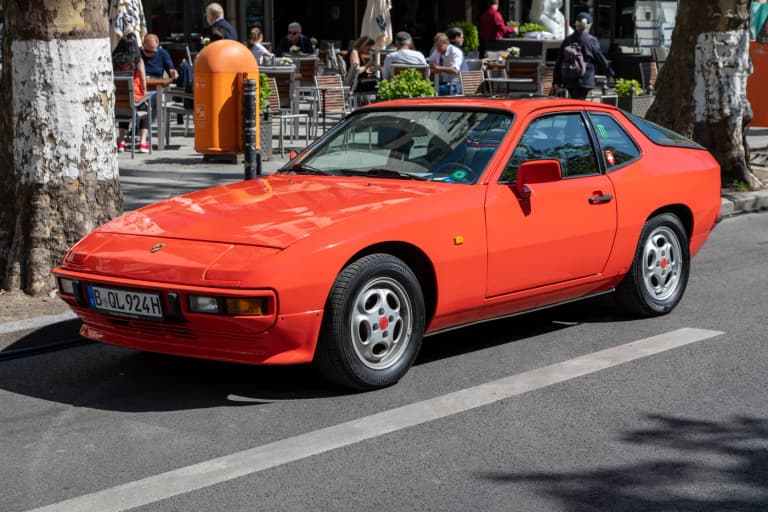
The Porsche 924 was Porsche’s first production car with a water-cooled, front-mounted engine and a rear transaxle, built from 1976 to 1988. It replaced the 914 as the entry-level Porsche and pioneered the transaxle layout that the 944 and 928 would share. The range ran from a 125-horsepower base model up to the turbocharged 924 Turbo and the rare 210-horsepower 924 Carrera GT.
In this article, we’ll explain the Porsche 924, Porsche’s first water-cooled, front-engine transaxle sports car. We’ll cover its transaxle layout, the 924 Turbo, the Carrera GT, and current values.
Contents
What Is the Porsche 924
The Porsche 924 was the car that took Porsche in a completely new direction. Where the 911 had a rear-mounted, air-cooled flat-six, the 924 used a water-cooled four-cylinder engine in the front and drove the rear wheels through a transaxle at the back. It was the first Porsche road car to do so.
It was built as the entry-level Porsche, replacing the 914 and the short-lived 912E. Built at Neckarsulm rather than Zuffenhausen, it sold in large numbers and made Porsche ownership accessible to a new group of buyers through the late 1970s and 1980s.
For years the 924 carried a reputation as the “cheap Porsche,” partly because of its Volkswagen and Audi engineering roots. That reputation has softened as enthusiasts have come to appreciate its excellent balance, clean styling, and the role it played in launching Porsche’s front-engine family.
From Volkswagen Project to Porsche Model
The 924 began life as a project Porsche developed for Volkswagen, intended to be a sporty VW flagship. When Volkswagen pulled back from the plan, Porsche bought the rights to the design and sold it as its own entry-level model.
That history explains the parts-bin engineering. The original engine was an Audi-sourced 2.0-liter four-cylinder, and the four-speed gearbox was adapted from a front-wheel-drive application. Porsche fitted its own cylinder head and tuned the package, but the bones were shared. This kept costs down and made the 924 affordable, while also fueling the snobbery it faced from purists.
The Transaxle Layout
The 924’s defining feature is its transaxle layout. The engine sits up front while the gearbox is mounted at the rear, combined with the differential. Connecting the two is a rigid torque tube running down the center of the car.
This arrangement gives the 924 near-equal weight distribution between the front and rear axles. The result is a car that handles with real precision and balance, traits that defined the entire transaxle family. The same basic concept underpinned the 944 and the larger 928.
The 924 Range
The standard 924 used a 2.0-liter four-cylinder engine producing 125 horsepower in European form. American cars were initially strangled by emissions equipment to as little as 95 horsepower, later improved to around 110 horsepower. It was never fast in a straight line, but it was light, balanced, and economical.
The base car’s appeal was always about handling and usability rather than outright speed. With its low weight, sharp steering, and even balance, the 924 rewarded smooth driving on a winding road far more than its modest power figures suggested.
The 924 Turbo
In 1979 Porsche added the 924 Turbo to address the performance complaints. A turbocharger lifted output to around 170 horsepower, transforming the car’s straight-line pace and making it genuinely quick for the era.
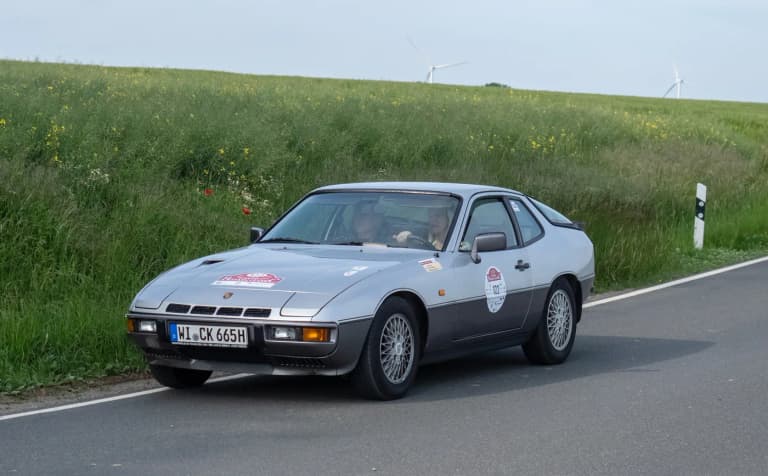
The Turbo is easy to spot thanks to the air intake in the nose and the cooling vents on the bonnet. It turned the 924 from a stylish but slow coupe into a serious sports car, and it laid the technical groundwork for the more famous 944 Turbo that followed.
The 924 Carrera GT
The high point of the 924 line is the Carrera GT, built in 1980 as a homologation special for motorsport. Its reworked turbocharged engine produced around 210 horsepower, and it wore aggressive flared arches and a deeper front spoiler that set it far apart from the standard car.
Only a few hundred Carrera GTs were built, making it one of the rarest and most collectible transaxle Porsches. It also previewed the wide-arch look that would define the 944, and it proved the 924 platform had genuine performance potential.
The 924S
Late in the model’s life, Porsche introduced the 924S. This fitted the narrower 924 body with a version of the 944’s 2.5-liter engine, producing around 148 horsepower and later 158 horsepower. It also borrowed the 944’s brakes, suspension upgrades, and five-lug wheels.
The 924S is arguably the best all-round 924 to own today. It combines the lighter, cleaner early body with the stronger, more modern Porsche-designed engine, and it shares many service parts with the more numerous 944. For drivers who want a usable classic transaxle Porsche, it is a smart choice.
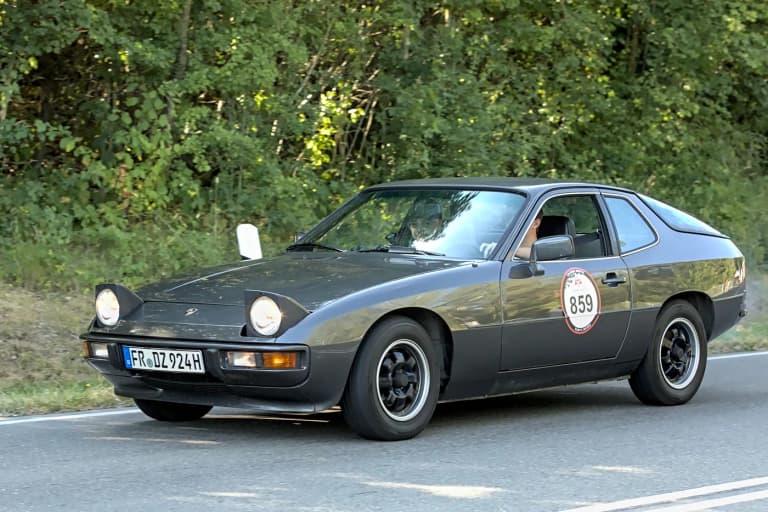
Values and Ownership
The 924 remains one of the most affordable ways into classic Porsche ownership, though the Turbo and Carrera GT have climbed well beyond the base car.
| Variant | Condition | Approx. Value |
|---|---|---|
| 924 (base, 2.0) | Good driver | $8,000 to $18,000 |
| 924S | Good to excellent | $12,000 to $25,000 |
| 924 Turbo | Good to excellent | $25,000 to $50,000 |
| 924 Carrera GT | Documented | $150,000 to $300,000+ |
Mechanically the base and S cars are durable and cheap to run, with the S sharing many parts with the 944. The Turbo demands more careful maintenance because early turbo installations ran hot and can be fragile if neglected. As with all cars of this era, rust and deferred maintenance are the real risks, so condition matters more than the badge. Figures are 2026 estimates.
Frequently Asked Questions
Was the Porsche 924 the first water-cooled Porsche?
Yes. The 924 was the first production road-going Porsche to use a water-cooled engine and a front-engine, rear-transaxle layout. It marked a major departure from the air-cooled, rear-engined 911 and started Porsche’s front-engine family.
What is the difference between the 924 and the 924S?
The base 924 used a 2.0-liter Audi-derived engine making 95 to 125 horsepower. The later 924S used a version of the 944’s 2.5-liter Porsche engine producing around 148 to 158 horsepower, along with 944 brakes and suspension parts, while keeping the narrower 924 body.
How rare is the 924 Carrera GT?
Very rare. The 924 Carrera GT was a homologation special built in only a few hundred examples in 1980. It produced around 210 horsepower and wore wide flared arches, making it the most powerful and collectible 924 by a wide margin.
Is the Porsche 924 a real Porsche?
Yes. Although it used Volkswagen and Audi components and began as a project for Volkswagen, Porsche bought the design, engineered the car, and sold it as its entry-level model. It launched the transaxle layout later used by the 944 and 928.
How much is a Porsche 924 worth?
Base 924s trade between roughly $8,000 and $18,000, and the 924S between $12,000 and $25,000. The 924 Turbo ranges from $25,000 to $50,000, while a genuine 924 Carrera GT can exceed $150,000. Condition and service history drive the price more than mileage alone.
Is the Porsche 924 reliable?
The naturally aspirated 924 and 924S are generally durable and cheap to maintain, especially the S, which shares parts with the 944. The 924 Turbo needs more careful upkeep because of its early turbo system. Rust and neglected maintenance are the main concerns on any surviving car.
Images: Hero red 924 by Matti Blume, CC BY-SA 4.0. 924 Turbo by Reinhold Möller, CC BY-SA 4.0. 924 side profile by Alexander Migl, CC BY-SA 4.0. Via Wikimedia Commons. Value figures are 2026 market estimates.