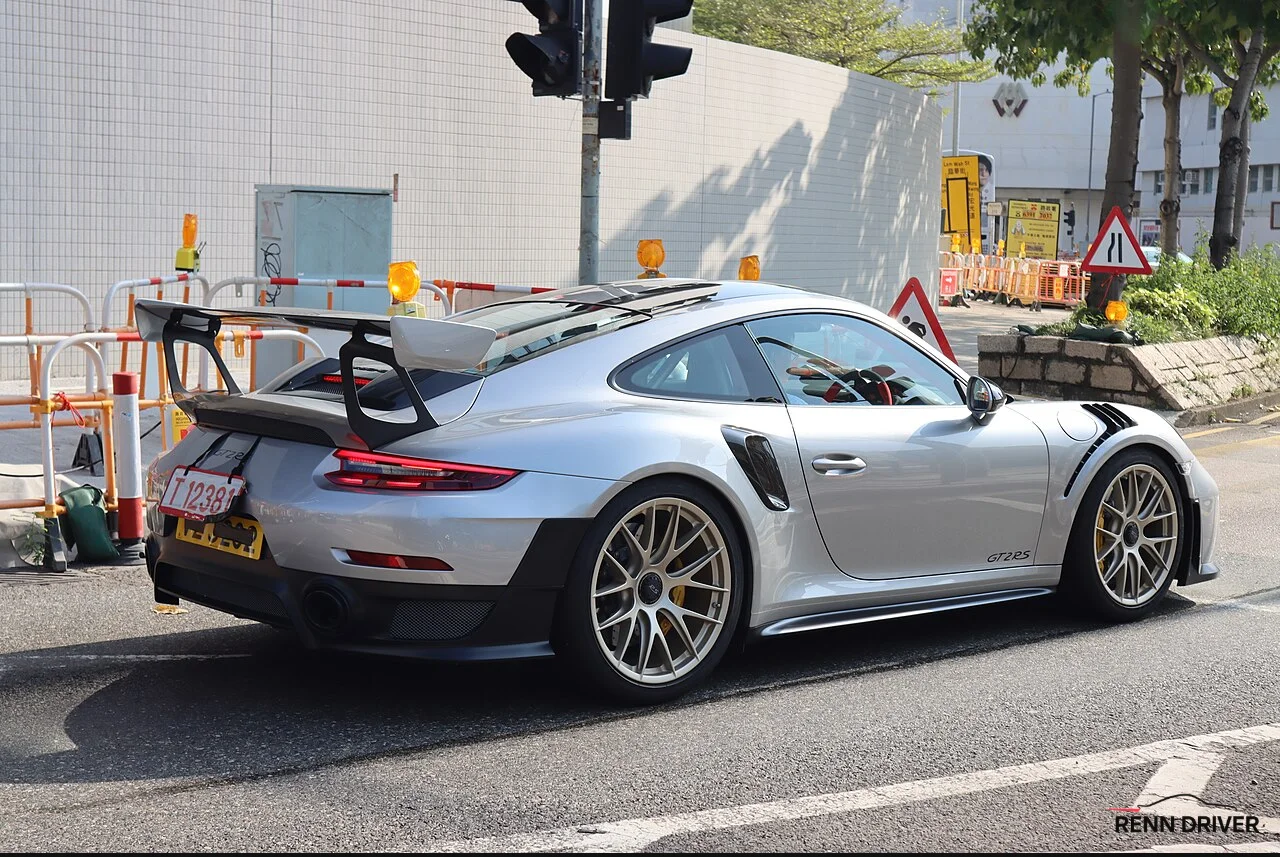
The Porsche 991 GT2 RS (2017 to 2019) is the only GT2 variant of the 991 generation. There was no standard GT2. The RS produces 700 hp from a 3.8L twin-turbo flat-six, sends power exclusively to the rear wheels through a seven-speed PDK, and set a Nürburgring lap record of 6:47.3. About 1,000 units were produced at an MSRP of roughly $293,200. Current market values sit between $400,000 and $600,000 or more.
Contents
- 1 Quick Summary
- 2 History and Context
- 3 Engine and Powertrain
- 4 PDK Only: The Manual Question
- 5 Design and Aero
- 6 The Weissach Package
- 7 Nürburgring Record
- 8 991 GT2 RS vs 997 GT2 RS
- 9 Driving Experience
- 10 Maintenance and Ownership
- 11 Market Values
- 12 Renn Driver's Take
- 13 FAQs
- 14 Final Thoughts
The full guide below covers all the details.
Quick Summary
- Production years: 2017 to 2019
- Generation: 991.2
- Engine: 3.8L twin-turbo flat-six
- Power: 700 hp (515 kW), 553 lb-ft (750 Nm)
- Transmission: 7-speed PDK (no manual option)
- Drive: Rear-wheel drive
- 0 to 60 mph: 2.7 seconds
- Top speed: 211 mph (340 km/h)
- Weight: ~3,241 lbs (1,470 kg)
- Nürburgring lap time: 6:47.3
- Production: ~1,000 units
- MSRP: ~$293,200
History and Context
Porsche skipped the standard GT2 for the 991 generation entirely. When the GT2 badge returned, it came back as the RS and nothing else. That decision tells you everything about where Porsche's motorsport division was heading.
The 997 GT2 RS had been a 620 hp, manual-only, rear-wheel-drive weapon limited to 500 units. For the 991, Porsche's GT division wanted to go further. The result was 700 hp, PDK only, and a car designed from the ground up to set lap records.
It debuted at the 2017 Goodwood Festival of Speed, revealed by Mark Webber. Before most buyers had even placed orders, the car had already posted a 6:47.3 at the Nürburgring Nordschleife, beating hypercars that cost three times as much.
The 991 GT2 RS was built alongside the 991 Turbo S at Porsche's Zuffenhausen plant, but shared very little with that car beyond the basic engine architecture. Everything from the cooling system to the chassis tuning was specific to the GT2 RS.
Engine and Powertrain
The 3.8L twin-turbo flat-six in the 991 GT2 RS is based on the 991.2 Turbo S engine but heavily reworked. Porsche fitted larger turbochargers, revised the intake and exhaust systems, increased boost pressure, and added water spray intercooling. The result is 700 hp at 7,000 rpm and 553 lb-ft of torque available from 2,500 to 4,500 rpm.
The water spray system is a direct motorsport adaptation. Small nozzles spray water onto the intercoolers under sustained high load, dropping intake temperatures and maintaining consistent power output during track sessions. A separate reservoir holds the water supply.
| Specification | 991 GT2 RS |
|---|---|
| Engine | 3.8L twin-turbo flat-six |
| Power | 700 hp @ 7,000 rpm |
| Torque | 553 lb-ft @ 2,500-4,500 rpm |
| 0 to 60 mph | 2.7 seconds |
| 0 to 124 mph | 8.3 seconds |
| Top speed | 211 mph (340 km/h) |
| Weight (Weissach) | ~3,175 lbs (1,440 kg) |
| Power to weight | 4.63 lbs per hp |
The exhaust uses titanium rear silencers, saving roughly 15 lbs over the standard steel units. The exhaust note is deeper and more aggressive than the Turbo S, with the characteristic GT2 RS bark on downshifts.
PDK Only: The Manual Question
The 991 GT2 RS is the first GT2 variant in Porsche history that was never offered with a manual transmission. Every previous GT2, from the 993 GT2 through the 997 GT2 RS, came with a manual gearbox.
Porsche's reasoning was straightforward. The seven-speed PDK shifts faster than any human can manage a clutch pedal. For a car designed to set lap records, the PDK was the objectively faster choice. The GT division also argued that managing 700 hp through the rear wheels already demanded full attention from the driver. Adding a clutch pedal would have introduced another variable in situations where a fraction of a second matters.
Enthusiasts debated this endlessly. Some felt it betrayed the analog, driver-focused character of the GT2 lineage. Others accepted that the PDK was the right tool for the job. The lap times speak for themselves.
Design and Aero
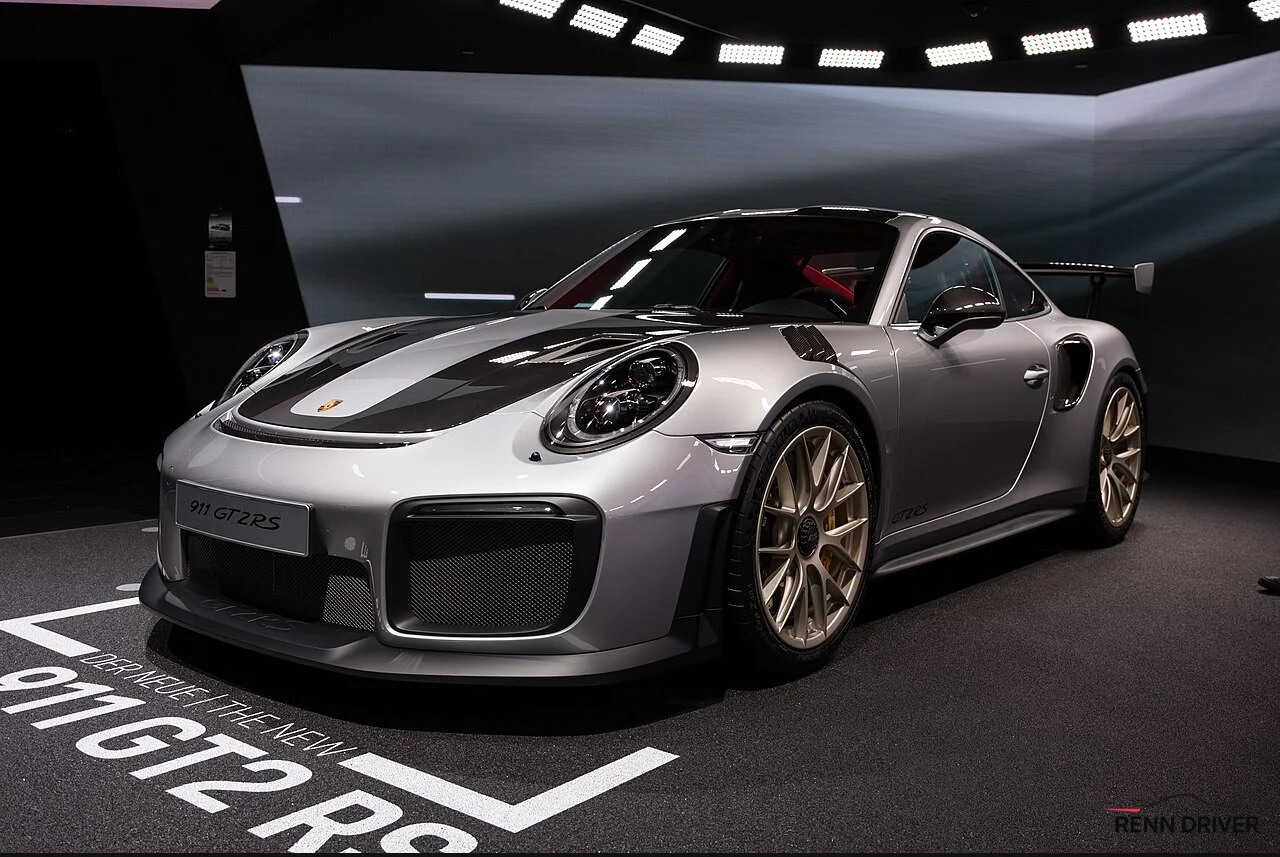
The 991 GT2 RS wears the Turbo wide body but replaces the front end entirely. Carbon fiber reinforced plastic is used for the hood, front fenders, roof, and rear engine cover. The front bumper features massive air intakes for turbo and brake cooling, along with a carbon fiber front splitter.
The fixed rear wing is the largest ever fitted to a road-going 911. It generates significant downforce and includes a manually adjustable Gurney flap for fine-tuning on track. The rear diffuser works with the wing to manage airflow under the car.
NACA ducts on the front fenders extract air from the wheel wells, reducing front-axle lift. Every body panel modification serves an aerodynamic purpose. Porsche claims the complete aero package generates substantially more downforce than the 991 Turbo S at the same speed.
The carbon fiber construction is extensive. The hood alone saves roughly 20 lbs over the steel Turbo S equivalent. The roof panel is also carbon, reducing the car's center of gravity.
The Weissach Package
Named after Porsche's development center in Weissach, Germany, this optional package strips approximately 40 lbs from the standard GT2 RS. The savings come from magnesium wheels, a carbon fiber anti-roll bar, carbon fiber roof panel, and additional carbon trim throughout the interior.
The Weissach Package also adds a titanium roll cage behind the rear seats. The cage serves both as a structural reinforcement and a weight-saving measure compared to a conventional steel cage.
Most buyers specified the Weissach Package. It adds roughly $18,000 to the base price but is essentially required for maximum track performance. Resale data shows that Weissach-equipped cars command a meaningful premium on the secondary market.
Nürburgring Record
The 991 GT2 RS set a Nürburgring Nordschleife lap time of 6:47.3 in September 2017, driven by Porsche test driver Lars Kern. At the time, it was the fastest production car lap ever recorded on the 20.6 km circuit.
That time beat the Lamborghini Huracán Performante (6:52.01), which had held the record for just five months. It also undercut the lap times of cars like the Porsche 918 Spyder, which managed 6:57 with hybrid assistance and all-wheel drive.
In 2021, a GT2 RS equipped with the Manthey Performance Kit lowered that time to 6:43.3. The Manthey kit adds revised aerodynamics, adjustable coilover suspension, upgraded brake pads, and an additional intercooler water reservoir. These are bolt-on parts available through Porsche Centers, not a re-engineered car. The fact that bolt-on modifications could shave four seconds off an already record-setting time speaks to the potential built into the platform.
991 GT2 RS vs 997 GT2 RS
| 997 GT2 RS | 991 GT2 RS | |
|---|---|---|
| Power | 620 hp | 700 hp |
| Torque | 516 lb-ft | 553 lb-ft |
| Transmission | 6-speed manual | 7-speed PDK |
| 0 to 60 mph | 3.4 s | 2.7 s |
| Top speed | 205 mph | 211 mph |
| Nürburgring time | 7:18 | 6:47.3 |
| Weight | ~2,998 lbs | ~3,241 lbs |
| Rear-axle steering | No | Yes |
| Production | 500 | ~1,000 |
The 997 GT2 RS is lighter and offers a manual gearbox. The 991 GT2 RS is faster by every measurable metric. They represent two fundamentally different philosophies within the same lineage. The 997 is the last analog GT2. The 991 is the first digital one.
Driving Experience
The 991 GT2 RS delivers its 700 hp with surprising linearity for a twin-turbo car. Boost builds progressively from around 2,500 rpm, and the power curve stays flat through the upper rev range. There is no sudden spike of torque, just relentless acceleration that pins you into the seat and keeps building.
The rear-axle steering transforms how the car handles at different speeds. At low speeds, the rear wheels turn opposite to the fronts, effectively shortening the wheelbase for sharper turn-in. At higher speeds, the rear wheels steer with the fronts, adding stability during fast direction changes.
On track, the car rewards precision. The rear end will rotate under power, but the chassis communicates clearly before it reaches the limit. The PSM (Porsche Stability Management) system can be set to a relaxed Sport mode or switched off entirely. In full-off mode, the car demands respect. 700 hp through rear wheels on a car with this power-to-weight ratio leaves no room for lazy inputs.
The PDK shifts with zero delay. Under full acceleration, upshifts are seamless. On downshifts, the system blips the throttle perfectly and stacks gears as fast as the paddles can be pulled. The absence of a clutch pedal becomes irrelevant once the car is moving.
Maintenance and Ownership
The 991 GT2 RS uses the same basic engine architecture as the 991 Turbo S. Porsche's twin-turbo flat-six is well proven and durable when properly maintained.
Key ownership considerations:
- PCCB ceramic brakes: Standard equipment. Rotor replacement runs $8,000 to $12,000 per axle. Pads are $2,000 to $3,000 per set. With proper pad selection, the rotors can last 50,000 miles or more on the street
- Tires: Michelin Pilot Sport Cup 2 tires are semi-slick and wear quickly on track. A set of four runs approximately $2,000
- Water spray system: The intercooler water reservoir needs to be refilled before track sessions. The system is simple and reliable
- PDK service: Fluid and filter changes at recommended intervals are critical. Budget $1,500 to $2,500 for PDK service
- Annual maintenance: Expect $4,000 to $8,000 per year depending on usage and whether the car sees track time
Track-driven examples need closer inspection. Check for curbed wheels, worn rotors, and any signs of hard contact. A pre-purchase inspection at a Porsche-certified facility is essential at this price point.
Market Values
The 991 GT2 RS launched at roughly $293,200 before options. Most were heavily optioned, with Weissach Package cars running over $330,000 before taxes.
Current market values range from $400,000 for higher-mileage standard cars to $600,000 or more for low-mileage Weissach-equipped examples. Paint-to-sample colors and desirable specifications push values further. A handful of delivery-mileage cars have traded above $700,000.
The market for 991 GT2 RS cars is strong because the car sits at an intersection of several collector preferences: limited production, record-setting performance, rear-wheel drive, and the last generation of the 991 platform. The generation it belongs to is increasingly viewed as the last 911 with a purely analog steering feel, which adds to its long-term collectibility.
Renn Driver's Take
I have not driven this car yet, but I will update this section once I do.
Frequently Asked Questions
How much horsepower does the 991 GT2 RS have?
The Porsche 991 GT2 RS produces 700 hp from its 3.8L twin-turbo flat-six engine, making it the most powerful road-going 911 ever produced.
Is there a standard 991 GT2 without the RS?
No, Porsche did not produce a standard GT2 for the 991 generation. The only GT2 variant offered was the GT2 RS.
Does the 991 GT2 RS come with a manual transmission?
No, the Porsche 991 GT2 RS is available exclusively with a seven-speed PDK dual-clutch transmission. It is the first GT2 in Porsche history without a manual option.
How many 991 GT2 RS cars were made?
Porsche produced approximately 1,000 units of the 991 GT2 RS worldwide.
What is the Nürburgring lap time for the 991 GT2 RS?
The Porsche 991 GT2 RS set a Nürburgring Nordschleife lap time of 6:47.3 in 2017. With the Manthey Performance Kit installed, the time was reduced to 6:43.3 in 2021.
How much does a 991 GT2 RS cost today?
A Porsche 991 GT2 RS currently sells for $400,000 to $600,000 depending on mileage, options, and condition. Weissach Package cars and low-mileage examples command the highest prices.
What is the Weissach Package on the 991 GT2 RS?
The Weissach Package on the Porsche 991 GT2 RS is an optional lightweight package that removes approximately 40 lbs through magnesium wheels, a carbon fiber anti-roll bar, titanium roll cage, and additional carbon body panels.
Final Thoughts
The 991 GT2 RS represents a turning point in the GT2 lineage. It abandoned the manual gearbox, doubled down on technology, and delivered performance numbers that embarrassed cars costing twice as much. Whether that trade-off was worth it depends on what you want from a GT2.
If you want the raw, unfiltered, manual-gearbox GT2 experience, the previous-generation GT2 RS is the car. If you want the fastest, most capable rear-wheel-drive 911 Porsche has ever built, the 991 GT2 RS stands alone.
Either way, the GT2 RS badge carries weight. The 991 earned it.
Images by: Contributors, licensed under CC BY-SA 4.0, via Wikimedia Commons