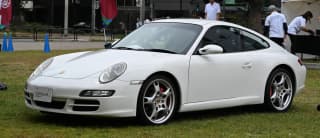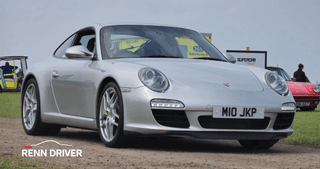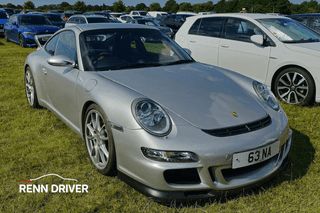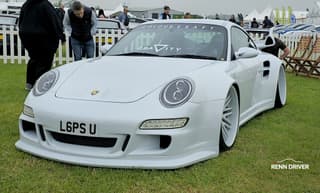
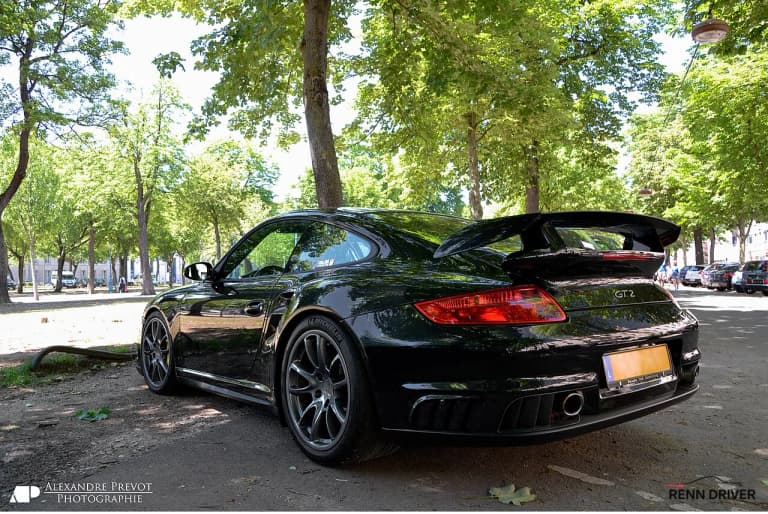
The Porsche 997 GT2 (2007 to 2012) makes 530 hp from a 3.6L twin turbo flat six. It is rear wheel drive with a six speed manual. The GT2 RS pushes output to 620 hp in a sub 3,000 lb package limited to 500 units. Both 911 GT2 variants represent the extreme end of what Porsche builds. Each 911 GT2 generation pushes the formula further. The 911 GT2 nameplate has meant one thing throughout its history: maximum output, rear-wheel drive, no safety nets.
In this article, we’ll explain the Porsche 997 GT2, the rear-drive twin-turbo 911 built from 2007 to 2012. We’ll cover its 530 hp engine, the GT2 RS, known issues, and market values.
Contents
- 1 Quick Summary
- 2 History, Engine, and the GT2 RS
- 2.1 Engine and Powertrain
- 2.2 The 911 GT2 RS
- 3 Design and Aero
- 4 911 GT2 vs 996 GT2
- 5 On the Road and Track
- 6 Maintenance and Known Issues
- 7 Market Values
- 8 FAQs
- 9 Final Thoughts
The full guide below covers all the details.
Quick Summary
- 911 GT2 production years: 2007-2009
- 911 GT2 RS production year: 2010-2012
- Engine: 3.6L twin-turbo flat-six
- 911 GT2 power: 530 hp (390 kW), 505 lb-ft (680 Nm)
- 911 GT2 RS power: 620 hp (456 kW), 516 lb-ft (700 Nm)
- Transmission: 6-speed manual only
- Drive: Rear-wheel drive
- 911 GT2 0-60 mph: 3.6 seconds
- 911 GT2 RS 0-60 mph: 3.4 seconds
- 911 GT2 top speed: 204 mph (329 km/h)
- 911 GT2 RS production: 500 units
History, Engine, and the GT2 RS
The original Widowmaker proved that a rear-wheel-drive, twin-turbo 911 without electronic aids had an audience. The 911 GT2 took that formula and refined it without softening it.
Porsche launched the 911 GT2 in 2007 with 530 hp, a significant jump from the 996 GT2's 462 hp. It still used a six-speed manual and rear-wheel drive, but this time Porsche added optional PCCB ceramic brakes, launch control, and optional stability control (PSM). The stability control system could be fully disabled for track use. The car was still raw, still demanding, and still earned the GT2 motorsport reputation. But it added features the 996 GT2 never had. Porsche Motorsport managed the 911 GT2 program throughout its production run. The motorsport division signed off on every engineering decision.
Then in 2010, Porsche released the GT2 RS. 620 hp. 500 units. Carbon fiber everywhere. It was the most powerful road-going 911 at the time and set a production car lap record at the Nürburgring.
Engine and Powertrain
The 911 GT2 uses a 3.6L twin-turbo flat-six based on the 997 Turbo engine. Porsche fitted larger turbochargers with variable turbine geometry (VTG), revised the intercoolers, retuned the engine management for higher boost pressure, and added features like launch control not available on the 996 GT2.
| 911 GT2 | 911 GT2 RS | |
|---|---|---|
| Power | 530 hp | 620 hp |
| Torque | 505 lb-ft | 516 lb-ft |
| 0-60 mph | 3.6 s | 3.4 s |
| Top speed | 204 mph | 205 mph |
| Weight | ~3,175 lbs | ~2,998 lbs |
| Transmission | 6-speed manual | 6-speed manual |
| Production | ~1,242 | 500 |
Both the GT2 and GT2 RS are manual only. No PDK was offered. The entire drivetrain sends power to the rear wheels through a motorsport-derived mechanical limited-slip differential. Porsche Motorsport developed the GT2 suspension setup from racing experience.
The 911 GT2 RS
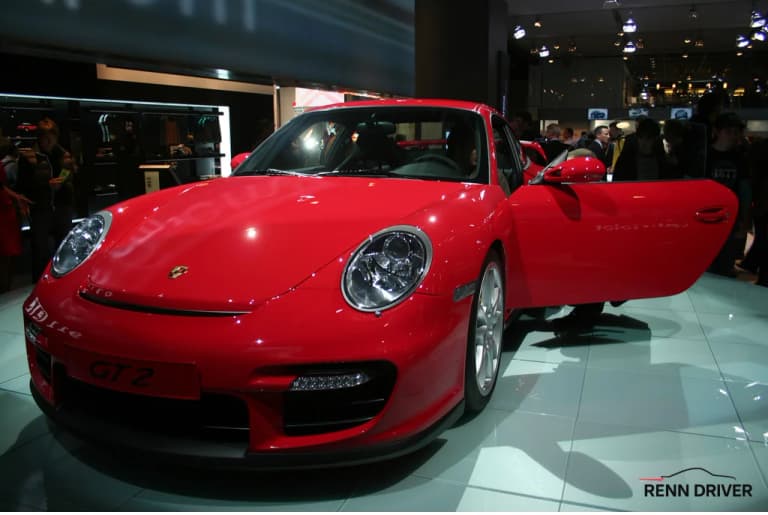
The GT2 RS model is the extreme version. Its weight reduction program is the most aggressive in the 997 lineup. Porsche added 90 hp over the standard GT2 through larger turbos, higher boost pressure, and revised exhaust. But the real story is weight reduction.
Carbon fiber front fenders with air extraction vents, trunk lid, engine cover, and interior trim. A titanium exhaust system saved further weight. Carbon-backed bucket seats with titanium roll cage fittings. Deleted air conditioning (available as a no-cost option to add back). The result is a car with a curb weight under 3,000 lbs while producing 620 hp. That weight figure, combined with 620 hp, gives it a power-to-weight ratio that rivals dedicated race cars. The weight saving over the standard 911 GT2 is approximately 80 kg.
Only 500 GT2 RS model units were built. All sold immediately. The car set a Nürburgring lap record of 7:18 when it launched, which was the fastest time for a production car at the time.
Design and Aero
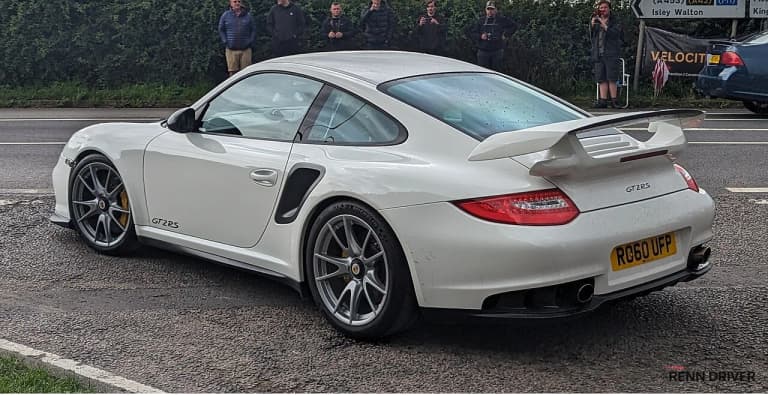
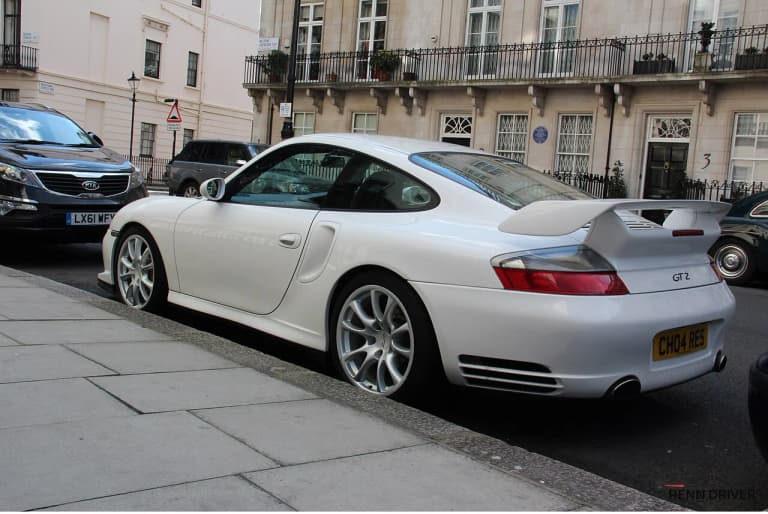
The 911 GT2 wears the 997 Turbo wide body with specific GT2 aero additions. The front bumper has larger air intakes for turbo intercooler cooling. Additional side air intakes on the rear fenders also route cool air directly to the engine. The fixed rear wing generates real downforce. NACA ducts on the rear fenders and additional side air intakes feed cool air to the brakes and intercoolers.
The GT2 RS adds carbon fiber front fenders with air extraction vents, a more aggressive front splitter, additional air intakes in the carbon fenders, and a revised rear diffuser. The RS wing sits higher and at a steeper angle than the standard GT2 wing.
Inside, the GT2 is a two-door focused cockpit with Alcantara surfaces, carbon fiber trim, and sport bucket seats. The door cards are stripped compared to the standard 997, and door-mounted storage is deleted on the RS. The GT2 RS strips this further with full carbon-shell racing seats. The door cards are bare carbon. The doors themselves are standard steel on the base GT2, carbon on the RS. Door pulls replace the standard padded handles. No rear shelf, no sound deadening. The door apertures are wide.
911 GT2 vs 996 GT2
| 996 GT2 | 911 GT2 | |
|---|---|---|
| Power | 462 hp | 530 hp |
| Traction control | None | Optional PSM stability control (fully disableable) |
| PCCB brakes | Not available | Optional |
| Launch control | No | Yes |
| RS version | Clubsport only | GT2 RS (620 hp) |
The 911 GT2 is the more capable car by every objective measure. The 996 GT2 is the more raw, unfiltered experience. Both are rear-wheel-drive, manual-only, twin-turbo 911s where managing traction is entirely the driver’s responsibility.
On the Road and Track
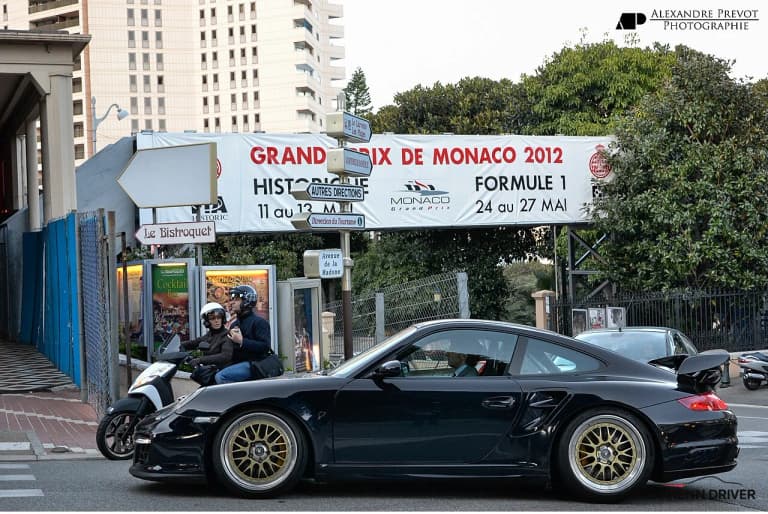
The 911 GT2 is fast in a way that feels relentless. The twin turbos build boost smoothly compared to the 996 GT2's more abrupt power delivery, but the output is so much higher that the car still demands complete attention.
On track, the combination of rear-wheel drive, 530 hp, and a relatively short wheelbase means the car rotates quickly under power. Corner exit requires progressive throttle application. Without traction aids, every input matters at the limit. With stability control disabled, the 911 GT2 is as raw as the 996. With stability control off, corner exit demands full attention. The optional PCCB brakes handle repeated hard stops without fade, which is a genuine improvement over the 996 GT2's standard iron brakes.
The GT2 RS amplifies everything. Traction from the rear tires is the limiting factor on exit. Managing traction at the limit requires experience. Most incidents happen not from lack of traction but from abrupt throttle inputs. The extra 90 hp and reduced weight make it noticeably more violent on corner exit. The lower weight, stiffer suspension, and revised aero keep the car more planted at high speeds, but the rear end is even more willing to rotate under power.
Maintenance and Known Issues
Like the 996 GT2, the 911 GT2 uses the Mezger engine. No IMS bearing concerns. The engine is durable and can handle high mileage with proper maintenance.
Common items to watch:
- Turbo wastegate actuators: Can develop play over time, affecting boost control
- Coolant pipes: Replace plastic pipes with aluminum at first opportunity
- Clutch: Heavy track use accelerates clutch wear. Budget for replacement around 30,000 to 50,000 miles depending on use
- PCCB rotors: If equipped, ceramic rotors are expensive to replace ($8,000+ per axle) but last a long time with proper pad selection
- Rear main seal: Some cars develop minor oil seepage at the rear main seal
Annual maintenance runs $3,000 to $6,000 depending on use and whether the car has ceramic brakes.
Market Values
The 911 GT2 has appreciated strongly. Standard GT2 model cars — the non-RS model — trade between $300,000 and $450,000 for clean, well-documented examples. The GT2 RS commands $600,000 to $900,000 depending on mileage and spec. Low-mileage, one-owner GT2 RS cars have crossed $1 million at auction.
Values for each model are driven by the same factors as the 996 GT2: Mezger engine, manual transmission, rear-wheel drive, limited production. The GT2 RS model adds the 500-unit production limit and its status as the most extreme road-legal 911 of its generation.
Frequently Asked Questions
How much horsepower does the Porsche 911 GT2 have?
The Porsche 911 GT2 produces 530 hp from its 3.6L twin-turbo flat-six. The GT2 RS version produces 620 hp.
How many Porsche 911 GT2 RS were made?
Porsche built exactly 500 units of the 911 GT2 RS.
Does the 911 GT2 have the IMS bearing issue?
No, the 911 GT2 does not have the IMS bearing issue. It uses the Mezger engine, which does not suffer from that problem.
Is the Porsche 911 GT2 rear-wheel drive?
Yes, the Porsche 911 GT2 is rear-wheel drive only. The 911 GT2 is rear-wheel drive only. Unlike the 911 Turbo, which uses all-wheel drive, the 911 GT2 keeps all the traction challenge entirely at the rear.
How much is a Porsche 911 GT2 worth?
A clean Porsche 911 GT2 sells for $300,000 to $450,000. The 911 GT2 RS sells for $600,000 to $900,000, with low-mileage examples exceeding $1 million.
Can you get a Porsche 911 GT2 with PDK?
No, the Porsche 911 GT2 only comes with a six-speed manual transmission. There is no PDK or automatic option.
What is the top speed of the Porsche 911 GT2?
The top speed of the Porsche 911 GT2 is 204 mph (329 km/h). The GT2 RS reaches 205 mph.
Final Thoughts
The 911 GT2 sits in the middle of the GT2 lineage. It is more refined than the previous generation but still analog enough to feel dangerous. The optional stability control and PCCB brakes give it a safety margin that the 996 GT2 never had, but you can switch the stability control off and get the same raw experience. The stability control system is the key difference between this generation and the 996 GT2, which had no stability control at all.
The GT2 RS is another level entirely. 620 hp, under 3,000 lbs, manual only, rear-wheel drive. It is a model that makes you question whether Porsche's engineers were being brave or reckless. The answer is both.
As an investment, both the GT2 and GT2 RS are solidly into blue-chip territory. The combination of Mezger engine, manual gearbox, and limited production means values are unlikely to decline. The next-generation GT2 RS is faster, but the 911 GT2 RS is rarer and more raw.
Images by: Alexandre Prévot, Artaxerxes, and others, licensed under CC BY-SA 2.0 and CC BY-SA 4.0, via Wikimedia Commons