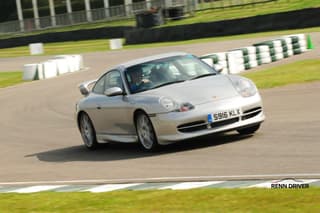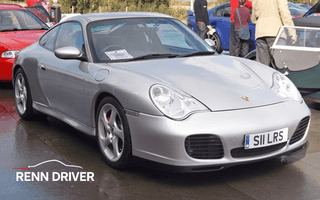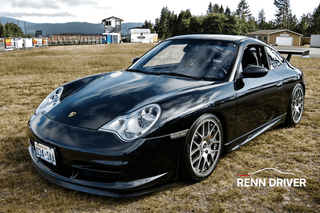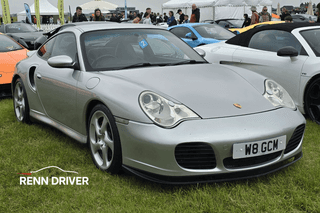
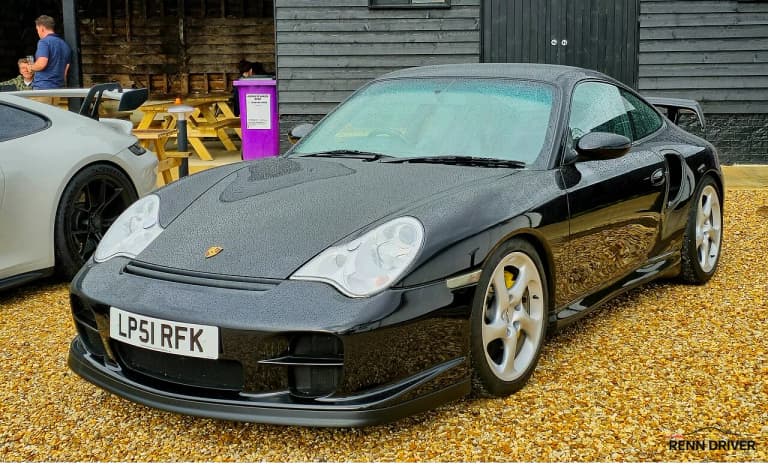
The Porsche 996 GT2 — officially the 911 GT2 — (2001 to 2003) makes 462 hp from a 3.6L twin turbo flat six. That configuration feeds power to the rear wheels only. It is rear wheel drive with a six speed manual and no traction or stability control. It earned the Widowmaker nickname for how quickly it could overwhelm an unprepared driver. Roughly 1,287 were built.
In this article, we'll examine the Porsche 996 GT2. We'll cover its history, turbo powertrain, and Widowmaker reputation.
Contents
- 1 Quick Summary
- 2 History, Engine, and the Widowmaker
- 2.1 Engine and Powertrain
- 2.2 The Widowmaker Reputation
- 3 Design and Aero
- 4 GT2 Clubsport
- 5 996 GT2 vs 996 Turbo
- 6 Maintenance and Known Issues
- 7 Market Values
- 8 FAQs
- 9 Final Thoughts
The full guide below covers all the details.
Quick Summary
- Production years: 2001-2003 (model years 2002-2004)
- Engine: 3.6L twin-turbo flat-six, 462 hp (340 kW), 457 lb-ft (620 Nm)
- Transmission: 6-speed manual only
- Drive: Rear-wheel drive (no AWD option)
- 0-60 mph: 4.0 seconds
- Top speed: 196 mph (315 km/h — fast enough for any public road)
- Weight: Approximately 3,175 lbs (1,440 kg)
- Production: Approximately 1,287 units
- Key feature: No traction control, no stability control, no AWD. Just boost and rear tires.
History, Engine, and the Widowmaker
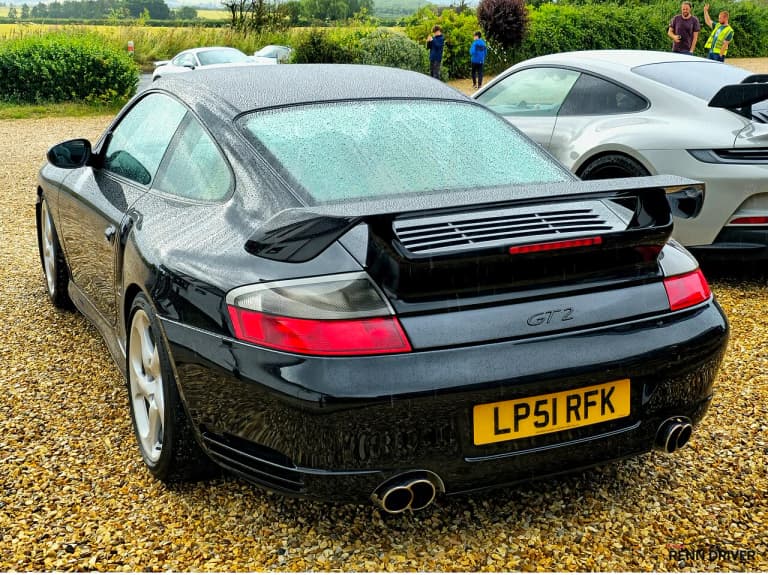
The GT2 nameplate goes back to the 993 generation, where Porsche built a stripped-out, rear-wheel-drive version of the 996 for homologation purposes. The 996 GT2 continued that formula: take the 996 Turbo, remove the all-wheel-drive system to make it rear wheel drive, remove the electronic safety nets, add more power, and see what happens.
What happened was among the most feared road cars of its era.
Porsche launched the 996 GT2 in 2001 as a limited-production model aimed at track-focused buyers who did not want a computer managing their throttle inputs. The 911 GT2 was the fastest and most expensive Porsche 911 you could buy at the time, and it required genuine skill to drive at its limits.
Engine and Powertrain
The 911 GT2 uses a modified version of the 996 Turbo's 3.6L flat-six with larger larger turbochargers and revised engine management. Output is 462 hp and 457 lb-ft of torque, compared to the Turbo's 415 hp.
All of that power goes through a six-speed manual gearbox to the rear wheels only. There is no PDK option. There is no automatic option. There is no all-wheel-drive option. You get a clutch pedal, a gear lever, and 462 hp aimed at two tires.
| Spec | Value |
|---|---|
| Displacement | 3.6 liters |
| Configuration | Flat-six, twin turbo |
| Power | 462 hp (340 kW) |
| Torque | 457 lb-ft (620 Nm) |
| Drive | Rear-wheel drive |
| Transmission | 6-speed manual |
| 0-60 mph | 4.0 seconds |
| Top speed | 196 mph (315 km/h) |
The Widowmaker Reputation
The 911 GT2 earned the Widowmaker nickname because of its combination of massive power, rear-wheel drive, and zero electronic intervention. There is no traction control. There is no stability management. There is no all-wheel-drive system to bail you out when the rear end steps out under boost.
The boost lag makes things worse. The car feels manageable at low revs, and then the power arrives in a rush. If you are mid-corner when that happens and your inputs are not precise, the rear end swings around before you can react.
Experienced drivers describe the 911 GT2 as underrated for how rewarding it is to drive fast once you understand its character. Inexperienced drivers describe it as terrifying. Both are correct.
Design and Aero
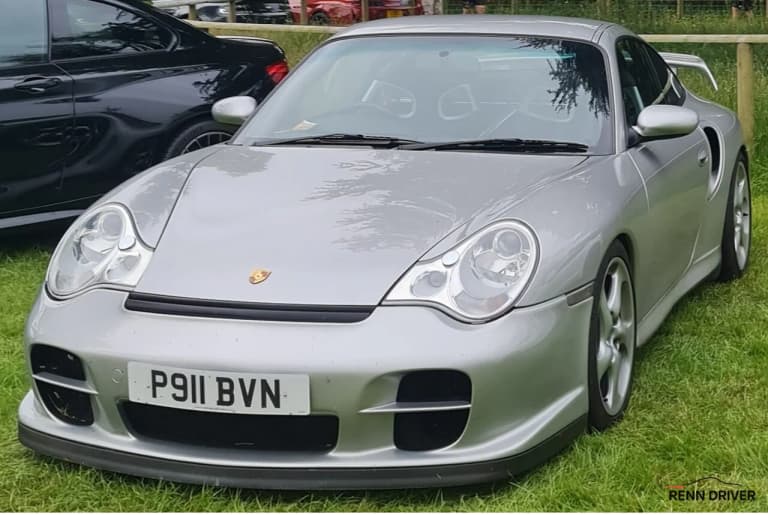
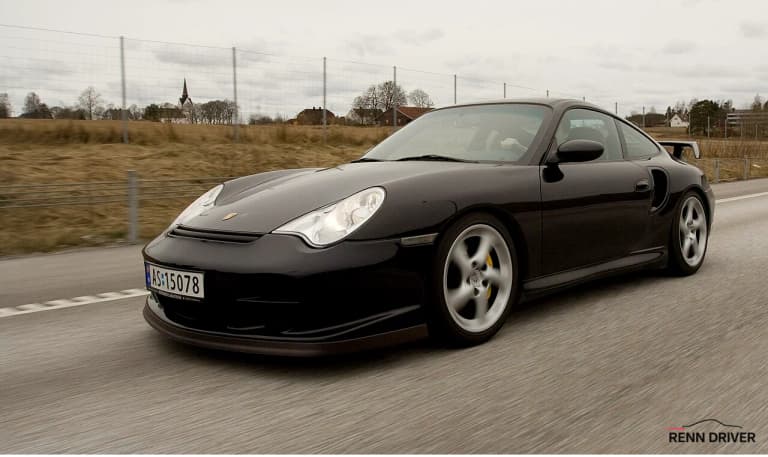
The 996 GT2 wears the Turbo's wide body but adds a more aggressive front bumper with additional cooling intakes, a fixed rear wing, and NACA ducts on the rear haunches for brake cooling, plus additional air intakes in the front bumper for intercooler airflow. These functional air intakes distinguish it visually from the standard 996 Turbo. The front and rear bumpers are carbon fiber, saving weight over the standard Turbo's units.
Inside, the GT2 gets a stripped-down interior compared to the 996 Turbo coupe. The rear seats are deleted, the sound insulation is reduced, and the carpeting is thinner. It is still a comfortable car by race car standards, but it is clear that Porsche prioritized weight reduction over luxury.
GT2 Clubsport
Porsche offered a Clubsport version of the 996 GT2 that deleted even more comfort equipment. The Clubsport gets a bolt-in roll cage, fire extinguisher, six-point harnesses, and further stripped interior. It was produced in very small numbers for customers who planned to use the car primarily on track.
Clubsport cars are now among the most collectible 996 variants. They rarely come up for sale, and when they do, they command a significant premium over the standard GT2.
996 GT2 vs 996 Turbo
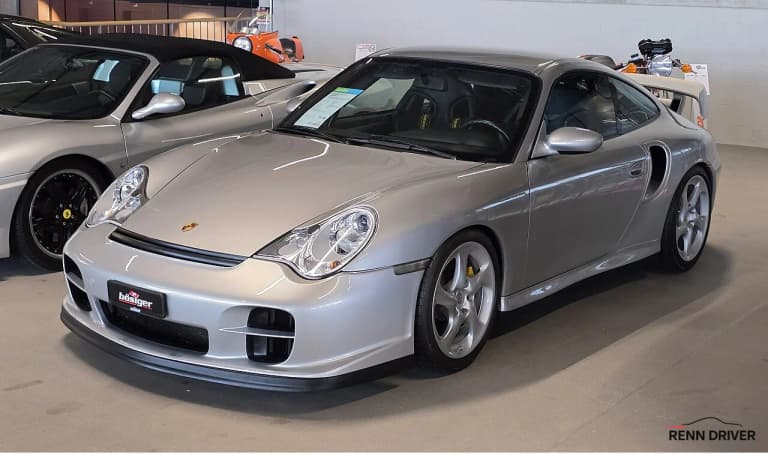
Both cars share the same basic engine and wide body, but they are fundamentally different cars.
| 996 Turbo | 996 GT2 | |
|---|---|---|
| Power | 415 hp | 462 hp |
| Drive | All-wheel drive | Rear-wheel drive |
| Traction control | Yes (PSM) | No |
| Rear seats | Yes | No |
| Weight | ~3,395 lbs | ~3,175 lbs |
| Production | ~20,000+ | ~1,287 |
| Character | Fast and safe | Fast and dangerous |
The 996 Turbo is the car you drive every day. The 996 GT2 is the car you respect every time you turn the key.
Maintenance and Known Issues
The 996 GT2 shares the Mezger engine with the 996 GT3 and 996 Turbo. This is the good news. The Mezger flat-six does not suffer from the IMS bearing failures that plague the standard base Carrera engines. It is among the most reliable engines Porsche has produced.
Common maintenance items:
- Turbocharger seals: Can develop oil leaks at high mileage. A full rebuild or replacement is expensive.
- Clutch: The single-mass flywheel and clutch wear faster on cars that see track use. Budget for a clutch replacement at 40,000 to 60,000 miles.
- Coolant pipes: Plastic coolant pipes can crack with age. Replace them with aluminum upgrades.
- Suspension bushings: Worn bushings affect handling precision. Factory bushings are soft and degrade over time.
Annual maintenance costs for a 996 GT2 run $3,000 to $5,000 depending on usage. Track use increases consumable costs significantly.
Market Values
The 996 GT2 was deeply underrated for years after production concluded. It is still underrated among the broader Porsche buying public — an underrated buy compared to how collectors who understand the car value it. It has appreciated significantly over the past decade, as buyers recognized that an underrated, no-aids GT car from this era is increasingly rare. Early cars that sold for $100,000 to $120,000 ten years ago now trade in the $250,000 to $350,000 range for clean examples. Low-mileage, well-documented cars can exceed $400,000. If you plan to buy a 996 GT2, prioritize documented service history and have a specialist inspect the turbochargers before you buy.
Clubsport versions command an additional premium of 30 to 50 percent over standard GT2 values. Paint-to-sample colors and documented service histories add further value.
As one of the last underrated, analog, no-electronics GT cars Porsche made, the 996 GT2 is likely to continue appreciating. Underrated classic cars like this with low production numbers and a motorsport lineage consistently outperform broader collector car markets. The combination of Mezger engine, manual transmission, rear-wheel drive, and no electronic aids is something Porsche will never build again.
Frequently Asked Questions
How much horsepower does the Porsche 911 GT2 have?
The Porsche 911 GT2 produces 462 hp from its 3.6L twin-turbo engine.
Does the 996 GT2 have the IMS bearing issue?
No, the 996 GT2 does not have the IMS bearing issue. It uses the Mezger engine, which is a completely different design from the M96 engine in the standard 996 Carrera. The Mezger is among the most reliable Porsche engines ever built.
How many Porsche 911 GT2s were made?
Porsche produced approximately 1,287 units of the 996 GT2 between 2001 and 2003.
Is the 996 GT2 rear-wheel drive or all-wheel drive?
It is rear wheel drive only. It does not have all-wheel drive. That is one of the key differences from the 996 Turbo, which is all-wheel drive.
Does the 996 GT2 have traction control?
No, the 996 GT2 does not have traction control or stability management. There are no electronic driving aids. This is the main reason it earned the Widowmaker nickname.
How much is a 996 GT2 worth today?
A clean Porsche 996 GT2 sells for $250,000 to $350,000 depending on mileage and condition. Low-mileage examples can exceed $400,000. Clubsport versions command an additional 30 to 50 percent premium.
Can you daily drive a 996 GT2?
Yes, you can daily drive a 996 GT2, but most owners choose not to. The lack of traction control and the aggressive throttle response make it more demanding in wet conditions or heavy traffic than a standard 996 Turbo.
Final Thoughts
The 911 GT2 is not the best-looking Porsche 911. It shares the controversial fried egg headlights that split the Porsche community for years. But none of that matters when you are behind the wheel.
The 911 GT2 is a car built for drivers who want the machine to get out of the way. No computers. No safety nets. Just twin turbo power, a manual gearbox, rear-wheel drive, and your ability to manage all of it.
The car that replaced it is faster in every measurable way. But it also has stability control, launch control, and PDK. The 996 GT2 has none of that. And for a certain kind of driver, that is exactly the point.
Images by: Various contributors, licensed under CC BY-SA 4.0 and CC BY-SA 2.0, via Wikimedia Commons