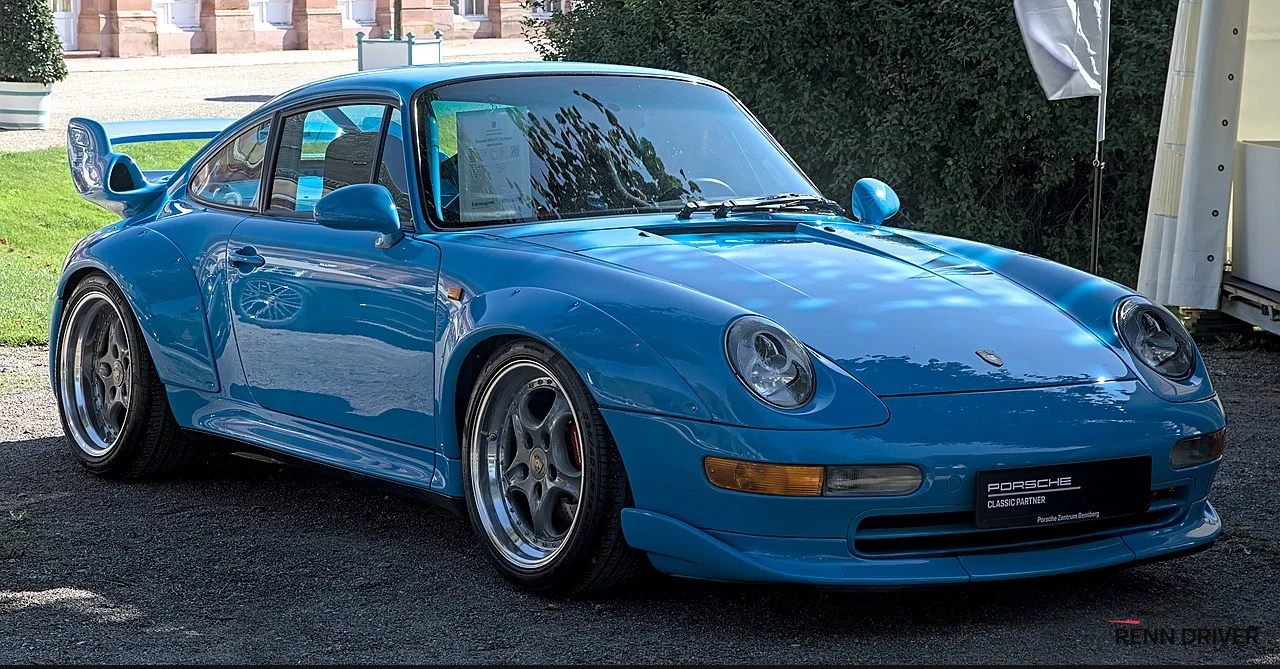
The Porsche 993 GT2 (1995 to 1998) is the original GT2. Built to homologate the 911 for FIA GT2 class racing, it takes the 993 Turbo, removes the all-wheel-drive system, strips weight, and adds power. The result is a twin-turbo, rear-wheel-drive 911 making 430 to 450 hp with no traction control. About 194 road cars were built alongside dedicated race versions. Values now exceed $1 million for clean examples.
Contents
- 1 Quick Summary
- 2 Racing Homologation: Why the 993 GT2 Exists
- 3 Engine and Powertrain
- 4 Design and Widebody
- 5 The Widowmaker Reputation
- 6 Road Car vs Race Car
- 7 993 GT2 Evo and Race Versions
- 8 Technical Specifications
- 9 Collectibility and Values
- 10 Renn Driver's Take
- 11 FAQs
- 12 Final Thoughts
The full guide below covers all the details.
Quick Summary
- Production years: 1995 to 1998
- Engine: 3.6L twin-turbo air-cooled flat-six
- Power: 430 hp (street), 450 hp (1998 revision), race versions up to 600 hp
- Transmission: 6-speed manual only
- Drive: Rear-wheel drive (no AWD option)
- 0 to 60 mph: 3.9 seconds
- Top speed: 189 mph (street version)
- Weight: Approximately 2,855 lbs (1,295 kg)
- Production: Approximately 194 road cars, plus race versions
- Values: $1 million and above
Racing Homologation: Why the 993 GT2 Exists
The 993 GT2 exists because of racing regulations. In the mid 1990s, the FIA ran a GT2 class in its international sports car racing series. To compete, manufacturers had to build a minimum number of road-legal versions of the car they wanted to race. This process is called homologation, and it is the reason some of the most extreme road cars in history exist.
Porsche wanted to race the 911 in the GT2 class. GT2 regulations required rear-wheel drive (all-wheel-drive was not permitted), and the cars had to be based on a production model. Porsche started with the 993 Turbo, stripped the all-wheel-drive system, increased power, reduced weight, and widened the body to fit larger tires and improved cooling. The result was the 993 GT2.
The 993 generation was already the most refined air-cooled 911. The GT2 took that refinement and threw most of it away in favor of raw performance. Air conditioning, sound insulation, rear seats, and most comfort features were deleted. The car was built for one purpose: to qualify for racing.
Engine and Powertrain
The 993 GT2 uses a modified version of the 993 Turbo's 3.6L twin-turbo flat-six. Larger KKK turbochargers, revised boost mapping, and modified intake and exhaust systems lift output to 430 hp and 398 lb-ft of torque. The 1998 revision bumped power to 450 hp with further turbo and management changes.
All of that power goes through a six-speed manual gearbox to the rear wheels only. There is no automatic option. There is no all-wheel-drive system. The front differential and driveshaft from the Turbo are completely removed, which saves approximately 110 lbs and shifts the weight distribution rearward.
The engine is a close relative of the Mezger design, and it is fundamentally robust. These engines can handle significant power increases with supporting modifications. Race versions of the 993 GT2 engine produced over 600 hp with upgraded turbochargers and engine internals.
The turbo response on the 993 GT2 is aggressive. Unlike the Turbo's more refined power delivery, the GT2 has a pronounced surge when the boost arrives. This is intentional. The car was designed for drivers who understood how to manage turbo power, not for those expecting a smooth and predictable throttle response.
Design and Widebody
The 993 GT2 wears a widebody that goes beyond even the 993 Turbo's already wide stance. The front and rear fenders are extended with bolt-on fiberglass flares that accommodate wider tires. At the front, the bumper has additional cooling intakes, and the headlight washers are deleted to save weight.
At the rear, a large bi-plane wing sits above the engine lid, providing downforce at high speeds. This wing is functional, not decorative. The upper element is adjustable to tune the car's aerodynamic balance for different circuits. Below the rear bumper, a mesh-covered opening allows heat to escape from the engine bay.
The overall visual effect is a car that looks wider, lower, and more aggressive than the Turbo. The widebody flares, the wing, and the stripped-out details (no fog lights, no rear wiper, no comfort items visible through the windows) all signal that this is a race car with license plates.
Inside, the 993 GT2 is spartan. The standard car has lightweight bucket seats, a roll cage (on Clubsport versions), minimal carpet, and a fire extinguisher. The dashboard and instrument cluster are carried over from the 993 Turbo, but the rest of the interior is stripped to save weight. Door cards are thin panels with simple pull straps instead of full door handles.
The Widowmaker Reputation
The 993 GT2 is where the Widowmaker nickname originated. The combination of 430 hp, rear-wheel drive, no traction control, no stability control, and aggressive turbo response created a car that could overwhelm an unprepared driver with terrifying speed.
The physics are straightforward. The engine sits behind the rear axle, which means there is significant weight over the driven wheels. This is good for traction under acceleration in a straight line. But when the car is turning and the driver applies throttle, the rear end can swing out with very little warning. Add turbo lag to the equation, where the car feels manageable at low boost and then the full 430 hp arrives in a rush, and you have a recipe for sudden and violent oversteer.
In GT2 class racing, the car earned a fearsome reputation. Several high-profile crashes reinforced the Widowmaker label. Experienced racing drivers could tame the car and exploit its tremendous speed, but it punished mistakes severely.
The Widowmaker name carried forward to the 996 GT2 and was later associated with the entire GT2 lineage, including the GT2 RS. But the 993 is where it started. This is the car that defined what a GT2 means in the Porsche world: maximum power, minimum safety net.
Road Car vs Race Car
Porsche built the 993 GT2 in two primary configurations: the road car (Strasse) and the race car (Rennversion). Understanding the difference matters because it affects values, usability, and what you are actually buying.
The road car (sometimes called GT2 Strasse or GT2 Street) is the homologation version. It has a VIN, is registered for road use, and meets emissions and safety requirements. It still has a heater, windshield wipers, and functioning lights. It is spartan but livable. About 57 of the initial road cars were produced, with additional street-legal cars built in subsequent years, bringing the total road car production to approximately 194 units.
The race car (GT2 Rennversion, also called GT2 R or GT2 Evo depending on specification) is a competition-only vehicle. It has a full welded roll cage, racing seat with six-point harness, fire suppression system, and no road-legal equipment. The engine is tuned to higher boost levels with race fuel, producing over 500 hp. Race cars wear different bodywork with additional cooling ducts and a more aggressive aerodynamic package.
993 GT2 Evo and Race Versions
The 993 GT2 Evo was a further development of the race car, introduced in 1996 for the updated BPR Global GT Series regulations. It featured revised bodywork with even wider fenders, a larger rear wing, and further engine development pushing output toward 600 hp.
The GT2 Evo dominated the GT2 class in international competition. Teams like Roock Racing, Champion Racing, and Stadler Motorsport campaigned the car with success at events including the 24 Hours of Le Mans, the 24 Hours of Daytona, and the BPR series.
At Le Mans, the 993 GT2 competed against purpose-built race cars and proved competitive thanks to its reliability and straight-line speed. The twin-turbo flat-six could be tuned for different circuits, giving teams flexibility in how they set up the car for each event.
Race-specification 993 GT2s are exceptionally rare and seldom come up for sale. When they do, they command prices well above the road cars because of their competition history and extreme rarity.
Technical Specifications
| Spec | 993 GT2 (Street) | 993 GT2 Evo (Race) |
|---|---|---|
| Engine | 3.6L twin-turbo flat-six | 3.6L twin-turbo flat-six |
| Power | 430 hp (450 hp from 1998) | 550 to 600+ hp |
| Torque | 398 lb-ft | Varies by tune |
| Weight | 2,855 lbs (1,295 kg) | ~2,535 lbs (1,150 kg) |
| Drive | Rear-wheel drive | Rear-wheel drive |
| Transmission | 6-speed manual | 6-speed sequential or manual |
| 0 to 60 mph | 3.9 seconds | ~3.3 seconds |
| Top speed | 189 mph | Varies (gear-ratio dependent) |
| Traction control | No | No |
| Production | ~194 units | ~20 to 30 units (estimated) |
Collectibility and Values
The 993 GT2 is one of the most valuable production 911s ever made. As of 2026, clean road car examples trade between $1 million and $1.8 million depending on specification, color, mileage, and provenance. Cars with documented history and low mileage sit at the top of that range.
Several factors drive these values:
- Rarity: Only about 194 road cars were built. That makes the 993 GT2 far rarer than the 993 Turbo (roughly 6,000 units) or the 993 Turbo S (345 units).
- Last air-cooled GT car: The 993 GT2 is the final air-cooled competition-derived 911. Air-cooled Porsches command a market premium, and the GT2 sits at the top of that hierarchy.
- Racing pedigree: The 993 GT2 was a genuine race car homologated for road use, not a road car with racing accessories. This distinction matters to collectors.
- The Widowmaker legacy: The reputation adds to the car's mystique and desirability. Collectors want the car that started the legend.
Race-specification cars with documented competition history can exceed $2 million. A 993 GT2 Evo with Le Mans provenance would be in a different pricing category entirely.
The 993 GT2 has appreciated strongly over the past decade and shows no signs of slowing down. As air-cooled Porsches continue to attract collector interest and the number of available cars shrinks, values are likely to remain firm.
Renn Driver's Take
I have not driven this car yet, but I will update this section once I do.
Frequently Asked Questions
How much horsepower does the 993 GT2 have?
The Porsche 993 GT2 road car produces 430 hp from its 3.6L twin-turbo flat-six. The 1998 revision increased output to 450 hp. Race versions produced 550 to 600 hp or more depending on the tune.
How many 993 GT2s were made?
Porsche built approximately 194 road-legal 993 GT2s between 1995 and 1998. Additional race-only versions (GT2 R and GT2 Evo) were produced in smaller numbers for competition teams.
Why is the 993 GT2 called the Widowmaker?
The Porsche 993 GT2 earned the Widowmaker nickname because it combines 430 hp with rear-wheel drive, no traction control, no stability control, and aggressive turbo response. The sudden arrival of boost mid-corner could cause violent oversteer that caught unprepared drivers off guard. Several high-profile racing incidents reinforced the reputation.
Is the 993 GT2 rear-wheel drive or all-wheel drive?
It is rear-wheel drive only. The all-wheel-drive system from the 993 Turbo was removed entirely to meet FIA GT2 class racing regulations and to reduce weight.
How much is a 993 GT2 worth?
A clean Porsche 993 GT2 road car sells for $1 million to $1.8 million depending on condition, mileage, and provenance. Race cars with documented competition history can exceed $2 million.
What is the difference between the 993 GT2 and 993 Turbo?
The Porsche 993 GT2 differs from the 993 Turbo in several key ways: it is rear-wheel drive (Turbo is AWD), it has more power (430 to 450 hp vs 408 hp), it is lighter (by approximately 110 lbs from AWD deletion plus weight reduction), it has widebody flares and a large rear wing, and it has no traction control or comfort features.
Final Thoughts
The 993 GT2 is one of the most important cars Porsche has ever built. It established the GT2 nameplate, created the Widowmaker reputation, and proved that Porsche could build a road car capable of winning international GT races straight off the factory floor.
Everything that followed, from the water-cooled successor to the modern GT2 RS, traces its lineage directly back to this car. The formula has been refined, the electronics have been added, and the power has nearly doubled. But the core idea remains the same: take the Turbo, remove the safety nets, and build the most extreme road-legal 911 possible.
The final air-cooled 911 generation already holds a special place in Porsche history. The GT2 sits at the absolute peak of that generation. It is the rarest, the most powerful, and the most feared car to wear the 993 badge. For collectors and enthusiasts who understand what it represents, the 993 GT2 is not just a car. It is the car that started a legend.
Image: Renn Driver