The Taycan is the better pick if you charge at home and want that instant electric shove. The Panamera is the better pick if you cover long distances and want a gas stop instead of a charging stop. They’re priced within about a thousand dollars of each other, at $111,900 and $113,000 before fees, so the real decision comes down to how and where you drive.
In this article, we’ll compare the Porsche Panamera and Taycan. We’ll cover performance, range and charging, practicality, and everyday usability to help you choose the right one.
Contents
Quick Summary
- Starting Price: $113,000 for the base Panamera; $111,900 for the base Taycan, before destination fees.
- Powertrain: 2.9-liter twin-turbo V6 in the Panamera; rear electric motor in the Taycan.
- Power Output: 348 hp in the Panamera; up to 429 hp in the Taycan.
- Performance: 0-60 mph in 5.0 seconds for the Panamera; 4.5 seconds for the Taycan with Launch Control.
- Top Speed: 169 mph for the Panamera; 143 mph for the Taycan.
- EPA Range: 498 miles for the Panamera; 274 miles for the Taycan.
- Best Fit: Taycan for reliable home charging and quick daily response; Panamera for frequent long trips and fast refueling.
Powertrain and Driving Character
The Panamera and Taycan wear a similar fastback shape, but what’s under them couldn’t be more different. One runs a turbocharged V6 through an eight-speed gearbox, the other sends power through an electric motor and a two-speed rear transmission.
Panamera Engine and Performance
The base Panamera runs a 2.9-liter twin-turbo V6 making 348 horsepower and 368 lb-ft of torque, paired with an 8-speed PDK dual-clutch transmission. Porsche’s US Panamera page puts the 0-60 sprint at about 5.0 seconds and the top speed at 169 mph. The base car sends that power to the rear wheels only; every other Panamera trim uses Porsche’s all-wheel-drive Traction Management system instead.
If you want some electric driving without going fully electric, the Panamera E-Hybrid range covers that middle ground. Those cars sit outside the base-model numbers used here.
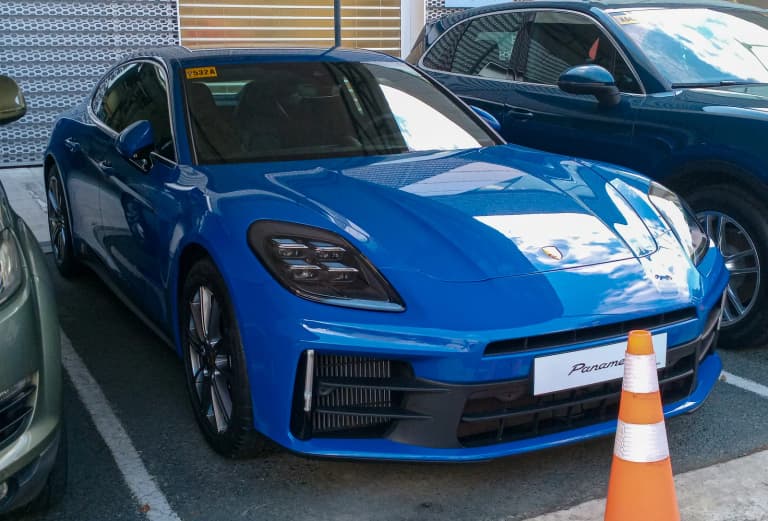
Adaptive air suspension with PASM comes standard here, so it’s already built into the price.
Taycan Motors and Performance
The base Taycan’s rear electric motor makes up to 429 horsepower and routes it through a two-speed rear transmission, according to Porsche’s US Taycan page. Hit Launch Control and it reaches 60 mph in about 4.5 seconds, quicker off the line than the Panamera, even though its 143 mph top speed trails the Panamera’s.
PASM adaptive air suspension is standard here as well. The Taycan delivers its power instantly, while the Panamera builds speed through revs and gears from its turbo six. That difference will shape the drive more than the equipment list.
Range, Charging, and Road Trips
If you regularly travel beyond your home charging radius, start here. Range and refueling will affect your ownership experience far more often than a quicker sprint to 60 mph.
Taycan Range and Charging Speed
The EPA rates the base Taycan with the Performance Battery at 274 miles of range and 91 MPGe combined for the 2026 model year. Other Taycan variants on the same results page stretch from 252 to 315 miles, since battery size, drivetrain, and wheel choice all move that number around.
Fast charging helps close the gap. Porsche’s newsroom lists a lineup maximum of 320 kW at a suitable 800-volt DC charger, with a 10 to 80 percent charge taking about 18 minutes under ideal conditions. Treat that as a best-case number for the right charger and battery combination. Real-world charging stops will vary.
Panamera Range and Refueling
The base Panamera is EPA-rated at 21 mpg combined (18 city, 25 highway) on premium gasoline. Its listed range is 498 miles, nearly double the base Taycan’s figure. Refueling takes a few minutes at any gas station, with no charger required. That advantage is most useful if you regularly drive long distances or cannot charge reliably at home.
Space, Comfort, and Daily Practicality
The Panamera technical data lists it at 198.8 inches long on a 116.1-inch wheelbase. The Taycan technical data lists 195.4 inches and 114.2 inches, so the Panamera has about 3.4 inches on it while both keep that low fastback roofline.
Cargo tells a similar story. Porsche lists 17.6 cubic feet behind the Panamera’s rear seats, growing to 46.8 cubic feet with them folded down. The Taycan splits its storage instead: 14.4 cubic feet in the rear plus a 3.0-cubic-foot front trunk. The Panamera’s single, larger compartment is easier to load with anything bulky, while the Taycan’s front trunk is handy for smaller bags you want to keep separate.
Both cars get adaptive air suspension with PASM as standard, so ride comfort starts from the same baseline. For how either fits against the rest of Porsche’s lineup, Renn Driver’s daily-driver guide covers the wider practicality picture.
Price and Running Costs
Porsche’s US model pages list the Panamera from $113,000 and the Taycan from $111,900, both before destination fees. That’s about a thousand dollars apart at the base trim, close enough that sticker price alone won’t decide this for most buyers.
Where they diverge is what you spend after the purchase. The Panamera runs on premium gas at 21 mpg combined, so its cost per mile tracks gas prices directly. The Taycan runs on electricity, and what you pay depends on your electricity rate and how much charging happens at home versus a public DC fast charger. Neither cost is fixed enough to promise a specific dollar savings without knowing your own rates.
Which One Fits Which Buyer
It mostly comes down to charging access and how you actually drive day to day.
If you’ve got reliable home or work charging and mostly stick to local or regional trips, the Taycan is the more rewarding daily drive. Its 4.5-second 0-60 time is the quicker launch of the two, and an 18-minute fast charge under ideal conditions keeps occasional longer trips manageable.
If you drive long distances often, live somewhere without consistent charging, or just like the certainty of a gas station, the Panamera is the easier car to own. Its 498-mile EPA range and few-minute refueling reduce the charging planning that becomes important when your regular routes do not include reliable charging.
What to Test Before You Decide
Take both cars over the same route if you can. Include slow traffic, a highway merge, and a stretch of rough pavement. That makes the difference between the Taycan’s instant response and the Panamera’s more traditional power delivery easier to feel, instead of judging either car from a short loop around the dealer.
Bring the people and gear you normally carry. Check rear-seat passenger space, how the cargo space works with your bags, and whether the driving position and controls feel natural after more than a few minutes. A family may value the Panamera’s single rear load area, while someone who packs lighter may prefer the Taycan’s separate front trunk.
For the Taycan, be honest about your charging routine before you sign. Map your home or work charging, then try a public fast charger on a route you actually use. The useful EV choice is the one whose charging stops fit your normal week and occasional longer trips.
Buying a Used Panamera or Taycan
Either car needs a documented service history, a specialist pre-purchase inspection, and a check for open recalls before you buy used. On a Taycan, make sure that inspection covers the high-voltage battery and charging system too. The Taycan model guide and Panamera model guide go deeper on generation-specific buying checks.
Panamera or Taycan: The Verdict
Neither one wins outright. They’re built around different questions: how you want power to arrive, and how you want to refuel.
| Choose this if… | Pick |
|---|---|
| You have reliable home or work charging and want the quickest daily launch. | The Taycan |
| You drive long distances often or don’t have consistent charging access. | The Panamera |
| You want the biggest single cargo compartment. | The Panamera |
| You want some electric driving without leaving gasoline behind entirely. | A Panamera E-Hybrid |
Choose around your normal week. Reliable home charging and mostly local driving favor the Taycan. Frequent long trips or uncertain charging favor the Panamera.
Frequently Asked Questions
Is the Porsche Taycan quicker than the Panamera?
Yes, at the base trim. The Taycan hits 60 mph in about 4.5 seconds with Launch Control engaged, versus roughly 5.0 seconds for the base Panamera. The Panamera’s 169 mph top speed is still higher than the Taycan’s 143 mph.
How far can a base Porsche Taycan drive on a full charge?
The EPA rates the base Taycan with the Performance Battery at 274 miles. Other Taycan variants range from 252 to 315 miles depending on battery, drivetrain, and wheel choice.
Does the Porsche Panamera come as a hybrid?
Yes. Porsche sells the Panamera E-Hybrid alongside the gasoline models, for buyers who want some electric driving without going fully electric. Those variants sit outside the base-model figures compared here.
Is the Panamera or the Taycan cheaper?
The Taycan is slightly cheaper. It starts at $111,900 versus $113,000 for the Panamera, both before destination fees, close enough that price alone rarely decides this comparison.
How fast does the Porsche Taycan charge?
Porsche lists a lineup maximum of 320 kW on a suitable 800-volt DC charger, with a 10 to 80 percent charge taking about 18 minutes under ideal conditions.
Should I buy a Panamera or a Taycan?
Buy the Taycan if you have reliable home charging and want the quickest daily response. Buy the Panamera if you drive long distances often or want the certainty of a gas station stop.
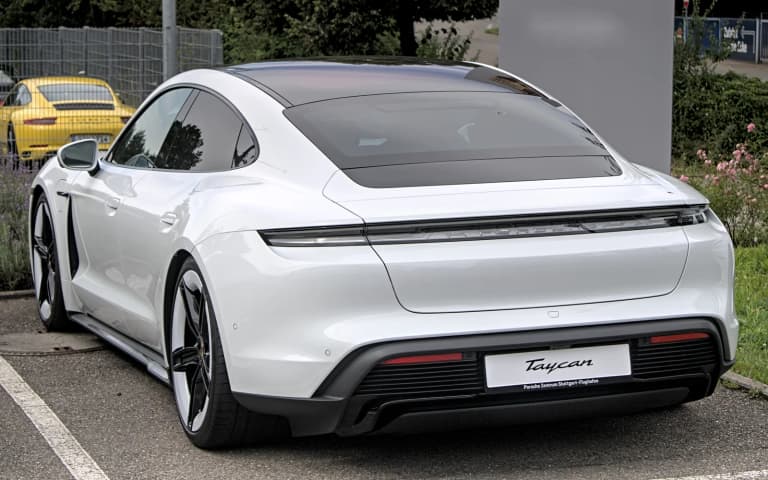
Images: Taycan, rear three-quarter by Alexander-93, CC BY-SA 4.0. Panamera in Lugano Blue by Ethan Llamas, CC BY-SA 4.0. Via Wikimedia Commons.