The Porsche 356 was the first car to wear the Porsche name, built from 1948 to 1965. It was a lightweight, rear-engined sports car powered by an air-cooled flat-four derived from the Volkswagen Beetle, and it evolved through four main series (pre-A, A, B, and C) over roughly 76,000 cars. The 356 established the rear-engine, air-cooled formula that the Porsche 911 would carry forward, and clean examples now trade well into six figures.
In this article, we’ll explain the Porsche 356, the car that started the brand. We’ll cover variants, engines, driving feel, and values.
Contents
- 1 Quick Summary
- 2 What Is the Porsche 356
- 3 Origins: From Gmund to Zuffenhausen
- 4 The Four Series: Pre-A, A, B, and C
- 5 Body Styles: Coupe, Cabriolet, Speedster
- 6 Engines and the Carrera Four-Cam
- 7 What It Is Like to Drive
- 8 Values and Collectibility
- 9 Ownership and Running Costs
- 10 Frequently Asked Questions
Quick Summary
- Production and role: Porsche’s first production car, built from 1948 to 1965 and predecessor to the Porsche 911.
- Series: Pre-A, A, B and C, with about 76,000 examples built in total.
- Layout and engine: Air-cooled flat-four; the 1948 No. 1 was mid-engine, while almost all later 356 models were rear-engine.
- Body styles: Coupe, cabriolet and Speedster.
- Carrera: Rare four-cam flat-four variant based on Porsche’s racing program and designed by Ernst Fuhrmann.
- Brakes: The 356 C brought four-wheel disc brakes, a major change from the earlier drum-braked cars.
What Is the Porsche 356
The Porsche 356 was the first production model from the company Ferry Porsche founded after the Second World War. Before the 356, the Porsche name belonged to an engineering office that designed cars for other companies, most famously the Volkswagen Beetle. The 356 was the first car the company built and sold under its own badge.
It was a small, light, rear-engined coupe and convertible with an air-cooled flat-four engine. Early cars made barely 40 horsepower, yet the 356 was quick for its day because it weighed so little and was shaped to slip through the air. Porsche built the 356 for 17 years, refining it continuously rather than replacing it.
By the time production ended in 1965, the 356 had grown from a hand-built curiosity into a genuine production sports car with a global reputation. It set the template that every Porsche since has been measured against: light weight, a flat engine behind the rear axle, and handling that rewards a skilled driver.
Origins: From Gmund to Zuffenhausen
The first 356, known as the 356 “No. 1,” was completed in 1948 in Gmund, Austria, where the Porsche company had relocated during the war. That very first car was unusual: it used a mid-engine layout, with the flat-four mounted ahead of the rear axle. Almost every 356 built afterward moved the engine behind the rear axle, where it would stay for decades.
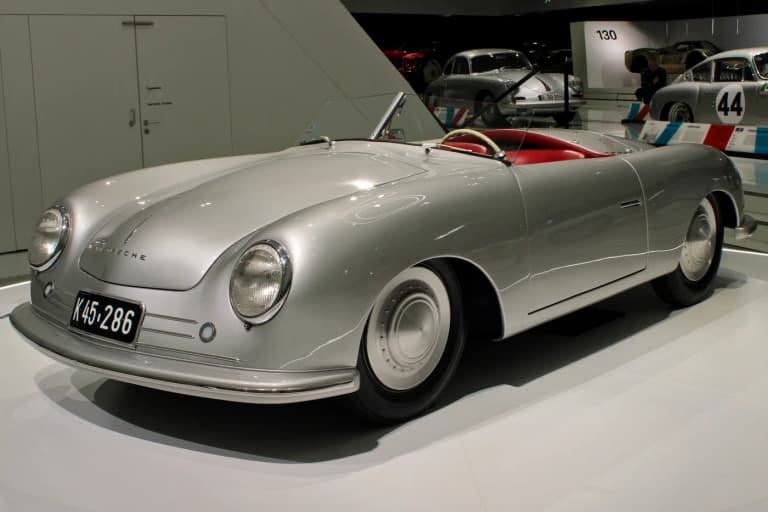
The earliest Gmund cars had hand-formed aluminum bodies and were produced in tiny numbers. In 1950 the company moved to Zuffenhausen, on the edge of Stuttgart, and switched to steel bodies built in larger volumes. Zuffenhausen remains the home of the 911 to this day, so the 356 quite literally established the ground Porsche still builds on.
Production grew steadily through the 1950s as the 356 found buyers in Europe and, crucially, the United States. The American importer Max Hoffman pushed Porsche to build cheaper, sportier variants for the US market, which led directly to one of the most famous 356 versions of all.
The Four Series: Pre-A, A, B, and C
The 356 evolved through four main series. Each one tightened the engineering and modernized the details without changing the basic shape or character of the car.
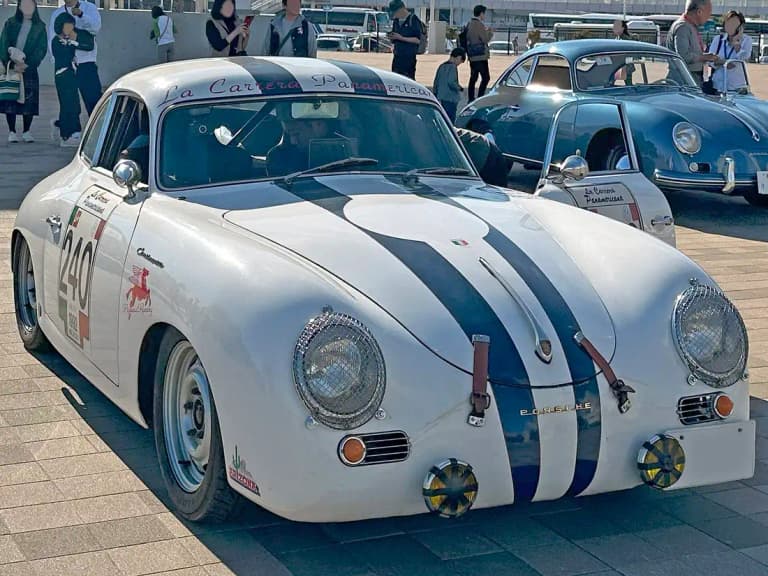
356 “Pre-A” (1948 to 1955)
The earliest cars are known to collectors as “pre-A” models. They are recognizable by their split or bent windscreen and their smaller engines, which ranged from 1.1 to 1.5 liters. These are the rarest and most valuable road 356s, prized for being closest to the original Gmund design.
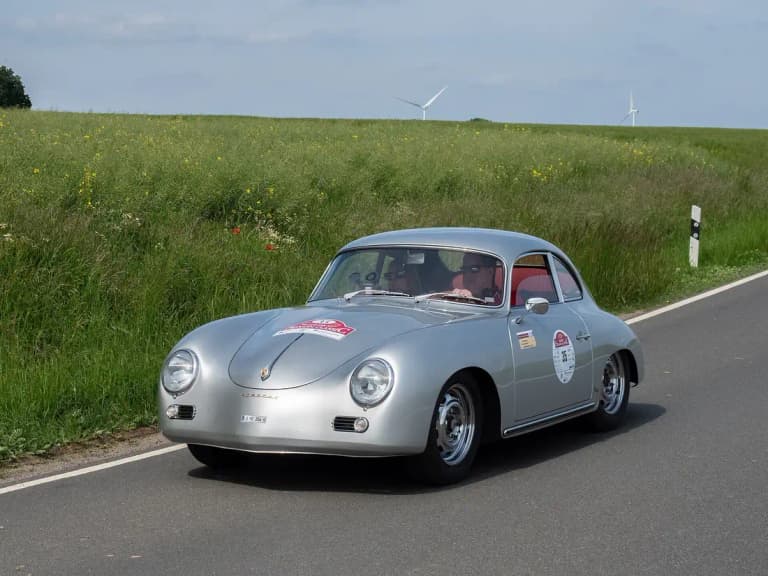
356 A (1955 to 1959)
The 356 A brought a single curved windscreen and a string of mechanical improvements. It was also the first road Porsche offered with the Carrera four-cam engine. The A is often considered the sweet spot for drivers who want an early car that is still usable on modern roads.
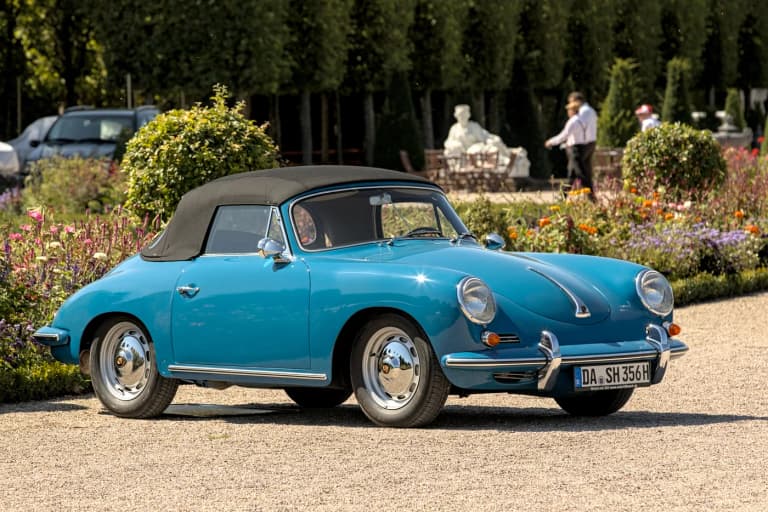
356 B (1959 to 1963)
The 356 B raised the bumpers and headlights, improved visibility, and made the car easier to live with day to day. It was built in two sub-series, the T5 and the later T6, the latter adding twin engine-lid grilles and a larger rear window. The B is the most numerous 356 and a common entry point into ownership.
356 C (1963 to 1965)
The final 356 C arrived in 1963 and was built alongside the new 911. Its headline change was four-wheel disc brakes, a major safety upgrade over the earlier drum-braked cars. The C also offered the most powerful pushrod engine of the range. Because it overlapped with the 911, the C represents the most developed and arguably the most usable classic 356.
Body Styles: Coupe, Cabriolet, Speedster
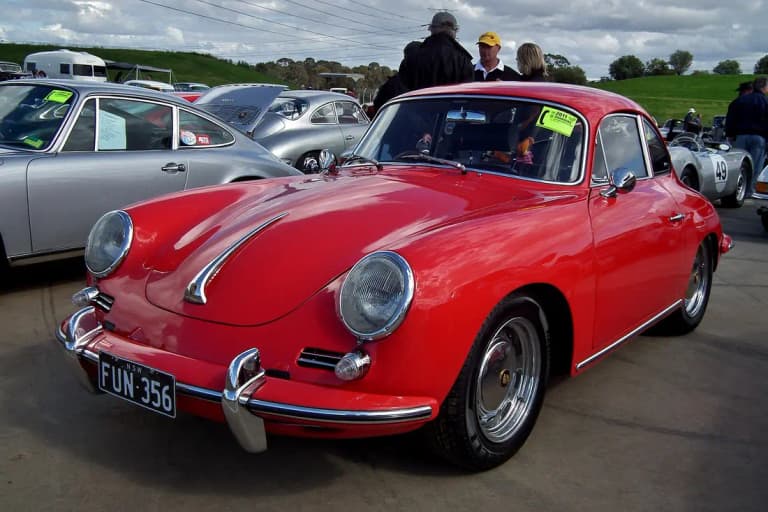
Across the four series, Porsche offered the 356 in several body styles. The coupe was the volume seller and the most weatherproof choice. The cabriolet added a padded, lined convertible top and a more upmarket feel.
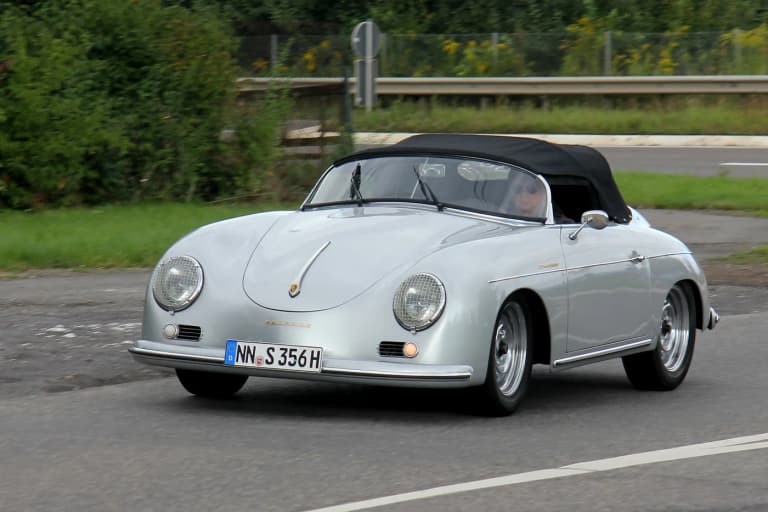
The most famous body style is the Speedster. Built mainly from 1954 to 1958 at Max Hoffman’s urging, the Speedster stripped out weight and cost with a low folding windscreen, lightweight bucket seats, and a minimal top. It was meant to be an affordable club racer for American buyers, and it has since become the most desirable and collectible 356 of all.
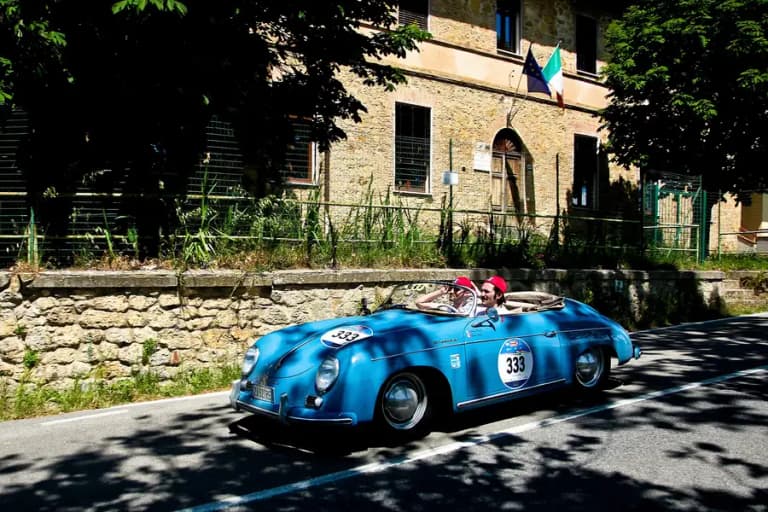
Porsche also offered the Roadster and, on later cars, the Karmann-bodied Hardtop. The Speedster’s spirit lives on today: Porsche has periodically revived the name on the 911, most recently with a limited-run open-top model.
Engines and the Carrera Four-Cam
Most 356s used a pushrod air-cooled flat-four developed from the Volkswagen unit but extensively reworked by Porsche. Displacement grew over the years from around 1.1 liters to 1.6 liters, and output climbed from roughly 40 horsepower in the earliest cars to about 95 horsepower in the final 356 SC. That basic pushrod flat-four later lived on in the 912, the four-cylinder model Porsche sold alongside the early 911 for buyers who found the six too expensive.
The legendary engine, though, is the Carrera four-cam. Designed by engineer Ernst Fuhrmann, this complex four-camshaft flat-four was the same engine that powered the 550 Spyder race car, detuned for road use. It was expensive to build, demanding to maintain, and gloriously powerful for its size. In its final 2.0-liter Carrera 2 form it produced around 130 horsepower, a remarkable figure for a small flat-four in the early 1960s.
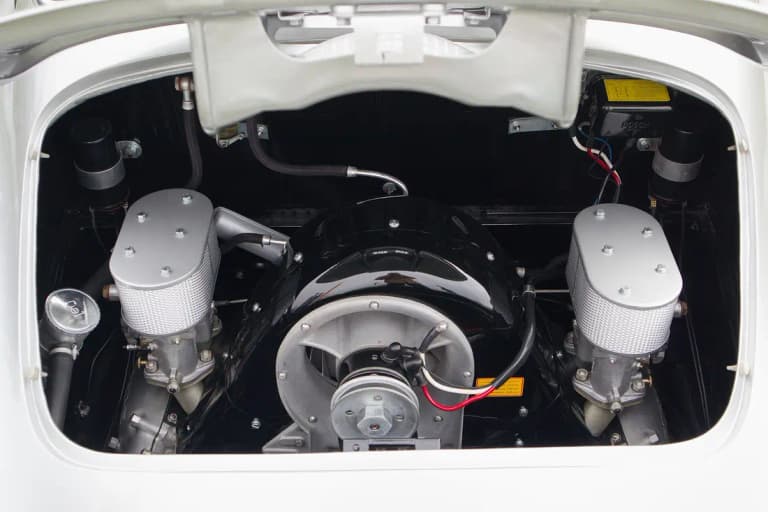
Carrera-engined 356s are the holy grail of the range. They combined the everyday usability of the 356 body with a genuine motorsport powertrain, and they were built in very small numbers. Today they command a large premium over equivalent pushrod cars.
What It Is Like to Drive
A 356 is a slow car by modern standards, but speed was never the point. The appeal is lightness and directness. The steering is unassisted and full of feel, the gearbox is precise, and the whole car responds to small inputs in a way that modern machinery cannot replicate.
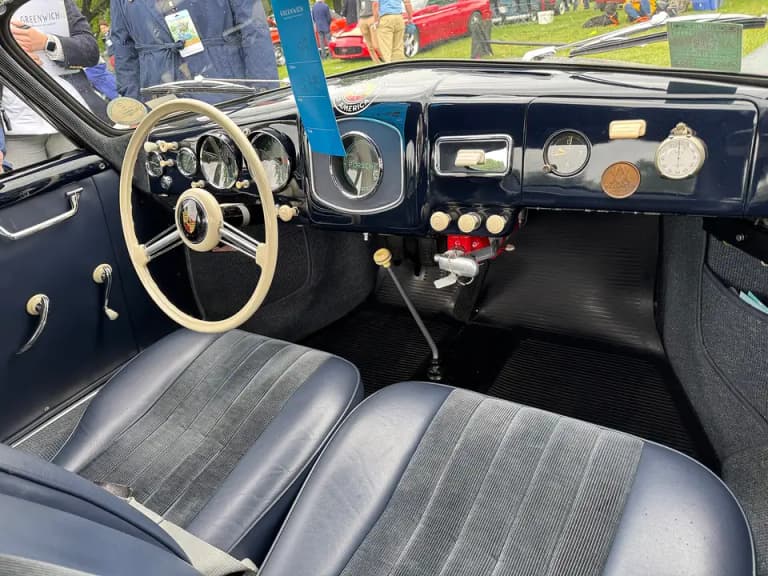
The rear-engine layout gives the 356 a distinctive balance. With most of the weight over the back wheels, it puts power down well and turns into corners eagerly. Pushed hard, early cars can be lively at the limit, a trait that carried through to the early 911. For most owners, driven at sensible road speeds, the 356 simply feels alive and engaging.
Values and Collectibility
The 356 has long graduated from affordable classic to blue-chip collectible. Values depend heavily on series, body style, engine, and originality.
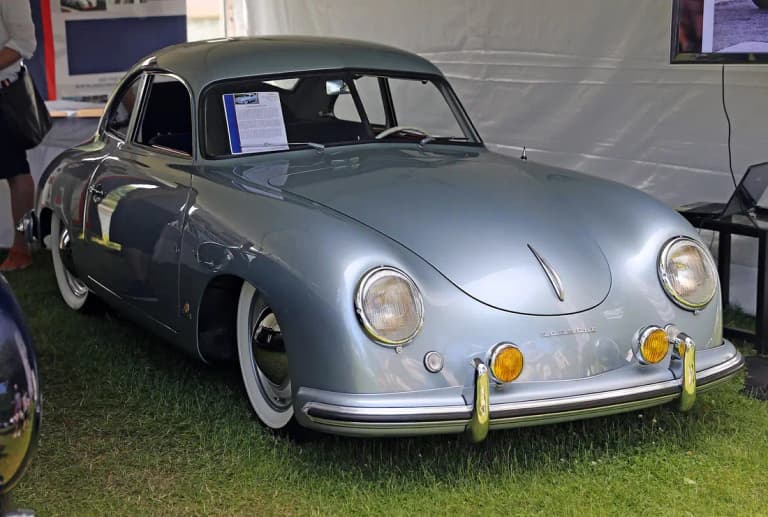
| Variant | Typical Condition | Approx. Value |
|---|---|---|
| 356 B/C Coupe | Good driver | $70,000 to $130,000 |
| 356 A/B/C Cabriolet | Good driver | $120,000 to $250,000 |
| 356 Speedster (pushrod) | Excellent | $300,000 to $500,000+ |
| 356 Carrera (four-cam) | Excellent | $500,000 to $1,000,000+ |
Pushrod coupes remain the most accessible way into 356 ownership, while Speedsters and Carrera-engined cars sit firmly in the world of serious collectors. Originality matters enormously: matching-numbers cars with documented history command large premiums over restored or modified examples. Figures here are 2026 market estimates and vary widely with condition and provenance.
Ownership and Running Costs
For a 60-year-old car, the 356 is relatively simple to maintain. The pushrod engines are robust and well understood, parts availability is excellent thanks to a deep specialist network, and there is a large global community to lean on for advice.
The main concern with any 356 is rust. The steel bodies corrode in the floors, longitudinals, battery box, and around the headlights. A car with solid, original metal is worth far more than one that has been heavily patched. A thorough pre-purchase inspection by a 356 specialist is essential before buying.
Carrera four-cam cars are a different proposition. The four-cam engine is famously difficult and expensive to rebuild, and only a handful of specialists worldwide can do it properly. Pushrod cars, by contrast, can be maintained by any competent air-cooled mechanic, which is a large part of their appeal as usable classics.
Frequently Asked Questions
What was the first Porsche 356?
The first Porsche 356 was the 356 “No. 1,” completed in Gmünd, Austria, in 1948. It used a mid-engine layout, with the air-cooled flat-four ahead of the rear axle. Almost all later 356 models used a rear-engine layout.
How many Porsche 356s were built?
Approximately 76,000 Porsche 356s were built between 1948 and 1965. Production covered the pre-A, A, B and C series. Around half are estimated to survive, thanks to a dedicated restoration community.
What is the difference between the 356 A, B, and C?
The 356 A introduced a single curved windshield and offered the Carrera engine option. The 356 B added raised bumpers and headlights. The 356 C brought four-wheel disc brakes and the most powerful pushrod engine of the series.
What is a Porsche 356 Carrera?
A Porsche 356 Carrera is a road-going 356 with a racing-derived four-cam flat-four. Ernst Fuhrmann designed the engine, and the 2.0-liter Carrera 2 made up to around 130 hp. Carreras are among the rarest and most valuable road 356s.
How much is a Porsche 356 worth?
A driver-quality Porsche 356 B or C coupe is worth roughly $70,000 to $130,000 in 2026 market estimates. Cabriolets sell for more, Speedsters routinely exceed $300,000, and Carreras can pass $1 million. Condition, originality and documentation drive the price.
Is the Porsche 356 the predecessor to the 911?
The Porsche 356 was the predecessor to the Porsche 911. The 911 was unveiled in 1963 and entered production in 1964. Regular 356 production ended in 1965, with limited final production in 1966.
Images: Hero 356 A Speedster by Lothar Spurzem, CC BY-SA 2.0 DE. 356 No. 1 roadster and 356 B cabriolet by Alexander Migl, CC BY-SA 4.0. Pre-A 1500 by Tokumeigakarinoaoshima, CC BY-SA 4.0. 356 A coupe by Reinhold Möller, CC BY-SA 4.0. 356 C coupe by sv1ambo, CC BY 2.0. 356 Speedster by Franco Vannini, CC BY 2.0. Carrera four-cam engine by Prova MO, CC BY-SA 4.0. 356 interior by Mr.choppers, CC BY-SA 4.0. Early 356 coupe by Mr.choppers, CC BY-SA 3.0. Via Wikimedia Commons. Value figures are 2026 market estimates and vary with condition, originality, and provenance.