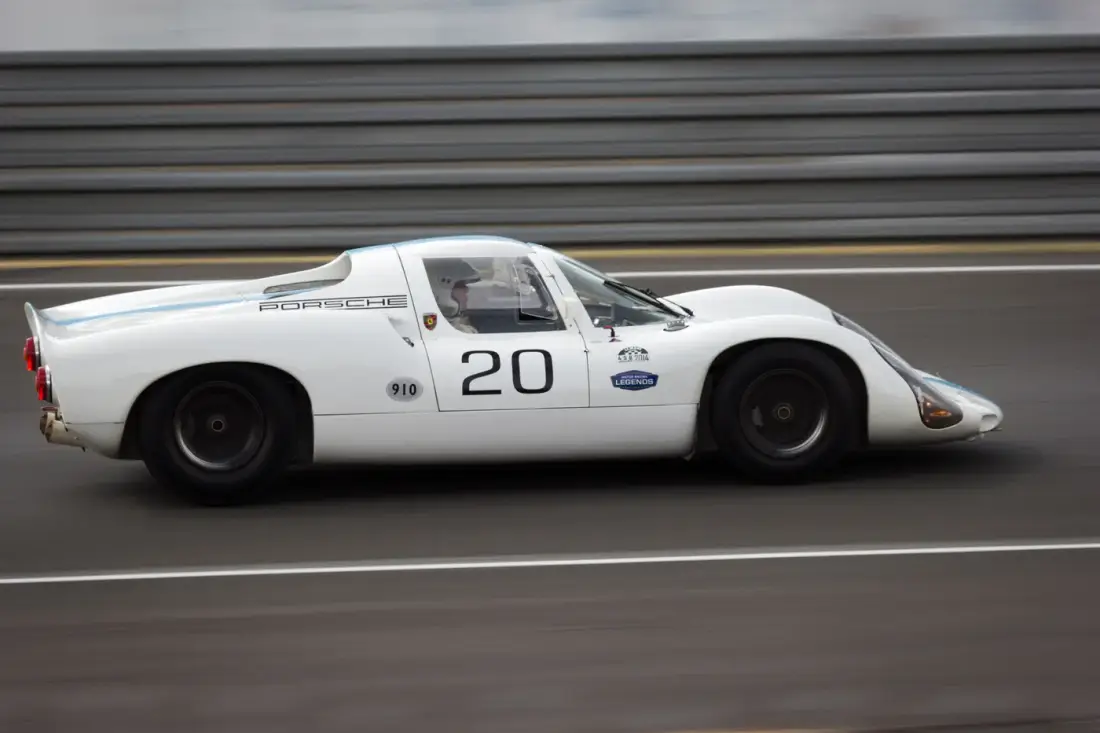
The Porsche 910 (also called the Carrera 10) was Porsche’s 1966-1967 evolution of the 906 Carrera 6, built as a pure racing prototype without road-legal or homologation compromises. Its 910/8 Bergspyder variant is the one Porsche itself points to for headline numbers: 275 PS, under 450 kg, and a roughly three-second 0-100 km/h time. Porsche verified those figures on the specific hillclimb chassis that won Gerhard Mitter the 1967 European Hill Climb Championship.
In this article, we’ll sort out the Porsche 910 family without mixing its variants. We’ll cover history, verified specifications, and racing legacy.
Contents
- 1 Quick Summary
- 2 What the Porsche 910 Was, and How It Differed From the 906
- 2.1 From the 906 to the 910
- 2.2 Kurzheck and Langheck Body Styles
- 3 The 910/8 Bergspyder: Porsche’s Own Benchmark Numbers
- 4 Gerhard Mitter and the European Hill Climb Championship
- 5 Preserved, Not Restored: 910 031 Today
- 6 Porsche 910 Specifications by Variant
- 7 Frequently Asked Questions
Quick Summary
- What it was: A 1966-1967 racing evolution of the 906 Carrera 6, built without road-car or homologation limits.
- Also known as: Carrera 10, following the same naming pattern as the 906’s Carrera 6 nickname.
- Bergspyder variant: Chassis 910 031 used an eight-cylinder engine making 275 PS, weighed under 450 kg, and hit 0-100 km/h in about three seconds, per Porsche.
- Racing legacy: Gerhard Mitter won the 1967 and 1968 European Hill Climb Championships in a 910/8 Bergspyder, after winning the 1966 title in a 906.
- Today: Porsche’s Museum preserves chassis 910 031 in its 1967 condition rather than restoring it to running order.
What the Porsche 910 Was, and How It Differed From the 906
The Porsche 910 was a racing prototype Porsche developed in late 1966 and early 1967 as a direct evolution of the 906 Carrera 6. The earlier 550 Spyder had shown how a light, agile Porsche could beat cars with bigger engines. The 910 pushed that idea further.
From the 906 to the 910
Porsche and period sources also called the 910 the Carrera 10, extending the “Carrera” naming Porsche had used for the 906, according to background research on the model’s identity. The 906 had been built to meet FIA Group 4 homologation rules, which meant carrying compromises like luggage space and a spare wheel even on a race car.
The 910 dropped those requirements. It kept the 906’s steel space frame under a lightweight fiberglass body. Porsche redesigned the doors to hinge forward rather than up from the roof. That change let the roof come off entirely on open-top variants built for hillclimbs and twisty circuits like the Targa Florio and the Nürburgring.
Kurzheck and Langheck Body Styles
Porsche built the 910 in short-tail (Kurzheck) form for tighter circuits. A lower-drag long-tail (Langheck) coupe suited faster tracks. Porsche later carried the same tradeoff into its outright Le Mans winners. Renn Driver’s Porsche at Le Mans guide covers how that choice shaped later prototypes.
The minimum production run required for homologation was 25 cars, and that rule did not yet apply when the 910 debuted. FIA lowered the minimum to 25 cars in January 1969, and Porsche retroactively homologated more than two dozen existing 910 prototypes for privateer entries at that point. Porsche’s prototype line kept evolving from there, through the 907 and on to the 917, the car that gave Porsche its first outright Le Mans win.
The 910/8 Bergspyder: Porsche’s Own Benchmark Numbers
When people quote a Porsche 910 horsepower or weight figure, they are almost always quoting the 910/8 Bergspyder, a specific lightweight hillclimb version, not a standard 910 coupe. Porsche’s own preserved example is chassis 910 031, completed on 13 May 1967 according to the company’s racing archive record.
Porsche describes 910 031’s engine as an “eight-cylinder boxer engine with fuel injection and power output of 202 kW (275 PS).” It sat ahead of the rear axle. A steel space frame supported its glass-fiber shell. Other 910 variants used a six-cylinder engine, so the “8” in 910/8 identifies a different engine architecture rather than a different tune.
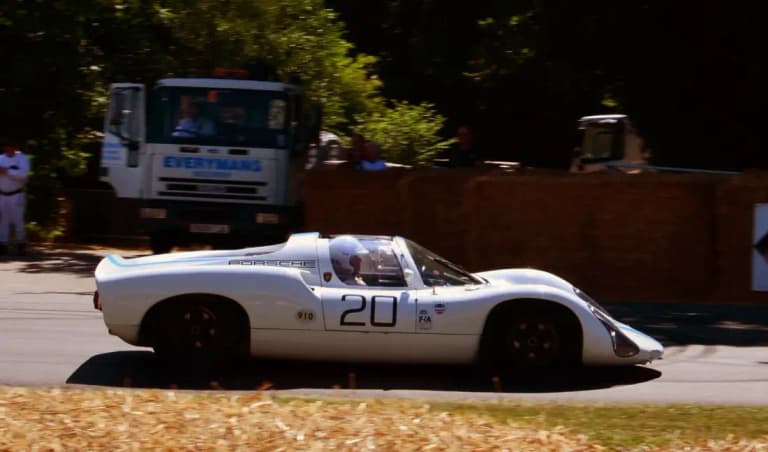
Porsche says titanium, magnesium, aluminum, and plastic replaced heavier conventional materials. The car weighed less than 450 kg and reached 100 km/h in around three seconds. Those figures describe this hillclimb chassis at its lightest, not every Porsche 910.
Gerhard Mitter and the European Hill Climb Championship
The 910/8 Bergspyder’s competition debut came almost immediately. Porsche’s record says chassis 910 031 first raced at Montseny, Spain, one week after completion. Gerhard Mitter drove it as car number 86. Three more wins and other podium finishes followed across eight races. The season ended with the 1967 European Hill Climb Championship.
Mitter’s success with the model was not a one-year fluke. A separate Porsche account records three consecutive European Hill Climb Championship titles. He won in a 906 Carrera 6 in 1966, then used a 910/8 Bergspyder for the 1967 and 1968 titles. The 906 gets credit for the first championship, and the 910/8 gets the next two.
Preserved, Not Restored: 910 031 Today
Porsche says the car last raced in 1967. Museum staff have no plans to return it to driving condition, according to the same Porsche Newsroom account.
That preservation approach leaves chassis 910 031 with its original 1967 components and finish. A fresh, race-ready rebuild would erase part of that record. Keeping the car as raced protects its history, not just the object.
Porsche 910 Specifications by Variant
Use this table to keep the 910 family’s facts separated by exactly which chassis or variant they describe.
| Detail | Standard 910 | 910/8 Bergspyder (chassis 910 031) |
|---|---|---|
| Built | Late 1966-1967 | Completed 13 May 1967 |
| Body/chassis | Steel space frame, fiberglass body | Steel space frame, glass-fiber shell |
| Engine | Six-cylinder (period variants) | Eight-cylinder boxer, fuel injection |
| Power | Not verified in this guide | 202 kW / 275 PS |
| Weight | Not verified in this guide | Under 450 kg |
| 0-100 km/h | Not verified in this guide | About 3 seconds |
The “not verified in this guide” rows are intentional. No Porsche-direct spec sheet for the standard six-cylinder 910 coupe turned up in this guide’s research, so those cells stay blank rather than borrowing the Bergspyder’s numbers.
Frequently Asked Questions
What was the Porsche 910, and why was it also called Carrera 10?
The Porsche 910 was a 1966-1967 racing prototype that evolved the 906 Carrera 6 into a car built purely for competition, without the road-legal and homologation compromises the 906 needed. Porsche and period sources also referred to it as the Carrera 10, following the same naming pattern as the 906’s Carrera 6 nickname.
How did the Porsche 910 differ from the Porsche 906?
The 910 kept the 906’s steel space frame and fiberglass body but dropped the requirements that had shaped the 906, like luggage space and a spare wheel. It also switched to forward-hinged doors instead of the 906’s roof-hinged gullwing doors, which let the roof come off entirely on open variants.
Which Porsche 910 specification applies to the 910/8 Bergspyder?
The 275 PS output, sub-450 kg weight, and roughly three-second 0-100 km/h time all come from Porsche’s own record for chassis 910 031, its preserved 910/8 Bergspyder. Do not apply those figures to a standard six-cylinder 910 coupe without separate confirmation.
What engine did the 910/8 Bergspyder use?
Porsche’s own record describes an eight-cylinder boxer engine with fuel injection, producing 202 kW (275 PS), mounted ahead of the rear axle in chassis 910 031. That is an eight-cylinder specification, distinct from the six-cylinder engines used in other 910 variants.
How light was Porsche’s 910/8 Bergspyder?
Porsche states its preserved 910/8 Bergspyder, chassis 910 031, weighed less than 450 kg, built with titanium, magnesium, aluminum, and plastic in place of heavier conventional materials. That figure applies to this specific hillclimb-focused chassis.
Which European Hill Climb Championships did Gerhard Mitter win in a Porsche 910?
Gerhard Mitter won the European Hill Climb Championship in 1967 and defended it again in 1968, both times in a Porsche 910/8 Bergspyder, according to Porsche’s own account. He had won the title the year before, in 1966, in a Porsche 906 Carrera 6.
Images: Porsche 910 (1967), Le Mans Legend 2015 by Kevin Decherf, CC BY-SA 2.0. Porsche 910 at Goodwood 2014 by Nic Redhead, CC BY-SA 2.0. Via Wikimedia Commons. Local copies resized and converted to WebP; no other modifications.