Contents
- 1 Quick Summary
- 2 What Is the Porsche 911 RSR?
- 3 The Original: 1973 Carrera RSR
- 4 996 GT3 RSR (2004 to 2006)
- 5 997 GT3 RSR (2007 to 2012)
- 6 991 RSR: Rear Engine (2013 to 2016)
- 7 991 RSR: Mid Engine (2017 to 2022)
- 8 Engine and Powertrain
- 9 Chassis and Aerodynamics
- 10 Le Mans and Race Results
- 11 RSR vs GT3 RS and GT3 R
- 12 Renn Driver's Take
- 13 Frequently Asked Questions
Quick Summary
The RSR badge has appeared on several generations of 911 race car, from the original air-cooled Carrera RSR of the 1970s to the mid-engine 991 RSR that competed in WEC and IMSA until 2022.
Here is a quick look at the key RSR versions.
| Version | Years | Engine | Power |
|---|---|---|---|
| Carrera RSR 2.8 | 1973 | 2.8L flat-6 | 308 hp |
| Carrera RSR 3.0 | 1974 | 3.0L flat-6 | 315 hp |
| 996 GT3 RSR | 2004 to 2006 | 3.8L flat-6 | 455 hp |
| 997 GT3 RSR | 2007 to 2012 | 4.0L flat-6 | 460 hp |
| 991 RSR (rear) | 2013 to 2016 | 4.0L flat-6 | 470 hp |
| 991 RSR (mid) | 2017 to 2022 | 4.0L flat-6 | 510 hp |
What Is the Porsche 911 RSR?
RSR stands for Rennsport (racing) in its most extreme factory form. While the GT3 RS is the most track-focused street-legal 911, the RSR is the version that actually races. It is not road legal. Porsche builds each RSR at the Motorsport Center in Weissach, and every car goes straight to the track.
The RSR competes in the GTE class of endurance racing, which includes the FIA World Endurance Championship and the IMSA WeatherTech SportsCar Championship. Before GTE existed, earlier RSR versions ran in GT2 and GT3 classes. The car has always served one purpose: to give Porsche's factory and customer teams a competitive platform in the top tier of GT racing.
What makes the RSR different from the GT3 line is scope. The GT3, GT3 RS, and GT3 R are all built within the limits of a production car platform. The RSR throws those limits away. It uses a bespoke carbon fiber chassis, full racing aerodynamics, and an engine tuned purely for endurance speed. The 2017 version went even further by moving the engine to a mid-mounted position, a first for any 911 race car.
The Original: 1973 Carrera RSR
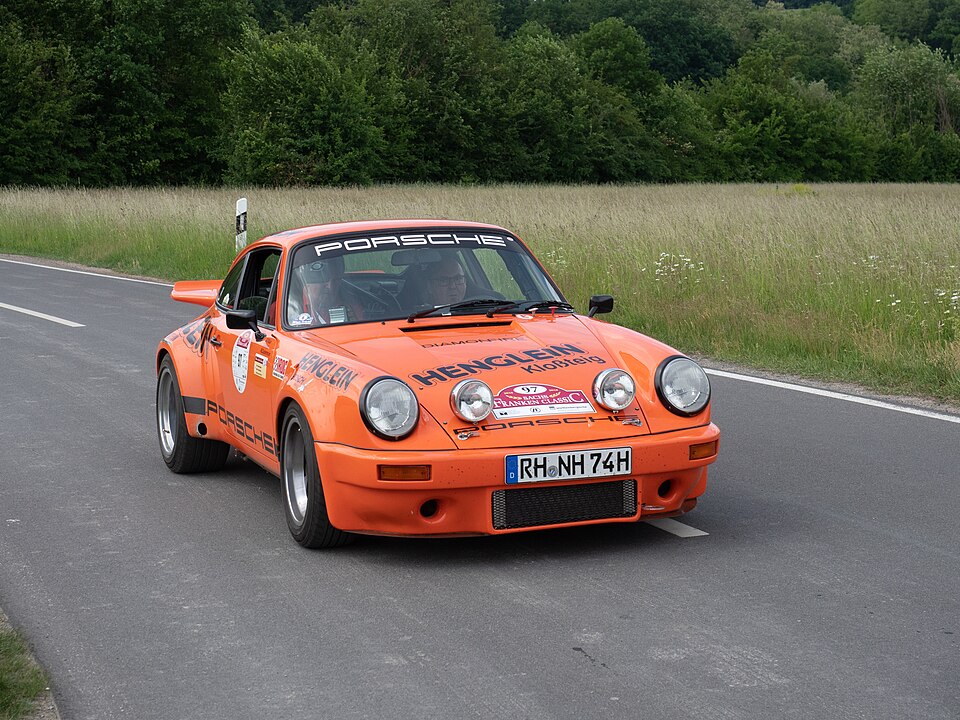
The RSR name started with the 1973 Porsche 911 Carrera RSR 2.8. Porsche took the Carrera RS 2.7, a car already stripped for performance, and pushed it further. The engine grew from 2.7 to 2.8 liters, producing around 308 horsepower. Wider rear fenders housed fatter tires, and the suspension was set up purely for competition.
Out of the 1,580 Carrera RS models built, only 55 received the M491 conversion to full RSR spec. These were not garage queens. They went racing immediately and won almost everything they entered. The RSR took a dominant class victory at the 1973 24 Hours of Daytona and won the Targa Florio outright that same year.
For 1974, Porsche enlarged the engine to 3.0 liters, producing 315 horsepower. This car was wider, faster, and even more aggressive. Porsche also built the Carrera RSR Turbo, a 2.1 liter turbocharged prototype that finished second overall at Le Mans in 1974. That turbocharged flat-six became the foundation for the 930 Turbo road car and Porsche's Group C dominance in the 1980s. The RSR Turbo also paved the way for the 911 GT1, Porsche's next purpose-built Le Mans contender two decades later.
996 GT3 RSR (2004 to 2006)
After a long gap, Porsche revived the RSR badge on the water-cooled 996 platform. The 996 GT3 RSR slotted above the GT3 R in Porsche's customer racing lineup. It used a 3.8 liter naturally aspirated flat-six making around 455 horsepower, mated to a sequential six-speed gearbox.
Porsche produced nearly 200 GT3 RSR race cars across the 996 and early 997 overlap. These cars were everywhere. They racked up seven class wins at Le Mans, five class wins at the Spa 24 Hours, and took an overall victory at Spa as well. The 996 RSR proved that Porsche's customer racing model worked. Privateers could buy a car from Weissach and be competitive against factory programs from Ferrari and Corvette Racing.
997 GT3 RSR (2007 to 2012)
The 997 generation RSR arrived in 2007 with a 3.8 liter flat-six producing 465 horsepower. In 2009, Porsche enlarged the engine to 4.0 liters, which became the standard displacement for GT3 RSR production going forward. The 2009 revision made 450 horsepower with the mandated air restrictor in place.
Manthey Racing became the standout team with this car, winning the Nurburgring 24 Hours four times between 2007 and 2011. The 997 RSR competed in the FIA GT Championship, Le Mans Series, and the American Le Mans Series. Porsche built around 35 units of the initial batch and 20 of the 2009 revision, selling each for just under 500,000 euros.
The 997 RSR was the last version to carry the GT3 prefix. From 2013 onward, the RSR stood alone as its own model.
991 RSR: Rear Engine (2013 to 2016)
When the 991 generation arrived, Porsche split the RSR away from the GT3 R for the first time. The 991 RSR was a dedicated GTE class car, built for the FIA World Endurance Championship and IMSA. It used a 4.0 liter naturally aspirated flat-six producing around 470 horsepower in race trim.
This version kept the traditional rear-engine layout but was based on the Carrera 4S platform rather than the GT3, which gave Porsche more flexibility with homologation. The fuel tank moved to the front for better weight distribution. Extensive carbon fiber panels kept the weight down, and the aero package was designed from scratch for endurance stability at high speed.
The 991 RSR was competitive but not dominant. Ferrari and Corvette Racing both had strong GTE entries during this period, and Porsche's engineers knew the rear-engine layout was reaching its limits in terms of balance and tire wear over long stints.
991 RSR: Mid Engine (2017 to 2022)
The 2017 991 RSR was a clean-sheet design and the most radical 911 race car ever built. Porsche moved the flat-six engine ahead of the rear axle, making it the first mid-engine 911 in history. The chassis, body structure, aerodynamic package, engine, and transmission were all completely new. Grant Larson led the design.
The engine was a 4.0 liter naturally aspirated flat-six producing 510 horsepower at up to 9,500 rpm. Power went through a six-speed sequential gearbox with paddle shift. The front suspension switched from MacPherson struts to double wishbones, a significant upgrade for cornering stability. The car weighed 1,245 kg and used a full carbon fiber monocoque with an integrated safety cage.
In 2019, Porsche released the RSR-19, an evolution with a larger 4.2 liter engine for improved low-end torque. The aero package was refined, and the car received dual exhaust outlets. This version became one of Porsche's most successful GT race cars of all time.
Across 75 races, the mid-engine RSR won 27 times. It took four teams' championships, two constructors' championships, and five drivers' championships. The RSR retired from competition after 2022 when the GTE class was replaced by GT3-spec machinery in WEC.
Engine and Powertrain
Classic RSR Engines
The original Carrera RSR engines were air-cooled flat-sixes derived from the production 911. The 2.8 liter unit used mechanical fuel injection and produced 308 horsepower. The 3.0 liter successor pushed that to 315 horsepower with a wider bore. These engines revved to around 8,000 rpm and were remarkably reliable for their era.
The 1974 RSR Turbo used a smaller 2.1 liter displacement with a turbocharger, producing around 500 horsepower under the FIA's 1.4x equivalency formula. That engine laid the groundwork for Porsche's turbocharged racing dynasty.
Modern RSR Engines
Every modern RSR runs a naturally aspirated flat-six. The progression from 3.8 liters in the 996 to 4.0 liters in the 997 and 991, and finally 4.2 liters in the RSR-19, reflects Porsche's push for more torque at lower revs. Natural aspiration is a class requirement in GTE racing, which keeps throttle response sharp and power delivery predictable during long stints.
The mid-engine RSR's 4.0 liter unit was a bespoke Porsche M97/80 engine, not a modified road car motor. It produced 510 horsepower and 489 Nm of torque, revving to a 9,500 rpm limit. All modern RSR engines are mated to sequential semi-automatic gearboxes with paddle shifters.
Chassis and Aerodynamics
The mid-engine RSR's chassis is a full carbon fiber monocoque. That alone separates it from every other 911 race car, which used steel or aluminum tubs reinforced with roll cages. The monocoque integrates the safety structure directly, saving weight and increasing torsional stiffness.
Dimensions on the 2017 RSR are 4,557 mm long, 2,048 mm wide, and just 1,040 mm tall. The wheelbase stretches to 2,516 mm. It sits low and wide, with every surface shaped for downforce. The rear wing, front splitter, and underbody diffuser work together to push the car into the track at high speed.
Ventilated steel brake discs handle stopping duties. Porsche chose steel over carbon ceramic for endurance reliability. The tires come from either Michelin or Dunlop depending on the series. Front suspension is double wishbone, rear is multi-link, and the entire setup is adjustable for ride height, camber, toe, and anti-roll bar stiffness.
Le Mans and Race Results
The RSR name is deeply tied to Le Mans. The original Carrera RSR Turbo finished second overall at Le Mans in 1974, beaten only by a prototype. That result announced Porsche's turbocharged future and led directly to the 935 and 936 programs.
The 996 and 997 GT3 RSR versions combined for multiple GTE class victories at Le Mans through the 2000s and early 2010s. Customer teams like Manthey Racing, IMSA Performance, and Flying Lizard Motorsports all took class wins with RSR machinery.
The mid-engine 991 RSR delivered the biggest results. In 2018, Porsche scored a one-two finish in the GTE Pro class at Le Mans. The following year, the RSR-19 won GTE Pro again. These victories came against strong factory programs from Ferrari, Ford, Aston Martin, and BMW. The car also won the IMSA championship multiple times and took titles in WEC's GTE Pro and GTE Am categories.
The RSR's final Le Mans entry came in 2022 before the GTE class was phased out in favor of GT3-homologated cars. Porsche shifted its factory endurance focus to the 963 hypercar program.
RSR vs GT3 RS and GT3 R
Porsche's GT racing ladder can be confusing. Here is how the RSR fits in. The GT3 is the base track-oriented road car. The GT3 RS is a more extreme street-legal version with more downforce and less weight. The GT3 R is a customer race car built from the GT3 RS platform, competing in GT3 class racing (SRO, IMSA GTD). The RSR sits above all of them as the top-tier factory GTE race car with a bespoke chassis and no road-legal requirements.
The key difference is that GT3 R cars are still recognizably 911s underneath. They use modified versions of the production chassis and retain the rear-engine layout. The RSR, from 2017 onward, abandoned that layout entirely. It is a purpose-built race car that happens to look like a 911.
Renn Driver's Take
I have not driven this car yet. When I do, this section will have my honest take on what it is actually like to live with and drive.
Frequently Asked Questions
Is the Porsche 911 RSR street legal?
No. The 911 RSR is a purpose-built race car and has never been road legal. It is built at Porsche's Motorsport Center in Weissach and delivered directly to racing teams. If you want the closest street-legal equivalent, that would be the GT3 RS.
What does RSR stand for?
RSR stands for Rennsport, which is German for racing sport. The original 1973 Carrera RSR used the abbreviation to distinguish the full race version from the road-going Carrera RS. The badge has been used on Porsche's top-tier GT race cars ever since.
Is the 911 RSR mid-engine?
The 2017 to 2022 version is mid-engine, with the flat-six mounted ahead of the rear axle. This was the first time any 911 race car used a mid-engine layout. Earlier RSR versions kept the traditional rear-engine position.
How much does a Porsche 911 RSR cost?
Porsche sold the 997 GT3 RSR for around 498,000 euros. The mid-engine 991 RSR was not publicly priced the same way because it was supplied primarily to factory and works-supported teams. Running costs for a full WEC or IMSA season can exceed several million euros.
How many Porsche 911 RSR wins at Le Mans?
The RSR in its various forms has taken numerous GTE class victories at Le Mans. The mid-engine 991 RSR won GTE Pro in 2018 and 2019. Earlier GT3 RSR versions won multiple GTE Am and GT2 class races through the 2000s and 2010s.
What replaced the 911 RSR?
When the GTE class was phased out after 2022, Porsche replaced the RSR with the 911 GT3 R in the new GT3-based top class for customer racing. For the overall prototype class, Porsche moved to the 963 hypercar. There is currently no direct RSR successor.