
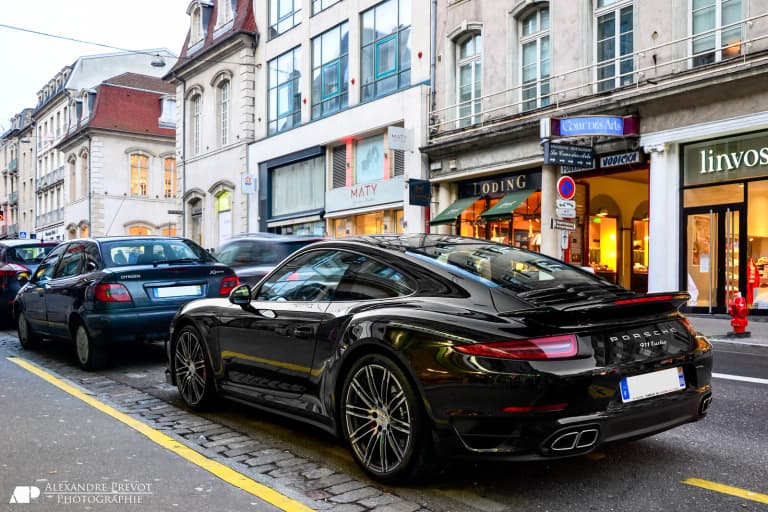
The 911 Stinger GTR is an aftermarket conversion by TopCar for the 991-generation Porsche 911 Turbo and Turbo S. It is not a Porsche factory derivative. TopCar describes a 24-panel carbon-composite exterior program that changes roughly 90 percent of the exterior, with a separate optional engine-output increase. Photos on this page show stock 991 Turbo donor cars, not Stinger GTR conversions.
In this article, we’ll cover what TopCar built, the power claim, and how to check a car.
Contents
What the Stinger GTR Is
TopCar presents the Stinger GTR as an aerodynamic body kit for the Porsche 991 Turbo and Turbo S. The conversion belongs in TopCar’s Porsche tuning catalog, alongside other company programs, not in a list of factory Porsche trims.
A clear name is “TopCar Stinger GTR conversion based on a Porsche 991 Turbo” or “Turbo S.” Use it once the donor is verified. Calling the car a “Porsche Stinger GTR” hides who built it. It also invites false ideas about factory engineering, warranty, or Porsche approval.
For the factory 911 family and purchase fundamentals, use the Porsche 911 guide and 911 buyer’s guide. Those pages own the base-car lineage. This page owns the TopCar conversion boundary. For other takes on a modified 911, see our RWB Porsche guide and Singer Porsche guide.
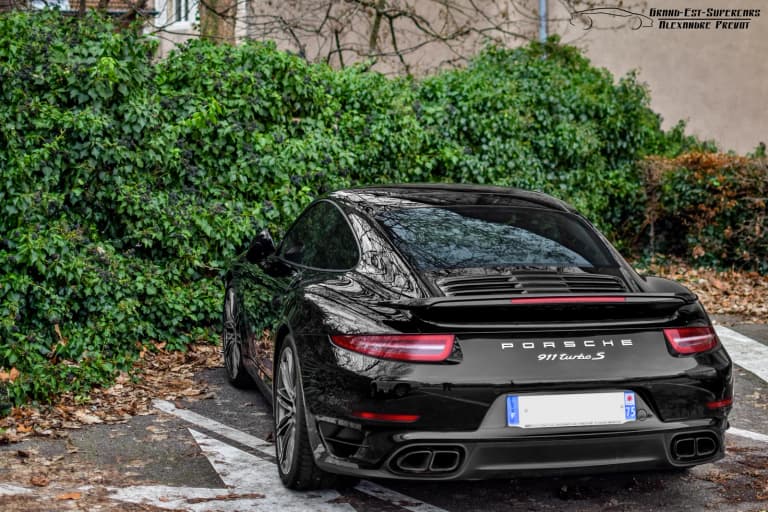
Stock 991 Turbo S, the donor model for the kit.
The 991 Turbo Donor
TopCar’s page names the 991 Turbo and Turbo S as the applicable donors. It does not establish the VIN, original specification, or service history of any individual converted car. Those facts still come from Porsche records and the car itself.
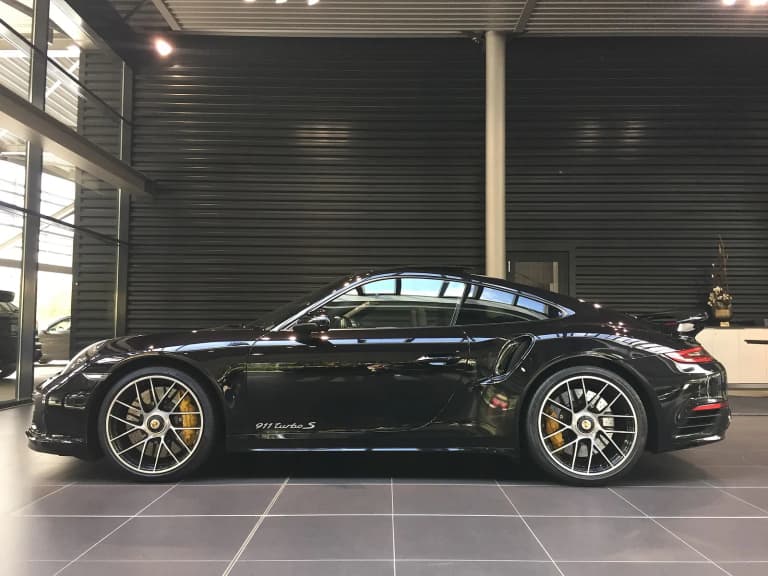
Stock 991 Turbo S side profile, before any TopCar conversion.
The donor check should happen before evaluating carbon weave or visual stance. Confirm whether the car began as a Turbo or Turbo S, its market, model year, original paint, factory options, accident record, and ownership trail. A conversion can preserve the donor’s identity while changing most of what the eye sees.
Do not infer the donor trim from badges added during the conversion. A VIN decoder, factory build sheet, and specialist inspection are stronger evidence.
The Carbon Body Conversion
What the kit includes
TopCar says the Stinger GTR kit consists of 24 Class-A carbon-fiber composite body panels and changes roughly 90 percent of the exterior. Its price list includes front and rear bumpers, front and rear fenders, door pads, side skirts, a hood, a front splitter, a rear diffuser, a rear spoiler, and air intake and outtake pieces.
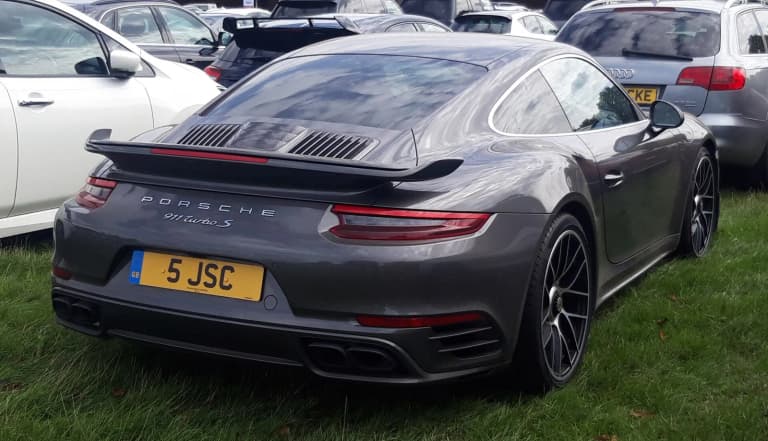
Stock 991.2 Turbo S rear. TopCar replaces most of these panels.
Finish and price
TopCar lists some parts as lacquered carbon and others as primed carbon. That difference affects how a completed car should be inspected. Exposed weave requires consistent alignment, resin finish, and UV protection. Painted carbon still needs evidence of substrate condition, fastening, and repair quality.
TopCar’s page lists euro prices, including €34,080 for the body kit with carbon parts, but a catalog figure is not an installed cost. Labor, paint, transport, taxes, wheels, exhaust, repair, and region can change the total. Treat the list as a guide to scope, not a quote.
Installation Scope
TopCar says several carbon panels are bonded to the steel body. It says the kit can be fitted professionally only at its specialized center, or at the client’s site by special request with TopCar specialists traveling. Its page says it can assemble two cars a month at its premises.
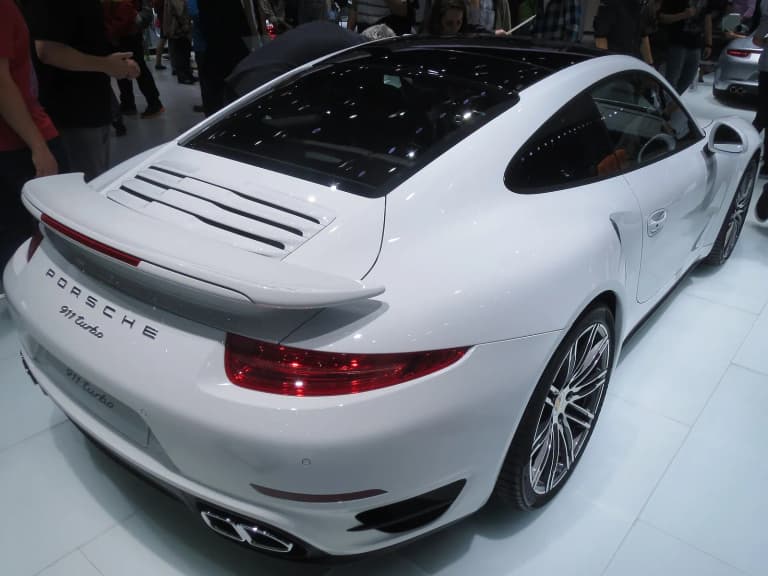
Stock 991 Turbo at IAA 2013, not a Stinger GTR.
Those are maker claims about its program, not proof that every car advertised today was completed there. A finished example may have been assembled by TopCar, by traveling company specialists, by another shop, or rebuilt after damage. Invoices should identify who performed each stage.
What to inspect on the body
Inspection should focus on panel gaps, bonding edges, fasteners, water sealing, lighting mounts, wheel-arch clearance, heat exposure around the exhaust, underside finish, and evidence of stress or cracking. Carbon can hide repairs behind paint or trim, so surface appearance alone is insufficient.
The Optional Performance Claim
TopCar’s page describes a separate “HP kit” that could increase output by 60 hp and 130 Nm. The wording is optional. It does not say every Stinger GTR received that work, and it does not publish a complete engine calibration, fuel requirement, test standard, or resulting total output for every donor. So check the paperwork before you trust a power number.
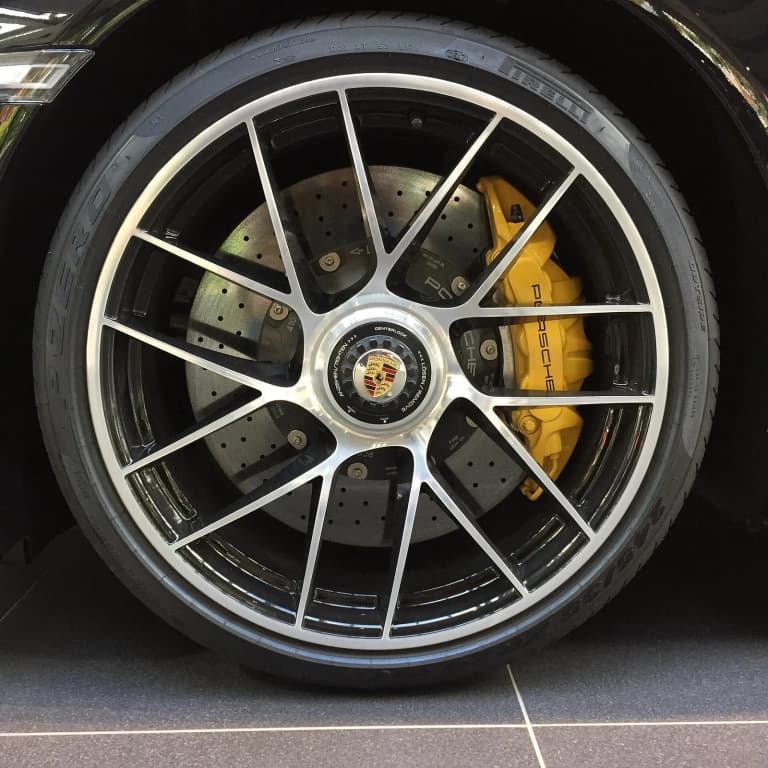
Factory 991 Turbo S wheel and brake, not TopCar parts.
A listing that repeats the increase should provide the original invoice, hardware list, software provider, dyno or diagnostic evidence, and maintenance implications. Later tuning may supersede the initial package. Without records, price and insure the car as a body conversion with stock power until a dyno sheet and invoice prove otherwise.
Wheels were also offered through an external partner. Their presence does not identify the engine package, and a similar wheel style does not authenticate the body conversion.
Factory and Aftermarket Identity
| Layer | Responsible party | Evidence to request |
|---|---|---|
| Original 991 Turbo/Turbo S | Porsche | VIN, build sheet, service and recall history |
| Stinger GTR exterior | TopCar program; installer must be verified | TopCar invoice, parts record, installation photos |
| Optional power work | TopCar or named tuner/installer | Invoice, calibration and hardware details |
| Later changes or repairs | Subsequent shops or owners | Dated receipts, images, measurements |
This layered identity also affects insurance, valuation, and parts supply. An insurer may need an agreed description of the modifications. A repairer needs to know which panels are TopCar parts and whether replacements remain obtainable. Local registration rules may treat width, lighting, exhaust, or output changes differently.
Documentation and Inspection
Begin with the donor. Verify VIN, trim, model year, title status, service record, recalls, and accident history. Then establish the conversion: dated TopCar paperwork, kit specification, installer, paint codes, assembly images, and any serial or authenticity documentation TopCar can confirm.
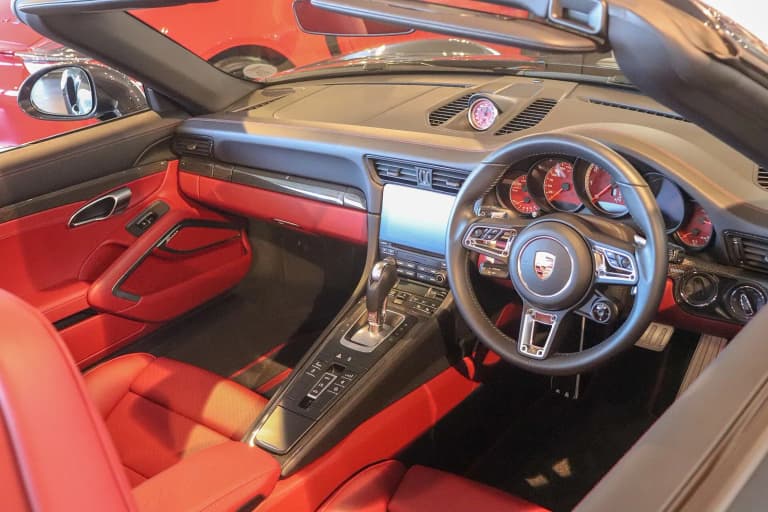
Stock 991 Turbo S Cabriolet cabin, not a converted car.
Ask a Porsche specialist to inspect the factory systems and a carbon-composite body expert to inspect the conversion. The two skill sets overlap but are not identical. Diagnostic scans, chassis measurement, paint-depth readings on retained steel panels, and close review of bonded joints can reveal issues a general visual check misses.
Finally, confirm tires, wheel offsets, suspension alignment, brake condition, cooling airflow, exhaust clearance, and calibration behavior. A wide-body appearance should not be treated as evidence that geometry or thermal management was validated after later changes.
Frequently Asked Questions
Is the Stinger GTR an official Porsche 911 model?
No. Stinger GTR is TopCar’s name for an aftermarket conversion offered for the 991-generation Porsche 911 Turbo and Turbo S. Porsche built the donor car; TopCar designed and supplied the conversion.
Which Porsche 911 does the TopCar Stinger GTR use?
TopCar’s official Stinger GTR page identifies the donor as the 991-generation Porsche 911 Turbo or Turbo S. A seller should document the exact donor VIN, model year, original trim, and subsequent work.
What does the Stinger GTR body kit include?
TopCar describes 24 Class-A carbon-fiber composite body panels and says roughly 90 percent of the exterior is changed. Its price list includes front and rear bumpers, front and rear fenders, door pads, side skirts, a hood, a rear diffuser, and a rear spoiler.
Does every Stinger GTR have more engine power?
No. TopCar describes a separate optional increase of 60 hp and 130 Nm. The body conversion alone does not prove that an engine package was installed or that a present-day car produces a specific output.
What should I inspect on a used Stinger GTR conversion?
Verify the donor VIN, factory specification, and accident history. Ask for TopCar invoices and the installer’s name. Then check panel bonding, gaps, carbon finish, wheel clearance, tuning changes, and local registration and insurance.
Image Credits
All images via Wikimedia Commons. Photos show standard donor cars, not Stinger GTR conversions.
- Standard 991 Turbo (hero) by Alexandre Prévot, CC BY-SA 2.0.
- Standard 991 Turbo S by Alexandre Prévot, CC BY-SA 2.0.
- Standard 991 Turbo S, side by KarleHorn, CC BY 3.0.
- Standard 991.2 Turbo S, rear by MrWalkr, CC BY-SA 4.0.
- Standard 991 Turbo, IAA 2013 by LukWe99, CC BY-SA 4.0.
- Standard 991 Turbo S wheel by KarleHorn, CC BY 3.0.
- Standard 991 Turbo S Cabriolet interior by Vauxford, CC BY-SA 4.0.