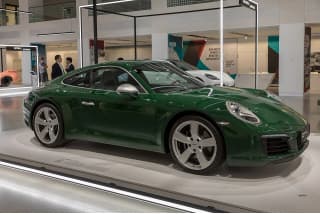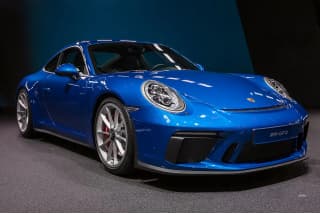
The Porsche 911 is a rear-engine, flat-six sports car with a lineup spanning 380 hp to 518 hp. Ferrari builds mid-engine V6, V8, and V12 supercars starting at roughly $275,000. The 911 is the better daily driver, more reliable, and cheaper to own. Ferrari offers more raw power and exclusivity for the money.
In this article, we’ll compare the Porsche 911 with Ferrari’s mid-engine 296 GTB and F8 Tributo. We’ll cover engine layout, straight-line speed, running costs, and resale value.

Contents
- 1 Quick Summary
- 2 What Are You Actually Comparing?
- 3 Engine and Layout
- 4 Performance
- 5 Pricing
- 6 Daily Driving and Practicality
- 7 Reliability and Ownership Costs
- 8 Interior and Technology
- 9 Design and Presence
- 10 Depreciation and Resale
- 11 Track Capability
- 12 Which Ferraris Compete With the 911?
- 13 Specs Comparison Table
- 14 FAQs
Quick Summary
- Porsche 911 (992): Rear-engine, twin-turbo flat-six, 380 to 518 hp (Carrera through GT3 RS), starts at $120,100
- Ferrari 296 GTB: Mid-engine, twin-turbo V6 hybrid, 819 hp combined, starts around $275,000
- Ferrari F8 Tributo: Mid-engine, twin-turbo V8, 710 hp, started around $280,000 (discontinued 2023)
- Better daily driver: Porsche 911
- More power per dollar: Porsche 911 Turbo S
- Lower ownership costs: Porsche 911
- More exclusivity: Ferrari
What Are You Actually Comparing?
The Porsche 911 and Ferrari are not direct competitors in the traditional sense. Porsche builds one sports car platform in dozens of variants, from a 380 hp base Carrera to a 518 hp GT3 RS. Ferrari builds individual mid-engine supercars, each designed around a specific engine and philosophy. The two brands overlap in price at the top end of the 911 range and the entry point of Ferrari’s lineup.
A base Porsche 911 Carrera costs about $120,000. A 911 Turbo S costs about $236,000. The most expensive 911 variants like the GT3 RS and S/T push past $250,000 with options. That upper range is where Ferrari’s current models begin. The 296 GTB starts around $275,000 and the Roma was priced at roughly $220,000 before it was discontinued.
So the real comparison comes down to this: should you spend $150,000 to $250,000 on a top-tier 911, or put that money toward a Ferrari? Both are valid choices. They just deliver completely different experiences.
Engine and Layout
The fundamental difference between these two cars is where the engine sits and how many cylinders it has. The Porsche 992 puts its engine behind the rear axle. Every 911 uses a variation of the flat-six, ranging from a 3.0L twin-turbo in the Carrera models to a 4.0L naturally aspirated unit in the GT3 and GT3 RS. The 992.2 GTS introduced a hybrid system paired to a 3.6L turbo flat-six making 534 hp plus 54 hp from an electric motor.
Ferrari takes the opposite approach. The 296 GTB uses a 120-degree twin-turbo V6 with a plug-in hybrid system, producing a combined 819 hp. The now discontinued F8 Tributo used a 3.9L twin-turbo V8 making 710 hp. Ferrari’s engines are mid-mounted, sitting behind the driver and ahead of the rear axle. This layout gives the car a lower polar moment of inertia, which translates to sharper turn-in and more balanced weight distribution.

The 911’s rear-engine layout is unusual in the sports car world. It puts more weight over the driven wheels, which is excellent for traction but requires careful chassis tuning to prevent oversteer. Porsche has spent 60 years refining this layout, and the 992 is the most composed rear-engine car ever built.
Performance
On paper, Ferrari wins the horsepower war at almost every price point. The 296 GTB produces 819 hp from its hybrid V6 powertrain. The F8 Tributo made 710 hp from its twin-turbo V8. Even the Ferrari Roma delivered 612 hp. By contrast, the most powerful production 911, the Turbo S, makes 641 hp from its 3.7L twin-turbo flat-six.
Straight-line acceleration tells a closer story. The 992 Turbo S hits 60 mph in 2.7 seconds and tops out at 205 mph. The Ferrari 296 GTB reaches 60 mph in 2.9 seconds with a top speed over 205 mph. The F8 Tributo also hit 60 mph in 2.9 seconds with a 211 mph top speed. The Turbo S matches or beats both Ferraris to 60 mph despite making less power, thanks to its all-wheel-drive launch capability and PDK gearbox.

The 911 GT3 and GT3 RS take a different approach entirely. Rather than chasing peak power numbers, Porsche gave these cars a 4.0L naturally aspirated flat-six that revs to 9,000 rpm. The GT3 makes 503 hp, which sounds modest next to an 819 hp Ferrari. But the GT3 RS lapped the Nurburgring Nordschleife in 6:44.8, faster than almost any road-legal Ferrari.
Pricing
This is where the 911 has a massive advantage. The Porsche 911 lineup covers a huge price range, starting at $120,100 for the base Carrera and climbing to $236,100 for the Turbo S. Ferrari’s current entry point, the 296 GTB, starts around $275,000. A typical Ferrari order with options lands between $300,000 and $400,000.
| Model | Base Price (MSRP) | Power |
|---|---|---|
| 911 Carrera | $120,100 | 380 hp |
| 911 Carrera S | $137,400 | 443 hp |
| 911 GTS | $157,500 | 534 hp |
| 911 Turbo S | $236,100 | 641 hp |
| 911 GT3 | $180,500 | 503 hp |
| 911 GT3 RS | $225,250 | 518 hp |
| Ferrari 296 GTB | ~$275,000 | 819 hp |
| Ferrari F8 Tributo | ~$280,000 | 710 hp |
For the price of one Ferrari 296 GTB, you could buy a fully loaded 911 Turbo S and still have money left over. The Turbo S will match the Ferrari in acceleration and beat it in foul weather grip. Price per horsepower favors the Porsche heavily across the entire lineup.
Daily Driving and Practicality
The 911 was designed from day one to be a car you can live with every day. It has a front trunk (frunk) that fits a carry-on bag and a set of golf clubs. The rear seats are small but functional for children or extra luggage. Visibility is good by sports car standards, and the driving position is comfortable for long highway stints.
Ferrari’s mid-engine cars are not daily drivers in the same sense. The 296 GTB has limited cargo space, no rear seats, and a cabin that prioritizes drama over comfort. Ground clearance is low enough that speed bumps and parking garage ramps require caution. The ride is firm even in its softest setting. You can daily drive a Ferrari, but it demands compromises that the 911 does not.

Fuel economy also favors the 911. The base Carrera returns roughly 20 to 24 mpg in mixed driving. A Ferrari 296 GTB averages around 15 to 18 mpg with the hybrid system assisting, and the F8 Tributo averaged about 14 to 17 mpg. These numbers add up over a year of regular use.
Reliability and Ownership Costs
Porsche consistently ranks among the most reliable luxury car manufacturers in owner surveys. The 911 in particular has a strong reliability record. Routine maintenance on a 911 costs roughly $1,500 to $3,000 per year depending on the model and driving habits. A major service at an independent Porsche specialist runs $2,000 to $4,000.
Ferrari ownership costs are in a different league. An annual service at a Ferrari dealer typically costs $3,000 to $5,000 for basic maintenance. The F8 Tributo’s engine-out service (required at certain mileage intervals) can run $8,000 to $15,000. Tires for a Ferrari cost 30% to 50% more than equivalent fitments for a 911. Insurance premiums on a Ferrari are significantly higher too, often double what a 911 Turbo S costs to insure.
Ferrari also requires that all warranty and recall work be performed at authorized dealers. Porsche is more flexible, and the independent Porsche specialist network is large and well established. This keeps competition healthy and prices reasonable for 911 owners.
Interior and Technology
The 992’s interior is clean, driver-focused, and well built. The center console has physical buttons for key functions, and the 10.9-inch touchscreen handles navigation, media, and Apple CarPlay. The optional Sport Chrono package adds a lap timer to the dashboard. Material quality is excellent, with leather, aluminum, and soft-touch surfaces throughout.

Ferrari interiors are more theatrical. The 296 GTB puts most controls on a large central touchscreen and the steering wheel, which has touch-sensitive pads for turn signals, wipers, and driving modes. The digital instrument cluster is configurable. Build quality is high, but some owners find the touch-heavy interface frustrating compared to Porsche’s more conventional layout.
Both brands offer extensive personalization programs. Porsche Exclusive Manufaktur lets you customize colors, materials, and trim. Ferrari’s Tailor Made program offers similar options but at a higher price point. A fully optioned Ferrari can easily add $50,000 to $100,000 in personalization costs.
Design and Presence
A Ferrari turns heads everywhere it goes. The prancing horse badge carries a cultural weight that few other automotive brands can match. Pulling up in a red 296 GTB will get a reaction at every gas station, valet stand, and parking lot. That presence is part of what you pay for when you buy a Ferrari.
The 911’s design is more subtle. Its silhouette has evolved gradually over 60 years, and while car enthusiasts recognize it instantly, the average person may not give it a second look unless it is a GT3 RS with its massive rear wing. The 911 communicates success without shouting. For some buyers, that restraint is exactly the point.

Ferrari also controls who can buy its cars. The allocation process for new models often requires an existing purchase history with the brand. Porsche has fewer restrictions on new car purchases, though limited-edition models like the GT3 RS and S/T also involve allocation lists and dealer relationships.
Depreciation and Resale
Both brands hold their value better than most luxury cars, but the patterns differ. The 911 depreciates predictably. A 992 Carrera S loses roughly 10% to 15% of its value in the first two years, then stabilizes. GT3 and Turbo S models often hold their value or appreciate, especially manual-transmission cars and limited editions.
Ferrari depreciation is less predictable. Some models hold value extremely well. The F8 Tributo traded at or above MSRP during the 2021 to 2023 market peak, then corrected significantly as supply caught up. The 296 GTB has followed a similar pattern. Ferrari’s strategy of limiting production helps protect values, but it is not a guarantee. The Roma, for example, depreciated more than most Ferrari owners expected.
One important difference: Ferrari charges a premium to get on allocation lists for desirable new models. If you want a shot at buying the next limited-run Ferrari, you need to build a purchase history. That means buying and holding previous models, which ties up capital. Porsche’s allocation process is less demanding for most models.
Track Capability
Both the 911 and Ferrari perform exceptionally on a racetrack, but the 911 has a structural advantage for track enthusiasts. Porsche offers dedicated track-focused variants, the GT3 and GT3 RS, that are designed from the ground up for circuit driving. The GT3 has a roll cage option, adjustable suspension, and can be ordered with a six-speed manual transmission.

The GT3 RS lapped the Nurburgring Nordschleife in 6:44.8, which is faster than the Ferrari 488 Pista’s time. It generates 860 kg of downforce at 285 km/h through active aerodynamic elements including a large rear wing with DRS. Porsche also encourages track use. The warranty is more accommodating of track driving than Ferrari’s, and Porsche Experience Centers offer track instruction programs for owners.
Ferrari’s cars are fast on track, but the ownership culture is different. Many Ferrari owners are cautious about tracking their cars due to warranty concerns, high consumable costs (brake pads, tires), and the risk of losing allocation privileges if a car is heavily modified or damaged. The 296 GTB’s hybrid system also adds complexity that some track day regulars prefer to avoid.
Which Ferraris Compete With the 911?
Ferrari 296 GTB
The 296 GTB is Ferrari’s current mid-engine “entry” model (though calling a $275,000 car entry-level is generous). Its 3.0L twin-turbo V6 hybrid makes 819 hp combined. It competes most directly with the 911 Turbo and Turbo S on performance, though it costs about $40,000 more than the Turbo S.

The 296 GTB also offers a track-focused Assetto Fiorano package with lighter carbon fiber components, revised springs, and a fixed rear spoiler. With that option fitted, it edges closer to GT3 RS territory in terms of lap time capability.
Ferrari F8 Tributo (Discontinued)
The F8 Tributo was Ferrari’s twin-turbo V8 mid-engine sports car from 2019 to 2023. It made 710 hp and hit 60 mph in 2.9 seconds. On the used market in 2026, F8 Tributos trade between $250,000 and $320,000 depending on mileage and spec. The F8 Tributo is a direct competitor to the 911 Turbo S in terms of performance and price.
Ferrari Roma (Discontinued)
The Roma was Ferrari’s front-engine grand tourer, positioned as a more refined and livable alternative to the mid-engine models. It made 612 hp from a 3.9L twin-turbo V8 and cost around $220,000 new. The Roma competed more with the 911 Carrera GTS and Turbo in character, though it had a very different personality. Production ended in 2024.
Specs Comparison Table
| Spec | 911 Turbo S | Ferrari 296 GTB | Ferrari F8 |
|---|---|---|---|
| Engine | 3.7L TT flat-six | 3.0L TT V6 hybrid | 3.9L TT V8 |
| Power | 641 hp | 819 hp (combined) | 710 hp |
| Torque | 590 lb-ft | 546 lb-ft | 568 lb-ft |
| 0 to 60 | 2.7 sec | 2.9 sec | 2.9 sec |
| Top Speed | 205 mph | 205+ mph | 211 mph |
| Weight | 3,616 lbs | 3,395 lbs | 3,164 lbs |
| Layout | Rear, AWD | Mid, RWD | Mid, RWD |
| Transmission | 8-speed PDK | 8-speed DCT | 7-speed DCT |
| Base Price | $236,100 | ~$275,000 | ~$280,000 |
Frequently Asked Questions
Is a Porsche 911 as fast as a Ferrari?
The Porsche 911 Turbo S is as fast or faster than most Ferraris in a straight line. It hits 60 mph in 2.7 seconds, which matches or beats the Ferrari 296 GTB (2.9 seconds) and the F8 Tributo (2.9 seconds). The 911 GT3 RS also posts faster Nurburgring lap times than most production Ferraris.
Is a Porsche 911 cheaper to maintain than a Ferrari?
Yes. Annual maintenance on a 911 typically costs $1,500 to $3,000 at an independent specialist. Ferrari annual service costs $3,000 to $5,000 at a dealer, and major services can run $8,000 to $15,000. Insurance, tires, and brake consumables are also significantly cheaper on the 911.
Can you daily drive a Ferrari like a Porsche 911?
You can daily drive a Ferrari, but the 911 is better suited for it. The 911 has a front trunk, optional rear seats, better visibility, higher ground clearance, and a more comfortable ride. Ferrari’s mid-engine cars require more caution around speed bumps and tight parking situations.
Which holds its value better, a Porsche 911 or a Ferrari?
Both hold value well compared to other luxury cars. Limited-production Ferraris can appreciate significantly, but standard models like the Roma have depreciated faster than expected. The 911 GT3, GT3 RS, and Turbo S consistently hold value or appreciate, especially manual-transmission examples.
Why is the Porsche 911 Turbo S faster to 60 mph than a more powerful Ferrari?
The 911 Turbo S uses all-wheel drive, which gives it superior traction off the line compared to rear-wheel-drive Ferraris. Its 8-speed PDK gearbox also launches with minimal wheel spin. Ferrari’s rear-wheel-drive layout produces more dramatic acceleration but sacrifices some launch consistency.
Should I buy a used Ferrari or a new Porsche 911 Turbo S?
A used Ferrari F8 Tributo and a new 911 Turbo S cost roughly the same ($230,000 to $280,000). The Turbo S comes with a full factory warranty, lower running costs, and all-weather capability. The F8 offers more power, a mid-engine layout, and the Ferrari badge. It depends on whether you prioritize ownership experience or driving theater.
Images: Porsche 992 Carrera S coupe by Alexander Migl, CC BY-SA 4.0. Ferrari 296 GTB by Alexander Migl, CC BY-SA 4.0. Porsche 992 Turbo S by Alexander Migl, CC BY-SA 4.0. Ferrari F8 Tributo by Alexander Migl, CC BY-SA 4.0. Porsche 992 GT3 with touring package by Alexander Migl, CC BY-SA 4.0. Ferrari F8 Spider by Alexander-93, CC BY-SA 4.0. Porsche 911 GT3 RS by Alexander-93, CC BY-SA 4.0. Ferrari 296 GTB by Alexander Migl, CC BY-SA 4.0. Via Wikimedia Commons.