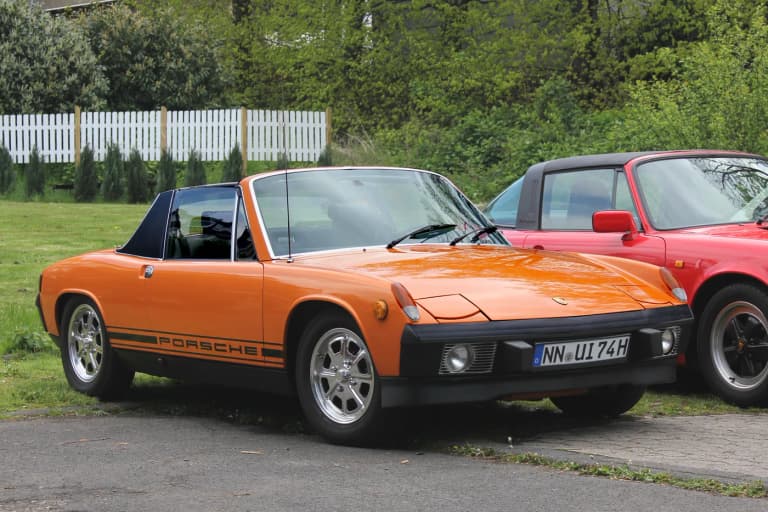
The Porsche 914 was a mid-engined, targa-topped two-seater built jointly by Porsche and Volkswagen from 1969 to 1976. Most cars were four-cylinder 914/4 models using a Volkswagen flat-four, while the rarer 914/6 used a Porsche flat-six. Long dismissed as the “VW-Porsche,” it has become a respected and increasingly collectible classic, especially the six-cylinder cars.
In this article, we’ll explain the Porsche 914, the mid-engine sports car built jointly with Volkswagen. We’ll cover the 914/4, the rare 914/6, its handling, and current values.
Contents
What Is the Porsche 914
The Porsche 914 was a small, mid-engined sports car with a removable targa roof panel, sold from 1969 to 1976. It was unusual for Porsche in two ways: it placed the engine in the middle of the car rather than at the rear, the layout Porsche had used since its first production car, and it was developed as a joint project with Volkswagen.
That dual parentage shaped everything about the car, including how buyers saw it. In Europe it was badged and sold as the VW-Porsche, which created lasting confusion about whether it was a “real” Porsche. In the United States it was sold purely as a Porsche, where it became the brand’s entry-level model and biggest seller.
The 914 replaced the four-cylinder 912 at the bottom of the Porsche range. For many buyers in the early 1970s it was their first Porsche, an affordable, lightweight, fun-handling car that looked unlike anything else on the road. When it was retired, the water-cooled Porsche 924 took over as the entry-level Porsche and carried that role into the 1980s.
The VW-Porsche Collaboration
By the late 1960s both companies needed a new model. Porsche wanted an affordable car to sit below the 911, and Volkswagen wanted a sporty flagship to replace the Karmann Ghia. The two firms agreed to develop one car to serve both needs, with Karmann building the bodies.
The plan was for Volkswagen to sell a four-cylinder version and Porsche to sell a more powerful six-cylinder version. Business and political complications between the companies muddied that arrangement, which contributed to the car’s awkward early reputation. Even so, the basic engineering was sound and genuinely modern.
The 914 Models: 914/4 and 914/6
The vast majority of 914s were four-cylinder 914/4 models. These used Volkswagen’s fuel-injected Type 4 flat-four engine, mounted amidships. The original 1.7-liter unit produced 80 horsepower, and later cars offered 1.8-liter and 2.0-liter versions, with the 2.0 making around 100 horsepower.
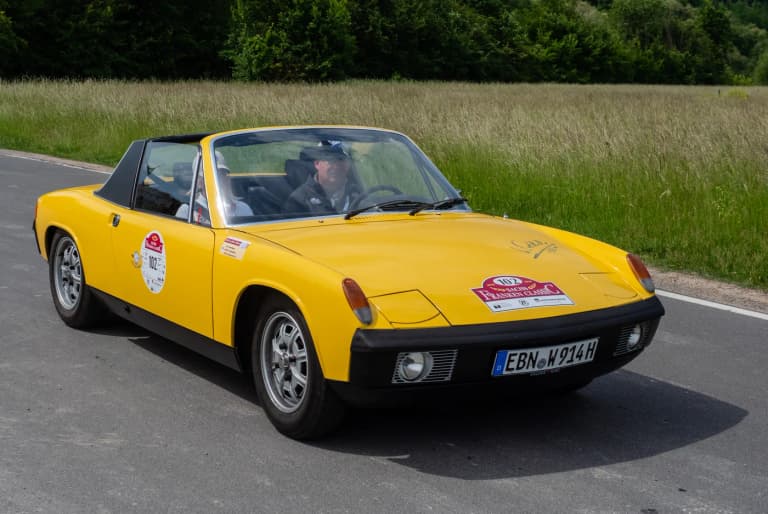
The 914/4 was the most affordable way into Porsche ownership at the time, and it sold in large numbers. Total 914 production reached nearly 119,000 cars, the overwhelming majority of them four-cylinder models. For 1970s buyers, the appeal was a genuine mid-engine sports car at a price far below the 911.
The 914/6: The Porsche-Engined Car
The car enthusiasts now chase is the 914/6. It used a 2.0-liter air-cooled flat-six taken from the 911 T, producing around 110 horsepower. With a proper Porsche engine in the middle of a light chassis, the 914/6 was genuinely quick and beautifully balanced.
The problem at the time was price. The 914/6 cost so much more than the four-cylinder car that it came uncomfortably close to a basic 911, and buyers struggled to justify it. As a result only around 3,300 were built before the model was dropped after 1972, making it far rarer than the four-cylinder cars. Porsche pushed the same platform further with the fixed-roof, six-cylinder Porsche 916 prototypes.
There was also a racing version, the 914/6 GT, which competed successfully in international events and even finished strongly at Le Mans. Those GT cars are now among the most valuable 914s of all.
Layout and Driving Character
The 914’s mid-engine layout gives it a balance that the rear-engined 911 of the era could not match. The weight sits between the axles, so the car turns in cleanly and behaves predictably at the limit. For a small, light car, it handles in a way that still feels modern.
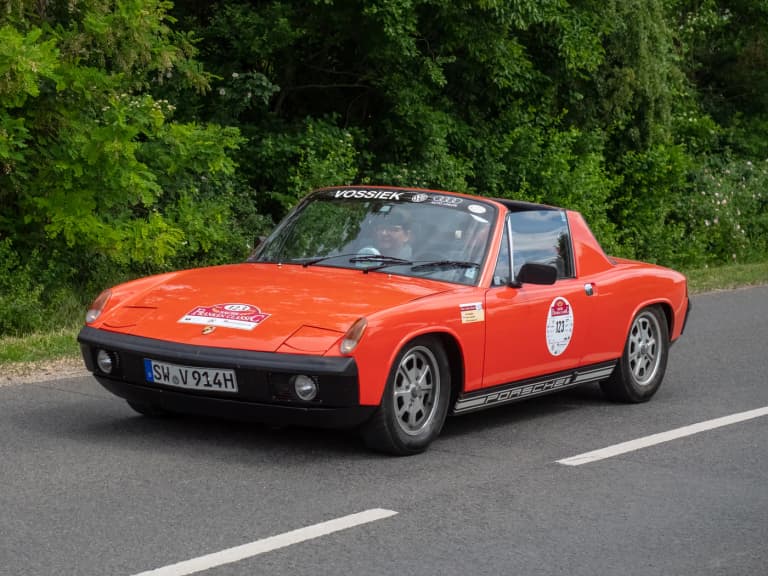
The trade-off is the engine note and outright pace. The four-cylinder cars are not fast by modern standards, and the VW-derived engine lacks the charisma of a Porsche flat-six. The driving reward comes from the handling, the low weight, and the open-air targa experience rather than from straight-line speed.
From Outsider to Cult Classic
For years the 914 was the Porsche enthusiasts looked down on. The shared Volkswagen engineering, the modest four-cylinder performance, and the styling all worked against it among purists who wanted a “proper” 911.
That view has shifted significantly. As values of air-cooled 911s climbed out of reach, buyers rediscovered the 914 as an affordable, characterful, well-handling classic with genuine Porsche history. The mid-engine layout, once seen as odd, now reads as ahead of its time and a clear ancestor of Porsche’s modern mid-engine cars.
Values, Buying, and Ownership
The 914 remains one of the more affordable classic Porsches, though the six-cylinder cars have moved well upmarket. Condition and originality matter enormously, because rust is the car’s biggest enemy.
| Variant | Condition | Approx. Value |
|---|---|---|
| 914/4 1.7 / 1.8 | Good driver | $15,000 to $30,000 |
| 914/4 2.0 | Good to excellent | $25,000 to $45,000 |
| 914/6 | Good to excellent | $70,000 to $150,000 |
| 914/6 GT (genuine) | Documented | $400,000 to $1,000,000+ |
Four-cylinder cars are still an attainable entry into classic Porsche ownership. The 914/6 has become a serious collector car, and genuine 914/6 GT race cars sit at the very top of the market. Beware of four-cylinder cars converted to six-cylinder power and sold as genuine 914/6 models; documentation is everything. Figures are 2026 estimates.
Ownership and Running Costs
Mechanically the 914/4 is simple and cheap to run, sharing much with the air-cooled Volkswagen world. Parts are available and the engineering is straightforward for any competent classic mechanic. The 914/6 is more expensive to maintain because of its Porsche flat-six.
Rust is the defining ownership issue. The 914 corrodes in the floors, the battery tray, the longitudinals, and the area around the windscreen and jacking points. Structural rust here is serious and expensive to fix properly. Any 914 purchase should hinge on a careful inspection of the metal, ideally by someone who knows the model.
Frequently Asked Questions
Is the Porsche 914 a real Porsche?
Yes. The 914 was developed jointly by Porsche and Volkswagen, but it was engineered as a Porsche model and sold as a Porsche in the United States. In Europe it was badged VW-Porsche, which created confusion, but it was always part of the Porsche range and replaced the 912 at the bottom of the lineup.
What is the difference between the 914/4 and 914/6?
The 914/4 uses a Volkswagen-derived flat-four engine of 1.7 to 2.0 liters, producing 80 to 100 horsepower. The 914/6 uses a 2.0-liter Porsche flat-six from the 911 T, producing around 110 horsepower. The 914/6 is far rarer, quicker, and much more valuable.
How many Porsche 914s were built?
Porsche and Volkswagen built nearly 119,000 examples of the 914 between 1969 and 1976. Only around 3,300 of those were the six-cylinder 914/6, which was discontinued after 1972 because its price was too close to that of the 911.
Why is the Porsche 914 mid-engined?
The 914 placed its engine between the axles for better weight distribution and handling balance. This mid-engine layout was modern for its time and set the 914 apart from the rear-engined 911, foreshadowing Porsche’s later mid-engine sports cars.
How much is a Porsche 914 worth?
Four-cylinder 914/4 cars typically trade between $15,000 and $45,000 depending on engine size and condition. The six-cylinder 914/6 ranges from roughly $70,000 to $150,000, and genuine 914/6 GT race cars can exceed $1,000,000. Rust-free, original cars command strong premiums.
What is the main problem with the Porsche 914?
Rust is the 914’s defining weakness. It corrodes in structural areas including the floors, battery tray, longitudinals, and around the windscreen. Hidden structural rust is expensive to repair, so a thorough metal inspection is essential before buying any 914.
Images: Hero orange 914 by Lothar Spurzem, CC BY-SA 2.0 DE. Yellow 914/4 and 914 side profile by Reinhold Möller, CC BY-SA 4.0. Via Wikimedia Commons. Value figures are 2026 market estimates.