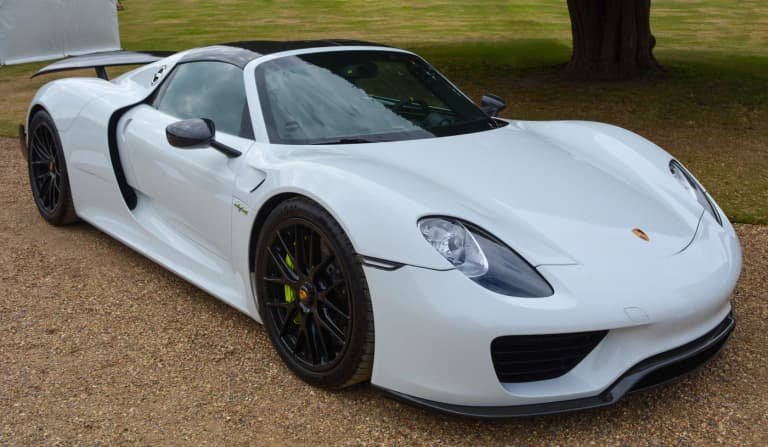
The Porsche 918 Spyder is a 2013 to 2015 plug-in hybrid hypercar limited to 918 cars. Its 4.6-liter V8 and two electric motors produce 875 hp, while the optional Weissach Package cuts weight rather than adding power. Porsche recorded a 6:57 Nürburgring Nordschleife lap with a Weissach-equipped car.
Its V8, twin-motor hybrid system, driving modes, Weissach Package, and collector ownership picture explain its place in Porsche history.
Contents
Quick Summary
- Production: 918 cars, built from 2013 to 2015.
- Engine: A 4.6-liter naturally aspirated V8 and two electric motors.
- System output: 875 hp and 944 lb-ft of torque.
- Performance: 0 to 60 mph in 2.6 seconds and a 214 mph top speed.
- Weissach Package: About 77 lb lighter, with no extra system power.
- Record: A Weissach-equipped car recorded a 6:57 Nürburgring Nordschleife lap.
What Is the Porsche 918 Spyder
Earlier flagships such as the Porsche 959 used advanced all-wheel drive and turbocharging. The 918 applied electrification, pairing a 6.8 kWh battery pack and two electric motors with a naturally aspirated V8.
The car began life as a concept shown at the 2010 Geneva Motor Show. Response was strong enough that Porsche polled potential buyers, and within a year the production decision was confirmed. The production model was announced at the 2011 Frankfurt Motor Show and deliveries began in September 2013.
Porsche capped production at 918 examples to match the model designation. All 918 sold out before a single car was delivered. The United States was the largest single market, taking approximately 297 examples.
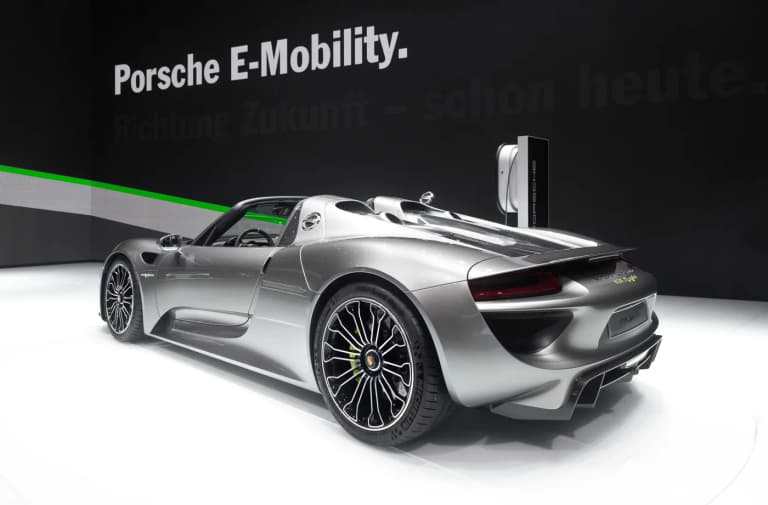
The 918 Spyder launched in the same generation as the McLaren P1 and Ferrari LaFerrari. All three used hybrid power to push performance beyond what an internal combustion engine alone could reach. Porsche’s approach differed in using a genuine plug-in hybrid system capable of running on electricity alone, rather than treating electrification purely as a performance supplement.
The Hybrid Powertrain
The mid-mounted 4.6-liter V8 made 608 hp at 8,700 rpm. Porsche added two electric motors. One sat on the front axle. The other connected to the seven-speed PDK at the rear.
The front electric motor produced around 127 horsepower and drove the front wheels independently. This gave the 918 all-wheel drive without a mechanical front driveshaft. The rear motor produced around 154 horsepower and worked alongside the V8 through the PDK. Combined peak output was 875 horsepower and 944 lb-ft of torque. Porsche’s later Taycan Turbo GT shows how far its electric performance program progressed.
Energy came from a 6.8 kWh lithium-ion battery pack mounted in a T-shape beneath the cabin. It provided up to 12 miles of pure electric driving range, enough for urban commuting. The battery could be recharged from a wall outlet or regenerated under braking. At speed, the electric motors operated as generators, harvesting energy that would otherwise be lost as heat.
The V8 itself was a remarkable unit separate from the hybrid story. It revved freely to 9,150 rpm and made peak power at the top of its rev range. Its sound was closer to a racing prototype than a road car. It was derived from Porsche’s Le Mans endurance racing program and built to close manufacturing tolerances.
Performance, Modes, and the Weissach Package
Porsche quoted 0 to 60 mph in 2.6 seconds for the 918. The electric motors delivered instant torque before the V8 reached its power band.
Official top speed is 214 mph (345 km/h). The V8 sustained high revs while the electric motors filled in torque through gear changes.
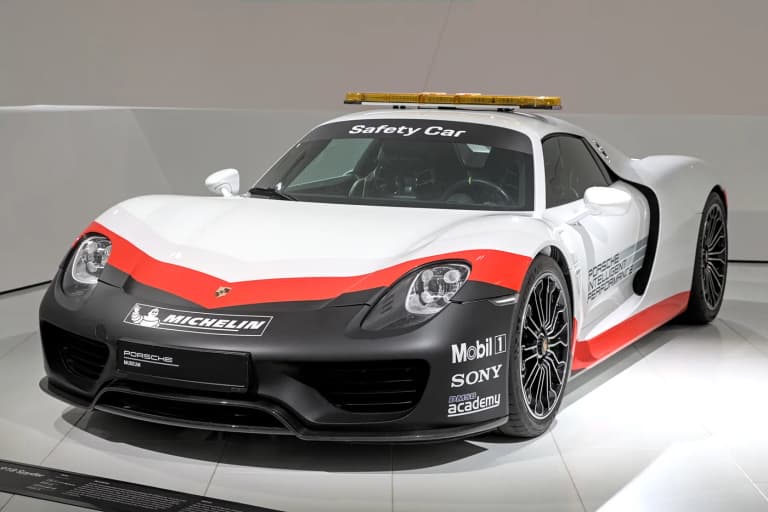
On September 4, 2013, Porsche driver Marc Lieb set a 6:57 Nürburgring Nordschleife lap in a 918. It was the first production car to lap the full 20.6-kilometer circuit in under seven minutes.
Driving Modes
The 918 offered four driving modes that changed how the V8 and electric motors worked together. Drivers selected them through a rotary switch on the steering wheel.
E-Power mode ran on electricity alone, drawing only from the battery pack and suppressing the V8. Range was around 12 miles at speeds up to 93 mph, sufficient for low-speed town driving. Hybrid mode kept the V8 running at normal operating efficiency while using the electric motors to fill in at lower speeds. The battery was conserved for use later in the drive.
Sport Hybrid mode held the battery at a higher state of charge for performance use. Both power sources stayed available through more of the rev range. Race Hybrid mode deployed every available joule for maximum acceleration and lap time. It made the full 875-horsepower output available without a conservation strategy.
The mode system gave the 918 real-world versatility its rivals could not offer. An owner could drive to a track on electric power. They could run the battery flat in Race Hybrid mode, then recharge overnight for the drive home.
The Weissach Package
Porsche offered an optional Weissach Package priced at around $84,000 on top of the base car. Named after Porsche’s development center in Weissach, Germany, it reduced the car’s weight by about 77 pounds through material substitution throughout.
The most visible change was forged magnesium wheels replacing the standard alloy wheels. Porsche described them as the lightest wheels it had fitted to a production car at that point. The front anti-roll bar and support struts were replaced with magnesium equivalents. The rear luggage compartment cover became carbon fiber. Some interior insulation was removed.
The package also added a fixed carbon fiber roll-over bar and a front aerodynamic element to reduce lift at speed. In testing the Weissach car covered 0 to 60 in around 2.5 seconds and posted a slightly faster Nürburgring time than the standard car. The Weissach-equipped example was the version Porsche used for the record run.
Chassis and Body
The 918 Spyder was built on a carbon-fiber reinforced plastic monocoque, which Porsche called the CFM. The floor structure, door sills, and front firewall were all carbon fiber. Aluminum subframes at the front and rear carried the suspension and drivetrain components, bolting directly to the carbon tub.
Suspension was double wishbones at all four corners with adaptive dampers. The front electric motor sat entirely within the front subframe, keeping mass centralized.
Carbon-ceramic brakes were fitted at both ends, with eight-piston calipers at the front and six-piston calipers at the rear.
Rear-axle steering came as standard. At low speeds, it turned the rear wheels fractionally opposite the fronts. At high speeds, it turned them the same way for stability.
Torque vectoring between the electric motors adjusted handling balance in real time. It optimized grip through each corner for the selected driving mode.
Interior and Design
The 918 Spyder was designed as an open roadster with two removable roof panels that stowed behind the seats. The cabin was narrow and track-focused, with carbon fiber visible across the sills, transmission tunnel, and door trims. The driving position was low and the windscreen tall, giving a view closer to a racing prototype than a traditional sports car.
The steering wheel housed the driving mode selector alongside traction, stability, and start-stop controls. Most other functions moved to a central touchscreen. Seats in higher-specification cars were fixed carbon buckets with no mechanical adjustment, relying instead on a movable pedal box to suit different drivers. The two targa-style roof panels were stored in the front luggage compartment beneath the bonnet.
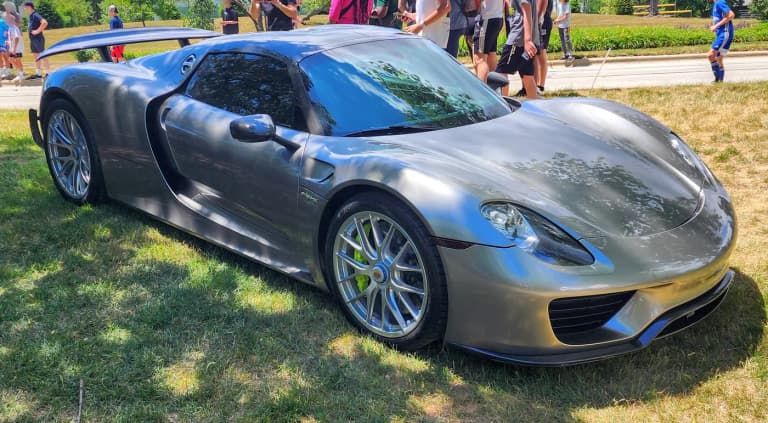
The exterior was shaped around aerodynamics and cooling. The front intakes directed air through the body and out near the top of the front clamshell. The rear had an active spoiler that deployed at speed. Two exhaust pipes exited through the rear clam, a layout taken directly from motorsport. The underbody was flat to generate downforce at speed.
Pricing and Values
The 918 Spyder launched at approximately $845,000 in the United States and €781,000 in Europe. The Weissach Package added $84,000. Most buyers added further options, and average transaction prices were reported above the base figure in most markets.
The 918 sold out before production began. By the time cars started arriving with owners, the used market had already moved prices above the original sticker. It was a car where buyers paid a premium simply to own one at all. This immediately set a trajectory that has continued since.
| Condition | Current Market Value |
|---|---|
| Standard, moderate mileage | $1,000,000 to $1,400,000 |
| Weissach Package | $1,200,000 to $1,800,000 |
| Exceptional example, low miles | $2,000,000+ |
Values reflect 2026 market estimates based on auction results and dealer listings. The 918 is treated as a future collectible in the same category as the Carrera GT. Mileage below 5,000 commands a significant premium. Weissach cars retain value best because they are the rarer, more desirable specification.
Ownership
Owning a 918 Spyder is unlike owning most other Porsches. The hybrid system requires specialist knowledge; battery management, electric motor seals, and charging infrastructure are not items that most Porsche centers encounter regularly. Porsche’s official service programme covers the 918, but access to technicians with direct experience on this specific car varies considerably by market.
The V8 itself is a high-revving unit that needs regular use to stay in good condition. Cars that have sat for extended periods can develop fuel system degradation and battery issues. A pre-purchase inspection by a Porsche specialist familiar with the 918’s hybrid architecture is essential before buying any used example.
Running costs are higher than for a standard sports car. Many service intervals require specialist tooling, and individual hybrid-system components have no secondary-market alternatives. Tires are bespoke Michelin Pilot Sport Cup 2 fitments sized specifically for the 918’s wheels.
Despite its complexity, the 918 has proven reliable by the standards of its class. Porsche overengineered the battery thermal management system and the V8’s lubrication. Early fears about long-term hybrid degradation have largely not materialized in documented owner experience.
Frequently Asked Questions
How many Porsche 918 Spyders were built?
Porsche built exactly 918 examples between September 2013 and June 2015. The production run was capped at that number to match the model designation. All 918 sold before deliveries began, with the United States receiving approximately 297 examples as the largest single allocation.
What is the Porsche 918 Spyder’s top speed?
Official top speed is 214 mph (345 km/h). The V8 sustains high revs while the electric motors fill in torque through gear changes.
What is the Weissach Package?
The Weissach Package was an $84,000 option. It reduced weight by about 77 pounds with magnesium wheels, carbon fiber panels, and less interior insulation. It also added a front aerodynamic element. Porsche used a Weissach-equipped car for its September 2013 Nürburgring record lap.
How does the 918’s hybrid system work?
The 918 uses a plug-in hybrid layout. Its 4.6-liter V8 drives the rear wheels through a seven-speed PDK. An independent front electric motor drives the front axle. A 6.8 kWh battery pack provides up to 12 miles of electric-only range. Four driving modes determine how the combustion and electric systems work together.
What did the Porsche 918 Spyder cost new?
The base price was approximately $845,000 in the United States and €781,000 in Europe. The Weissach Package added around $84,000. The car sold out before production started and most examples changed hands above the original sticker price almost immediately after delivery.
Is the Porsche 918 a good investment?
Yes, the Porsche 918 has risen substantially above its original purchase price. Weissach examples have appreciated strongly. The 918 shares its generation with the McLaren P1 and Ferrari LaFerrari, and collector interest in all three has remained firm. Low-mileage examples with documented service history and the Weissach Package command the strongest auction results.
Images: Hero by Chelsea Jay, CC BY-SA 4.0; Museum display by Alexander Migl, CC BY-SA 4.0; Rear view by Thomas Wolf (foto-tw.de), CC BY-SA 3.0 DE; Street by UltraTech66, CC BY-SA 4.0. Via Wikimedia Commons.