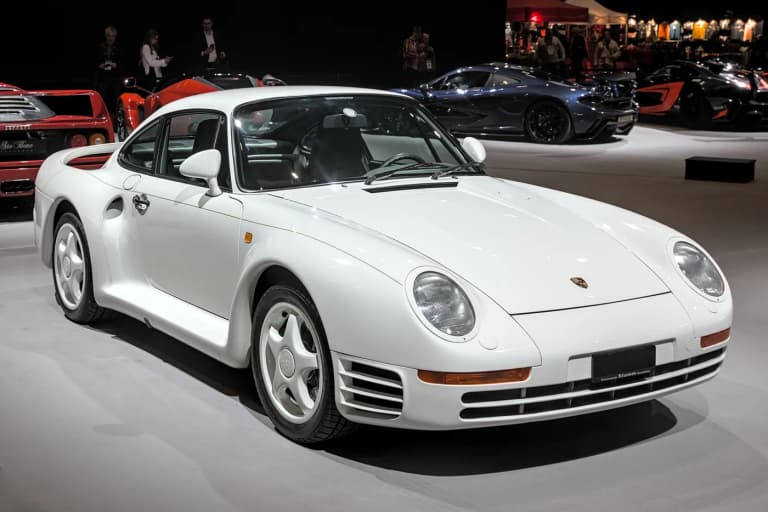
The Porsche 959 was the technological supercar of the 1980s, built from 1986 to 1988. Its sequential twin-turbo flat-six produced 444 horsepower and pushed it to nearly 197 mph, making it the fastest production car in the world at launch. It pioneered the advanced all-wheel-drive system that every turbocharged Porsche has used since, and only around 292 were built.
In this article, we’ll explain the Porsche 959, the technological supercar that predicted the future of Porsche performance. We’ll cover its twin-turbo engine, all-wheel drive, the Paris-Dakar win, and current values.
Contents
What Is the Porsche 959
The Porsche 959 was Porsche’s no-limits showcase of what the company could do when freed from cost and convention. Based loosely on the 911 body shape, it was packed with technology that was years, sometimes decades, ahead of anything else on the road.
When it arrived, the 959 was the fastest production car in the world, capable of nearly 197 mph. But raw speed was only part of the story. The 959 was also a demonstration of advanced engineering: all-wheel drive, sequential turbocharging, adjustable suspension, and tire-pressure monitoring, all in one car in 1986.
Porsche famously sold the 959 for less than half what it cost to build each one. It was never about profit. It was about proving what Porsche engineering could achieve, and almost every fast Porsche since has inherited something from it.
Born for Group B
The 959 began as a homologation project for Group B, the wild, technology-driven category of 1980s motorsport. The rules required a manufacturer to build a minimum number of road cars to qualify, so Porsche developed the 959 as the road-going basis for a Group B competitor.
By the time the 959 was ready, Group B had been canceled in the wake of several tragic accidents. The racing programme it was built for no longer existed. Rather than abandon the car, Porsche turned it into a road-going technology flagship and a rally weapon, and it became something far more significant than another race homologation special.
The Twin-Turbo Flat-Six
At the core of the 959 was a 2.85-liter flat-six derived from Porsche’s racing engines, specifically the units used in the 956 and 962 endurance cars. It used sequential twin turbocharging, with a small turbo for low-rev response and a larger one for top-end power, smoothing out the brutal lag that defined earlier turbo Porsches.
The result was 444 horsepower and a top speed close to 197 mph, figures that made the 959 the fastest production car on sale. The engine combined a water-cooled cylinder head design with air-cooled barrels, a sign of how aggressively Porsche was pushing its technology forward at the time.
All-Wheel Drive, Technology, and Variants
The single most influential feature of the 959 was its all-wheel-drive system. It could vary the split of power between the front and rear axles electronically, adapting to grip and conditions. This was revolutionary for a road car and shaped the direction of high-performance cars for decades.
That system led Porsche to a lasting decision: every turbocharged Porsche sports car after the 959 would use all-wheel drive. The modern 911 Turbo traces its all-wheel-drive DNA directly back to this car. The same philosophy shaped the 918 Spyder decades later, where independent electric motors at each axle took that idea further than any mechanical driveshaft could. The 959 also featured adjustable ride height, run-flat tires, tire-pressure monitoring, and lightweight hollow-spoke magnesium wheels.
Winning Paris-Dakar
With its Group B racing plans gone, Porsche proved the 959’s engineering in the brutal Paris-Dakar Rally. A rugged, raised version of the car was built for the desert, and it delivered emphatically.
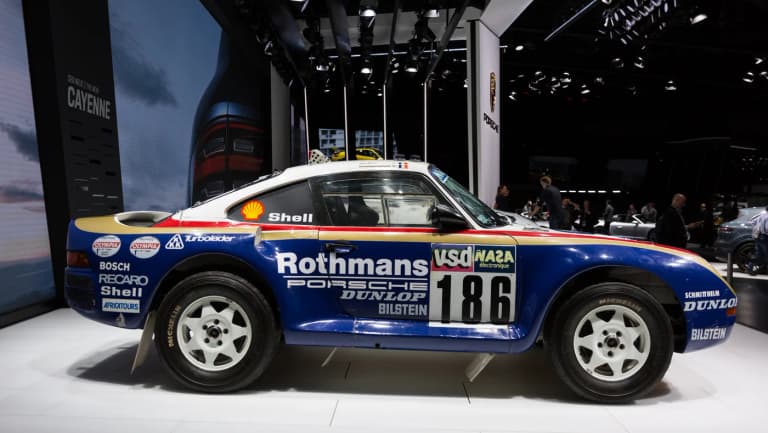
At the 1986 Paris-Dakar Rally, the Rothmans-liveried 959s finished first and second overall, with a third car also in the top six. Winning one of the toughest events in motorsport with a high-technology supercar was an extraordinary statement, and the blue-and-white Dakar 959 remains one of the most recognized rally Porsches ever.
Komfort and Sport
The 959 was offered in two main forms. The Komfort version was the luxurious flagship, with the full suite of electronic systems, adjustable suspension, and a well-appointed cabin. It was meant to be a usable, civilized supercar.
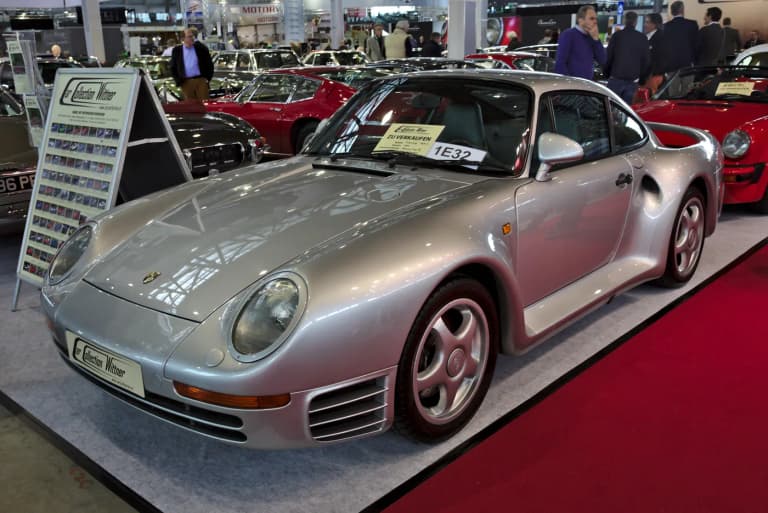
The Sport version stripped out some of the electronic complexity and weight in favor of a more focused, harder-edged driving experience. Built in far smaller numbers, the Sport is the more valuable of the two among collectors today. Both versions shared the same astonishing engine and core engineering.
Legacy and the US Import Saga
The 959 was never officially sold in the United States because it did not meet American crash-test and emissions certification, and Porsche declined to provide cars for destructive testing. This created one of the most famous import sagas in car history, with high-profile buyers unable to legally drive their cars.
The frustration eventually contributed to the creation of the “Show or Display” law in the United States, which allowed limited use of historically significant vehicles like the 959. That legal workaround is part of the car’s legend, and it underlines just how special the 959 was considered even decades later.
Values and Collectibility
With only around 292 built and a place in history as a genuine technological landmark, the 959 is a blue-chip collector car. Values have climbed far beyond its original price and continue to reflect its significance.
| Version | Condition | Approx. Value |
|---|---|---|
| 959 Komfort | Excellent | $1,300,000 to $2,000,000 |
| 959 Sport | Excellent | $2,000,000 to $3,500,000+ |
| 959 Dakar / works car | Documented history | $3,000,000 to $6,000,000+ |
These are seven-figure cars in any condition, and genuine works rally cars are essentially priceless to the right collector. Maintenance is highly specialized, with the complex twin-turbo engine and bespoke electronics requiring expert care. Figures are 2026 estimates and depend heavily on history and originality.
Frequently Asked Questions
Why is the Porsche 959 so important?
The 959 was the world’s fastest production car at launch and a showcase of technology that was years ahead of its time. Most importantly, it pioneered the advanced all-wheel-drive system that every turbocharged Porsche has used since, making it one of the most influential cars Porsche ever built.
How fast is the Porsche 959?
The 959 produced 444 horsepower from its sequential twin-turbo flat-six and reached close to 197 mph. That top speed made it the fastest production car in the world when it launched in the mid-1980s.
How many Porsche 959s were built?
Porsche built only around 292 examples in series production from 1987 to 1988, plus a small number of prototypes and works cars. The car was originally created to homologate a Group B racer, which required a minimum production run.
Did the Porsche 959 win Paris-Dakar?
Yes. At the 1986 Paris-Dakar Rally, the Rothmans-liveried 959s finished first and second overall, with a third car in the top six. It was a dramatic demonstration of the car’s engineering after its Group B racing programme was canceled.
Why was the Porsche 959 not sold in the United States?
The 959 did not meet US crash-test and emissions certification, and Porsche refused to supply cars for destructive testing. This kept it off American roads for years and eventually helped lead to the “Show or Display” law that now allows limited use of historically significant cars.
How much is a Porsche 959 worth?
A 959 Komfort typically trades between $1,300,000 and $2,000,000, while the rarer 959 Sport can exceed $3,500,000. Genuine works and Dakar cars are worth several million more. Condition, history, and originality drive the values.
Images: Hero white 959 and 959 front three-quarter by Alexander Migl, CC BY-SA 4.0. 959 Paris-Dakar car by Matti Blume, CC BY-SA 4.0. Via Wikimedia Commons. Value figures are 2026 market estimates.