The Porsche Carrera GT is a mid-engine hypercar built from 2004 to 2006, powered by a 5.7 liter naturally aspirated V10 making 603 hp and revving to 8,400 rpm. Its engine traces back to a canceled Le Mans prototype, and the car has no traction control or stability system, which is why it is remembered as the last great analog hypercar. Porsche built 1,270 of them, and good examples now trade well above a million dollars.
In this article, we’ll explain the Porsche Carrera GT, the analog V10 hypercar with no traction control. We’ll cover its V10 engine, ceramic clutch, current values, and 918 comparison.
Contents
- 1 What Is the Porsche Carrera GT
- 2 Quick Summary
- 3 The V10, Performance, and Chassis
- 3.1 Performance and Specs
- 3.2 Chassis, Brakes, and the Ceramic Clutch
- 4 Design and the Removable Roof
- 5 Why It Is Called an Analog Hypercar
- 6 Production and Why It Ended
- 7 Pricing and Value Today
- 8 Carrera GT vs 918 Spyder
- 9 Frequently Asked Questions
What Is the Porsche Carrera GT
The Carrera GT is the car Porsche built when it took a stranded racing engine and decided to put it on the road. It arrived in 2004 as the brand’s flagship hypercar, sitting far above the 911 in both price and ambition. The internal project code was Type 980.
At its heart is a 5.7 liter V10 that was never meant for a road car. The engine was developed for a Le Mans prototype program that Porsche canceled, and rather than waste it, the company built a car worthy of carrying it. The result was a 603 hp two-seater with a carbon fiber chassis, a removable roof, and almost no electronic driver aids.
That last point is what made the Carrera GT special and is also why it earned a fearsome reputation. It has no traction control and no stability control. The driver is responsible for everything, which is rare in a car this fast and is the reason enthusiasts now treat it as the high point of the analog hypercar era.
Quick Summary
Here is the Carrera GT at a glance.
| Production | 2004 to 2006 |
| Units built | 1,270 |
| Engine | 5.7 liter naturally aspirated V10 |
| Power | 603 hp (612 PS) at 8,000 rpm |
| Torque | 435 lb-ft at 5,750 rpm |
| Redline | 8,400 rpm |
| Gearbox | 6-speed manual, ceramic clutch |
| 0 to 60 mph | 3.5 seconds |
| Top speed | 205 mph (330 km/h) |
| Weight | 3,042 lb (1,380 kg) |
| Layout | Mid-engine, rear-wheel drive |
| Original price | $440,000 |
The V10, Performance, and Chassis
The Carrera GT engine is the most interesting part of the whole car. It is a 68 degree V10 displacing 5.7 liters, mounted longitudinally behind the cabin. It produces 603 hp at 8,000 rpm and revs all the way to 8,400 rpm, which gives it a sound and a top end closer to a race car than a road car.
The story behind it starts in Formula One. Porsche built a V10 for the Footwork team in the early 1990s, then later developed the design for a Le Mans prototype known internally as the LMP2000. When Porsche canceled the Le Mans project, the engine had nowhere to go. The Carrera GT gave it a home, which is why this road car carries a powertrain with genuine racing intent rather than a detuned version of something from the parts shelf.
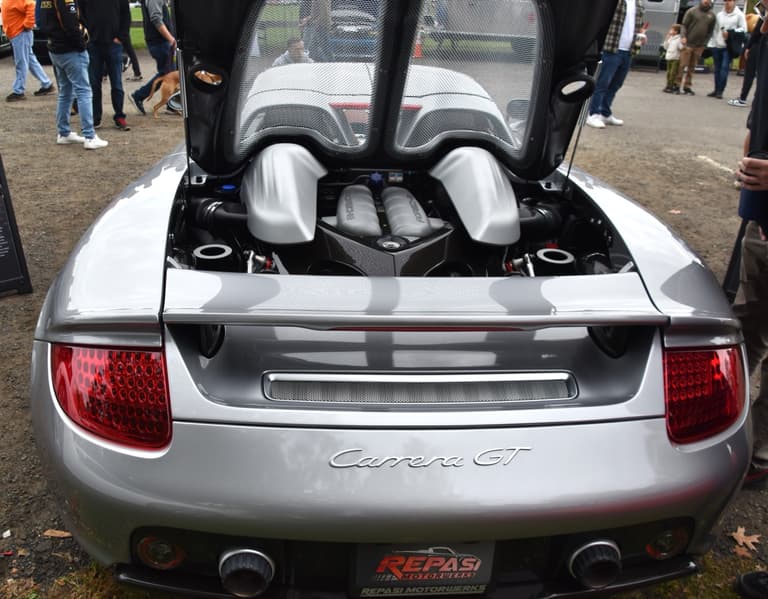
The engine uses an aluminum block and heads, forged titanium connecting rods, and sodium-cooled exhaust valves. These are the kind of materials you find in motorsport, not in a typical production car. Because it is naturally aspirated, the power builds with revs rather than arriving in a turbocharged surge, and the car demands that you use the full rev range to find its performance.
This racing heritage puts the Carrera GT in rare company. It shares the same spirit as Porsche’s purpose-built competition cars, from the early giant killers of the 1950s to the 911 GT1, which was a Le Mans racer first and a road car second.
Performance and Specs
The numbers were extreme for 2004 and still hold up today. The Carrera GT reaches 60 mph in 3.5 seconds and runs to a top speed of 205 mph. The standing quarter mile passes in just under 11 seconds.
What matters more than the headline figures is how the car delivers them. With 603 hp going through the rear wheels and no traction control, the performance is only available to a driver who knows how to manage it. The car recorded a Nürburgring Nordschleife lap of 7 minutes and 28 seconds, a serious time for a road car of its era.
This puts it firmly in the conversation about the quickest cars the brand has ever made. For where it sits in that history, see our guide to the fastest Porsche models.
Chassis, Brakes, and the Ceramic Clutch
The Carrera GT was one of the first road cars built around a full carbon fiber monocoque. The tub and subframe were produced in Italy, and this construction kept the curb weight down to 1,380 kg despite the size of the engine and the strength of the structure.
The suspension uses pushrod-actuated coilover dampers with double wishbones, a layout borrowed straight from racing. Braking comes from ceramic composite discs measuring 380 mm, which resist fade far better than steel under repeated hard use.
The most talked-about component is the clutch. Porsche fitted a small-diameter twin-plate ceramic clutch and mounted it very low in the car to lower the center of gravity. The trade-off is that it is notoriously difficult to operate smoothly from a standstill. The biting point is narrow and the clutch is unforgiving, which is one reason the Carrera GT has a reputation for catching out drivers who underestimate it.
Design and the Removable Roof
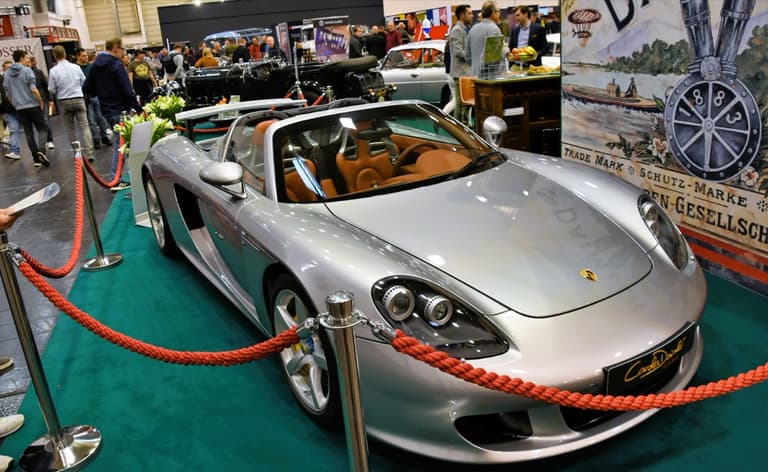
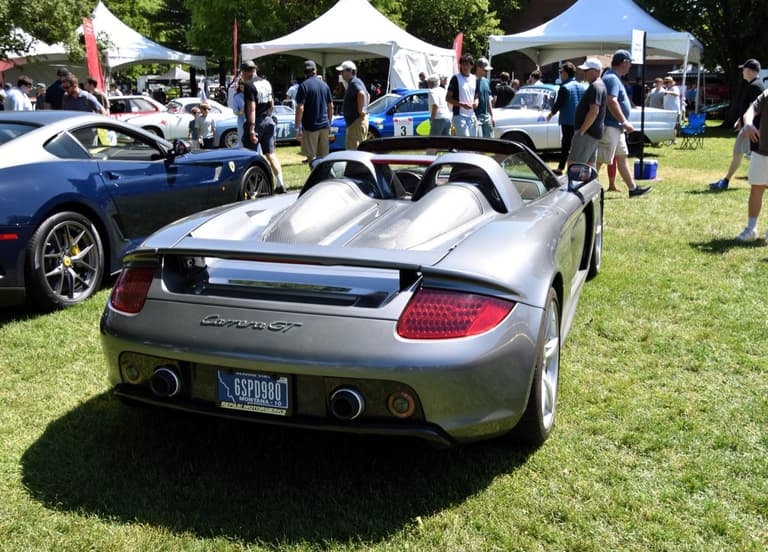
The Carrera GT is a clean and purposeful design rather than a flashy one. The body is low and wide, with twin headlights that echo the look of the legendary 917 race car. A rear wing rises automatically once the car passes 70 mph to add downforce at speed.
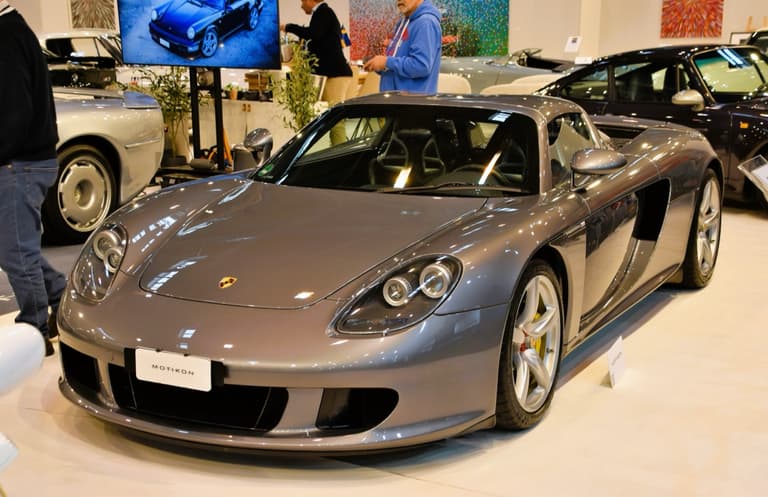
The roof is a two-piece targa design. Both panels are made from carbon fiber and lift out by hand, and they store in the front luggage compartment so you can carry them with you. The cabin is stripped of clutter, and the gear lever is topped with a laminated wood knob, a deliberate nod to the balsa-wood shifter of the 917. It is the only piece of wood trim in an otherwise technical interior.
Why It Is Called an Analog Hypercar
Modern hypercars lean heavily on electronics to make their performance usable. They use traction control, stability systems, and clever differentials to keep a driver out of trouble. The Carrera GT has none of that.
There is no traction control and no stability control to intervene when the rear wheels lose grip. The car gives the driver full authority and full responsibility, which makes it thrilling for a skilled owner and dangerous for anyone who treats it casually. That purity is exactly why values have climbed and why it is held up as the last hypercar of its kind.
It belongs to a small group of Porsches valued for involvement over assistance, the same quality that draws people to a focused driver’s car like the 911 R.
Production and Why It Ended
Porsche built 1,270 Carrera GTs over the production run, with 644 of them sold in the United States. Production was greenlit in part because the success of the Cayenne SUV gave Porsche the financial room to build a low-volume halo car. The concept was first shown at the 2000 Paris Motor Show.
The car went out of production in 2006. The reason was not a lack of demand but a change in United States airbag regulations that the Carrera GT could not meet without significant redevelopment. Porsche chose to end production rather than re-engineer a car that was always going to be a limited run.
Pricing and Value Today
The Carrera GT cost around $440,000 when new, which made it one of the most expensive cars Porsche had ever sold. For years after production ended, values stayed flat and some examples could be bought at or below the original price.
That changed dramatically. Good examples now sell in the range of roughly $1.0 million to $2.2 million, with a median around $1.3 million. Low-mileage cars command the strongest prices, and the Carrera GT is now firmly established as a blue-chip collector Porsche. For more cars in this bracket, see our guide to the most expensive Porsche models.
Carrera GT vs 918 Spyder
Porsche’s next flagship hypercar was the 918 Spyder, launched in 2013, and the two cars could not be more different in philosophy. The 918 is a hybrid that uses electric motors and advanced electronics to produce huge performance that almost any driver can access.
The Carrera GT is the opposite. It asks the driver to do the work and offers no safety net. Many enthusiasts see the two cars as bookends of an era, with the Carrera GT representing analog purity and the 918 Spyder representing the technology-led future. Both are remarkable, but they reward completely different things.
Frequently Asked Questions
How many Porsche Carrera GTs were made?
Porsche built 1,270 Carrera GTs between 2004 and 2006, and 644 of those were sold in the United States.
What engine does the Carrera GT have?
It uses a 5.7 liter naturally aspirated V10 producing 603 hp and revving to 8,400 rpm. The engine was developed from a canceled Le Mans prototype program.
Is the V10 really a Le Mans engine?
Yes. The V10 traces back to an engine Porsche built for Formula One and then developed for the canceled LMP2000 Le Mans prototype. When that project ended, the engine was adapted for the Carrera GT.
Why does the Carrera GT have no traction control?
Porsche built it as a pure driver’s car with no traction control and no stability system. This was a deliberate choice that makes the car engaging for skilled drivers and demanding for everyone else.
What is a Porsche Carrera GT worth today?
Values now sit roughly between $1.0 million and $2.2 million depending on mileage and condition, with a median around $1.3 million. That is a large increase over the original price of about $440,000.
Why is the Carrera GT considered dangerous?
It combines very high power with no electronic safety aids and a tricky ceramic clutch. A driver who is not prepared for its sharp responses can lose control, which is why it demands respect.
Images: Hero, engine bay, rear view, and front three-quarter by Charles from Port Chester, New York, CC BY 2.0. Via Wikimedia Commons.