The Porsche 992 Turbo S is the top production Porsche 911 of the 992 generation, producing 641 hp in its original 992.1 form and 711 hp combined in the 992.2 T-Hybrid introduced in 2026. All-wheel drive, Porsche Ceramic Composite Brakes as standard, and a 0 to 60 mph time of 2.6 seconds put it in the same conversation as purpose-built supercars.
In this article, we'll compare the Porsche 992 Turbo S across its two versions. We'll cover 992.1 performance, T-Hybrid changes, Turbo comparison, and buying advice.
Contents
- 1 Quick Summary
- 2 What Is the Porsche 992 Turbo S?
- 3 Turbo S vs Standard Turbo: What Do You Actually Get?
- 4 992.1 vs 992.2: What Changed?
- 5 Engine and Powertrain
- 6 Performance and Specs
- 7 Chassis and Handling
- 8 Interior and Technology
- 9 Design
- 10 Turbo S Cabriolet
- 11 Pricing: New and Used
- 12 Ownership and Running Costs
- 13 Special Editions
- 14 Frequently Asked Questions
Quick Summary
Here is the Porsche 992 Turbo S at a glance.
| Spec | 992.1 (2020–2025) | 992.2 (2026–present) |
|---|---|---|
| Engine | 3.7L twin-turbo flat-six | 3.7L twin-turbo flat-six + e-motor |
| Power | 641 hp / 478 kW | 711 hp combined / 523 kW |
| Torque | 590 lb-ft / 800 Nm | 590 lb-ft / 800 Nm |
| 0 to 60 mph | 2.6 s (Sport Chrono) | 2.4 s (Sport Chrono) |
| Top speed | 205 mph / 330 km/h | 200 mph / 322 km/h |
| Transmission | 8-speed PDK | 8-speed PDK with integrated e-motor |
| Drive | All-wheel drive (PTM) | All-wheel drive (PTM) |
| Weight (coupe) | 3,821 lbs / 1,733 kg | 3,803 lbs / 1,725 kg |
| MSRP (coupe) | From $203,500 | TBD |
| Nürburgring | ~7:17 | 7:03.92 (official) |
What Is the Porsche 992 Turbo S?
The Porsche 992 Turbo S is the flagship of the standard 992 generation 911 lineup. It sits above the regular 992 Turbo and is the most powerful non-GT version of the current 911.
Porsche launched the 992 Turbo S in early 2020, following the 992 Turbo by several months. The Turbo S uses the same 3.7-liter twin-turbocharged flat-six as the standard Turbo, but with a higher state of tune that pushes output to 641 hp and 590 lb-ft of torque.
The 992 Turbo S is part of a lineage that goes back to the 911 Turbo of the 1970s. Each generation has represented the absolute peak of what Porsche could extract from a turbocharged road car. The 992 Turbo S continues that tradition while adding all-weather capability that the early turbos never had.
Both coupe and Cabriolet versions are available. All-wheel drive with Porsche Traction Management is standard across both.
Turbo S vs Standard Turbo: What Do You Actually Get?
The 992 Turbo produces 572 hp against the Turbo S at 641 hp. That 69 hp difference is meaningful, but the bigger story is everything else that comes standard on the Turbo S.
- PCCB ceramic brakes: 10-piston front calipers clamping on ceramic composite rotors. Optional on the standard Turbo. The 10-piston front caliper is a first for any 911.
- Sport Chrono Package: Standard on the Turbo S, optional on the Turbo. Adds launch control, a drive-mode rotary switch on the steering wheel, and a dashboard stopwatch.
- Rear-axle steering: Standard on the Turbo S. Makes the car feel sharper at low speed and more stable at high speed.
- Sport exhaust: The Turbo S gets twin oval exhaust tips and a deeper note as standard. The standard Turbo has four square tips.
- LED Matrix headlights: Standard on the Turbo S.
- 18-way adaptive sport seats: Standard on the Turbo S. The standard Turbo uses 14-way units.
- PDCC (Porsche Dynamic Chassis Control): Active anti-roll bars that reduce body roll in corners. Standard on the Turbo S.
If you options the standard 992 Turbo to match the Turbo S specification, the price gap narrows considerably. For most buyers who want everything turned up, the Turbo S is the cleaner choice.
992.1 vs 992.2: What Changed on the Turbo S?
The 992.1 Turbo S ran from 2020 to 2025 and established the 641 hp benchmark. The 992.2 update, launched in late 2025, brought the most significant powertrain change in Turbo S history.
992.2 Turbo S T-Hybrid
The 992.2 Turbo S adopts the T-Hybrid system. An electric motor integrated into the 8-speed PDK adds 80 hp, taking combined output to 711 hp. The electric motor is powered by a compact lithium-ion unit that charges via regenerative braking. There is no plug-in charging.
The T-Hybrid motor fills torque during gear changes and from low revs, making acceleration even more seamless than the 992.1. The 0 to 60 mph time drops from 2.6 to 2.4 seconds.
Top speed is slightly lower at 200 mph compared to 205 mph for the 992.1. The additional electric components add a small amount of weight, though Porsche kept the 992.2 Turbo S coupe lighter than the 992.1 through material changes elsewhere.
The 992.2 also revised the front bumper, updated the PCM infotainment with a faster processor, and standardized Android Auto across the range. The Turbo S specifically gets larger rear fender air vents compared to the 992.1.
Which Should You Buy?
The 992.1 Turbo S is a known quantity with an established ownership record. It is already available used at prices well below new. If you want the latest technology and maximum straight-line pace, the 992.2 is the answer. If you want a slightly simpler powertrain with proven reliability and more attractive used pricing, the 992.1 is the smarter buy today.
Engine and Powertrain
The 992 Turbo S uses a 3.7-liter twin-turbocharged flat-six. Both turbochargers use variable-geometry vanes that control boost across the rev range and virtually eliminate lag. Power arrives immediately from just above idle and stays on song all the way to the redline.
The engine produces 641 hp at 6,750 rpm in the 992.1. Torque peaks at 590 lb-ft between 2,500 and 4,000 rpm. That wide torque band is what makes the Turbo S feel so relentless. You do not need to chase revs. The power is simply there, all the time.
The 8-speed PDK dual-clutch transmission is the only gearbox available. There is no manual option. The PDK shifts faster than any human driver and can execute upshifts in under 100 milliseconds. Porsche calibrated the Turbo S PDK maps specifically for the higher torque output compared to the standard Turbo.
Porsche Traction Management all-wheel drive sends power to the front axle when rear traction is exceeded. The system monitors wheel speed and steering angle continuously. In dry conditions, the car behaves as rear-biased. In wet or slippery conditions, the front axle pulls its share immediately.
The 992.2 Turbo S adds an 80 hp electric motor integrated into the PDK housing. The motor weighs about 7 kg and draws power from a compact 1.9 kWh lithium-ion unit behind the rear axle. Porsche designed this system to be unobtrusive. You do not feel a mode switch between combustion and electric assist. It is seamless.
Performance and Specs
The 992.1 Turbo S coupe reaches 0 to 60 mph in 2.6 seconds with Sport Chrono. The Cabriolet takes 2.8 seconds. The 992.2 cuts those to 2.4 and 2.6 seconds respectively.
Top speed for the 992.1 coupe is 205 mph. The 992.2 is governed to 200 mph.
The 992.2 Turbo S set an official Nürburgring Nordschleife lap time of 7:03.92, notarially certified and achieved by development driver Jörg Bergmeister. That is 14 seconds faster than the 992.1 and puts the Turbo S in territory previously occupied only by dedicated track cars.
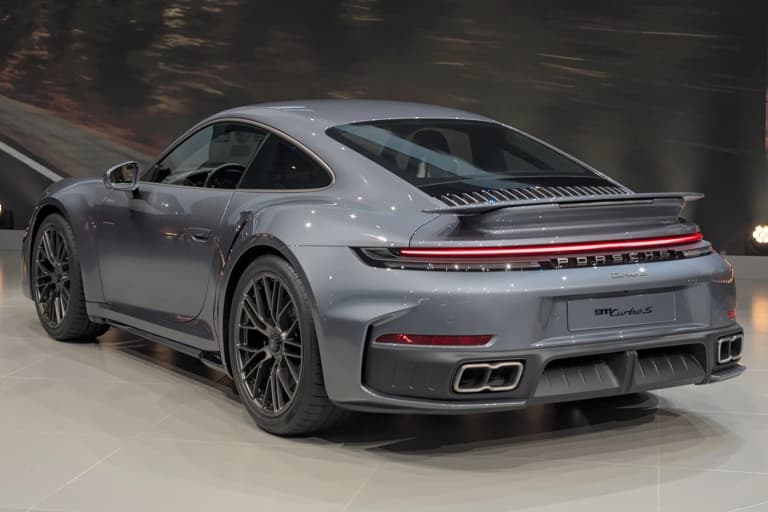
The 0 to 100 mph time for the 992.1 coupe is around 5.8 seconds. The rolling acceleration at motorway speeds is even more impressive. Overtakes that take most cars several seconds are done before you can blink in the Turbo S.
Quarter mile time for the 992.1 Turbo S coupe is approximately 10.3 seconds at around 130 mph. These are numbers that were supercar territory just ten years ago.
Chassis and Handling
The 992 Turbo S runs on the widest body in the standard 911 range. The rear track is 45 mm wider than the Carrera. That extra width gives the Turbo S more mechanical grip and a more planted feel through fast corners.
Porsche Active Suspension Management (PASM) adaptive dampers are standard. The system adjusts damping in milliseconds based on road surface, speed, and driver inputs. In Normal mode, the ride is genuinely comfortable. In Sport Plus, it stiffens considerably for track use.
Rear-axle steering is standard on the Turbo S. At speeds below about 50 mph, the rear wheels turn opposite to the fronts, tightening the effective turning radius. Above that speed, they turn with the fronts, increasing stability. The system makes the Turbo S feel more agile in city driving and more confidence-inspiring on motorways.
PDCC active anti-roll bars use hydraulic actuators to counteract body roll in corners. The result is flat cornering balance that makes the Turbo S feel almost like a touring car on smooth roads.
Brakes
PCCB ceramic composite brakes are standard on every Turbo S. The front rotors measure 420 mm and are clamped by 10-piston fixed calipers, the largest ever fitted to a production 911. The rear rotors are 390 mm with 4-piston calipers.
Ceramic rotors are lighter than steel, which reduces unsprung mass at each corner. They also generate less heat fade under repeated hard stops. You can brake from 200 mph repeatedly without the brakes losing performance.
The distinctive yellow PCCB calipers are the most recognizable visual cue that you are looking at a Turbo S.
Interior and Technology
The 992 Turbo S interior matches the broader 992 layout. A central analog tachometer sits flanked by two digital screens. The 10.9-inch central touchscreen runs Porsche Communication Management (PCM) for navigation, media, and vehicle settings.
The Turbo S receives 18-way power-adjustable adaptive sport seats as standard. These seats are heated and ventilated and can be configured for comfort or lateral support depending on driving mode. They are among the best road car seats available.
Carbon trim, power-folding mirrors, and a Bose or Burmester sound system are included. The Sport Chrono Package dashboard stopwatch and steering wheel mode switch are standard.
The 992.2 PCM update adds a faster processor and ChatGPT-powered voice control. Android Auto joins Apple CarPlay as standard. The system responds quicker than the 992.1 unit and handles split-screen navigation without lag.
The rear seats remain, unlike the GT3 RS which deletes them. They are suitable for short trips or as luggage space. The front trunk adds usable cargo capacity for a weekend away.
Design
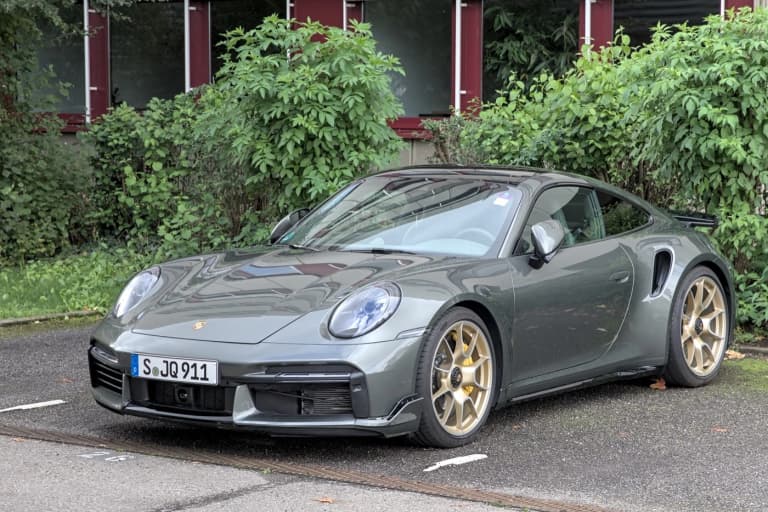
The 992 Turbo S is visually wider than any Carrera model. Air intake scoops sit in the rear fenders ahead of the rear wheels, feeding the intercoolers. The rear body is broader, with a full-width LED light bar connecting the tail lights.
The twin oval exhaust tips identify the Turbo S immediately from behind. The standard Turbo uses four square tips. The exhaust note is deeper and more pronounced on the Turbo S from idle.
Active front aerodynamics include a nose spoiler that deploys at speed to increase downforce and reduce lift. The rear wing extends automatically above 75 mph and retracts below 50 mph.
The 992.2 Turbo S gets revised front and rear bumpers with reshaped intake and exhaust openings. The changes are subtle but the 992.2 has a slightly more aggressive appearance at the rear.
Porsche offers the Turbo S in a wide range of standard colors including Gentian Blue, Chalk, GT Silver Metallic, and Jet Black Metallic. Paint to Sample is available for buyers who want something more individual. The gold wheels on the 50 Years edition became one of the most talked-about color combinations of the 992 generation.
Turbo S Cabriolet
The Turbo S Cabriolet uses the same powertrain as the coupe. The 992.1 version reaches 0 to 60 mph in 2.8 seconds, 0.2 seconds behind the coupe. The 992.2 Cabriolet does it in 2.6 seconds.
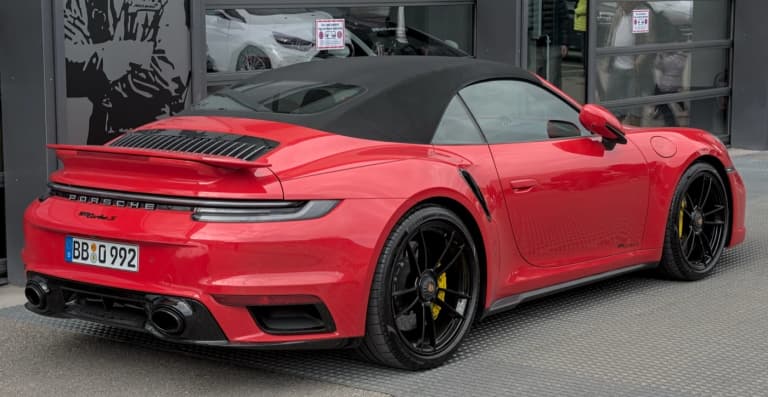
The electrically operated fabric soft top opens and closes in about 12 seconds and can be operated at speeds up to 30 mph. The 992.1 Turbo S Cabriolet weighs 3,975 lbs, about 155 lbs more than the coupe.
Porsche reinforced the Cabriolet floor pan and added windshield bracing to compensate for the missing roof. The chassis feels only marginally softer than the coupe. At normal road speeds, the difference is difficult to detect.
The Turbo S Cabriolet MSRP starts about $13,000 above the coupe price. Most buyers who want open-air driving and maximum performance find the price premium worthwhile.
Pricing: New and Used
New Pricing
- 992.1 Turbo S Coupe (2021 model year): From $203,500
- 992.1 Turbo S Cabriolet (2021 model year): From $216,300
- 992.2 Turbo S: Pricing not yet confirmed for all markets
Options can add $30,000 to $60,000. Popular additions include exclusive paint colors via Porsche Exclusive Manufaktur, carbon interior trim, a Burmester sound system, and four-wheel steering delete (for purists who prefer the standard setup). A well-optioned 992.1 Turbo S regularly reached $250,000 or more before delivery.
Used Pricing (992.1)
- Turbo S Coupe: $180,000 to $240,000 depending on year and specification
- Turbo S Cabriolet: $195,000 to $260,000
- 911 Turbo 50 Years edition: $270,000 to $320,000+
The 992.1 Turbo S holds its value well. Depreciation in the first two years has been modest compared to most luxury cars. Lightly used examples from 2021 and 2022 represent the best value point today, as the 992.2 premium has pushed the gap between new and used wider than usual.
Ownership and Running Costs
The 992 Turbo S is one of the most livable ultra-high-performance cars available. The PASM adaptive suspension in Normal mode delivers a comfortable ride on imperfect roads. Noise levels at motorway speed are low. The climate control, heated seats, and adaptive cruise control make it a practical daily driver.
Fuel consumption averages around 17 to 20 mpg in mixed driving. Highway fuel economy approaches 25 mpg if you keep speeds sensible. The 992.2 T-Hybrid improves city fuel economy slightly through regenerative braking.
Oil changes at a Porsche dealer run $350 to $500. Major service intervals are every 20,000 miles or two years. The ceramic brakes last significantly longer than steel in normal road use. You are unlikely to need new PCCB rotors before 60,000 miles unless you track the car regularly.
Track use changes the calculus considerably. Brake pads and tires wear quickly under sustained hard driving. A set of replacement PCCB front rotors can cost $5,000 to $8,000.
The Porsche 911 has a strong reliability record, and the 992 Turbo S has followed that pattern. Known issues on the 992.1 include occasional infotainment software glitches, addressed via updates. The engine and transmission have not shown systemic problems across the production run.
The 992.2 T-Hybrid adds electric components with no production reliability data yet. Porsche offers an extended warranty, which is worth considering on any 992.2 bought new.
Special Editions
911 Turbo 50 Years
Porsche produced 1,974 units of the 911 Turbo 50 Years to celebrate half a century of the turbocharged 911. The number references the year the original turbocharged 911 prototype was shown at the Paris Motor Show.
The 50 Years edition uses the 992.1 Turbo S as its base. It gets Turbonite accents on the exterior, illuminated "turbo 50" door sill guards, and a MacKenzie tartan interior with Pepita houndstooth headliner. A limited-edition Porsche Design timepiece is included with every car.
Pricing started at approximately €274,000 in Europe and around $298,000 in the United States. Used examples are already trading above those figures. This edition has become one of the most collectible 992 models.
Frequently Asked Questions
What is the difference between the 992 Turbo and 992 Turbo S?
The 992 Turbo S produces 641 hp versus 572 hp for the standard Turbo. Beyond power, the Turbo S comes standard with PCCB ceramic brakes, Sport Chrono Package, rear-axle steering, PDCC active anti-roll bars, LED Matrix headlights, and 18-way adaptive sport seats. These items are optional or unavailable on the standard Turbo. The result is a meaningfully better-equipped car, not just a power upgrade.
How fast is the Porsche 992 Turbo S?
The 992.1 Turbo S coupe reaches 0 to 60 mph in 2.6 seconds with Sport Chrono and has a top speed of 205 mph. The 992.2 T-Hybrid does 0 to 60 mph in 2.4 seconds. The 992.2 set a Nürburgring Nordschleife lap time of 7:03.92 in official testing.
Does the Porsche 992 Turbo S have ceramic brakes?
Yes, Porsche Ceramic Composite Brakes (PCCB) are standard on the 992 Turbo S. The front uses 420 mm rotors with 10-piston calipers, a first for a production 911. Ceramic brakes are optional on the standard 992 Turbo but standard on every Turbo S.
Is the 992 Turbo S available with a manual gearbox?
No. The 992 Turbo S is PDK only. The 8-speed dual-clutch gearbox is the only transmission available. A manual was never offered on the Turbo S in the 992 generation. For a manual 911 at this power level, the Sport Classic uses the Turbo engine detuned to 543 hp with a 7-speed manual.
What is the 992.2 Turbo S T-Hybrid?
The 992.2 Turbo S T-Hybrid pairs the 3.7-liter twin-turbo flat-six with an electric motor integrated into the PDK. Combined output is 711 hp and 590 lb-ft. The electric motor is powered by a 1.9 kWh lithium-ion unit and charges via regenerative braking only. There is no plug-in option and no meaningful electric-only range. The system reduces 0 to 60 mph time to 2.4 seconds.
How much does a used 992 Turbo S cost?
Used 992.1 Turbo S coupes range from approximately $180,000 to $240,000 depending on year, mileage, and specification. Cabriolet versions command a premium of $10,000 to $20,000 over comparable coupes. The 911 Turbo 50 Years edition starts around $270,000 used and has been appreciating. For the full Turbo S lineage across all generations, see our dedicated guide.
Images: Hero by Alexander Migl, CC BY-SA 4.0. IAA 2025 and Cabriolet by Alexander-93, CC BY-SA 4.0. Via Wikimedia Commons.