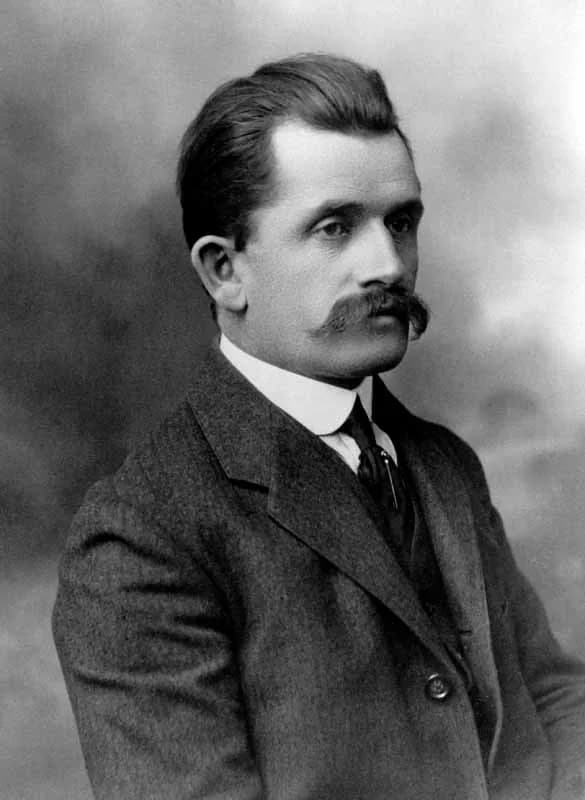
Ferdinand Porsche helped build the engineering office behind Porsche AG. He was also a Nazi Party and SS member who requested forced labor at Volkswagenwerk. Do not treat him as the sole inventor of the Beetle or the Porsche 356.
Read his engineering career with the Nazi-era record in view, and give the Volkswagen and Porsche 356 their full team histories.
Contents
- 1 Quick Summary
- 2 Who Ferdinand Porsche Was
- 3 From Wheel-Hub Motors to Daimler and Steyr
- 3.1 Electrical and Hybrid Work at Lohner
- 3.2 Austro-Daimler, Daimler, and Steyr
- 4 The 1931 Design Office and Auto Union
- 5 The Volkswagen Project Was Not a One-Man Invention
- 6 Nazi Party, SS, and Regime Ties
- 7 Armaments Production and Forced Labor
- 8 His Personal Responsibility at Volkswagenwerk
- 9 Arrest, Acquittal, and the Postwar 356
- 10 How to Assess the Legacy
- 11 Frequently Asked Questions
Quick Summary
- Engineering career: Wheel-hub electric drive at Lohner, then senior roles at Austro-Daimler, Daimler, and Steyr before he went independent.
- 1931 office: He founded a Stuttgart design and consulting office, which is the predecessor of Porsche AG but was not a sports-car maker.
- Beetle: His office led the Volkswagen project, but the Beetle had several contributors and earlier concepts, so sole-inventor claims are wrong.
- Nazi ties: He joined the NSDAP and the SS, reached the rank of Oberführer, and had a good personal connection with Hitler.
- Forced labor: He used forced laborers at Volkswagenwerk, actively asked for them, and knew their murderous working conditions.
- Factory scale: Around 20,000 people did forced labor at the factory, a figure for the whole plant rather than for people Porsche personally selected.
- Postwar cars: His son Ferry Porsche and a team led the 356, so Ferdinand should not get sole credit for it.
Who Ferdinand Porsche Was
Ferdinand Porsche was born on September 3, 1875, in Maffersdorf, a Bohemian town that is now Vratislavice in the Czech Republic. He trained as a tinsmith with his father. In 1893, he started at Vienna electrical company Béla Egger & Co., according to the German Patent and Trade Mark Office (DPMA). He died on January 30, 1951.
Calling him “the founder of Porsche” needs a qualifier. In 1931 he founded a design and consulting office that sold engineering work to other companies and to governments. His son Ferry and the postwar team later turned that base into a sports-car business.
The family names also cause confusion. Ferdinand was Ferry Porsche’s father and the grandfather of Ferdinand Alexander “Butzi” Porsche and of Ferdinand Piëch. The 911’s body design belongs to Butzi, and the postwar 356 belongs to Ferry and his team.
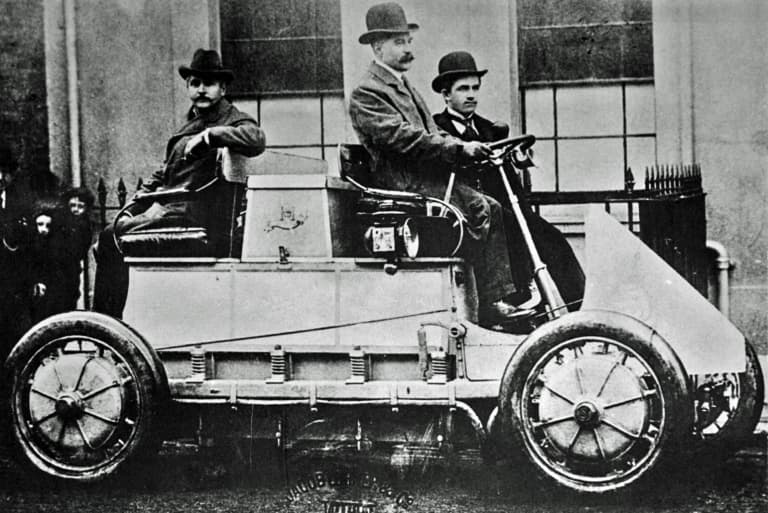
From Wheel-Hub Motors to Daimler and Steyr
From the 1890s through 1930, Porsche worked inside a sequence of engineering departments: Lohner, Austro-Daimler, Daimler, and Steyr. Those years began with electric hub motors in Vienna. They ended with a brief stint at Steyr before he returned to Stuttgart to start his own office.
Electrical and Hybrid Work at Lohner
At the Vienna carriage maker Jacob Lohner & Co., Porsche built a drive around electric motors in the wheel hubs. The Lohner-Porsche was shown at the 1900 Paris World’s Fair, and one version had four 1,500-watt hub motors. The Mixte paired a gasoline engine with battery-powered hub drive, and DPMA calls it the first fully functional hybrid.
The Mixte’s battery weighed about 1,800 kilograms, which was a major drawback. The lasting idea was the architecture: generation, storage, electric traction, and wheel-level drive combined while the motorcar was still young.
The four-motor car was an early all-wheel-drive design. Porsche was doing unusually early work on hub-motor drive, all-wheel traction, and mixed-power systems.
Austro-Daimler, Daimler, and Steyr
From 1906 to 1923 Porsche worked for Austro-Daimler in Wiener Neustadt, then moved to Daimler-Motoren-Gesellschaft in Stuttgart-Untertürkheim, where he was also a board member. After Daimler merged with Benz, his contract was not renewed in 1928. A brief stint as technical director at Steyr followed before he returned to Stuttgart in 1930.
DPMA names the Austro-Daimler “Sascha” and the Mercedes-Benz Type S, SS, and SSK among his successful sports cars. Those cars came out of company engineering teams, so Porsche led the work rather than drawing them alone.
The 1931 Design Office and Auto Union
In 1931, with some engineers from Steyr, Porsche founded “Dr. Ing. h.c. F. Porsche GmbH, constructions and consulting for engines and vehicles.” DPMA calls it the predecessor of today’s Porsche AG. It was a consultancy that designed engines, vehicles, and components for clients, not a maker of Porsche-badged sports cars.
Its people counted as much as its founder. DPMA names Karl Rabe as a longtime collaborator. It names Erwin Komenda as chief engineer and head of body construction from 1931 until his death in 1966.
For Auto Union, the office designed a racing car with the engine ahead of the rear axle, patented as a racing-car chassis. DPMA says the Type 22 dominated racing alongside the Mercedes-Benz Silver Arrows. That is a real achievement, but “Porsche invented the mid-engine race car” goes further than the record does.
DPMA also credits Porsche with patents on a folding steering wheel, spindle steering, torsion-bar suspension, and a patent that practically describes today’s anti-slip control. Those patents show the problems his office was chasing. A patent alone does not mean an idea was widely adopted or that he got there first.
The Volkswagen Project Was Not a One-Man Invention
In June 1934, the Reich Association of the German Automotive Industry commissioned Porsche to develop a “people’s car,” according to the Volkswagen Place of Remembrance of Forced Labor. That memorial page says he submitted a memorandum on a German people’s car to the Reich Ministry of Transport that January. The car became the KdF-Wagen under National Socialism and the Volkswagen Beetle after the war.
DPMA says Porsche is widely regarded as the Beetle’s “father,” but the popular story leaves out other contributors. It names Josef Ganz, whose earlier “Maikäfer” and “Standard Superior” influenced the design. It also names Karl Rabe, Porsche’s longtime collaborator.
DPMA names Béla Barényi, whose contribution was disputed after the war. It also names Hans Ledwinka, whose Tatra 97 anticipated many Beetle elements. Erwin Komenda was the named inventor on the 1936 patent showing the Beetle’s body line.
None of that erases Porsche’s leadership. He headed the commissioned program. DPMA says he played a major role in creating Volkswagenwerk as chief executive and supervisory-board member. His son-in-law Anton Piëch became plant manager. But the car, the factory, the financing, and the propaganda were all bigger than one engineer.
The civilian people’s car never reached the public before the war. Volkswagen’s memorial says civilian series production “remains a dream” once World War II began. The plant became part of the armaments industry.
Nazi Party, SS, and Regime Ties
Porsche worked for Hitler’s regime and belonged to its party and its SS. After Hitler came to power, DPMA says Porsche took German citizenship. He joined the NSDAP and became an SS member with the rank of Oberführer. DPMA also reports that he had a good personal connection with the dictator. It describes him as one of the best-known engineers of the Third Reich.
These were not side details in an otherwise apolitical career. The regime supplied major commissions and commercial growth. His office received orders for a “people’s tractor” and other lucrative jobs. Restructured as a limited partnership in 1937, the company prospered through proximity to the Nazi regime. His tank developments turned out to be failures.
Party and SS membership are only part of the story. His own role in the forced labor at Volkswagenwerk is covered in the sections below.
Armaments Production and Forced Labor
When the Second World War began on September 1, 1939, Volkswagenwerk became part of the German armaments industry. It repaired aircraft components and made drop containers, anti-tank mines, and bazookas, and later it built the military Kübelwagen and Schwimmwagen. From January 1943 it was also the main supplier for the first 100 cells of the Fi 103 flying bomb, known as the V1.
The first forced laborers arrived in June 1940, when 300 Polish women were assigned to the plant. Soviet prisoners of war followed from October 1941, deported civilians and military internees joined them, and the plant also used concentration-camp prisoners. The memorial says around 20,000 people did forced labor at the company during the war, including around 5,000 concentration-camp prisoners. On April 30, 1944, 11,334 foreign workers made up the majority of a 17,365-person workforce.
Those are factory-scale figures for the plant and its labor system, not a count of people Porsche personally selected or supervised.
The memorial records segregation, hunger, corporal punishment, and deaths. Pregnant women were sent back to their homelands only until December 1942, and later babies were separated from their mothers a few days after birth. By the end of the war 365 children had died of neglect and inadequate nutrition.
The “Arbeitsdorf” concentration camp was set up on the factory premises in April 1942. Plant management and Heinrich Himmler agreed to use prisoners to finish the light-metal foundry. In May 1944, the plant engineer selected 300 Hungarian Jews at Auschwitz for flying-bomb work. In October, those men were moved to Mittelbau-Dora, where many died. The memorial ties those decisions to plant management and the SS system, not to Porsche personally.
His Personal Responsibility at Volkswagenwerk
Porsche played a major role in creating Volkswagenwerk. The DPMA biography says he used forced laborers at the factory, actively asked for them, and was fully aware of their murderous working conditions. That is direct personal responsibility. He held leadership roles at the company, requested the labor, used it, and knew how those people were treated.
That does not make him the author of every camp rule or every abuse at Volkswagen’s sites. His own requests and knowledge tie him to forced labor at the plant.
The victims belong in the story too. These were deported, confined, underfed, beaten, and overworked people, and many were killed or carried lifelong trauma. A technical history that leaves them out has left out how wartime production actually worked.
Arrest, Acquittal, and the Postwar 356
As the war ended, Porsche moved his development office and parts of its production to Carinthia. DPMA says he was arrested several times over the Peugeot takeover during Germany’s occupation of France. He was ultimately acquitted in 1948.
That acquittal was about Peugeot. It was not a finding that no forced labor was used at Volkswagenwerk, and it does not erase his ties to the regime.
Meanwhile Ferry Porsche had the car designed in Gmünd that became the Porsche 356. The later Porsche 911 came from a different postwar team. DPMA says Ferdinand was satisfied with the 356 and saw series production begin.
The line from the prewar consultancy to the sports-car maker is real. It runs through Ferry Porsche’s postwar direction and a new team, not one man’s design work.
How to Assess the Legacy
Ferdinand Porsche’s engineering changed vehicle design. Hub-motor electric drive, hybrid architecture, a mid-engine racing layout, suspension patents, and the ability to organize whole vehicle programs all belong in the record. So do his party and SS membership, his profitable regime work, his leadership at Volkswagenwerk, and the forced labor he requested and knew about.
At Volkswagenwerk, thousands of forced laborers were confined, underfed, beaten, and overworked, and 365 children died of neglect and inadequate nutrition. Porsche requested that labor and knew their conditions.
The later cars need their own credit. The 356, the 901 and 911, and Porsche’s racing record came from new teams in a new political setting. The wartime history stays visible behind them.
Frequently Asked Questions
Who was Ferdinand Porsche?
Ferdinand Porsche was a Bohemian-born automotive engineer who founded the design office behind Porsche AG. He was also a Nazi Party and SS member. His Volkswagen role is tied to forced labor. His career ran from wheel-hub electric drive through Austro-Daimler, Daimler, Steyr, Auto Union, and Volkswagen.
Did Ferdinand Porsche invent the Volkswagen Beetle?
No, Ferdinand Porsche did not invent the Beetle alone. His office led the Nazi-backed Volkswagen development project. The German Patent and Trade Mark Office says the Beetle had several contributors. It names Josef Ganz, Karl Rabe, Béla Barényi, Hans Ledwinka, and Erwin Komenda.
Was Ferdinand Porsche a member of the Nazi Party and SS?
Yes, Ferdinand Porsche was a member of both the Nazi Party and the SS. The German Patent and Trade Mark Office states that he joined the NSDAP and the SS, held the SS rank of Oberführer, and had a good personal connection with Adolf Hitler.
What was Ferdinand Porsche’s connection to forced labor?
Porsche was chief executive and a supervisory-board member of Volkswagenwerk. The German Patent and Trade Mark Office says he used forced laborers there, actively asked for them, and knew their murderous working conditions. Volkswagen’s memorial records around 20,000 forced laborers at the company during the war. That figure includes around 5,000 concentration-camp prisoners and describes the factory, not Porsche’s personal headcount.
Did Ferdinand Porsche create the Porsche 356?
No, Ferdinand Porsche did not create the 356 alone. Ferry Porsche and a team in Gmünd led the postwar 356 project. Ferdinand was satisfied with the car and saw series production begin before his death in 1951.
Images: Hero portrait: local WebP derivative of Ferdinand Porsche; author not specified, Public domain. Lohner-Porsche: local WebP derivative of Lohner Porsche; author unknown, Public domain. Both images were resized and encoded as WebP.