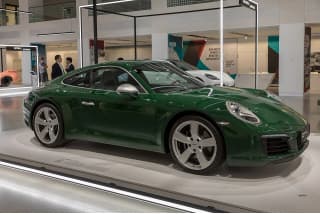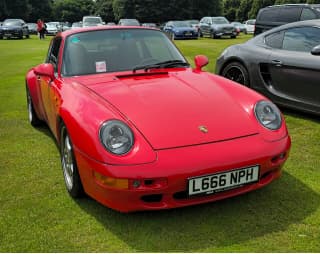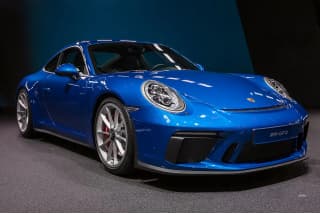
The Porsche 911 is a rear-engine, rear-drive sports car starting at around $120,000 with 389 to 701 hp depending on trim. The BMW M3 is a front-engine sport sedan starting at around $76,000 with 473 to 543 hp. The 911 is the sharper driver’s car. The M3 is the more practical performance machine.
In this article, we’ll compare the 992 Porsche 911 with the BMW M3 sport sedan. We’ll cover flat-six versus inline-six, rear-engine handling, the price gap, and everyday practicality.

Contents
Quick Summary
- Porsche 911 (992): Rear-engine, RWD/AWD, flat-six, 2+2 coupe
- BMW M3 (G80): Front-engine, RWD/AWD, inline-six, four-door sedan
| Spec | 911 Carrera S | M3 Competition |
|---|---|---|
| Engine | 3.0L twin-turbo flat-six | 3.0L twin-turbo inline-six |
| Power | 473 hp | 503 hp |
| Torque | 391 lb-ft | 479 lb-ft |
| 0 to 60 mph | 3.3 sec | 3.4 sec |
| Top Speed | 191 mph | 180 mph |
| Weight | 3,340 lbs | 3,840 lbs |
| Layout | Rear-engine, RWD | Front-engine, RWD |
| Starting Price | ~$148,000 | ~$80,000 |
What Are These Cars?
The Porsche 911 and BMW M3 are not direct competitors in the traditional sense. They occupy different segments and price points. They use completely different layouts. But they keep getting compared because they serve the same purpose. Both deliver a pure driving experience in a package you can use every day.
The 911 has been in production since 1964. It uses a rear-mounted flat-six engine. This layout is unique among modern sports cars. The current 992 generation starts with the Carrera. It runs up to the Turbo S. The range covers comfortable grand touring and track-focused aerodynamics.
The M3 launched in 1986 as a homologation special for touring car racing. It takes BMW’s 3 Series sedan and adds a hand-built engine, wider bodywork, stiffer suspension, and bigger brakes. The current G80 generation uses a twin-turbocharged 3.0-liter inline-six and is available as a sedan or as the M4 coupe.

Both cars have manual transmission options, rear-wheel-drive variants, and decades of motorsport heritage. They attract the same type of buyer: someone who cares about how a car feels from the driver’s seat.
Engine and Powertrain
Porsche 911 Engines
The 992 Carrera uses a 3.0-liter twin-turbocharged flat-six producing 389 hp in base form and 473 hp in the Carrera S. The flat-six sits behind the rear axle, giving the 911 its distinctive weight distribution and traction advantage out of corners.
Move up the lineup and the numbers climb sharply. The GT3 uses a 4.0-liter naturally aspirated flat-six making 503 hp, revving to 9,000 rpm. The 992.2 GTS introduces a hybrid powertrain with a 3.6-liter turbo flat-six plus an electric motor for a combined 534 hp. The Turbo S in 992.2 form produces a staggering 701 hp with its own hybrid system.
Transmission options include an 8-speed PDK dual-clutch on most models. A 7-speed manual is available on the Carrera S, and a 6-speed manual on the GT3.
BMW M3 Engine
The G80 M3 uses a single engine across the lineup: the S58 3.0-liter twin-turbocharged inline-six. In the standard M3 (no longer sold in all markets), it produces 473 hp. The M3 Competition makes 503 hp. The M3 CS pushes that to 543 hp with a higher-boost tune and reduced weight.

The S58 is one of BMW’s best engines. It pulls hard from 2,500 rpm. It keeps pulling past 7,000 rpm. Its broad 479 lb-ft torque plateau makes it relentless on highway on-ramps. The M3 comes with a 6-speed manual on the base model only. It also offers a ZF 8-speed torque converter automatic. Both rear-wheel drive and BMW’s xDrive all-wheel-drive system are available.
How They Compare
The M3 has more torque and a wider powerband. The 911 has more layout variety, from turbocharged grand tourers to naturally aspirated track weapons. For pure engine character, the 911 GT3’s 9,000-rpm flat-six is in a different league. For everyday muscle, the M3’s S58 is hard to beat.
Performance and Specs
On paper, the M3 Competition and 911 Carrera S are remarkably close. The Carrera S reaches 60 mph in 3.3 seconds with Sport Chrono. The M3 Competition does it in about 3.4 seconds with launch control. In a straight line, there is almost nothing between them.
Top speed is where the 911 pulls ahead. The Carrera S is limited to 191 mph. The M3 Competition hits 180 mph with the optional M Driver’s Package (165 mph without it). At higher speeds, the 911’s aerodynamics and lower center of gravity give it a clear advantage.
On track, the gap widens. The 911 Carrera S laps most circuits several seconds faster than the M3 Competition. The GT3 RS occupies a completely different performance tier. The GT3 RS posted a 6:44 at the Nurburgring. No M3 variant comes close to that.
But track times do not tell the whole story. The M3 is 500 pounds heavier and sits higher. It also carries two extra doors. It stays within a few seconds of the Carrera S on most tracks. That shows how well engineered the chassis is.
Handling and Driving Feel
This is where the two cars feel most different.
The 911’s rear-engine layout gives it unique handling characteristics. Weight over the rear axle provides exceptional traction out of corners. It can also snap into oversteer if you lift off the throttle mid-corner. Modern stability control systems have made this manageable. But the underlying physics still reward drivers who understand weight transfer.

The 911 steers with precision and minimal body roll. The brakes are progressive and strong. Everything about the driving experience feels taut and focused, even in the base Carrera. Step up to the GT3, and the level of mechanical grip and steering feedback borders on race car territory.
The M3 takes a different approach. Its front-engine, rear-drive layout gives it a more traditional balance. The nose turns in eagerly. Throttle input can provoke the rear into slides. The chassis communicates clearly through the steering wheel and seat. The M3 feels playful where the 911 feels surgical.
BMW’s adaptive M suspension works well on the street, soaking up bumps without losing composure. The 911 rides firmer, especially in GT3 and GTS trim. On a smooth track, the 911’s stiffness is an asset. On a broken B-road, the M3’s compliance is more enjoyable.
Model Lineups Compared
Porsche 911 Lineup
The 992 generation offers an enormous range of variants. The base Carrera starts at around $120,000 and makes 389 hp. The lineup expands through the Carrera S, with 473 hp. It includes the Carrera GTS T-Hybrid, with 534 hp. It also includes the Targa and Cabriolet. The GT3 makes 503 hp, and the GT3 RS makes 518 hp. The Turbo formerly made around 572 hp. The Turbo S makes 701 hp in 992.2 hybrid form.
That is nine distinct performance levels before you count body style variations. No other sports car offers this kind of range from a single model line.
BMW M3 Lineup
The M3 lineup is simpler. The base M3 (473 hp, manual, RWD) is the purist’s choice but is being phased out in some markets. The M3 Competition (503 hp, automatic, RWD or xDrive) is the volume seller. The M3 CS (543 hp, automatic, xDrive) is the limited, track-focused variant with carbon fiber body panels and a stripped interior.
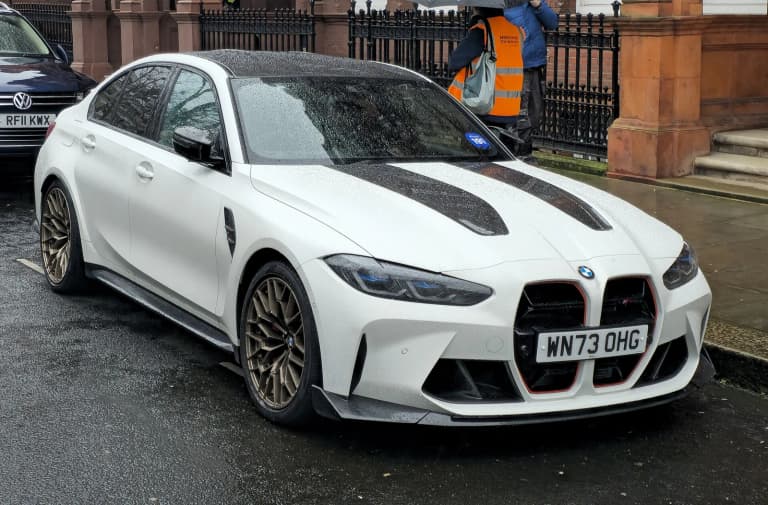
BMW also offers the M4, which is essentially the two-door coupe version of the M3, and the M3 Touring wagon in European markets. The Touring is something Porsche has no answer to.
Interior and Practicality
The M3 wins this category and it is not close. Four proper doors, a usable rear seat that fits adults, and a 480-liter trunk make the M3 a genuine family car. You can drop kids at school, load groceries, and drive to a track day without needing a second vehicle.
The 911’s rear seats are vestigial. They work for small children or bags, but no adult wants to sit back there for any meaningful distance. The front trunk (frunk) holds about 132 liters, enough for a weekend bag and not much else.
Both cars have high-quality interiors with digital gauge clusters, large infotainment screens, and premium materials. BMW’s iDrive system is more intuitive for daily use. Porsche’s PCM system is cleaner in layout but has a steeper learning curve. Both support Apple CarPlay and Android Auto.
The M3’s cabin is wider, more spacious, and better insulated from road noise. The 911 puts you in a tighter, more cockpit-like environment where you sit lower and feel more connected to the road. Which you prefer comes down to taste.
Design and Styling
The 911’s silhouette has barely changed in 60 years. The sloping roofline, round headlights, and wide rear haunches are instantly recognizable. No other car is as instantly recognizable, and Porsche has refined the shape without ever losing the essence.
The G80 M3 is more polarizing. BMW gave it a large, vertically oriented kidney grille that divided opinion when it launched. The aggressive front end looks better in person than in photos, especially in darker colors. The rear is more conventional, with quad exhaust tips and a subtle lip spoiler. The flared wheel arches and wider track distinguish it from a standard 3 Series.

Side by side, the 911 looks low, wide, and purpose-built. The M3 looks muscular and imposing. The 911 draws admiration from everyone. The M3 draws attention, but not always the kind BMW intended.
Pricing and Value
This is the category where the M3 makes its strongest case. A new M3 Competition starts at around $80,000. A new 911 Carrera starts at around $120,000, and a Carrera S is closer to $148,000. For the same money as a base 911, you can have a fully loaded M3 Competition with every option box ticked.
| Model | Starting MSRP (est.) |
|---|---|
| BMW M3 Competition | ~$80,000 |
| BMW M3 CS | ~$110,000 |
| Porsche 911 Carrera | ~$120,000 |
| Porsche 911 Carrera S | ~$148,000 |
| Porsche 911 GT3 | ~$195,000 |
| Porsche 911 Turbo S | ~$250,000+ |
On the used market, the M3 depreciates faster than the 911. A three-year-old M3 Competition can be found for $55,000 to $65,000. A three-year-old 911 Carrera S holds closer to $120,000 to $130,000. The 911’s resale value is among the strongest of any sports car, while the M3 follows typical BMW depreciation curves.
If your budget is $80,000 and you want the best new performance car, the M3 wins. If you are thinking long-term and care about resale, the 911 is a better investment. You can compare a manual 911 and M3 side by side.
Ownership and Reliability
Both cars are generally reliable by performance car standards, but maintenance costs differ significantly.
The 911 requires more expensive scheduled maintenance. Oil changes run $300 to $500. Brake jobs cost $1,500 to $3,000 depending on the axle. Tires are staggered sizes and typically cost $1,200 to $1,800 for a set. A major service at 40,000 miles can run $2,000 to $3,000.
The M3 is cheaper to maintain overall. Oil changes are around $150 to $250. Brake work runs $800 to $1,500. Tires are less expensive due to more common sizes. BMW’s warranty coverage and included maintenance packages (in some markets) further reduce the early-year cost of ownership.

Insurance costs are higher on the 911 due to its higher replacement value. Both cars require premium fuel. Fuel economy is similar in real-world driving: expect 20 to 24 mpg in mixed use for both the Carrera S and M3 Competition.
Heritage and Motorsport
Both cars have deep racing histories, but in very different disciplines.
The 911 has competed in virtually every form of motorsport. It has won Le Mans overall, dominated GT racing for decades, and remains the foundation of Porsche’s one-make race series. The 911 RSR has been a fixture in the World Endurance Championship. From rallying to endurance racing to hillclimbs, the 911 has done it all.
The M3 was born on the touring car grid. The original E30 M3 was built to homologate BMW’s Group A touring car. It won the European Touring Car Championship, DTM, and the 24 Hours of the Nurburgring. Every M3 generation since has carried that DNA. The M3 GTS and M3 GT4 have been popular choices in customer racing programs worldwide.
The 911’s motorsport pedigree is broader and deeper. The M3’s is more focused and arguably more connected to the road car you can buy. Both are legitimate racing legends.
Frequently Asked Questions
Is the Porsche 911 faster than the BMW M3?
Yes, the Porsche 911 Carrera S is faster than the BMW M3 Competition in most metrics. The Carrera S reaches 60 mph in 3.3 seconds versus the M3’s 3.4 seconds. It also has a higher top speed, 191 mph versus 180 mph, and posts faster lap times on track. Higher 911 variants like the GT3 and Turbo S are significantly faster still.
Why is the BMW M3 so much cheaper than the Porsche 911?
The BMW M3 is based on the 3 Series platform, which BMW produces in high volume. This shared architecture keeps costs lower. The 911 uses a dedicated rear-engine platform that Porsche does not share with any other model line. Higher production costs, a unique layout, and stronger brand pricing power all contribute to the 911’s premium.
Can you daily drive both the Porsche 911 and BMW M3?
Yes, the Porsche 911 and BMW M3 are both excellent daily drivers. The M3 is more practical with four doors, a larger trunk, and a usable rear seat. The 911 has a smaller cabin and limited cargo space, but its ride quality and refinement are strong enough for daily use. The M3 is the better choice if you regularly carry passengers or cargo.
Which holds its value better, the Porsche 911 or BMW M3?
The Porsche 911 holds its value significantly better than the BMW M3. After three years, a 911 typically retains 75% to 85% of its original value. The M3 retains closer to 55% to 65%. Special 911 variants like the GT3 and GT3 RS often appreciate above their original sticker price.
Is the BMW M3 a good alternative to the Porsche 911?
Yes, the BMW M3 is a good alternative to the Porsche 911. It is an outstanding sports sedan that delivers serious performance at a lower price point than the 911. Need four doors and rear seats, and want to spend $70,000 less than a comparable 911? The M3 is a compelling choice. It is not a substitute for the 911’s driving purity, but it offers a different and equally valid kind of performance.
Images: Porsche 992 Carrera S coupe by Alexander Migl, CC BY-SA 4.0. BMW M3 Competition (G80), green by Alexander-93, CC BY-SA 4.0. Porsche 992 GT3 with touring package by Alexander Migl, CC BY-SA 4.0. Porsche 992 Turbo S by Alexander Migl, CC BY-SA 4.0. 2024 BMW M3 CS xDrive Auto 6 by Calreyn88, CC BY-SA 4.0. BMW M3 Competition (G80), blue by Alexander Migl, CC BY-SA 4.0. Porsche 911 GT3 RS by Alexander-93, CC BY-SA 4.0. Via Wikimedia Commons.