
A well-maintained Porsche Macan is usually a reliable car, but early 2015 to 2018 petrol models need more caution. The main fault checks are transfer-case shudder, V6 timing-cover oil leaks, open fuel-system campaigns, and neglected transmission service.
A documented 2019 to 2021 petrol facelift is the safest starting point, while the Macan Electric is too new for a long-term verdict. Before buying, require a Porsche-specialist inspection and a VIN campaign check.
In this article, we’ll explain Porsche Macan reliability by generation. We’ll cover best years, common problems, recall checks, and pre-purchase inspection priorities.
Contents
Quick Summary
- Best starting point: Choose a documented 2019 to 2021 petrol facelift.
- Early-car risks: Check 2015 to 2018 petrol cars for transfer-case shudder and V6 timing-cover oil leaks.
- Service evidence: Match PDK and scheduled work to invoices for the exact car.
- Recall evidence: Check the VIN and request the dealer’s campaign-completion record.
- Macan Electric: Treat it separately because its long-term record is still developing.
- Final decision: Let an independent Porsche-specialist inspection decide the purchase.
The Short Reliability Verdict
The petrol Macan, known internally as 95B, is not a car to buy on low mileage and a good specification alone. Its condition depends on routine maintenance, the quality of past repairs, and whether its known warning signs were addressed early. A complete Porsche or specialist history is more valuable than a vague claim that the car was “serviced regularly.”
There is no public source that establishes a failure rate for every Macan drivetrain or ranks every model year. Federal recalls prove a specific safety defect in a defined population. Porsche technical bulletins describe conditions technicians may encounter. Specialist reports can identify repeat repair patterns, but they do not prove that every vehicle will fail. Use these sources to decide which systems need inspection, then let the individual car’s records and specialist findings settle the purchase.
For the model’s background, engines, trims, and dimensions, see our Porsche Macan guide. If your choice is between Porsche’s two SUVs, use the separate Cayenne vs Macan comparison. This page stays focused on reliability and inspection risk.
Macan Years and Buyer Tiers
| Model years | Buyer view | What decides the purchase |
|---|---|---|
| 2015 to 2018 petrol | Buy selectively | Road-test for driveline shudder, inspect V6 timing-cover area, verify fuel-system and seat-sensor recalls by VIN, and demand evidence of scheduled maintenance. |
| 2019 to 2021 petrol facelift | Best starting point | Still inspect the transfer case and service history, but these cars pair the facelift with a longer record of completed campaigns and repairs. |
| 2022 to final petrol cars | Strong choice if documented | Fewer years of age do not replace a proper inspection. Check PDK service, suspension condition, tires, brakes, and any open campaigns. |
| 2024 onward Macan Electric | Too early for a long-term verdict | Verify software campaigns, charging behavior, battery warranty terms for the local market, and the exact vehicle’s dealer history. |
Early Petrol Macans Need the Strictest Screen
Early 95B cars can represent value, but they are now old enough that deferred maintenance matters as much as design history. A low-mileage example that spent years on short trips can still have aging fluids, tires, seals, a weak battery, or an incomplete service record. Treat a cheap early Turbo or GTS as a complex performance SUV, not a bargain version of a newer base car.
The 2015 to 2018 range also carries several defined U.S. recall populations. The relevant record varies by VIN, trim, production date, and market. Ask whether the VIN has an open campaign. Then request the dealer record showing the remedy.
2019 to 2021 Petrol Cars Are the Sensible Default
A 2019 to 2021 petrol Macan is the practical target for a buyer who wants the first-generation formula without choosing the oldest cars. This is an editorial buying recommendation, not a claim that these years have no faults. A well-kept earlier Macan can be safer than a neglected facelift.
Prioritize condition over trim. A base Macan with complete records and a clean inspection is usually a more defensible buy than a poorly documented S, GTS, or Turbo. The higher-performance versions add heat, braking, tire, and suspension cost exposure, so inspect optional air suspension and performance hardware with the same care as the engine.
Later Petrol Cars Still Need Service Evidence
The final petrol cars are newer, but they are not maintenance-free. Ask for the stamped service booklet or itemized invoices, then match the dates and mileage to Porsche’s maintenance schedule for that exact year and market. Do not accept a verbal assurance that PDK service, brake fluid, plugs, or driveline work was completed.
Macan Electric Is a New Reliability Question
The Macan Electric is a separate, 800-volt PPE-platform vehicle rather than an evolution of the petrol 95B. Porsche introduced it in 2024, so a mature long-distance ownership record does not yet exist. That does not make it unreliable. It means a buyer should avoid pretending that a few model years of recall and dealer data answer a ten-year durability question.
Known Problems and What They Mean
Transfer-Case Shudder Requires a Proper Diagnosis
The transfer case is the biggest mechanical conversation around used petrol Macans. Porsche’s 2022 technical information lists shuddering, jerking, jolting, lurching, and vibration among the search terms for Macan transfer-box diagnosis. An earlier Porsche bulletin says that PDK units were sometimes replaced even though the supplier found the PDK sound and the transfer case was the defective component. That is useful evidence of a diagnostic trap, not a failure-rate statistic.
On the road test, drive gently from a stop, make tight low-speed turns, and accelerate smoothly at low speed and part throttle. Any repeated binding, thump, hesitation, or shudder deserves a Porsche-specialist diagnosis before money changes hands. A seller’s claim that a behavior is “normal PDK character” is not a substitute for a diagnostic report.
Ask specifically whether the transfer case has been replaced, repaired, or serviced, and request invoices. A documented repair may be a positive sign if it identifies the part and workshop. An undocumented claim is not enough. The purchase decision should turn on the current behavior, diagnostic findings, and evidence of the work, not on a blanket internet rule about every early Macan.
Early V6 Timing-Cover Leaks Need Visual Proof
Independent Porsche specialist Pcarwise identifies timing-case-cover oil leakage as a repeat concern on V6 Macans. Its report is specialist evidence, not a Porsche recall or a confirmed population rate. On 2015 to 2018 S, GTS, and Turbo examples, ask the inspector to check the timing-cover area for fresh oil. Have the workshop trace the source instead of assuming every wet surface requires the same repair.
Ask whether the engine has been resealed, whether any repair was limited to accessible fasteners, and whether the invoice records the cause. Oil on an undertray can travel from another point. A proper inspection should distinguish a minor seep, an active leak, and fluid left after an old repair. Do not approve an expensive repair estimate without that distinction.
PDK Symptoms Should Not Be Guessed From One Drive
The seven-speed PDK is a dual-clutch transmission. It can feel different from a torque-converter automatic at parking speeds, but repeated harsh engagement, warnings, slipping, or a fault-code history warrant further investigation. Porsche’s transfer-case bulletin is a reminder that similar driving symptoms can have more than one cause.
Confirm the scheduled PDK service using invoices for the actual car. The correct interval and work scope vary with model year and market, so use the owner’s documentation and Porsche schedule rather than a generic online mileage claim. A specialist should scan the car before purchase, including the drivetrain modules, then explain any stored or pending faults in writing.
Suspension and Option Complexity Change the Risk
Every Macan should be checked for uneven tire wear, worn suspension bushes, noisy wheel bearings, brake condition, and evidence of collision repair. Cars with air suspension, PASM, larger wheels, carbon-ceramic brakes, or performance packages add expensive systems, but no single option is automatically a reason to walk away. It is a reason to use a workshop familiar with that system.
NHTSA recall 21V224000 covers certain 2021 Macans with shock-absorber screw connections that might not have been tightened properly. Porsche advised owners not to drive until the remedy was performed. This is why a VIN check and dealer campaign printout belong in the inspection file, even on a newer car.
Macan Electric Campaigns Are Software and Visibility Checks
NHTSA lists a headlight-control software campaign, 24V889000, for certain 2024 to 2025 Macan Electric vehicles. It also lists rear-camera campaign 25V220000 for certain 2024 to 2025 cars. These campaigns do not establish a battery or motor durability verdict. They do establish a practical pre-purchase task: verify the VIN, campaign completion, and current software status with a Porsche center.
Recall History Is a VIN Check
Recall lists are not a reliability ranking. They identify safety campaigns for defined vehicle populations. A repaired recall should be recorded as remedied, not treated as a permanent defect. An open recall should be completed before delivery wherever possible.
For early petrol cars, the fuel system deserves special attention. NHTSA campaign 20V077000 covers certain 2015 to 2018 Macans because fuel-pump-cover contact could crack the flange and lead to a fuel leak. Earlier campaign 17V289000 covered certain V6 and 2017 models for a cracking fuel-pump flange. NHTSA also lists a 2015 brake-booster campaign, certain 2017 anti-rollbar-link and passenger-seat-sensor campaigns, a 2018 control-unit campaign, and a 2023 rear-seat-belt-anchor campaign affecting selected cars.
Use the NHTSA VIN recall lookup and a Porsche dealer campaign printout. A model-year web page can be helpful for context, but it is not a substitute for the exact VIN record, especially for cars imported from or sold outside the United States.
Pre-Purchase Inspection Priorities
Pay for an independent pre-purchase inspection at a Porsche-focused workshop. It should happen before the deposit becomes non-refundable. Give the workshop the following brief in writing.
- Cold start and road test: Check for warning lights, abnormal smoke, rough running, driveline shudder, low-speed binding, PDK behavior, braking pull, and suspension noise.
- Diagnostic scan: Read all modules, save fault codes, and ask which codes are current, pending, historical, or likely to return.
- Underbody and engine inspection: Identify oil or coolant sources, inspect the timing-cover area on early V6 cars, and look for impact damage or wet driveline components.
- Service proof: Match invoices to VIN, mileage, and dates. Confirm the exact scheduled items, not just oil changes.
- Transfer-case history: Ask whether it has been diagnosed or replaced, then road-test for the symptoms described above.
- Campaign status: Run the VIN through NHTSA and Porsche. Keep the result with the sale documents.
- Condition items: Measure tires and brakes, check battery age, inspect wheel damage, and assess air-suspension operation if fitted.
- Electric cars: Confirm software campaigns, charging performance, warranty transfer and local battery terms, then inspect the charge port, cables, and underbody.
A seller who will not allow an independent inspection is giving you useful information. Walk away rather than converting uncertainty into a repair budget after purchase.
Budgeting Without Inventing a Repair Bill
There is no defensible universal repair price for a Macan transfer case, timing-cover reseal, PDK repair, or air-suspension fault. Labor rates, access, regional parts pricing, prior damage, and the scope discovered during diagnosis can change the bill dramatically. This guide intentionally does not repeat internet cost ranges as if they were a quote.
Instead, price the exact car. Obtain a written pre-purchase inspection, ask for written estimates for any identified defects, and keep a reserve for age-related maintenance after purchase. Compare current quotes from qualified Porsche workshops in your area rather than relying on a generic online range.
The Used Macan Decision
The best used petrol Macan is not defined by one “safe year.” Look for a transparent service file, a clean specialist inspection, and no unexplained driveline shudder. The car should also have documented campaign work and an ownership budget that matches its specification.
For most buyers, begin with a 2019 to 2021 petrol facelift, then let condition decide. Consider a 2015 to 2018 car only when the price leaves room for proper inspection and documented repairs. Choose a 2024 onward Macan Electric for its current strengths, but acknowledge that its long-term reliability record is still being written.
Frequently Asked Questions
Are Porsche Macans reliable?
A well-maintained Macan can be a satisfying used performance SUV, but reliability depends strongly on the individual car. The early petrol Macan needs careful transfer-case, oil-leak, campaign, and service-history checks. Recall records and specialist reports identify specific risks, but neither proves every Macan will experience them.
What are the best years for a used Porsche Macan?
A documented 2019 to 2021 petrol Macan is the best starting point for most buyers. It combines the facelift with enough age for servicing and campaign history to be visible. A clean inspection and invoices still matter more than model year alone.
Which Porsche Macan years should I avoid?
Avoid any year with an unexplained transfer-case shudder, active oil leak, missing service records, accident damage, or unresolved recalls. That applies most often to poorly documented 2015 to 2018 cars, but it can apply to a newer vehicle too.
Does the Porsche Macan have transfer-case problems?
Some Macans have transfer-box symptoms that Porsche technical material describes as shuddering, jerking, jolting, lurching, or vibration. Diagnose the individual car because similar symptoms can be mistaken for PDK trouble. Do not buy a car with those symptoms until a qualified specialist identifies the cause and provides a written repair path.
Is the electric Porsche Macan reliable?
It is too early to make a mature long-term reliability claim. NHTSA lists certain 2024 to 2025 cars in headlight and rear-camera software campaigns, which should be checked by VIN. That is useful current evidence, but it cannot yet settle ten-year battery, motor, or electronics durability.
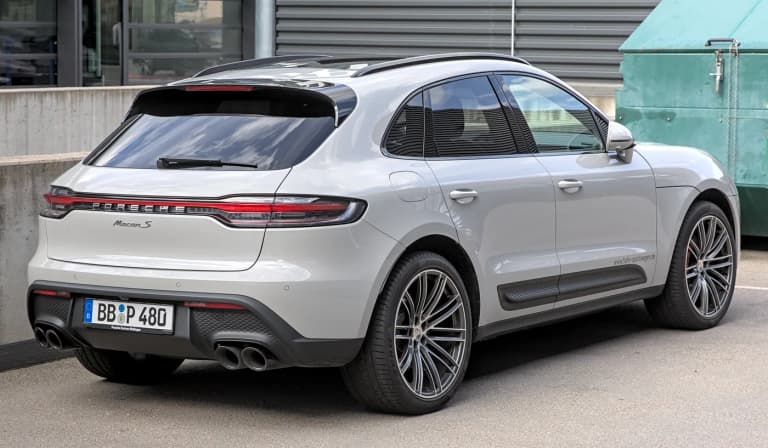
Images: 2022 Porsche Macan S by Alexander Migl, CC BY-SA 4.0. Via Wikimedia Commons.