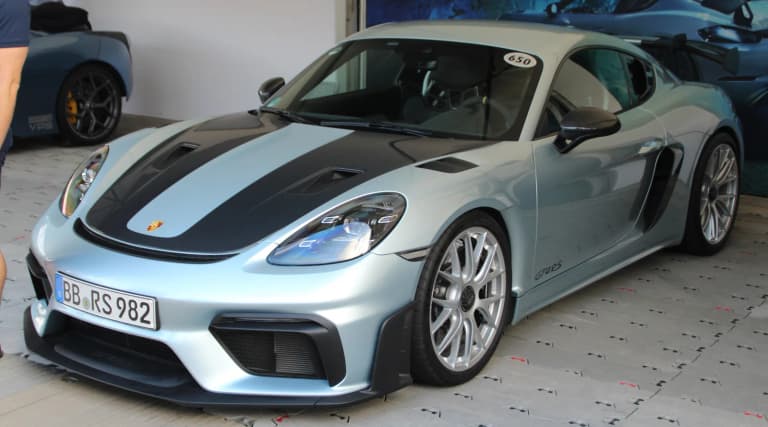
The Porsche 718 Cayman GT4 RS is the RS derivative of the 718 Cayman GT4. Porsche gave it a GT3-related naturally aspirated flat-six producing 500 PS (368 kW), a seven-speed PDK, and a 1,415 kg DIN weight [1]. RS-specific chassis changes and approximately 25 percent more downforce in its track-only Performance setting complete the package [1]. It is not simply a GT4 with an option package.
In this article, we’ll explain what makes the Porsche 718 Cayman GT4 RS different from the standard GT4. We’ll cover its engine, aerodynamics, Weissach package, and Nürburgring evidence.
Contents
Quick Summary
- Engine: naturally aspirated flat-six related to the 911 GT3, producing 500 PS (368 kW) and 450 Nm, revving to 9,000 rpm
- Transmission: seven-speed PDK only, with no manual gearbox option
- Performance: Porsche claims 0 to 100 km/h in 3.4 seconds and a 315 km/h top speed
- Weight: 1,415 kg DIN, 35 kg lighter than a PDK-equipped GT4
- Downforce: about 25 percent more than the GT4 in the track-only Performance setting
- Weissach Package: adds carbon-weave finishes and titanium details; forged magnesium wheels cost extra
- Nürburgring Lap: 7:03.121 with the Manthey Kit on optional Michelin Pilot Sport Cup 2 R tires
What the 718 Cayman GT4 RS Is
The Porsche 718 Cayman GT4 RS was the first 718 to carry Porsche’s RS badge.[2] It sits above the regular Cayman GT4 through a connected set of changes rather than one headline power increase. Those changes include a different engine origin, more power and revs, short-ratio PDK, a revised intake path, lower mass, ball-jointed chassis connections, and additional aerodynamic load.[1]
The mid-engine layout remains central. The engine sits behind the occupants and ahead of the rear axle, as it does in other Caymans.
The RS uses the space behind the side windows for process-air intakes, bringing the intake path closer to the cabin [1]. The side intakes ahead of the rear wheels continue to handle engine cooling [1].
That division explains the derivative’s job. The broad Cayman lineage includes road-focused and performance models. The Porsche 718 Cayman GT4 RS is the narrow branch developed around response, race-track use, downforce, and low mass. It should not be used as a universal description of the 718 range.

The GT3-Related Naturally Aspirated Flat-Six
Output and rev limit
Porsche describes the GT4 RS engine as familiar from the 911 GT3 Cup race car and the series-production 911 GT3. Each application uses a different calibration. In the GT4 RS, the engine produces 500 PS (368 kW) and 450 Nm. It revs to 9,000 rpm.[1]
Against the GT4, Porsche states an increase of 80 PS and 20 Nm.[1] Those figures define the factory comparison more cleanly than an unlabeled horsepower conversion. PS, kW, and US mechanical horsepower are different units; this article retains Porsche’s published PS and kW.
The intake location is part of the engine experience and function, but no first-person sound claim is needed. Porsche says the new openings improve intake airflow and place the intake noise beside the occupants.[1] That is a manufacturer design explanation, not an independent cabin-noise test.
Porsche claims 3.4 seconds from 0 to 100 km/h and a 315 km/h top speed reached in seventh gear [1]. These should not be rewritten as a 0 to 60 mph result, because the speed threshold and test context differ.
Seven-Speed PDK Only
The Porsche 718 Cayman GT4 RS is exclusively PDK. Porsche fitted a seven-speed dual-clutch transmission with short ratios, steering-wheel paddles, and a redesigned center selector.[1] There was no factory manual alternative in the launch specification.
This is one of the clearest decision points against the standard 718 Cayman GT4. A buyer who requires a clutch pedal should start with the GT4 rather than treating the RS as a trim that can be configured the same way.
The short gearing helps explain the acceleration claim and how the car uses its high engine speed. It also means a used-car inspection should include shift quality, fluid/service documentation, cooling, and diagnostic review. A fast shift during a short test does not prove the transmission has correct history or no stored faults.
Lightweight Construction With a Defined Measurement
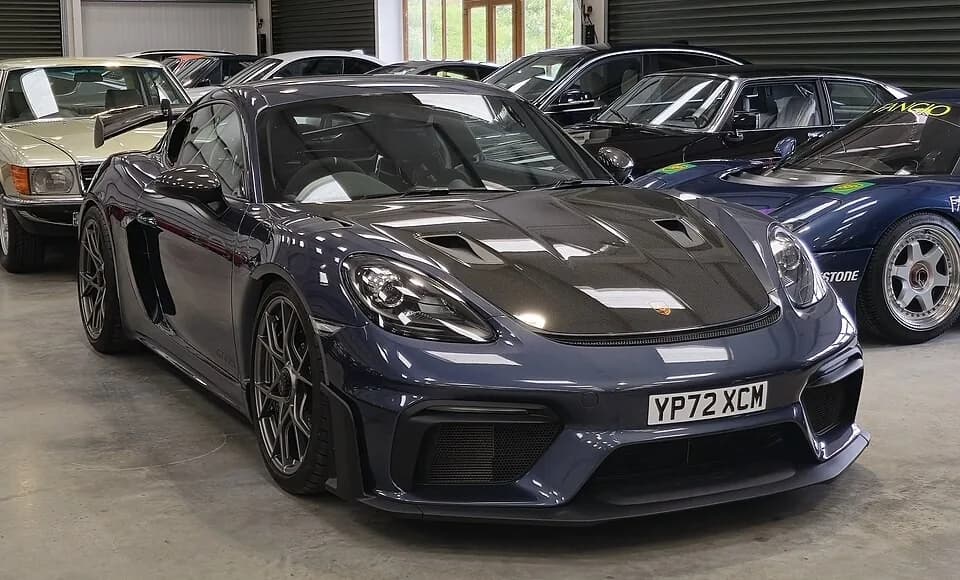
Porsche gives a DIN weight of 1,415 kg with a full fuel tank and without a driver. On that basis, the GT4 RS is 35 kg lighter than a PDK-equipped GT4.[1] The definition is essential: curb, DIN, EU, dry, and track-ready weights cannot be swapped without changing the comparison.
Carbon-fiber-reinforced plastic is used for the front luggage-compartment lid and front fenders. Porsche also lists lightweight carpets, reduced insulation, lightweight rear glass, and simplified door panels with textile loops and storage nets [1].
These lightweight components are production-car measures, not proof that every optional configuration weighs 1,415 kg. Wheels, packages, seats, brakes, fluids, accessories, and later track hardware can change an individual car’s measured mass. Verify a chassis’s equipment rather than treating the launch number as a scale ticket.
Aerodynamics and RS-Specific Chassis Changes
Wing, underbody, and ride height
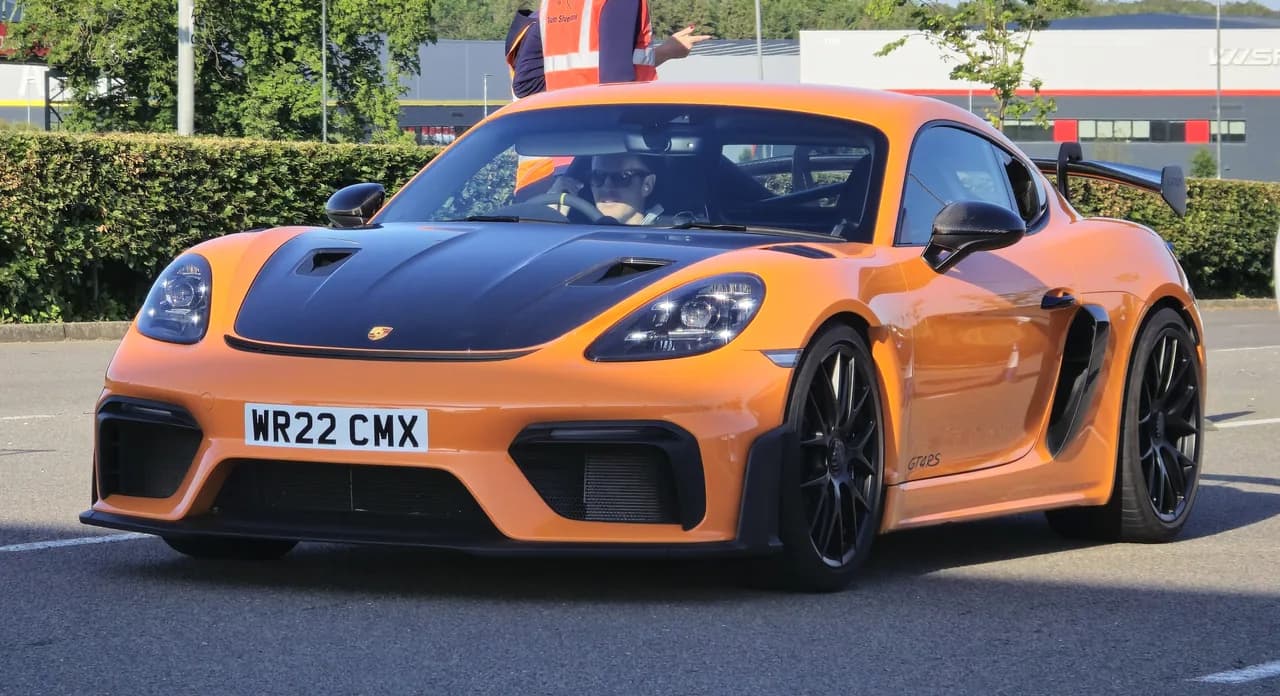
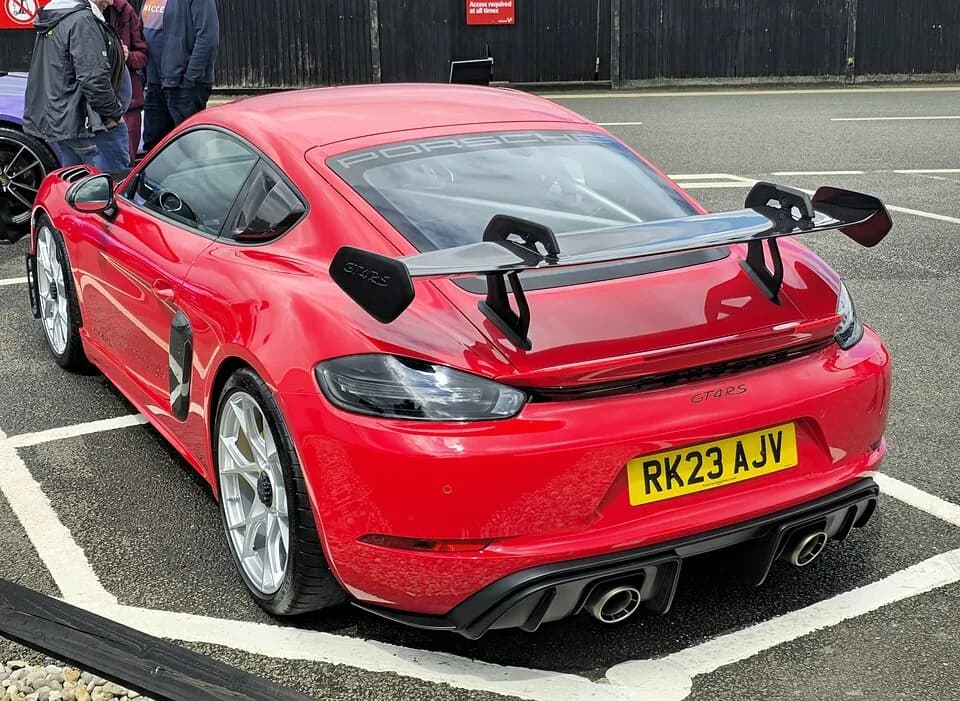
The fixed rear wing uses swan-neck supports, a principle Porsche connects to the 911 RSR and the series-production 911 GT3. The Porsche 718 Cayman GT4 RS also sits 30 mm lower than a standard 718 Cayman.[1] Its front-axle aero includes wheel-arch vents, underbody work, an adjustable front diffuser, and front spoiler elements. Porsche also fitted a rear diffuser.[1]
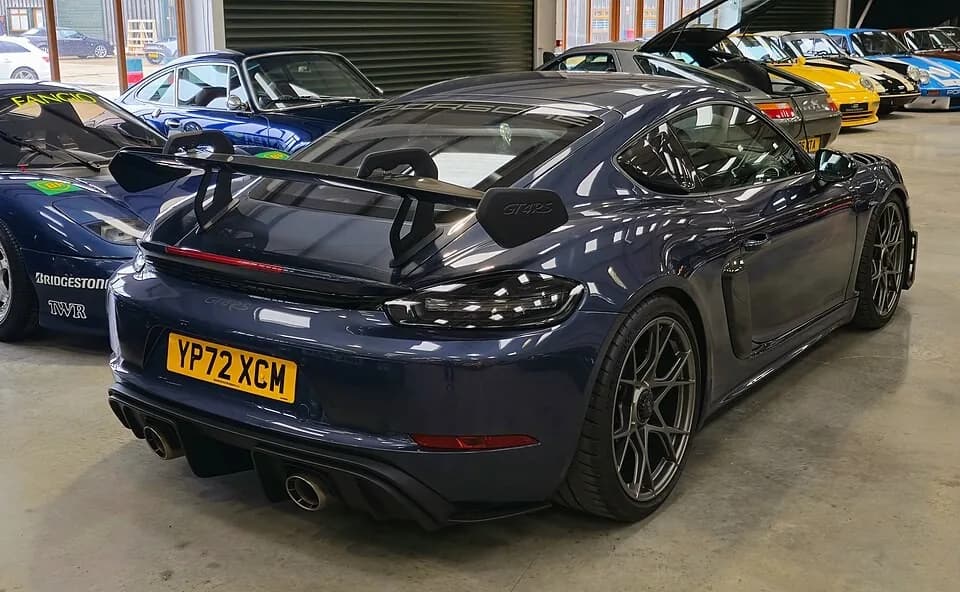
In the Performance mode reserved for the race track, Porsche says the car generates approximately 25 percent more downforce than the GT4 [1]. Road settings do not necessarily produce the same increase. Aero position, speed, ride height, and configuration define the result.
Ball joints connect the chassis more tightly to the body. Porsche also lists RS-specific dampers plus revised spring and anti-roll-bar rates.[1] The release describes an adjustable circuit-ready chassis, but it does not establish one setup for every circuit. Alignment, tire, temperature, and driver needs still determine the working setup.
The aero and chassis systems should be inspected together after circuit use. Splitters, underbody panels, diffuser mounts, wheel-arch vents, wing supports, ball joints, dampers, alignment hardware, wheels, and tires all carry evidence that paint alone cannot reveal.
Porsche 718 Cayman GT4 RS Specs Versus the Standard GT4
| Item | 718 Cayman GT4 RS | Porsche’s GT4 comparison |
|---|---|---|
| Output | 500 PS / 368 kW | 80 PS more than GT4[1] |
| Torque | 450 Nm | 20 Nm more than GT4[1] |
| Maximum engine speed | 9,000 rpm | RS-specific high-revving engine context[1] |
| Transmission | Seven-speed PDK only | GT4 sibling has a broader transmission choice; see dedicated guide |
| 0 to 100 km/h | 3.4 s | GT4 with PDK: 3.9 s[1] |
| Top speed | 315 km/h | GT4 with PDK: 302 km/h[1] |
| DIN weight | 1,415 kg | 35 kg lighter than PDK GT4[1] |
| Downforce | About 25% more in track Performance mode | Factory RS-to-GT4 comparison[1] |
The table is a launch-specification comparison, not a current sales sheet. Market equipment and individual options can vary. It also avoids duplicating the separate GT4 RS versus GT3 RS comparison, which addresses a different reader choice.
What the Weissach Package Adds
The optional Weissach package changes finish and equipment. Porsche lists carbon-weave finishes for the luggage-compartment lid, air intakes, airbox cover, mirror trims, and rear wing. The package also adds titanium exhaust tips and a titanium rear roll cage. Race-Tex covers the upper dashboard, and a large Porsche logo fills the rear window [1].

The forged magnesium wheels require careful wording. Porsche says that with the Weissach package, 20-inch forged magnesium wheels could be ordered at additional cost instead of the forged aluminum wheels.[1] A Weissach-equipped car does not automatically have magnesium wheels.
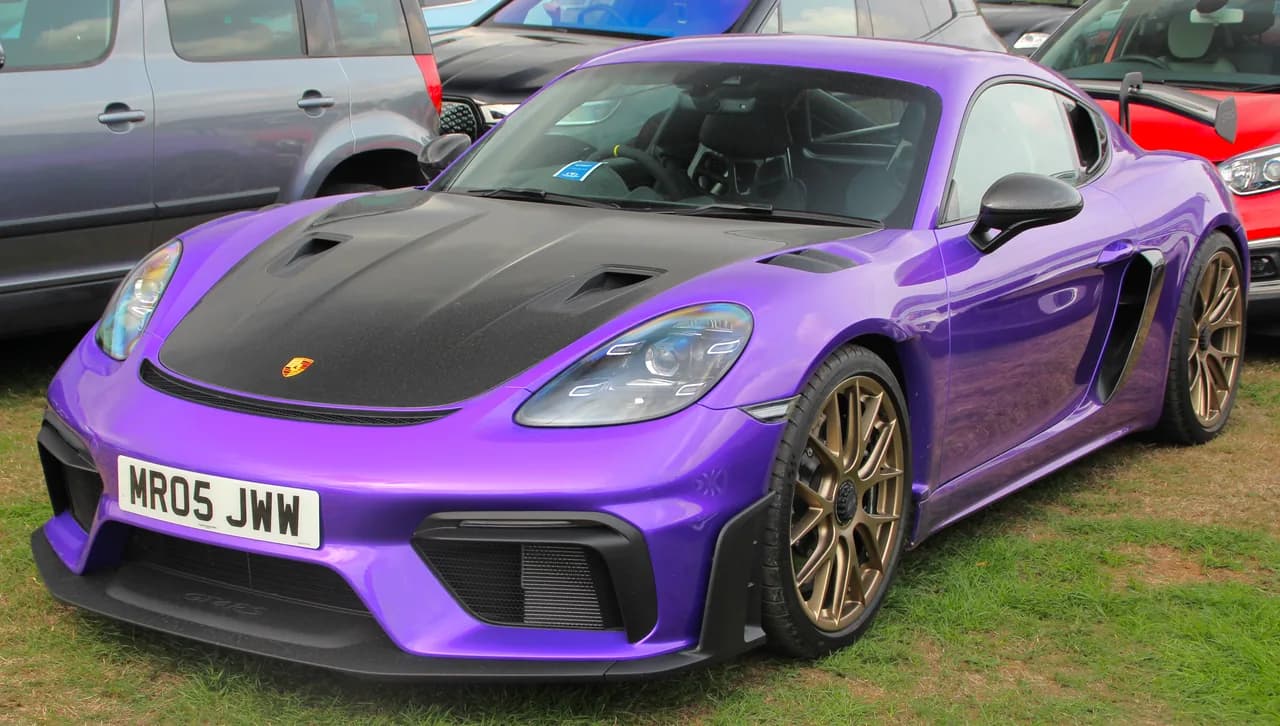
For a used example, verify the option record and the physical parts. Carbon-look finish is not enough to establish a factory package. Wheel material, part numbers, condition, repair history, and fastener specifications deserve separate inspection, especially when magnesium wheels are claimed.
What the Nürburgring Times Prove
Porsche published two lap lengths for the standard GT4 RS test. Jörg Bergmeister completed the 20.832 km Nürburgring Nordschleife in 7:09.300 and the older 20.6 km benchmark in 7:04.511. Porsche says the shorter-course time was 23.6 seconds faster than the GT4.[1][2]
The conditions belong with the result. The lightly disguised production car used optional Michelin Pilot Sport Cup 2 R tires and a racing seat for driver protection. Porsche says a notary confirmed its standard condition and weight.[2] The tire remains optional, and the two course lengths are not interchangeable.
A factory lap is strong evidence of circuit capability in that configuration. It is not a promise that an owner will reproduce the time, that the car is comfortable on every road, or that tire and brake costs are low. Those conclusions require separate evidence.
The Manthey Kit
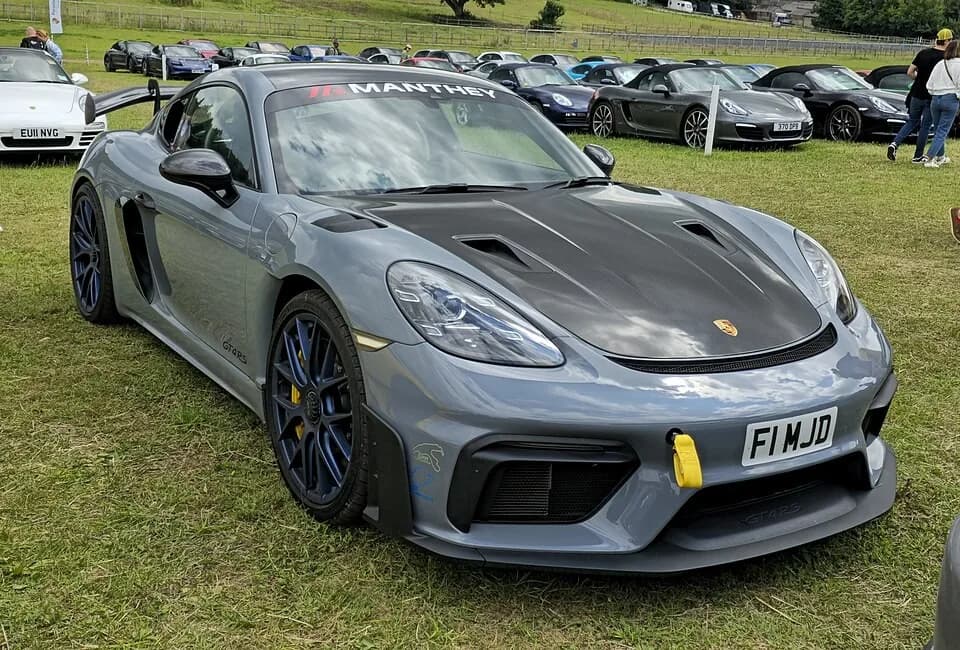
Porsche and Manthey developed a road-legal retrofit focused on track aerodynamics and chassis adjustment. Its aero parts include front flaps, air curtains, wheel-arch Gurney elements, a revised carbon underbody, a wider rear wing, and rear-wheel aerodiscs. The kit also adds reinforced rear bodywork, adjustable coilovers, and steel brake lines.[3]
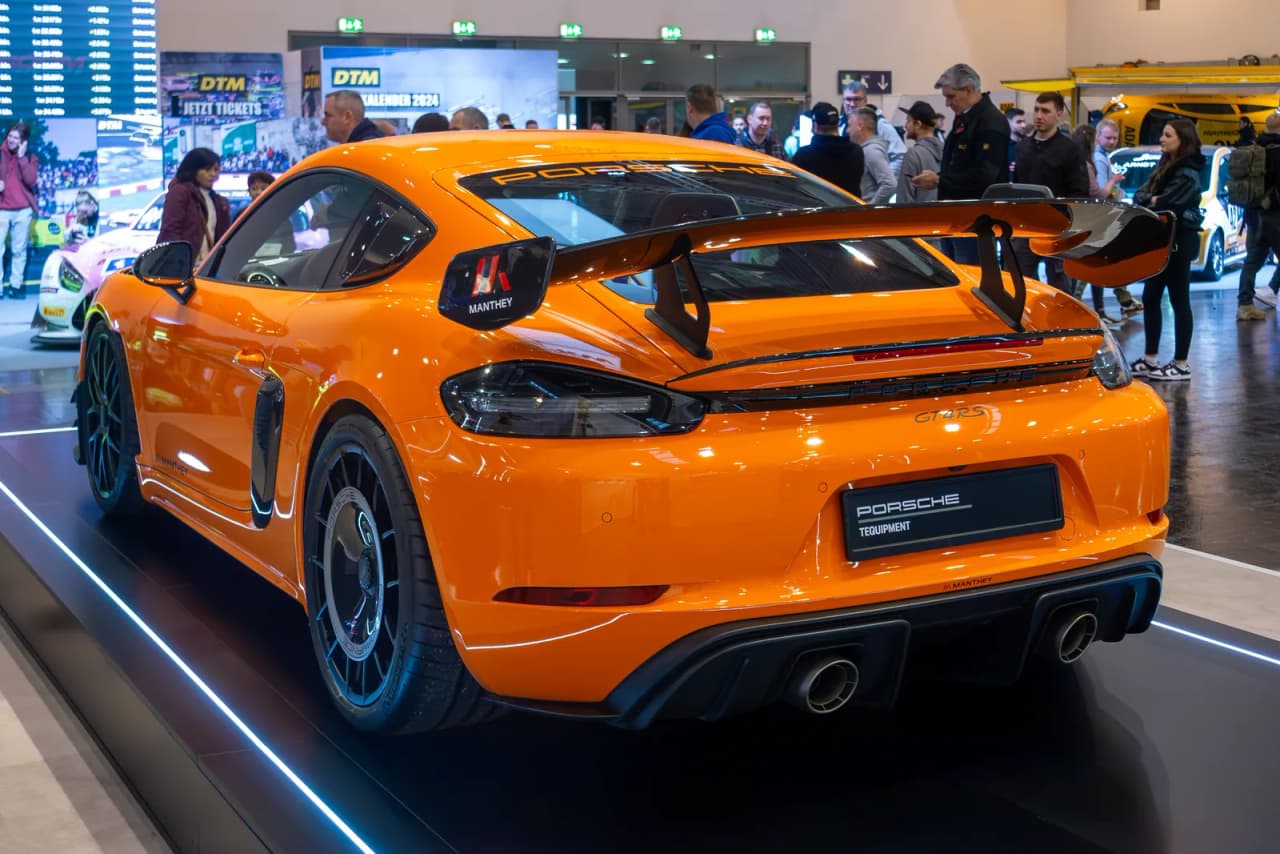
At 200 km/h with the wing in the track Performance setting, Porsche says total downforce rises from 89 kg to 169 kg. Front spring rates increase by 20 percent, while rebound and compression can be adjusted without tools. Track brake pads were listed as an option rather than a standard kit component.[3]
The Manthey-equipped car completed the 20.8 km Nordschleife in 7:03.121, 6.179 seconds quicker than the standard car in Porsche’s comparison. Both cars used optional Michelin Pilot Sport Cup 2 R tires. Porsche recorded an 18°C, overcast test and notary certification.[3]
This does not turn every car with a large wing into an authenticated Manthey build. Check invoices, Porsche Center or installer records, part numbers, setup sheets, alignment, ride-height settings, and whether later changes altered the original kit.
Road and Track Decision
The Porsche 718 Cayman GT4 RS makes sense when its fixed choices match the intended use: PDK, high engine speed, low mass, cabin-adjacent induction, and adjustable track hardware. If a manual gearbox is non-negotiable, the standard GT4 is the relevant sibling. If the decision is against a rear-engine RS, use the dedicated GT4 RS versus GT3 RS guide rather than reducing the choice to lap times.
Frequent circuit use raises practical questions that the launch releases do not price: tires, pads, discs, fluid intervals, alignment, transport, noise restrictions, insurance, and consumable heat cycles. Obtain quotes for the actual jurisdiction, circuit schedule, and configuration. Do not use a generic annual ownership figure.
Road use asks a different question. Verify clearance for local ramps, underbody exposure, seat and harness legality, tire suitability in temperature and rain, and whether race-track camber or toe settings create undesirable road wear at the front axle. The car’s road registration does not mean every track setup suits every public road.
Used GT4 RS Inspection and Configuration Checks
Begin with identity: VIN, option record, market specification, odometer history, Porsche dealer or specialist service records, campaigns, invoices, and diagnostic report. Confirm standard, Weissach, magnesium-wheel, tire, brake, lift-system, and Manthey claims individually.
- Body and aero: inspect CFRP panels, splitter, undertray, diffusers, wheel-arch vents, wing, mounts, and fasteners for impacts, repairs, or replaced parts.
- Chassis: measure alignment, inspect ball joints, dampers, springs, anti-roll bars, pickup points, lift equipment, and signs of curb strikes.
- Wheels and tires: confirm material and part numbers, inspect inner barrels and mounting faces, record tire model, date, heat cycles where known, repairs, and pressure history.
- Brakes: measure remaining material and inspect discs, pads, calipers, lines, fluid records, heat checking, and track-specific substitutions.
- Powertrain: review fault history, over-rev or operating-range data where available, PDK behavior, leaks, cooling condition, intake integrity, and service documentation.
- Track history: request event invoices, setup sheets, footage, timing records, and transport logs. Track use is not automatically disqualifying; undocumented damage or neglected consumables are the concern.
- Modifications: document every non-factory component, coding change, exhaust part, restraint, and fire-system addition. Verify road legality and event eligibility separately.
A pre-purchase inspection should be completed by a Porsche specialist familiar with GT cars and composite panels. It cannot guarantee future reliability, but it can convert configuration claims and visible wear into documented findings.
Frequently Asked Questions
What engine is in the Porsche 718 Cayman GT4 RS?
The GT4 RS uses a naturally aspirated flat-six related to the engine in the 911 GT3 and 911 GT3 Cup. Porsche lists 500 PS (368 kW), 450 Nm, and a 9,000 rpm maximum engine speed.
Is the 718 Cayman GT4 RS available with a manual transmission?
No. Porsche launched the GT4 RS exclusively with a seven-speed dual-clutch transmission. The standard 718 Cayman GT4 offers the broader manual-versus-PDK choice, but the RS does not.
How fast is the Porsche 718 Cayman GT4 RS?
Porsche claims 0 to 100 km/h in 3.4 seconds and a 315 km/h top speed. Those are manufacturer figures in metric test terms, not independently tested 0 to 60 mph results.
What does the Weissach package add to the GT4 RS?
The Weissach package adds visible carbon-weave finishes, titanium exhaust tips, a titanium rear roll cage, Race-Tex dashboard trim, and a rear-window Porsche logo. Porsche says forged magnesium wheels can then be ordered at additional cost, so the wheels are not automatically included.
What is the Manthey Kit for the GT4 RS?
The Manthey Kit is a Porsche-and-Manthey track package centered on aerodynamic and chassis changes. Porsche recorded 169 kg of downforce at 200 km/h in the track Performance setting and a 7:03.121 Nürburgring Nordschleife lap on optional Michelin Pilot Sport Cup 2 R tires.
Sources
- Porsche Newsroom: The new Porsche 718 Cayman GT4 RS.
- Porsche Newsroom: GT4 RS final testing and Nürburgring context.
- Porsche Newsroom: Manthey Kit for the 718 Cayman GT4 RS.
Image Credits
- 2022 Porsche 718 Cayman GT4 RS Weissach Package, MrWalkr, CC BY-SA 4.0.
- Porsche 718 Cayman GT4 RS (982), BrackishStowaway, CC0 1.0.
- 2023 Porsche 718 Cayman GT4 RS 11, Calreyn88, CC BY-SA 4.0.
- 2022 Porsche 718 Cayman GT4 RS SCD 24, MrWalkr, CC BY-SA 4.0.
- 2022 Porsche 718 Cayman GT4 RS 8, Calreyn88, CC BY-SA 4.0.
- 2022 Porsche 718 Cayman GT4 RS 9, Calreyn88, CC BY-SA 4.0.
- Porsche 718 Cayman GT4 RS 1, Calreyn88, CC0 1.0.
- 2022 Porsche 718 Cayman GT4 RS Weissach, MrWalkr, CC BY-SA 4.0.
- 2023 Porsche 718 Cayman GT4 RS 9, Calreyn88, CC BY-SA 4.0.
- Manthey Porsche GT4 RS, EMS 23, Essen, Matti Blume, CC BY-SA 4.0.