The Porsche 904 Carrera GTS was a compact mid-engine competition car with road approval, and it was Porsche’s first car with a glass-fiber-reinforced plastic body. It came with four-, six-, and eight-cylinder engines. In 1964 it won a class at Sebring, took a class win at Le Mans, and won the Targa Florio overall.
This guide covers how the 904 was built, which engines it used, and what it actually won in 1964.
Contents
Quick Summary
- What it was: A mid-engine competition car with road approval, designed by F. A. Porsche.
- Construction: Porsche’s first glass-fiber-reinforced plastic body, bonded to a steel body frame.
- Engines: 106 four-cylinder cars, works six-cylinder cars at 210 hp, and three eight-cylinder cars.
- Sebring 1964: A class win, according to Porsche.
- Le Mans 1964: A fourfold result in the up-to-two-liter class and a GT-class win, not an overall win.
- Targa Florio 1964: An overall win for Antonio Pucci and Colin Davis.
What the Porsche 904 Was
Ferdinand Alexander “Butzi” Porsche, the man behind the 911’s shape, drew the 904. According to the Porsche Museum, the body has a frontal area of only 1.4 square meters. The car was small, low, and built for endurance racing.
It was still a car you could register. Porsche’s account of the original GTS says the race car came with the usual road approval, and it gives the featured car’s figures as 650 kilograms and 1.06 meters high. That mix of road approval and race pedigree comes up again when we get to the name.
If you want the lightweight Porsche racer that came before it, that is the 550 Spyder. The 904’s biggest change was its material.
A Fiberglass Body Glued to a Steel Frame
The 904 is the first Porsche with a glass-fiber-reinforced plastic body. Porsche created it in collaboration with Heinkel Flugzeugbau, an aircraft manufacturer.
The important detail is what the plastic was attached to. Porsche says it tested and used a metal-plastic construction in 1964, glued to the steel body frame of the 904. The result was a very torsion-resistant unit.
So the 904 was not an all-plastic tub. There was a steel frame underneath, and the bonded body helped stiffen it.
Four, Six, and Eight Cylinders
Ask what engine a 904 had and the honest answer is that it depends on the car. The Porsche Museum lists 106 cars with four-cylinder engines, works cars with six-cylinder engines rated at 210 hp, and three cars with eight-cylinder powertrains.
The Museum’s eight-cylinder example is a 1,982 cc boxer engine rated at 240 hp, with a listed top speed of 263 km/h. Those numbers belong to that car. They do not describe a typical 904.
The road-approved car in Porsche’s GTS history has a different set of figures: 132 kW, or 180 hp, and the same 263 km/h top speed. Two different power ratings with one top speed is a good reason to keep each number attached to its own source. The Museum gives no count for the six-cylinder works cars, so there is no honest way to add these groups into a total.
1964: Sebring, Le Mans, and Sicily
Porsche says the 904’s international career in 1964 began with a class win at Sebring, continued at Le Mans, and reached a high point at the Targa Florio. The Sebring result is a class win and nothing more is claimed here, because the source gives no drivers or finishing position.
Le Mans Was a Class Win
At Le Mans, Porsche’s history describes a fourfold result in the class for cars up to two liters. It also says the 904 won the GT class for that displacement.
That is not an overall victory, and it should not be described as one.
The Targa Florio
The Targa Florio ran on public roads in Sicily. In 1964, Antonio Pucci and Colin Davis won it overall in a 904 GTS, completing ten laps of 72 kilometers in about seven hours and ten minutes, according to Porsche’s GTS history.
The Porsche Museum records a second result from the same race. Edgar Barth and Umberto Maglioli won the prototype class in one of the eight-cylinder cars. That is a class win in a different car with a different engine, so it stays separate from the Pucci and Davis overall win.
Where the GTS Name Comes From
Porsche’s own account ties the 1964 season to the badge. It says the success of the 904 Carrera GTS was “the birth of a new seal of quality: GTS.” The same account expands the letters as Gran Turismo Sport.
The badge went on to appear on many other Porsches, and you can follow that story on the Porsche GTS guide. The 904 is where Porsche itself starts the story.
Frequently Asked Questions
What was the Porsche 904 Carrera GTS?
The 904 Carrera GTS was a mid-engine competition car with road approval, designed by F. A. Porsche. Porsche calls it its first car with a glass-fiber-reinforced plastic body and points to it as the birth of the GTS name.
What engine did the Porsche 904 use?
There was no single 904 engine. Porsche’s Museum lists 106 cars with four-cylinder engines, works cars with 210 hp six-cylinder engines, and three cars with eight-cylinder powertrains. Each power figure belongs to its own version.
Did the Porsche 904 win Le Mans?
No, the Porsche 904 did not win Le Mans overall. Porsche describes its 1964 Le Mans debut as a fourfold result in the class for cars up to two liters, and says the 904 won the GT class for that displacement.
Did the Porsche 904 win the Targa Florio?
Yes, the Porsche 904 won the 1964 Targa Florio overall. Antonio Pucci and Colin Davis drove the winning 904 GTS; separately, Edgar Barth and Umberto Maglioli won the prototype class in an eight-cylinder 904.
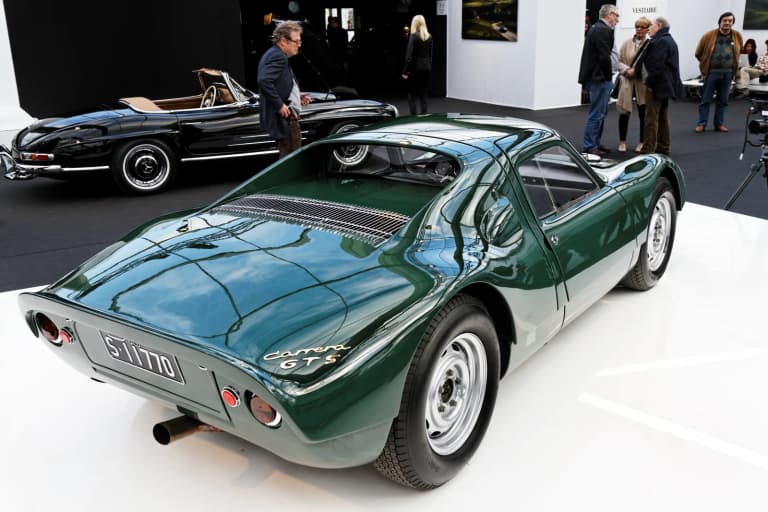
Images: Porsche 904 Carrera GTS, 1964 by Thesupermat, CC BY-SA 3.0; resized and converted. Via Wikimedia Commons.
A 1964 Porsche 904 Carrera GTS; the photograph is car context, not a period-race image.