The Porsche 908 was a family of three-liter sports-racing prototypes, not one fixed specification. The open 908/02 Spyder and the compact 908/03 shared an air-cooled flat-eight but differed sharply in body, weight, gearbox, and purpose. The 908/03 weighed just 545 kg in 1970 and won both the Targa Florio and the Nürburgring 1,000 km. A separate 908/02 chassis became Steve McQueen’s race car and carried cameras at Le Mans.
The 908/03 was a 545 kg wedge that won at the Targa Florio and the Nürburgring, and one 908/02 Spyder carried Steve McQueen’s cameras at Le Mans.
Contents
- 1 Quick Summary
- 2 How the 908/02 and 908/03 Differ
- 3 Why Porsche Built the Three-Liter 908
- 4 The 908/02 Spyder
- 5 The 908/03: Built for Two Tracks
- 5.1 A Driver Seated Ahead of the Engine
- 5.2 Lightweight Construction and Aerodynamics
- 5.3 Flat-Eight, Gearbox, and Brakes
- 6 The 1970 Targa Florio and Nürburgring Wins
- 7 The 1971 Finale and Privateer Afterlife
- 8 Steve McQueen and the Le Mans Camera Car
- 9 What the 908/04 Was and Was Not
- 10 How to Read a Surviving 908
- 11 Frequently Asked Questions
Quick Summary
- Two forms: This guide compares the 908/02 Spyder and the 908/03, whose weights, outputs, and gearboxes are not interchangeable.
- 908/02 Spyder: Chassis 908.022 has a 2,997 cc flat-eight, 350 hp, a six-speed gearbox, and a weight of 720 kg.
- 908/03: Built for the Targa Florio and Nürburgring, it made 370 hp with five speeds and weighed 545 kg in 1970.
- 1970 results: The 908/03 won the Targa Florio and took a one-two at the Nürburgring 1,000 km.
- McQueen connection: His Solar Productions owned chassis 908.022, which finished second at Sebring and carried cameras at the 1970 Le Mans.
- 908/04: A private, unofficial design project by five enthusiasts, not a Porsche factory car.
- 908/03 pace: Porsche lists an approximate maximum speed of 275 km/h, or about 171 mph, for the 1970 car.
How the 908/02 and 908/03 Differ
This guide covers two Porsche 908 forms: the open 908/02 Spyder and the compact 908/03. They raced in the same three-liter prototype class with the same flat-eight, but their bodies, weights, and gearboxes served different jobs.
The 1970 908/03 weighed 545 kg in race-ready trim. The 908/02 Spyder, chassis 908.022, weighed 720 kg and had a six-speed gearbox.
| Form | Purpose or identity | Specification or result |
|---|---|---|
| 908/02 Spyder | Open prototype form | Chassis 908.022: 2,997 cc flat-eight, 350 hp, six speeds, 720 kg |
| 908/03 | Compact 1970 and 1971 car for the Targa Florio and Nürburgring | 2,997 cc flat-eight, 370 hp, five speeds, 545 kg in 1970 |
| 908/04 | Unofficial modern design exercise | Private five-person project, not a Porsche factory car |
The 908/03 figures come from Porsche’s history of the 908/03, and the Spyder figures come from its account of chassis 908.022. For the full run of Porsche results at the Sarthe, the Porsche Le Mans history covers the rest.
Why Porsche Built the Three-Liter 908
Porsche developed the 908 flat-eight for the three-liter prototype class starting in 1968. According to Porsche Newsroom, the engine first ran in autumn 1967 and made roughly 340 hp at the start. Later development took it to 370 hp.
By 1970 Porsche was matching cars to circuits. The 917 would run on fast tracks where power and low drag paid off. The purpose-built 908/03 would take the Targa Florio and the Nürburgring Nordschleife, where constant direction changes, elevation, and heavy braking rewarded a compact, light car.
That did not make the 908/03 a better car than the 917. It made it a better tool for two specific jobs, and the 917 took the fast circuits.
The 908/02 Spyder
The 908/02 was the open form of the 908. Chassis 908.022 began the 1969 24 Hours of Daytona as a white factory long-tail coupé with a yellow nose. After factory work, it reappeared later that year as an open car owned by Steve McQueen’s Solar Productions.
Porsche’s technical panel for that Spyder lists an air-cooled 2,997 cc flat-eight making 350 hp at 8,400 rpm, a fully synchronized six-speed manual gearbox, and 720 kg unladen. The car measured 4,000 mm long, 1,830 mm wide, and 730 mm high.
| 908/02 Spyder item | Chassis 908.022 figure |
|---|---|
| Engine | Air-cooled flat-eight |
| Displacement | 2,997 cc |
| Maximum power | 350 hp at 8,400 rpm |
| Transmission | Fully synchronized six-speed manual |
| Unladen weight | 720 kg, about 1,587 lb |
| Length / width / height | 4,000 / 1,830 / 730 mm |
The same chassis later got a twin-turbo six-cylinder Porsche engine and a 935 gearbox during a historic-racing phase before it was restored.
The 908/03: Built for Two Tracks
The 908/03 was the most extreme 908. Everything about it was tuned for the Targa Florio and the Nürburgring, and the engineers were willing to give up conventional layout to get there. Porsche says it built 13 of them between 1969 and 1971.
A Driver Seated Ahead of the Engine
Project manager Manfred Bantle developed the 908/03 from ideas used in Porsche’s 909 hillclimber. Moving the differential behind the transmission pushed the gearbox, the engine, and the driver forward. The result was a 45:55 front-to-rear axle-load split.
The driver sat just behind the front axle, with the pedals up at the nose. Only about 30 centimeters of body stuck out ahead of the front wheels. That packaging helped the short car rotate through the repeated corners of both circuits, where a long, high-speed body would have solved the wrong problem.
Lightweight Construction and Aerodynamics
Ferdinand Piëch wanted the hillclimber’s extreme lightness to survive 1,000-kilometer racing. Engineers swapped steel for titanium, aluminum, and magnesium and thinned the material wherever they could. Porsche says the aluminum tube frame weighed just over 30 kg, the body only 12 kg, and steel made up 2.9 percent of the chassis excluding the brake discs.
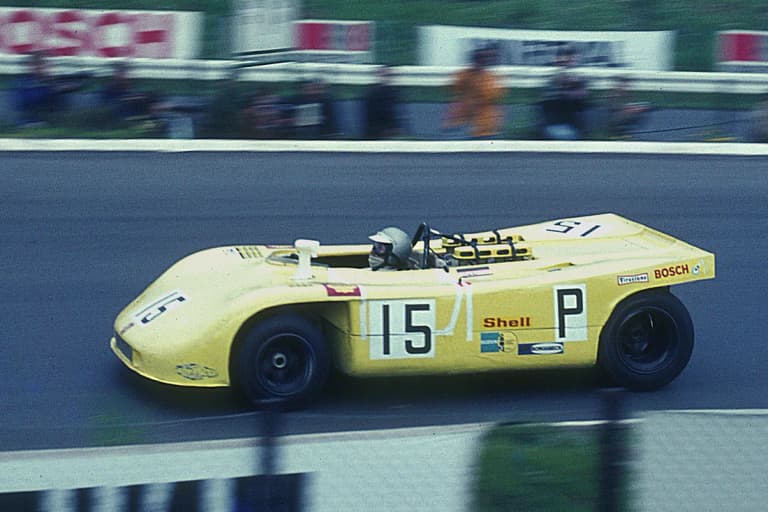
The 1970 car came in at 545 kg race-ready, about 1,202 pounds. A stronger rollover bar and larger rear wheels added 20 kg for 1971. The body was foam-reinforced plastic over the tube frame, and it made useful downforce without a conventional rear wing. Rear fins and a small spoiler arrived for 1971.
Flat-Eight, Gearbox, and Brakes
The 908/03 used an air-cooled 2,997 cc flat-eight mounted longitudinally in the middle of the car. It had two valves per cylinder, chain-driven dual overhead camshafts, Bosch fuel injection, 370 hp at 8,400 rpm, and 318.5 Nm at 8,000 rpm. The engine weighed about 180 kg.
Early engines vibrated badly enough to earn the workshop nickname “the shaker,” and a redesigned crankshaft fixed the problem. The car ran a newly developed five-speed transmission with a locking differential, and perforated brake discs saved mass and shed heat.
| 908/03 specification | Figure |
|---|---|
| Engine | Air-cooled 2,997 cc flat-eight |
| Power | 370 hp at 8,400 rpm |
| Torque | 318.5 Nm at 8,000 rpm |
| Transmission | Five-speed, locking differential, rear-wheel drive |
| Frame and body | Aluminum tube frame, foam-reinforced plastic body |
| Wheelbase | 2,300 mm |
| Length / width / height | 3,540 / 1,950 / 680 mm |
| 1970 weight | 545 kg |
| Approximate maximum speed | 275 km/h, about 171 mph |
| Build period and quantity | 1969 to 1971, 13 cars |
The 1970 Targa Florio and Nürburgring Wins
The 1970 Targa Florio ran 11 laps of the 71.9-kilometer Piccolo Circuito delle Madonie. Porsche’s account describes 700 to 900 corners per lap on public mountain roads, which is exactly the kind of course the 908/03 was built for. Jo Siffert and Brian Redman won, and Leo Kinnunen and Pedro Rodríguez finished second in another 908/03.
Kinnunen’s final lap took 33 minutes 36.0 seconds. Porsche called that lap record unbeaten as of 2017.
The 908/03 then went to the Nürburgring 1,000 km and produced another one-two. Kurt Ahrens and Vic Elford won, with Hans Herrmann and Richard Attwood second. Together the two results show what the car was for: on tracks where power alone could not decide the race, low weight and quick direction changes won.
The 1971 Finale and Privateer Afterlife
The 1971 Targa Florio went badly for Porsche. Gérard Larrousse led in the remaining 908/03 until repeated tire damage and a damaged rear axle ended its race.
The final factory race came at the Nürburgring 1,000 km, and it ended in a win. Elford and Larrousse took the victory in the silver Martini 908/03. Rodríguez and Siffert finished second in the JWA car, only a tenth of a second ahead of Helmut Marko after a late fight.
Private teams kept the 908/03 racing. A Spanish team ran one in October 1971, and Reinhold Joest’s team won the 1973 9 Hours of Kyalami with a privately owned car. Turbocharged versions appeared later, and Porsche says the model’s racing career ran until 1983. A surviving chassis can therefore show a 1970 works setup, a privateer phase, or a later restoration.
Porsche’s later 936 took a different route to endurance-racing success, using turbocharged power rather than the 908’s naturally aspirated flat-eight.
Steve McQueen and the Le Mans Camera Car
Chassis 908.022 is the link between real competition and the film Le Mans. McQueen did not own the car personally in Porsche’s telling. His company, Solar Productions, did, and McQueen entered it in four races in February and March 1970. He won two and, according to Porsche, set a lap record at Holtville.
At the 12 Hours of Sebring, McQueen and Peter Revson finished second. Porsche notes that Revson set the stronger times.
For the real 1970 24 Hours of Le Mans, the car carried three Arriflex cameras. Herbert Linge recalled that the installations added 40 kg without seriously upsetting balance or speed, and the footage was later cut into the film.
Porsche says chassis 908.022 crossed the line ninth, but only seven cars were classified after covering the minimum distance. Officially, it was not a ninth-place finisher.
The car came back to Le Mans in 1973 and finished seventh with Guillermo Ortega and Fausto Morello, then suffered a severe crash in 1974. After a heavily modified twin-turbo phase it was restored to an earlier form and returned to historic competition in 2000. Its fame comes from that whole layered history, not just the cameras.
What the 908/04 Was and Was Not
Searches for the historic car can also turn up something called the “908/04.” Porsche Newsroom profiled it in 2017, but it never came from Porsche. Five enthusiasts designed it privately after hours while employed by another automaker, spending almost two years and about 5,000 hours on it.
The team described it as a modern take on a long-tail 908, drawing on both the 1968 car and a 1969 908 LH. It is a heritage-inspired design exercise, not a Porsche factory concept, a commissioned successor, a race entry, or a production car. It also tells you nothing about how the real 908 was engineered.
How to Read a Surviving 908
A surviving 908 is a competition car that changed over time. If you are looking at one, these are the points to pin down on the car and in its paperwork.
- Check the chassis number and suffix. Confirm them on the car and in the papers, since one chassis can wear more than one body.
- Get dated records of every configuration. Ask for the coupé, Spyder, long-tail, aerodynamic, engine, gearbox, and livery changes.
- Get the accident and repair history. Ask who did the work and with what materials.
- Know the restoration target. Find out which race or period the car was restored to represent.
- Have the safety gear inspected on its own. Fuel cells, brakes, belts, wheels, and magnesium parts all need checking before track use, whatever the history says.
Frequently Asked Questions
What was the Porsche 908?
The Porsche 908 was a family of three-liter sports-racing prototypes, not one fixed specification. The open 908/02 Spyder and the compact 908/03 shared an air-cooled flat-eight but differed sharply in body, weight, gearbox, and purpose.
What engine did the Porsche 908 use?
The 908/02 Spyder and 908/03 used an air-cooled 2,997 cc flat-eight. Porsche lists 350 hp for chassis 908.022, a 908/02 Spyder, and 370 hp at 8,400 rpm for the later 908/03.
What is the difference between the Porsche 908/02 and 908/03?
The 908/02 was an open Spyder form of the 908, while the 908/03 was a much smaller, lighter car built for the Targa Florio and the Nürburgring. Porsche lists 720 kg and a six-speed gearbox for chassis 908.022, a 908/02, versus 545 kg and five speeds for the 1970 908/03.
How much did the Porsche 908/03 weigh?
Porsche records 545 kg, or about 1,202 pounds, in fully race-ready 1970 form. A stronger rollover bar and larger rear wheels added another 20 kg for 1971.
Did the Porsche 908/03 win the Targa Florio?
Yes, the 908/03 won the 1970 Targa Florio with Jo Siffert and Brian Redman, and Leo Kinnunen and Pedro Rodríguez finished second in another 908/03. Porsche’s 1971 Targa attempt failed, but the car won the Nürburgring 1,000 km in both 1970 and 1971.
What was Steve McQueen’s connection to the Porsche 908?
McQueen’s Solar Productions owned chassis 908.022, and McQueen raced it in early 1970, including a second-place finish at Sebring with Peter Revson. The car then carried three cameras in the real 1970 Le Mans race to collect footage for the film Le Mans.
Was the Porsche 908/04 a real Porsche race car?
No, the 908/04 was not a real Porsche race car. The design Porsche Newsroom showed in 2017 was an unofficial private project by five enthusiasts, not a Porsche factory race car, commissioned concept, production model, or historical 908 variant.
Image Credits
Porsche 908/03 driven by Hans Herrmann at the Nürburgring. Local WebP derivative of Porsche 908.03 - Hans Herrmann 1970-05-31 by Lothar Spurzem, CC BY-SA 2.0 DE.