
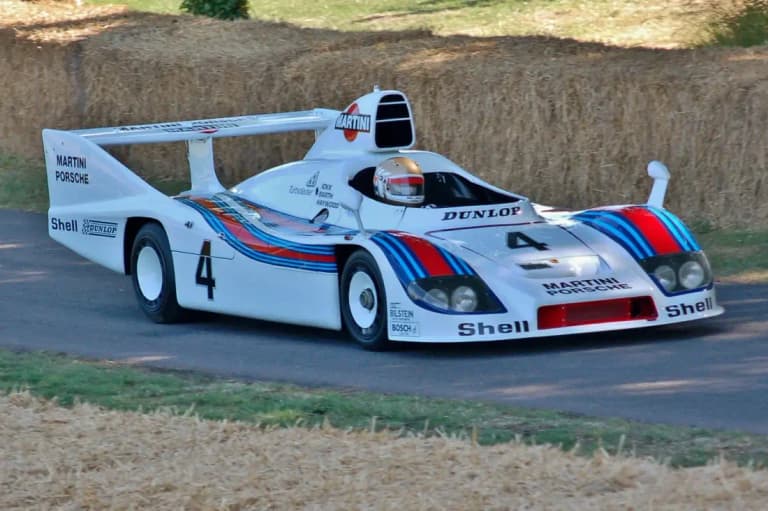
The Porsche 936 was Porsche’s open-cockpit turbo prototype, and it won the 24 Hours of Le Mans overall in 1976, 1977, and 1981. Its 1976 victory was the race’s first overall win by a turbocharged car.
In this article, we’ll place the Porsche 936 in Porsche’s endurance-racing history. We’ll cover Le Mans wins, the 1977 recovery, and the 956 link.
Contents
Quick Summary
- Role: The 936 was an open-cockpit Porsche turbo prototype.
- Le Mans record: It won overall in 1976, 1977, and 1981.
- 1976 milestone: Porsche describes it as the first turbocharged car to win Le Mans.
- 1977 lesson: Porsche’s surviving 936 recovered from early trouble and finished with five working cylinders.
- Legacy: The 1981 engine informed Porsche’s 956 programme.
What the Porsche 936 was
The 936 was an open-cockpit prototype. It was not a production-based customer racer like the Porsche 935. Porsche’s history calls it the 936 Spyder and records overall wins there in 1976, 1977, and 1981. Its prototype role makes it a distinct model, even though Porsche’s turbo program connected several cars of the era.
Porsche competition names can look deceptively close. The 935 was a Group 5 car. The open-cockpit 936 carried Porsche back to overall Le Mans victories. See the broader Le Mans chronology.
The three Le Mans wins
Porsche’s historical record lists overall victories in 1976, 1977, and 1981. Each win has a different story. The 1977 result was a recovery win. The 1981 car linked the 936 to Porsche’s next prototype program.
Why the 1976 win is important
The 1976 victory broke new ground. Porsche Christophorus calls it the first overall Le Mans win by a turbocharged car. It gave the 936 a place in Porsche turbo history beyond a single race result.
Porsche also places that win close to the launch of the road-going 911 Turbo. The shared turbo era is historical context, but the 936 remained a purpose-built endurance racer. The Porsche 917 belongs to an earlier era.
1977: a win under pressure
Porsche’s 1977 account shows why the second victory is remembered. The factory entered two 936 long-tails and a 935/77. The number 3 936 retired with engine damage, while the number 4 car lost its fuel pump and fell to 41st place during the repair.
Jacky Ickx then joined Jürgen Barth and Hurley Haywood in the remaining 936. Porsche says the car recovered to lead by 19 laps on Sunday morning. A piston failed with 46 minutes remaining. The team isolated the damaged cylinder, and Barth took the car over the line with five working cylinders. The recovery rewarded durability and clean race execution.
1981 and the road to the 956
The third victory came in 1981. Jacky Ickx and Derek Bell shared the car. Porsche Christophorus reports that they averaged more than 200 km/h at Le Mans that year. Porsche also says project manager Norbert Singer took the 1981 car’s type 935/76 twin-KKK-turbo six-cylinder boxer engine into the 956 program.
That makes the 936 a bridge to the next car. The Porsche 956 used a new aluminum monocoque and ground-effect body. Porsche’s 956 and 962 C successor won Le Mans without interruption from 1982 through 1987. The 936’s 1981 engine lineage carried into that program.
Where the 936 fits
The 936 connected two eras of Porsche prototypes. The 917 had delivered Porsche’s first overall Le Mans wins. The 936 then proved turbo power at the same race, while the closed-body 935 followed a different rules path.
Its 1981 return pointed forward. The 956 began Porsche’s Group C chapter with a new chassis and ground-effect body. Porsche carried the 936 winner’s engine lineage into that program.
Why the 936 remains significant
The 936 had a short but decisive career. Three overall wins establish its result, while the first turbocharged overall victory establishes its significance. The 1977 and 1981 stories make it more than a statistic. They show Porsche’s turbo ambition meeting the practical demands of a 24-hour race.
Frequently asked questions
What was the Porsche 936?
The Porsche 936 was Porsche’s open-cockpit turbocharged prototype racer. It is best known for overall victories at the 24 Hours of Le Mans in 1976, 1977, and 1981.
How many times did the Porsche 936 win Le Mans?
The Porsche 936 won the 24 Hours of Le Mans overall three times: 1976, 1977, and 1981.
Why is the Porsche 936 important?
The 936 gave Porsche the first turbocharged overall victory in Le Mans history in 1976 and helped bridge Porsche’s earlier prototypes and the 956 era.
Image: 1976 Porsche 936, Goodwood, 2009 by Bahnfrend, CC BY-SA 4.0. Via Wikimedia Commons.
.jpg)