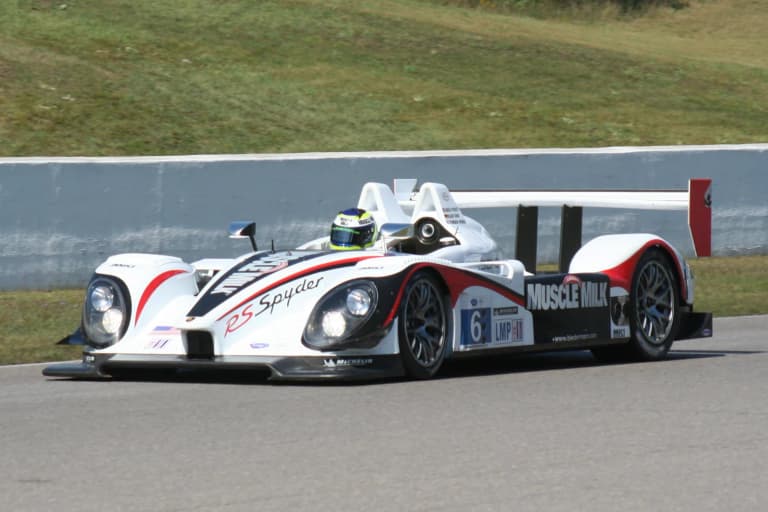
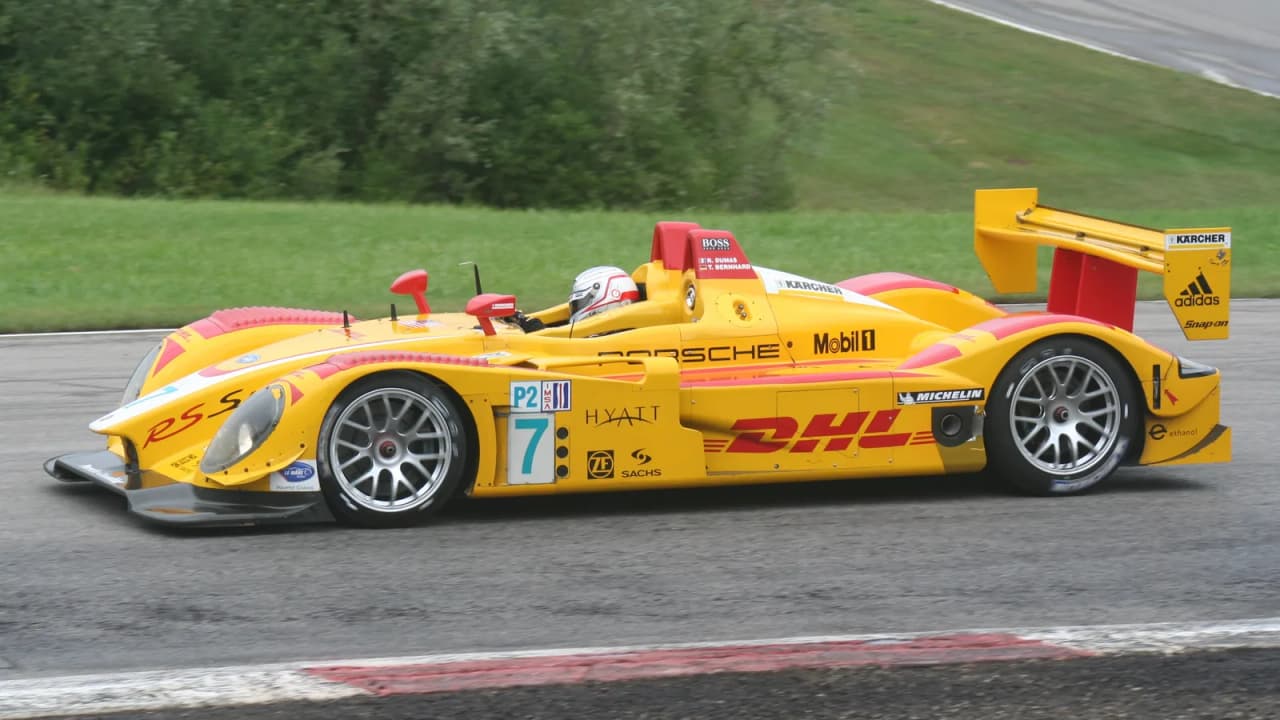
The Porsche RS Spyder was a 2000s LMP2 racing prototype powered by a 3.4-liter V8. Porsche says Penske’s customer-team program won the American Le Mans Series LMP2 titles from 2006 through 2008. The car also scored an overall victory at the 2008 12 Hours of Sebring.
In this article, we’ll cover the LMP2 program, the Sebring win, and the V8 lineage.
Contents
Porsche RS Spyder Identity
The RS Spyder was a competition car, not a road model or a trim package. Porsche identifies it as an LMP2 class racer and describes the Penske operation as a customer-team program.[1][2] That context belongs with any specification or result.
Its name nods to earlier lightweight Porsche racers, including the 550 Spyder, but the modern prototype used a different architecture, rule set, engine, and era. Porsche’s 2018 Rennsport Reunion release explicitly says the RS Spyder name referenced the 550 of the 1950s.[2]
The “RS” and “Spyder” labels can also lead readers toward road cars. Here they identify a prototype program designed for endurance competition. Registration, road comfort, and production-car equipment are outside its job.
Its LMP2 Purpose
LMP2 sat below the top prototype category, with its own regulations and championship. The RS Spyder’s results therefore need two labels: class and overall. A class title establishes sustained LMP2 success. An overall win means the car finished ahead of every class in that event.
Porsche’s retrospective does not provide one complete period rulebook or a year-by-year technical data sheet. This guide avoids filling those gaps from memory. Exact weight, output, aerodynamic package, and race configuration can vary by season and event; they should be attached to dated technical records.
For the wider endurance story, the Porsche at Le Mans guide covers the marque across categories and decades. The RS Spyder page stays with this one LMP2 program.
The 3.4-Liter V8
What the primary record supports
Porsche’s 963 technical history traces its later V8 back to the RS Spyder. It states that the prototype used a 3.4-liter engine.[1] The article identifies the design as a V8 through its lineage discussion. That supports engine form and displacement without assigning one output figure to every configuration.
Porsche’s 963 technical history describes a sequence from the RS Spyder’s 3.4-liter V8 to the 918 Spyder’s larger V8. It then reaches the 963 combustion engine.[1] That is a development line, not a specification sheet for each car.
“Based on” and “traced back to” do not mean the engines are interchangeable. The 918’s road-hybrid installation and the 963’s 4.6-liter twin-turbo hybrid package have different displacement, charging, electronics, duty cycles, and regulations. Engineering lineage describes development, not parts identity.
Penske Program and LMP2 Titles
Keep titles and entry status separate
Porsche says the former customer team Penske won every ALMS LMP2 title from 2006 through 2008 with the RS Spyder.[1] A separate Porsche retrospective calls the three-year span three manufacturer championships.[2]
The two statements support a sustained program, but they should not be expanded into an unsourced list of every driver, team, and race trophy. Championship titles can be divided among manufacturer, team, and driver classifications, and exact names should come from season-specific records.
The customer-team description is also important. Porsche designed the car, while Penske campaigned it with major success. That is different from casually calling every entry a factory car or, at the other extreme, implying Porsche had no technical role.
The 2008 12 Hours of Sebring
The standout event in Porsche’s concise retrospective is the 2008 12 Hours of Sebring. Porsche says the RS Spyder won the race and calls it the first victory at Sebring for a car outside the top prototype class in 14 years.[2]
That phrasing establishes an overall victory by an LMP2 entry. It does not prove that the lower class had a general performance advantage. Endurance results emerge from pace, traffic, reliability, pit work, penalties, weather, and attrition over the full event.
It is also distinct from the 1960 Sebring result in the same Porsche release. The earlier winner was the 718 RS 60, driven by Hans Herrmann and Olivier Gendebien, with a mid-mounted flat-four. The 2008 winner was the V8 LMP2 RS Spyder.[2]
Technical Legacy
Porsche says the RS Spyder contributed to the 918 Spyder and the 919 Hybrid.[2] Its later 963 account adds a direct V8 development line from the RS Spyder to the 918 and then to the Porsche 963.[1]
The useful takeaway is continuity of engineering experience: naturally aspirated V8 development, structural packaging, endurance operation, and knowledge transferred between racing and road-hybrid projects. The unsafe takeaway would be to call all three cars versions of the same engine or to copy the 963’s 4.6-liter turbo specifications backward onto the RS Spyder.
The program’s legacy is therefore both competitive and technical. Its ALMS success gave Porsche a strong prototype chapter before the 919 era, while its powertrain concept remained relevant to later electrified vehicles.
Cars Not to Confuse
| Car | Era and role | Key distinction |
|---|---|---|
| 550 Spyder | 1950s sports racer | Namesake reference, not the same program[2] |
| 718 RS 60 Spyder | 1960 sports racer | Mid-mounted flat-four; 1960 Sebring winner[2] |
| RS Spyder | 2000s LMP2 prototype | 3.4-liter V8; 2006–2008 ALMS LMP2 title period[1] |
| 918 Spyder | Road-going hybrid supercar | Later enlarged V8/hybrid development[1] |
| 963 | 2020s LMDh hybrid prototype | 4.6-liter twin-turbo V8 lineage; different rules and hardware[1] |
Chassis and Provenance Checks
Evaluate a historic racing prototype by chassis, not only by model. Request its chassis identity and ownership trail. Then check team and season records, race logs, crash repairs, replacement tubs or bodywork, engine and gearbox histories, technical passports, and current event eligibility.
Configuration can change after an active career. Aero, suspension, electronics, cooling, engine calibration, safety systems, and livery may reflect different seasons or later historic-racing requirements. A period photograph can support appearance at one event but cannot certify every internal component today.
Inspection should involve marque historians and race-car specialists with access to relevant archives. Confirm spare parts, operating procedures, engine life records, fire-system dates, fuel-cell dates, and support equipment before planning demonstration or competition use.
Frequently Asked Questions
What was the Porsche RS Spyder?
The Porsche RS Spyder was a purpose-built LMP2 sports-racing prototype. Porsche’s retrospective sources describe a 3.4-liter V8 program run successfully by customer teams, including Penske, in the American Le Mans Series.
Is the RS Spyder the same as the 718 RS 60 Spyder?
No. The 718 RS 60 was an early-1960s sports racer with a mid-mounted flat-four. The RS Spyder discussed here is a 2000s LMP2 prototype with a 3.4-liter V8. Their Spyder names and racing roles do not make them one model.
What championships did the RS Spyder win?
Porsche says the Penske-run RS Spyder won all LMP2 titles in the American Le Mans Series from 2006 through 2008. Another Porsche retrospective summarizes that period as three manufacturer championships.
Why was the 2008 Sebring victory important?
Porsche says the RS Spyder won the 2008 12 Hours of Sebring and that it was the first victory there for a car outside the top prototype class in 14 years. That is an event result, not a claim that LMP2 cars were always faster than the top class.
How did the RS Spyder influence later Porsche cars?
Porsche traces the later 918 Spyder and 963 V8 lineage back to the RS Spyder and says the race car contributed to development of the 918 Spyder and 919 Hybrid. The later cars are related through engineering lineage, not identical powertrains.
Sources
- Porsche Newsroom: 963 V8 DNA from RS Spyder and 918 Spyder.
- Porsche Newsroom: Rennsport Reunion VI race-car history.
Images: Muscle Milk Team Cytosport RS Spyder, 2010. Penske Racing RS Spyder, 2007. TorontoGuy79. CC BY-SA 4.0. Via Wikimedia Commons.