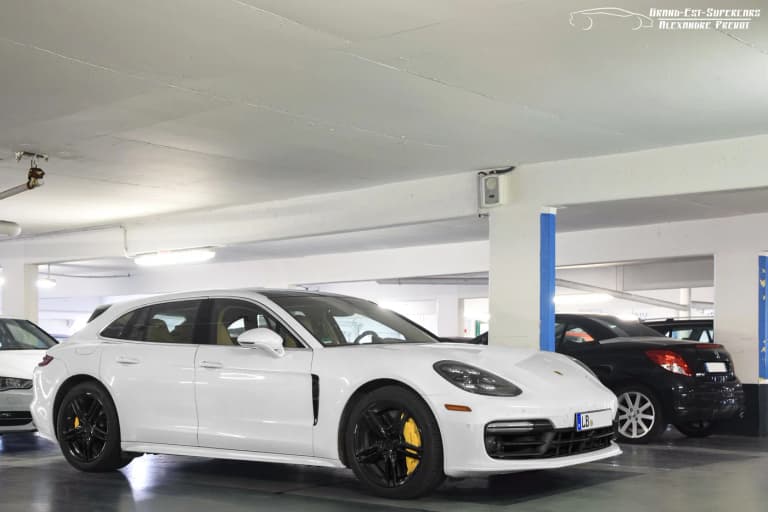
The Porsche Panamera Sport Turismo is the wagon-shaped body style Porsche built only on the second-generation (971) Panamera, sold from 2017 to 2023. It shares its engines and chassis with the Panamera sedan but adds a 2+1 rear seat, a bigger tailgate opening, and more cargo room. Porsche never brought it to the third-generation car.
In this article, we’ll explain the Panamera Sport Turismo, the wagon-bodied Panamera, and what to check before buying one. We’ll cover its engine lineup, cargo space, inspection checklist, and sedan comparison.
Contents
- 1 Quick Summary
- 2 What the Panamera Sport Turismo Is
- 3 Panamera Sport Turismo Model and Engine Range
- 4 Cabin, Rear Seat, and Cargo Reality
- 5 Driving and Chassis
- 6 Common Problems and Maintenance
- 7 Inspection Checklist
- 8 Sport Turismo vs Sedan and Taycan Cross Turismo
- 9 Which Version Fits Which Buyer
- 10 Frequently Asked Questions
Quick Summary
- Body Style: The wagon-shaped Sport Turismo was built only on the second-generation (971) Panamera, sold from 2017 to 2023
- Discontinued: Porsche did not carry the body style to the third-generation (972) Panamera; every Sport Turismo is now a used car
- Seating: Standard 2+1 rear layout with three rear seatbelts, or an optional four-seat layout with two individual rear seats
- Cargo Space: About 18.36 cu ft with seats up and 49 cu ft folded on non-hybrid models; the E-Hybrid holds less at 15 cu ft up and 45.7 cu ft folded
- Engine Range: Spans a 330-hp V6 Panamera 4 through a 690-hp Turbo S E-Hybrid, all with standard all-wheel drive and an eight-speed PDK
- Reliability: Shares its mechanical platform with the 971 sedan; no verified Sport Turismo-specific failure data exists, so judge the individual car’s service record
What the Panamera Sport Turismo Is
The Panamera Sport Turismo is the wagon-bodied version of the Porsche Panamera. Porsche built it only on the second-generation Panamera, badged internally as the 971, which ran from 2016 to 2023. See the full Porsche Panamera guide for how the Sport Turismo fits into the wider Panamera story.
Porsche revealed the production Sport Turismo at the Geneva Motor Show in March 2017, with European sales starting on October 7, 2017, according to the Porsche Newsroom. US dealers received the car in the third quarter of 2017 as a 2018 model.
A Body Style Porsche Never Repeated
When the third-generation Panamera (972) arrived for the 2024 model year, Porsche did not bring the Sport Turismo body back. The sedan and the Executive long-wheelbase sedan continued into the 972; the wagon did not. Porsche Club of America writer Rob Sass called the timing bittersweet. He noted that the “enigmatic Sport Turismo long-roof is dead” just as the rest of the range moved forward, in a 2024 Porsche Club of America piece.
Sass also pointed out that the Sport Turismo sold in small numbers relative to the sedan, calling it “the first Porsche wagon ever.” He predicted it would become semi-collectible. A short production run confined to a single generation is why used Sport Turismo listings are thinner than sedan listings from the same years.
A Concept Car Came First
The Sport Turismo name and shape first appeared as a concept car at the 2012 Paris Motor Show, five years before the production model. Porsche’s concept technical specifications list a 3.0-liter V6 plug-in hybrid with 416 hp and about 18.6 miles of electric range. It previewed the shooting-brake roofline and a four-seat layout.
Panamera Sport Turismo Model and Engine Range
The production Sport Turismo used the same engine family as the 971 Panamera sedan, but not every engine reached every market. Two performance models joined the wagon lineup only after launch.
Panamera 4 and Panamera 4S Sport Turismo
The entry Panamera 4 Sport Turismo used a 3.0-liter single-turbo V6 making 330 hp and 331 lb-ft of torque. Porsche’s US launch specifications list 0-60 mph in 5.2 seconds, or 5.0 seconds with Sport Chrono, and a 160 mph top speed. Every Sport Turismo used all wheel drive and an eight-speed PDK.
The 4S Sport Turismo stepped up to a 2.9-liter twin-turbo V6 with 440 hp and 405 lb-ft. The same Porsche launch release lists 0-60 mph in 4.0 seconds with Sport Chrono and a 177 mph top speed. Launch prices were $96,200 for the Panamera 4 and $109,200 for the 4S, before fees.
Panamera 4 E-Hybrid Sport Turismo
The plug-in hybrid combined the 2.9-liter twin-turbo V6 with an electric motor for 462 hp and 516 lb-ft. Porsche’s US figures list 0-60 mph in 4.4 seconds, a 170 mph top speed, and a $104,000 launch price.
The regenerative braking system fed the hybrid’s battery during braking and coasting, and an “E-Charge” mode could top up the battery from the engine mid-journey. Sport Plus mode drew on both the engine and the regenerative braking system to keep power in reserve for hard acceleration. Porsche compared that strategy to the one used on the 918 Spyder.
Panamera Turbo, GTS, and Turbo S E-Hybrid Sport Turismo
The Panamera Turbo Sport Turismo used a 4.0-liter twin-turbo V8 rated at 550 hp and 567 lb-ft. Porsche’s launch release lists 0-60 mph in 3.4 seconds with Sport Chrono, a 188 mph top speed, and a $154,000 US price.
The GTS and Turbo S E-Hybrid Sport Turismo were not part of the original 2017 launch. Porsche added the Panamera GTS to the wagon line about a year later. PCA’s Rob Sass drove a GTS Sport Turismo on a Porsche press trip to Bahrain in October 2018. These later variants share their engines and chassis tuning with the equivalent sedan and Executive models covered in the main Panamera guide.
The lineup kept changing through the end of production. By the final 2021 update, Porsche gave the GTS Sport Turismo its own twin-turbo 4.0-liter V8 rated at 473 hp. It also replaced the original Turbo Sport Turismo with a Turbo S Sport Turismo rated at 620 hp.
Alongside that came a Turbo S E-Hybrid Sport Turismo making 690 hp combined, according to Car and Driver’s model-year coverage. A used-market shopper comparing an early Turbo Sport Turismo against a later Turbo S or Turbo S E-Hybrid is comparing genuinely different powertrains, not just a trim rename.
| Model | Power | 0-60 mph (Sport Chrono) | US launch price |
|---|---|---|---|
| Panamera 4 Sport Turismo | 330 hp | 5.0 sec | $96,200 |
| Panamera 4S Sport Turismo | 440 hp | 4.0 sec | $109,200 |
| Panamera 4 E-Hybrid Sport Turismo | 462 hp combined | 4.4 sec | $104,000 |
| Panamera Turbo Sport Turismo | 550 hp | 3.4 sec | $154,000 |
Figures are Porsche’s launch-year claims for US-market 2018 model year cars, from Porsche’s Sport Turismo press kit. GTS and Turbo S E-Hybrid Sport Turismo models arrived later and are not included in this table. European buyers also had a 4S Diesel Sport Turismo at launch that was never sold in the US.
2021 Performance Update
The 2021 update materially changed the numbers used in later listings. Porsche’s full-range update and hybrid announcement give these Sport Turismo figures:
| 2021 model | Output | 0 to 60 mph | Top track speed |
|---|---|---|---|
| Turbo S | 620 hp | 2.9 sec | 196 mph |
| Turbo S E-Hybrid | 689 hp | 3.0 sec | 196 mph |
| 4 E-Hybrid | 455 hp | 4.2 sec | 174 mph |
Those acceleration figures use Launch Control. Porsche also increased the E-Hybrid battery from 14.1 to 17.9 kWh gross for 2021. A used-car listing should therefore be checked against its exact model year rather than the 2018 launch table alone.
Final 2023 Model Year Snapshot
Late cars differ enough from the 2018 launch models that buyers should compare figures by model year. For 2023, Car and Driver listed the Sport Turismo from $104,650 to $201,850, depending on trim and options.
| 2023 trim | Engine | Power | Best fit |
|---|---|---|---|
| Panamera 4 | 2.9L twin-turbo V6 | 325 hp | Lowest running-cost entry |
| Panamera 4S | 2.9L twin-turbo V6 | 443 hp | Performance-value balance |
| GTS | 4.0L twin-turbo V8 | 473 hp | Driver-focused V8 |
| Turbo S | 4.0L twin-turbo V8 | 620 hp | Maximum non-hybrid pace |
| Turbo S E-Hybrid | V8 plug-in hybrid | 690 hp combined | Peak output with charging |
That same 2023 review recommends the 443 hp 4S as the performance-value sweet spot. It also records standard all wheel drive and the eight-speed PDK across the range. These final-year figures should not be mixed with the 2018 launch outputs above.
For 2023, the 4, 4S, and Turbo S were available with gas or E-Hybrid powertrains. The GTS was the exception and had no hybrid counterpart, according to the same Car and Driver model-year review.
Fuel economy varies by trim more than the shared engine family suggests. EPA ratings for the non-hybrid range span from 18 mpg city and 23 mpg highway on the base Panamera 4 Sport Turismo. The V8 GTS Sport Turismo drops to 15 city and 22 highway. The plug-in Panamera 4 E-Hybrid Sport Turismo is rated at 51 MPGe combined, according to Car and Driver’s EPA-sourced breakdown.
The 4S Sport Turismo sits in between at 20 city and 26 highway, per Motor Trend’s published spec sheet for the model. In real-world mixed driving, Motor Trend logged 24.4 mpg over roughly 640 miles in a Panamera 4S Sport Turismo, a useful data point beyond the sticker numbers.
Cabin, Rear Seat, and Cargo Reality
The raised roof adds rear headroom, a lower loading edge, and a power tailgate. Porsche’s world-premiere release documents the standard 2+1 rear bench and optional four-seat layout.
Car and Driver found rear headroom generous but rear legroom snug for taller passengers. The options list included massaging front and rear seats, so used buyers should test every fitted seat function.
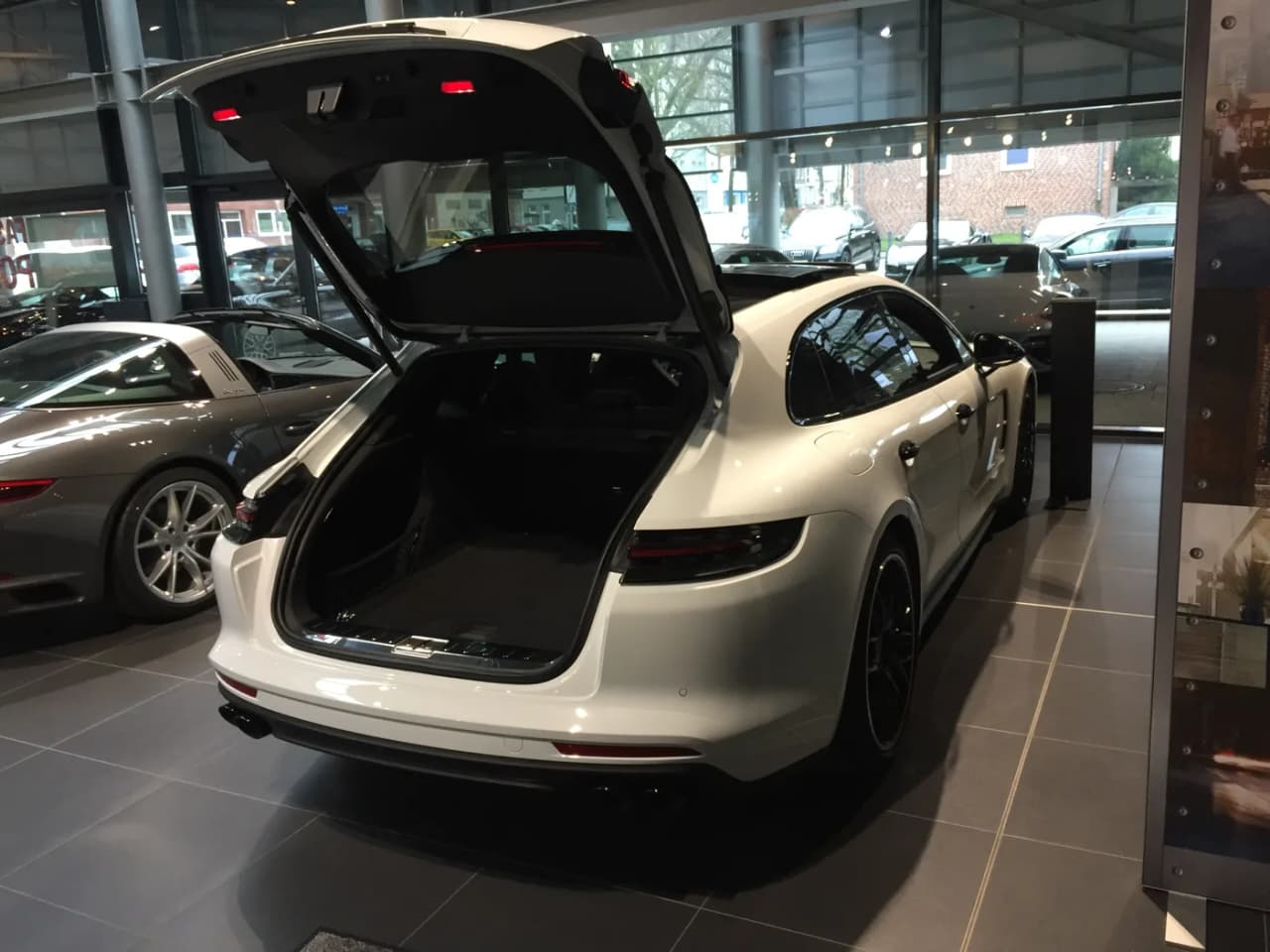
Cargo volume grows too, though the hybrid gives some of it back to the battery. With the rear seats up, non-hybrid Sport Turismo models hold about 18.36 cubic feet, roughly 0.7 cubic feet more than the Panamera sedan’s trunk.
Folding the 40:20:40 rear seats expands capacity to 49 cubic feet. Porsche’s US cargo figures list 45.7 cubic feet for the E-Hybrid with its seats folded.
| Panamera sedan | Sport Turismo (non-hybrid) | Sport Turismo E-Hybrid | |
|---|---|---|---|
| Rear seat layout | 2+1, bucket seats with fixed middle | 2+1 standard, 4-seat optional | 2+1 standard, 4-seat optional |
| Cargo, seats up | about 17.7 cu ft | 18.36 cu ft | 15 cu ft |
| Cargo, seats folded | about 47.3 cu ft | 49 cu ft | 45.7 cu ft |
| Loading edge height | higher, fixed trunk opening | 24.8 in., power tailgate | 24.8 in., power tailgate |
The sedan cargo figures above are calculated from Porsche’s stated differences rather than a separately published sedan number. Porsche says the Sport Turismo adds 0.7 cubic feet with the seats up and 1.7 cubic feet with them folded.
Cubic feet only tell part of the story. Car and Driver’s own luggage test fit seven carry-on suitcases with the rear seats up and thirteen with them folded, a concrete comparison point beyond the spec sheet. In UK measurements, Carwow lists the same boot at 520 liters, which converts to almost exactly the 18.36 cubic feet quoted above.
Carwow also notes it is wider and boxier than the sedan’s trunk. It is still smaller than the boots on wagon rivals like the Mercedes-AMG E63 S Estate and Audi RS6 Avant. The Sport Turismo trades some outright cargo volume for its coupe-like roofline.
The 4, 4S, GTS, and Turbo also get underfloor storage beneath the main cargo area, useful for keeping a charging cable or tools out of sight. On E-Hybrid models that same space holds the battery pack instead, according to Carwow’s review. Buyers who regularly carry rear-seat passengers should also look at the optional Executive pack. It adds a panoramic glass sunroof that doesn’t cut into rear headroom, plus electrically reclining rear seats, per the same review.
The cabin’s 12.3-inch infotainment screen includes Apple CarPlay, navigation, and a Wi-Fi hotspot. Car and Driver found the menus attractive but overcomplicated, so a used-car test drive should include pairing a phone and trying the functions you use every day.
Driving and Chassis
Underneath, the Sport Turismo is a Panamera. Porsche’s US technical presentation details its all wheel drive, Porsche Active Suspension Management, steering, and three-chamber air suspension.
Optional rear-axle steering turns the rear wheels opposite the fronts at low speed to tighten the turning circle. At highway speed, it turns with the fronts to add stability. Porsche Dynamic Chassis Control Sport and Porsche Torque Vectoring Plus were also optional chassis equipment.
The Sport Chrono package added a drive mode switch on the steering wheel. Its Sport Response button unlocks maximum power for 20 seconds.
Carrying more weight and more cargo than the sedan meant Porsche fitted larger brakes across the Sport Turismo range. Front discs measure 15.35 inches and rear discs 14.37 inches on the 4, 4S, and E-Hybrid. The Turbo Sport Turismo steps up to 16.14-inch front and 14.96-inch rear discs. Porsche Ceramic Composite Brakes were optional on the Sport Turismo too.
All that hardware adds weight: a 2018 4S Sport Turismo tested by Motor Trend scaled 4,221 lb. Ride quality held up consistently across all PASM suspension settings on smooth roads, with the difference between them only likely to show up on rougher pavement. Optional 21-inch wheels sharpened the look but added measurable road noise on that test car, a trade-off worth weighing against the roughly $3,640 the option cost at launch.
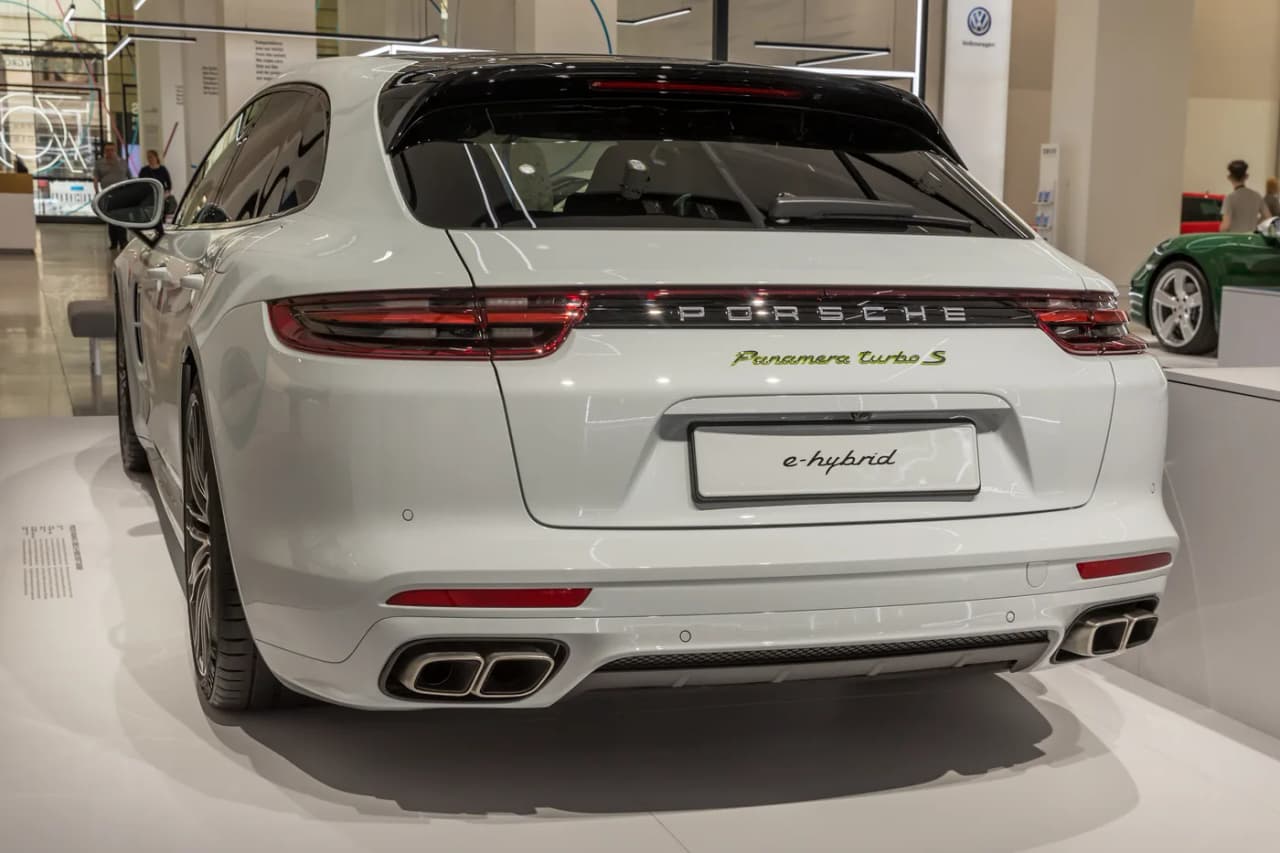
Porsche also gave the Sport Turismo an adaptive roof spoiler. Its world-premiere specification describes three positions and up to 110 lb of extra rear-axle downforce.
The Sport Turismo offered optional driver-assistance systems including Night Vision Assist, lane assistance, and Porsche InnoDrive. Porsche documents those systems in its US Sport Turismo presentation and later 2021 model update.
Common Problems and Maintenance
Porsche never published Sport Turismo-specific reliability data, and none of the sources available for this guide document failure patterns unique to the wagon body. What the Sport Turismo does inherit is the mechanical package of the 971-generation Panamera sedan, so the same watch items apply.
Start with records, not internet folklore. Confirm the scheduled maintenance history, ask what has been repaired, and have a Porsche specialist scan the car before purchase. On an E-Hybrid, that inspection should include the charging system and high-voltage battery condition. On any version, test the air suspension, transmission behavior, tailgate, rear-seat releases, and roof spoiler during the inspection. Those are sensible checks for expensive systems, not a claim that they are common Sport Turismo failures.
Because the Sport Turismo sold in far smaller numbers than the sedan, generalist mechanics may have seen fewer of them. That is not evidence of a body-style-specific problem. It is a reason to lean on a shop that already knows the 971 platform, rather than assuming local experience covers this variant too.
As a new car, Porsche backed every Sport Turismo, gas or hybrid, with a 4-year/50,000-mile limited warranty and a matching 4-year/50,000-mile powertrain warranty. Coverage also included 24-hour roadside assistance for the same period. It also included one year or 10,000 miles of complimentary scheduled maintenance, according to Car and Driver’s coverage of the lineup.
Every Sport Turismo on the used market today is well outside that original coverage window, so ask specifically whether any factory or third-party warranty transferred with the car. A lapsed warranty puts these repair costs entirely on the buyer.
Inspection Checklist
A few checks are specific to how the Sport Turismo is built and used, on top of the usual pre-purchase basics for any 971 Panamera.
- Confirm complete service records, including PDK fluid changes and any air suspension work.
- Have a specialist cycle the air suspension through its Normal, Lift, and Low levels and check that it holds level overnight instead of sagging.
- On E-Hybrid cars, run a PIWIS check on the battery and confirm the onboard charger and charging cable both work.
- Test that all three rear seatbacks release electrically from the cargo area and fold flat in their 40:20:40 split.
- Cycle the power tailgate fully and check that the adaptive roof spoiler moves through its positions without hesitation.
- Inspect brake pad and rotor wear given the Sport Turismo’s larger discs and its use for cargo duty.
- Clean examples are rare. Expect to search beyond your local market instead of settling for the nearest listing.
- Check whether a reversing camera is fitted. Visibility through the narrow tailgate glass is tight, it wasn’t standard on lower-spec cars at launch, and a missing or malfunctioning camera makes tight parking noticeably harder.
Sport Turismo vs Sedan and Taycan Cross Turismo
The Sport Turismo and the standard Panamera sedan share engines, chassis hardware, and interior technology. The real difference is what happens behind the B-pillar: more rear headroom, a true 2+1 or optional 4-seat rear bench, and a lower loading edge. The Sport Turismo also gains more cargo room.
The sedan keeps a sleeker fastback roofline and, because Porsche built far more of them, a deeper used inventory to choose from. Neither is the better car in every case. It depends on whether the extra practicality is worth trading some choice and some roofline for.
Sport Turismo vs Audi RS6 Avant and Mercedes-AMG E63 Wagon
The Audi RS6 Avant and Mercedes-AMG E63 wagon are roomier choices for buyers who put maximum cargo capacity first. The Sport Turismo is the more coupe-like fast wagon, with less luggage room and a lower driving position.
The Porsche earns its place on steering and chassis feel. Autocar’s Sport Turismo review found clearer handling precision, roll control, steering feedback, and driver engagement than cars of the Audi RS6’s type. It still retained a composed ride, all-wheel-drive traction, and long-distance stability. Choose the Porsche for that balance. Choose the Audi or Mercedes if cargo volume matters more than the last degree of road feel.
The Taycan Cross Turismo is a different kind of comparison. It is Porsche’s fully electric shooting brake, built on the dedicated Taycan platform with a raised ride height and standard all wheel drive. That makes it different from a wagon version of a gas or hybrid grand tourer. Choosing between them comes down to how you use a car day to day.
The Panamera Sport Turismo, gas or E-Hybrid, refuels or recharges quickly and covers long distances without route planning. The Taycan Cross Turismo needs charging stops on longer trips but is quieter around town and produces no tailpipe emissions. Buyers who have already weighed the Panamera against the Taycan sedan will recognize the same trade-off here, just with more cargo room on both sides of the comparison.
Which Version Fits Which Buyer
Buyers cross-shopping the base Panamera 4 Sport Turismo are usually after the lowest entry price into a used Sport Turismo, not outright pace. It is quick enough for daily use and carries the practicality gains without the running costs of a V8.
The 4S Sport Turismo is the trim most buyers land on, the same way the 4S is the sweet spot in the sedan lineup. It’s meaningfully quicker than the base V6, it comes with standard all wheel drive, and it costs less to own than the Turbo.
The 4 E-Hybrid Sport Turismo suits buyers who can charge at home and do a mix of short commuting and longer trips. Its regenerative braking system and plug-in range bring real efficiency gains in city driving, and the V6 is still there for the highway.
The GTS Sport Turismo is the one to search for if you want driver-focused chassis tuning without the outright price of the Turbo. Its rarity within an already rare model means patience while shopping. The Turbo and Turbo S E-Hybrid Sport Turismo sit at the top for buyers who want sedan-beating pace with wagon practicality and are prepared to pay for both.
Frequently Asked Questions
What generation of Panamera was the Sport Turismo?
The Sport Turismo was only built on the second-generation (971) Panamera. It debuted at the Geneva Motor Show in March 2017 and reached US dealers in the third quarter of 2017 as a 2018 model. Porsche did not carry the body style over to the third-generation (972) car.
Is the Panamera Sport Turismo still in production?
No. Porsche discontinued the Sport Turismo when the third-generation Panamera arrived for 2024. Every Sport Turismo is a used 971-generation car, and low production numbers make clean examples harder to find than the sedan.
How much cargo space does the Panamera Sport Turismo have?
With the rear seats up, non-hybrid Sport Turismo models hold about 18.36 cubic feet, roughly 0.7 cubic feet more than the sedan. Folding the seats expands that to around 49 cubic feet. The Sport Turismo E-Hybrid holds less because of its battery pack: about 15 cubic feet up and 45.7 cubic feet folded.
Does the Sport Turismo seat three across the back?
Yes, in its standard 2+1 layout. Two outer bucket seats flank a slim middle position with its own seatbelt, making it the first Panamera with three rear belts. Porsche also offered an optional four-seat layout that swaps the middle seat for two power-adjustable individual seats.
Is the Panamera Sport Turismo a good used buy?
It can be, if the specific car has a complete service record and passes a Porsche-specialist inspection. The Sport Turismo shares its mechanical platform with the 971 sedan, but this guide found no verified Sport Turismo-specific failure data. Judge the actual car rather than treating generic online problem lists as a diagnosis.
Images: Porsche Panamera Turbo Sport Turismo by Alexandre Prévot, CC BY-SA 2.0. Cargo area by KarleHorn, CC BY 3.0. Rear aero view by Matti Blume, CC BY-SA 4.0. Via Wikimedia Commons. Local copies resized and converted to WebP.