Quick Answer: The Porsche 718 Spyder RS is the open-top counterpart to the 718 Cayman GT4 RS. It combines a 493 hp, 9,000 rpm 4.0-liter flat-six with rear-wheel drive, a seven-speed PDK, and a lightweight two-piece roof. It is not a normal Boxster with a body kit. It is the loud, exposed version of Porsche’s most focused mid-engine road car.
In this article, we’ll explain the Porsche 718 Spyder RS, the open-air end point of the gasoline 718 line. We’ll cover GT3 engine, two-piece roof, and used-car checks.

Contents
Quick Summary
- Engine: Naturally aspirated 4.0-liter flat-six from the 911 GT3.
- Output: 493 hp and 331 lb-ft in U.S. specification.
- Transmission: Seven-speed PDK only, sending power to the rear wheels.
- Performance: 0-60 mph in 3.2 seconds and a 191 mph top speed.
- Roof: A lightweight sunshield plus weather protector, both removable.
- Best for: Drivers who want a GT4 RS-level engine with wind, noise, and no fixed roof.
The Spyder RS Formula
Porsche introduced the Spyder RS in 2023 as the open-top companion to the 718 Cayman GT4 RS. The key move was simple. Porsche put the GT3-derived engine behind the seats of a roadster.
The regular 718 Spyder is already a serious car. It has a 414 hp 4.0-liter engine, GT4 hardware, and a manual option. The RS adds the higher-revving GT3 engine, PDK only, more chassis hardware, and a roof that treats weather as a planning issue.
That makes it a very specific purchase. Buy a GTS 4.0 if you want a great six-cylinder Boxster with normal roof convenience. Buy the Spyder RS if the point is hearing every inch of the engine’s 9,000-rpm run.
Engine and Performance
GT3-derived 4.0-liter flat-six
Porsche’s U.S. announcement rates the naturally aspirated 4.0-liter boxer at 493 hp and 331 lb-ft. It is the same basic powertrain used in the 718 Cayman GT4 RS, with a 9,000-rpm redline.
That engine changes the character of the car. It does not deliver the broad, early shove of a turbocharged motor. It builds hard as revs climb, which is why the short PDK ratios feel right here.
PDK performance
The seven-speed PDK is mandatory. That will disappoint manual diehards, but it fits the RS brief. Porsche quotes 3.2 seconds to 60 mph and a 191 mph top speed. Those numbers make more sense on a clear track than on a coffee run, obviously.

Roof and Chassis
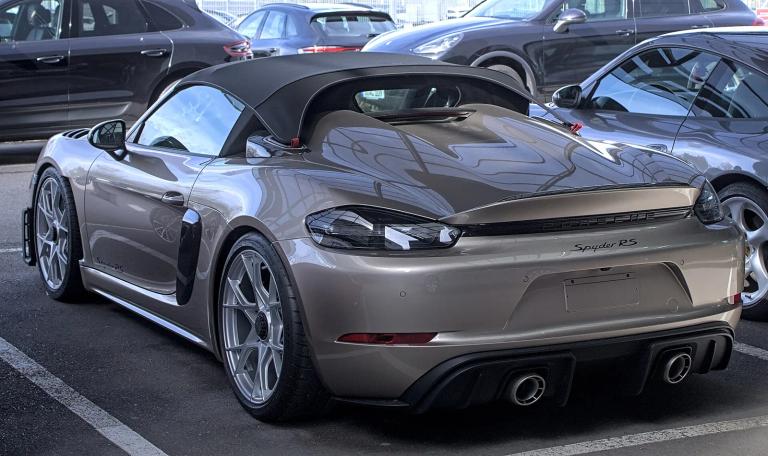
The roof is the part that separates the Spyder RS from every regular Boxster. Porsche calls it a lightweight system with two removable parts: a sunshield and a weather protector. The car can be driven with either section removed, but neither is a powered top you raise at a red light.
That trade is intentional. Porsche says the chassis uses GT4 RS components and sport-tuned PASM. It sits 30 millimeters lower, with Porsche Torque Vectoring, a mechanical limited-slip differential, and forged 20-inch wheels.
It is still a roadster, so it will not feel exactly like the fixed-roof GT4 RS. The payoff is the engine. With the roof off, the intake and exhaust sound are not background noise. They are the main event.
Spyder RS vs 718 Spyder
| Feature | 718 Spyder RS | 718 Spyder |
|---|---|---|
| Engine | 493 hp GT3-derived 4.0-liter flat-six | 414 hp 4.0-liter flat-six |
| Gearbox | Seven-speed PDK only | Six-speed manual or PDK |
| Redline | 9,000 rpm | 8,000 rpm |
| Roof | Two-piece removable lightweight system | Manual fabric top |
| Character | Maximum noise and focus | More analog, less extreme |
The standard Spyder is the better answer for many buyers. Its official press kit confirms the 414 hp engine, manual or PDK choice, 8,000-rpm limit, and manual fabric top. The RS is for the buyer who will actually use the rev range and accepts the roof routine as part of the ritual.
Buying a Used Spyder RS
Roof and paperwork first
Start with completeness. Confirm both roof sections, their fasteners, the storage equipment, and the car’s manuals are present. Missing roof parts turn a fun roadster into a stupidly expensive scavenger hunt.
For the broader model context, compare the standard 718 Boxster range and the 718 Cayman GT4. Those guides make the RS compromise clearer before you decide that maximum noise is the whole mission.
Track-use inspection
Then inspect the front splitter, underbody, wheels, and brake discs. This is a low, fast car that many owners will take to track days. Track use is not automatically bad, but it makes a clean service record and a pre-purchase inspection more important.
Check the tires for matched brands, sizes, and dates. Ask the seller to demonstrate the roof setup. Finally, drive it long enough to hear for rattles and check the PDK shifts when cold and hot.
If that feels like more effort than you want, it probably is. The Spyder RS rewards an owner who treats it as a special car, not as a normal weekend convertible.
Frequently Asked Questions
Does the Porsche 718 Spyder RS have a GT3 engine?
Yes, the Porsche 718 Spyder RS has the naturally aspirated 4.0-liter flat-six from the 911 GT3. Porsche rates it at 493 hp in U.S. specification, and it revs to 9,000 rpm.
Is the 718 Spyder RS manual?
No, the Porsche 718 Spyder RS is PDK-only. Its short-ratio seven-speed dual-clutch transmission is the only factory gearbox.
How fast is the Porsche 718 Spyder RS?
The Porsche 718 Spyder RS reaches 60 mph in 3.2 seconds and has a 191 mph top speed, according to Porsche’s U.S. launch information.
Is the 718 Spyder RS roof removable?
Yes, the Porsche 718 Spyder RS has a removable two-piece lightweight roof. It uses a sunshield section and a weather protector rather than the regular Boxster’s powered fabric top.
What should I inspect on a used 718 Spyder RS?
A used Porsche 718 Spyder RS needs both roof sections and their storage equipment. Check servicing, track use, wheel damage, and underbody scrapes.
Images: Porsche 718 Spyder RS at IAA 2023 by Alexander Migl, CC BY-SA 4.0. Porsche 718 Spyder RS front view by Alexander Migl, CC BY-SA 4.0. Porsche 718 Spyder RS rear view by Alexander Migl, CC BY-SA 4.0. Via Wikimedia Commons.