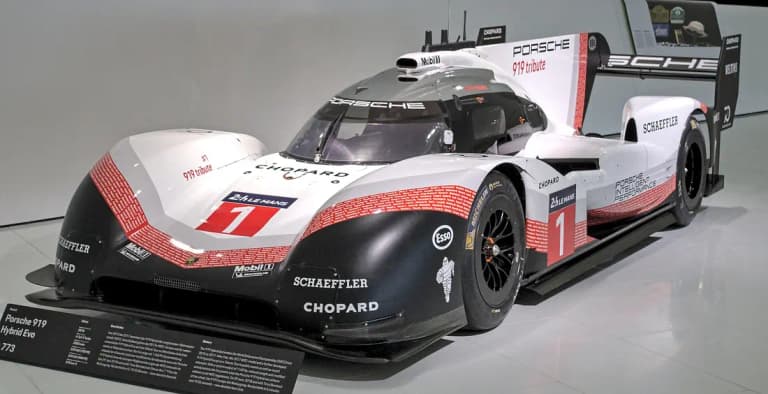
The Porsche 919 Hybrid Evo was a derestricted development of Porsche’s 2017 Le Mans winner. The company built it for a 2018 Tribute Tour and outright lap records, not competition. Freed from World Endurance Championship rules, its turbocharged V4 and front electric motor combined for 1,160 hp. Its active aerodynamic package produced 53 percent more downforce than the 2017 Spa WEC qualifying configuration. The Evo weighed 849 kilograms dry and was never a race-legal specification.
In this article, we’ll explain the Porsche 919 Hybrid Evo, the derestricted 2018 version of Porsche’s Le Mans winner. We’ll cover its 1,160 hp, active aerodynamics, 849-kilogram weight, and two lap records.
Contents
Quick Summary
- What It Was: A derestricted 2018 development of Porsche’s 2017 championship-winning 919 Hybrid Le Mans prototype
- Purpose: Built for a 2018 Tribute Tour and two outright lap records, not competition, and never a race-legal WEC specification
- Combined Output: 1,160 hp from a 720 hp turbocharged V4 and a 440 hp front electric motor
- Weight: 849 kilograms dry, down from 888 kilograms including driver ballast in the 2017 Spa WEC configuration
- Aerodynamics: 53 percent more downforce and a 66 percent efficiency gain over the 2017 Spa qualifying specification
- Spa-Francorchamps Record: Neel Jani lapped in 1:41.770 on April 9, 2018, beating Lewis Hamilton’s 2017 F1 qualifying time by 0.783 seconds
- Nürburgring Nordschleife Record: Timo Bernhard lapped in 5:19.55 on June 29, 2018, beating Stefan Bellof’s 1983 record by 51.58 seconds
The Regulated 919 Programme, in Brief
The Evo did not appear on its own. It grew out of Porsche’s factory 919 Hybrid. The company raced that closed cockpit prototype in the top FIA World Endurance Championship class from 2014 through 2017. It paired a compact turbocharged V4 with two energy recovery systems, one at the front brakes and one in the exhaust. Both fed a liquid cooled battery that could power the front axle under boost.
Porsche built the factory 919 program to win. It won the 24 Hours of Le Mans in 2015, 2016, and 2017. The program also earned three drivers’ and three manufacturers’ WEC titles. Porsche summarizes that record in its Evo record release. The full campaign belongs to Porsche’s wider Le Mans history. This page picks up where that regulated story ends.
What Changed for the Evo, and Why
Porsche’s factory LMP1 campaign ended after the 2017 season, but the 919 program continued in a different form. The company built the 919 Hybrid Evo for a 2018 Tribute Tour and two outright lap records. It used the 2017 championship winning car as its starting point.
The purpose was different from anything the car had done before. A WEC race car must comply with rules covering fuel flow, electrical energy deployment, aerodynamics, and weight. Those limits shaped the regulated 919. The Evo had no WEC rulebook to answer to. Porsche’s own technical record of the car describes it as released from the restrictions that shaped the WEC specification.
This page therefore treats the Evo and regulated race car as two specifications built on one foundation. They are not one car with one set of numbers. A figure that describes one almost never applies to the other.
What the WEC Rulebook Actually Limited
FIA WEC LMP1 rules did not set one simple horsepower ceiling. They limited fuel flow and the electrical energy available over a lap, constraining how Porsche could use the combustion engine and hybrid system together. Porsche’s Nurburgring technical release publishes regulated and Evo figures side by side. The Evo retained the underlying powertrain hardware while removing those regulatory limits.
Power, Motor, and Energy: Same Hardware, Different Limits
The 2017 car had to divide its available energy within WEC fuel-flow and hybrid-deployment limits. Porsche removed those limits for the Evo, allowing the same physical engine and front motor to produce the higher published power outputs shown below. The recovery-system energy figure also needs circuit context. Porsche scopes that number to the Belgian circuit configuration specifically, so this page does not treat it as a figure that applies everywhere.
Aerodynamics, Weight, and Performance
The regulated car’s aerodynamic package had to comply with WEC rules, while the Evo did not. Porsche added a larger rear wing, a larger diffuser, and an active DRS system. Together with the other revisions, this produced 53 percent more downforce and a 66 percent efficiency gain over Porsche’s 2017 qualifying comparison.
The same mission change explains the missing equipment. Porsche removed air conditioning, the windshield wiper, exterior lighting, and the pneumatic jack system. Those systems served the regulated car’s endurance-racing job but were unnecessary for the Evo’s record program. Their removal helped reduce the published dry weight to 849 kilograms.
Suspension, Brakes, and Tires Built for Load, Not Distance
More downforce increased the loads carried by the chassis. Porsche’s technical documentation for the Evo lists a Pitch Link System with actively controlled lockout. It also lists stronger wishbones and uprated brakes and steering. Michelin developed new tire compounds for the Evo. Porsche did not publish an isolated lap-time gain for each change, so this page does not assign one.
A Record Car, Not a Race-Eligible WEC Car
Several Evo changes individually placed it outside the 2018 WEC rule set. It ran without the regulated fuel-flow and hybrid-deployment limits, used active aerodynamics, and omitted equipment carried by the race car. That is the distinction behind the tables on this page. The regulated 919 Hybrid was built to win races under shared rules. The Evo showed what the platform could do after Porsche removed those constraints.
Powertrain Performance and Energy Recovery
Retained Hardware, Unlocked Software
Porsche kept the 919’s core powertrain hardware for the Evo. A 2.0 liter, 90 degree, turbocharged V4 drove the rear axle. The front axle electric motor generator recovered braking energy and drove the front wheels under boost. The software and fuel and energy limits changed around that hardware.
Running on E20 race fuel and free of the WEC’s fuel-flow restriction, the same combustion engine produced 720 hp. Porsche compares that with less than 500 PS in the regulated WEC configuration. The front electric motor rose from more than 400 PS to 440 hp. Combined output reached 1,160 hp, according to Porsche’s official technical release. Porsche published the two specifications in different units. This article preserves them rather than treating PS and mechanical horsepower as identical.
Electric Motors and Energy Recovery
The WEC rulebook limited power through fuel-flow rules and capped usable recovered electrical energy per lap. The 919 recovered energy from front axle braking and the exhaust. Both paths mattered in race trim. Removing the deployment ceiling changed how much recovered energy the Evo could use.
Porsche’s Spa comparison puts the Evo’s usable recovery-system energy at 8.49 megajoules per lap, compared with 6.37 megajoules for the 2017 Spa WEC configuration. That does not describe every circuit or every 2017 race setup.
Porsche’s published figures show that the Evo had more recovery-system energy available per lap at Spa. They do not reveal the timing or duration of front-motor deployment. This article therefore does not infer a boost map or an unpublished acceleration figure.
Active Aerodynamics and Weight
Active Aerodynamics and the DRS System
The aerodynamic package changed as much as the powertrain limits did. Porsche fitted a larger front diffuser and a substantially larger rear wing. An active drag reduction system could adjust the diffuser and open a slot in the rear wing to cut drag on straights. Revised turning vanes, an optimized floor, and fixed height side skirts completed the package.
The result was 53 percent more downforce and a 66 percent gain in aerodynamic efficiency compared with the regulated qualifying specification Porsche used for comparison. A four wheel brake by wire system and adapted power steering handled the higher cornering loads. Stronger wishbones and special Michelin tire compounds on forged magnesium BBS wheels supported the added load.
Cutting Weight to 849 Kilograms
Porsche also stripped equipment the Evo no longer needed. It removed the air conditioning, windshield wiper, exterior lighting, pneumatic jack system, and several sensors and electronic devices used by race control. The finished car weighed 849 kilograms dry. Porsche’s 2017 Spa comparison figure was 888 kilograms including driver ballast, so the two mass labels should not be treated as identical measurement conditions.
The company also removed equipment used during endurance racing, added active aerodynamics, and lifted the regulated power limits. It described the Evo as a record and demonstration car, not a racing specification.
The 2018 Spa and Nürburgring Records
Top speed alone does not explain either record. Both laps combined straight-line performance with braking and corner speed. More downforce increased aerodynamic load on the tires at speed.
Porsche also fitted four-wheel brake-by-wire, but it did not publish a separate lap-time gain for that system. Jani’s Belgian circuit lap averaged 245.61 km/h despite a 359 km/h top speed. That peak was lower than the Evo reached at the Nürburgring.
| Record | Date | Driver | Time | Beaten mark | Margin |
|---|---|---|---|---|---|
| Spa-Francorchamps (7.004 km) | April 9, 2018 | Neel Jani | 1:41.770 | Lewis Hamilton’s 2017 F1 qualifying record, 1:42.553 | 0.783 seconds |
| Nurburgring Nordschleife (20.832 km) | June 29, 2018 | Timo Bernhard | 5:19.55 | Stefan Bellof’s 1983 record, 6:11.13 | 51.58 seconds |
Corner Speed and Record Performance
The record laps came from the complete package rather than one headline figure. Added downforce supported cornering performance, while the upgraded brakes and steering handled the greater loads. Porsche’s technical documentation for the Evo also lists variable control of wheel torques to optimize the car’s balance. Porsche did not publish a separate lap-time gain for these systems or its lap-by-lap control map.
Average speed shows why top speed alone cannot explain either result. Bernhard’s Nurburgring lap averaged 233.8 km/h against a 369.4 km/h peak. Jani’s Spa lap averaged 245.61 km/h against a 359 km/h peak.
The Nordschleife is 20.832 kilometers long, while Spa is 7.004 kilometers. Their corner layouts and straight-line speed demands differ, so the average-to-peak gaps are not directly comparable. Porsche also recorded a 13-degree Celsius asphalt temperature for the Spa run. This article preserves that condition without assigning it an unpublished lap-time effect.
Both records also support comparisons Porsche did not fully control, covered for each run below. The lap times themselves are genuine, verified results. The Formula comparison and the benchmark that had stood for more than three decades are informative headlines rather than head-to-head tests.
Spa-Francorchamps: Beating a Formula One Time
The Evo’s first public record came at Spa-Francorchamps on April 9, 2018. Neel Jani lapped the 7.004-kilometer Grand Prix circuit in 1:41.770. Lewis Hamilton had set the Formula One qualifying record at 1:42.553 in a Mercedes W08. Porsche’s official record of the run states Jani beat that Formula benchmark by 0.783 seconds. Jani’s lap averaged 245.61 km/h with a 359 km/h top speed. Porsche recorded an asphalt temperature of 13 degrees Celsius.
The Formula comparison sets a prototype lap against a Formula One qualifying time. It is a useful headline, but the cars followed different rulebooks and objectives. They also used different tires. The result does not prove a Le Mans prototype is faster under race conditions. It says nothing about a wheel-to-wheel contest. It shows only that the Evo beat one verified qualifying lap at that circuit on that day.
Nürburgring Nordschleife: Beating Stefan Bellof
The better-known run followed on June 29, 2018. Timo Bernhard covered the 20.832-kilometer Nürburgring Nordschleife in 5 minutes 19.55 seconds. Porsche’s detailed technical report records a 233.8 km/h average and a 369.4 km/h peak speed.
Bernhard’s lap beat Stefan Bellof’s 1983 benchmark of 6:11.13 by 51.58 seconds. Bellof set his time in a Porsche 956 during practice for a 1,000 kilometer WEC race. It stood for more than three decades. The comparison is record history, not an equal test. The cars, tires, rules, and safety standards changed between 1983 and 2018. Porsche presented the Nurburgring run as the close of the Evo’s record chasing chapter.
Evo Versus the Regulated WEC 919
The table below keeps the two specifications separate. Use it when a 919 Hybrid number lacks a clear label. The cars share a name and foundation, but little else on paper.
| Feature | 2017 Spa WEC configuration | 2018 919 Hybrid Evo |
|---|---|---|
| Legal status | FIA WEC LMP1 rules | Derestricted, non race legal |
| Combustion output | Less than 500 PS | 720 hp on E20 fuel |
| Front motor output | More than 400 PS | 440 hp |
| System output | Limited by fuel and energy rules | 1,160 hp combined |
| Recovery-system energy at Spa | 6.37 megajoules | 8.49 megajoules |
| Aerodynamics | Race legal fixed package | Active DRS, larger wing and diffuser |
| Mass | 888 kg including driver ballast | 849 kg dry |
| Purpose | Endurance racing and championships | Tribute Tour and outright records |
The pattern across every row is the same. Porsche kept the platform and powertrain hardware, then lifted rules around each changed figure. That makes the Evo a different specification rather than a race car with a new coat of paint.
The regulated car had to win under rules. Its Le Mans victories and championships belong in the left column. The Evo never raced a rival or won a championship. It only raced the clock.
Technology and Legacy
The 919 Hybrid Evo sits between two other Porsche hybrid stories without belonging to either one. The road legal 918 Spyder is a naturally aspirated V8 plug-in hybrid hypercar. It had production obligations the 919 platform never faced. The later 963 is Porsche’s current top class prototype. It follows the LMDh rulebook with a twin turbo V8 and a standard rear mounted hybrid system. Neither car shares the 919’s front axle hybrid layout or directly inherited its record hardware.
What the Evo demonstrated was more specific than a simple horsepower number. It showed how the WEC rulebook shaped the performance of Porsche’s winning race car. The regulated 919 was not a compromised machine waiting to be unlocked. It was built to win within class rules. The Evo made the difference visible after Porsche removed those limits.
Frequently Asked Questions
What was the Porsche 919 Hybrid Evo?
The Porsche 919 Hybrid Evo was a 2018 development of Porsche’s 2017 championship winning Le Mans prototype. The company freed it from World Endurance Championship rules for a Tribute Tour and two record attempts. It kept the 919’s powertrain hardware but ran different software, active aerodynamics, and a lighter body. Those changes were not legal under WEC regulations.
How much horsepower did the Porsche 919 Hybrid Evo have?
Porsche’s technical figures put the Evo’s turbocharged V4 at 720 hp and its front electric motor at 440 hp. The combined output was 1,160 hp. In Porsche’s comparison with the 2017 Spa WEC configuration, the regulated car produced less than 500 PS from its engine and more than 400 PS from its motor. The company published those source figures in different units.
Was the Porsche 919 Hybrid Evo legal to race?
No. The Evo was never a race-legal WEC specification. The company built it after the factory LMP1 program ended. It ran without the fuel flow, energy deployment, aerodynamic, and weight restrictions that governed the regulated car. Porsche used it for a 2018 Tribute Tour and two outright lap record attempts, not competition.
What lap records did the Porsche 919 Hybrid Evo set?
Neel Jani lapped Spa-Francorchamps in 1:41.770 on April 9, 2018, beating Lewis Hamilton’s 2017 Formula One qualifying time. Timo Bernhard then lapped the 20.832-kilometer Nürburgring Nordschleife in 5 minutes 19.55 seconds on June 29, 2018. He averaged 233.8 km/h and reached 369.4 km/h, beating Stefan Bellof’s 1983 record by 51.58 seconds. Neither comparison was a controlled car-versus-car test.
How is the 919 Hybrid Evo different from the regular 919 Hybrid?
The Evo is a derestricted derivative of the 2017 championship winning 919 Hybrid, not a separate race car. It retained the combustion engine and hybrid hardware but lifted the WEC’s fuel and energy limits. Porsche also added active aerodynamics and a larger wing, cut weight to 849 kilograms, and dropped equipment such as the windshield wiper and air conditioning.
Image: Porsche 919 Hybrid Evo on display in the Porsche Museum, Stuttgart, by Alexander Migl, source, CC BY-SA 4.0, via Wikimedia Commons. Local copy resized and converted to WebP.