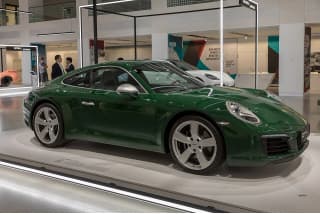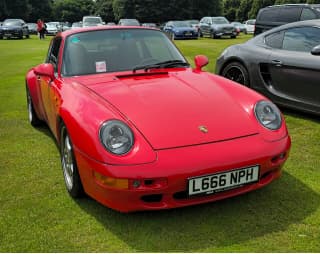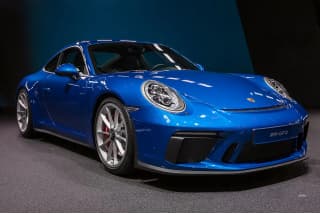
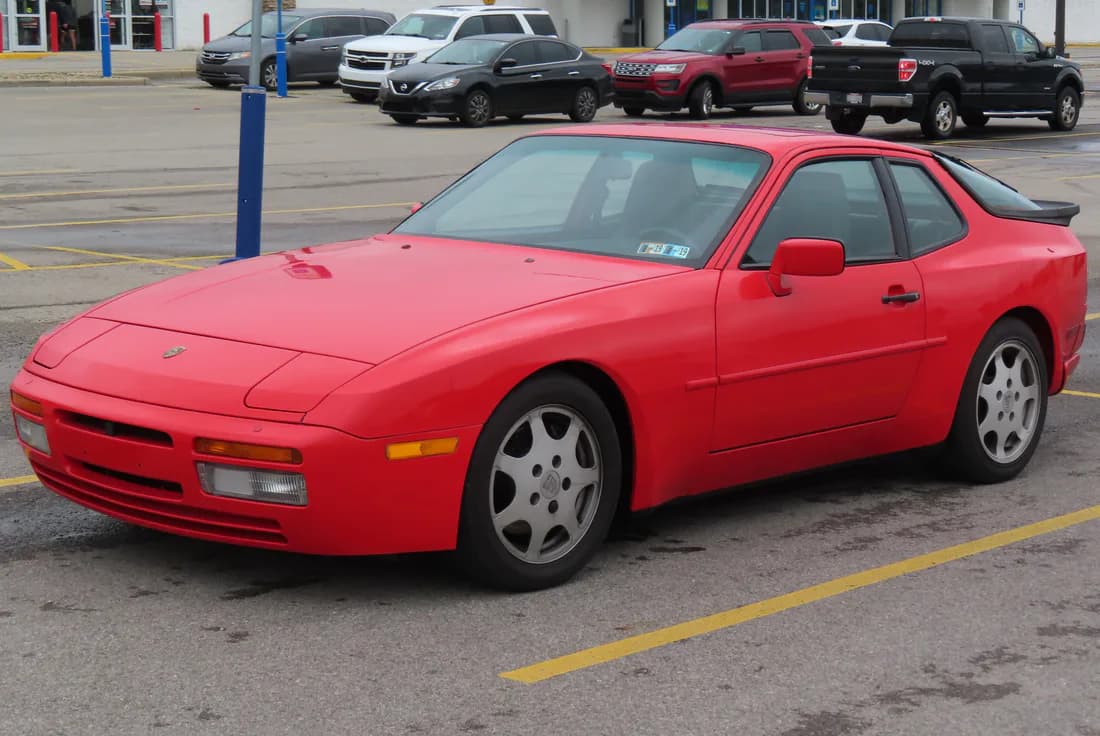
The Porsche 944 Turbo is the turbocharged top version of Porsche’s front-engine 944 family, which Porsche officially introduced in 1985. It uses a turbocharged four-cylinder engine, rear-wheel drive, and a rear-mounted transaxle. Separately, Porsche used a 944 Turbo to test an early dual-clutch transmission, but that was an experimental car, and production 944 Turbos were never sold with PDK.
The 944 Turbo is a transaxle sports car with a surprisingly big role in Porsche’s engineering story.
Contents
Quick Summary
- Introduced: Porsche officially introduced the 944 Turbo in 1985, four years after the original 944 debuted.
- Formula: A 2.5-liter turbocharged four-cylinder, rear-wheel drive, with the engine in front and the transmission at the rear.
- 944 Turbo S: A limited series of 1,000 cars in 1988 with a 261 km/h top track speed, which Porsche calls the world’s fastest four-cylinder production car of its time.
- Power history: The Turbo S engine rated 184 kW (250 PS), and Porsche says it went into the regular 944 Turbo in 1989.
- PDK prototype: A 944 Turbo tested an early dual-clutch gearbox, but no production 944 Turbo could be ordered with PDK.
- Family size: Porsche built 163,302 cars across the whole 944 series, and only some of those were Turbos.
- Buying approach: Confirm the car’s identity and records first, then have a specialist inspect the car.
The 944 Turbo in the 944 Family
The 944 premiered at the IAA in 1981 with a four-cylinder engine making 120 kW (163 PS), and Porsche’s 2026 transaxle history says dealers took 30,000 orders in its first year. It slotted between the 924 and the 911, and by 1983 it accounted for around 51 percent of Porsche’s total production.
The Turbo came after some racing proof. In 1984 a 944 Turbo won a 24-hour race for series cars at Nelson Ledges in Ohio by 42 laps, and Porsche officially introduced the 944 Turbo in 1985. Porsche’s 2024 turbo history places it in a tradition that began with the 924 Turbo, where a successful model gets a Turbo version on top. Porsche positioned it as a comfortable travel sports car that combined the transaxle’s space use and even weight distribution with turbo technology.
Porsche’s transaxle history records the milestones: the 944 Turbo Cup launched in 1986 with 192 cars built, 272 kg less weight, and 162 kW (220 PS). In 1988 the limited 944 Turbo S arrived with 1,000 units and a 261 km/h top track speed. In 1989 its 184 kW (250 PS) engine also went into the regular Turbo, and a 944 Turbo Cabriolet followed in 1991 with 528 built.
The 163,302 total covers the entire 944 series through 1991, while the 1,000, 192, and 528 figures each belong to a single derivative. The Porsche 968 carried the front-engine transaxle line on after the 944.
The Transaxle Layout and Arctic Run
A transaxle puts the transmission and final drive at the driven axle instead of behind the engine. In the 944 the engine sits up front, the transaxle sits at the rear, and a torque tube connects the two. That layout spreads the major components along the length of the car, which is the core of the 944’s identity and what separates it mechanically from a rear-engine 911.
In 2017 Porsche put the Turbo on a winter road trip. It sent a museum 944 Turbo and a then-current 718 Cayman S from Norway’s North Cape through Lofoten to Pirelli’s test center in Älvsbyn, Sweden, and Porsche’s account of the run explains the pairing. Both cars use four cylinders, turbocharging, and rear-wheel drive; Porsche identifies the 718 Cayman S as the 2.5-liter car in that comparison.
The museum car had once promoted Porsche’s unleaded turbo engines. On snow and ice, the Cayman had modern safety systems to help it stay on course, while the 31-year-old transaxle car needed a sensitive right foot.
The Experimental 944 Turbo PDK
The 944 Turbo has a second identity in Porsche history as a test car for an early dual-clutch transmission. According to Porsche’s history of the PDK, Rainer Wüst, a transmission test engineer at Porsche since 1971, became technical manager of the power-shifting project in the early 1980s. His team revived earlier dual-clutch work at a time when production-ready control electronics and vehicle-suitable electrohydraulic valves did not exist yet.
The engineers adapted pneumatic valves to work hydraulically and reached what Wüst called a pre-series level. Porsche successfully tested the transmission in a 944 Turbo, using a simple lever with minus ahead for downshifts and plus behind for upshifts.
None of this meant a 944 Turbo buyer could tick a PDK box. Porsche calls the 944 test an intermediate step before motorsport development, and PDK did not reach the 911 option list until 2008.
How the Prototype Transmission Worked
The prototype split its gears between two sub-transmissions, each with its own clutch. While one path delivered drive, the next gear could already be engaged on the other. The shift happened by closing the newly active clutch while opening the previous one.
The payoff in competition was less interruption of engine power. Porsche later used the system in its 956 development, where drivers could shift with both hands on the wheel and keep turbo boost up more effectively through a corner. The modern PDK is a very different piece of hardware from that early system.
Why It Never Reached Production
Porsche points to several barriers. Suitable control electronics were not available, vehicle-compatible electrohydraulic valves were missing from series production, and the conditions for a wet clutch were not yet in place. Shift quality was a problem too. Wüst recalled that the PDK gave the race car a forward kick during shifts, which could help lap time but stressed the transmission and driveshaft.
The motorsport route continued. After the 944 Turbo test came the 956, and the 962 became the first racing car with PDK. Hans-Joachim Stuck and Derek Bell won the 1986 360-kilometer race at Monza in a PDK-equipped 962 and went on to win that year’s World Sports-Prototype Championship.
Production Car and PDK Prototype Compared
| Question | Series-production 944 Turbo | Experimental PDK 944 Turbo |
|---|---|---|
| Core identity | Turbocharged four-cylinder, rear-wheel-drive transaxle model | 944 Turbo adapted for dual-clutch transmission testing |
| Transmission | Rear-mounted transaxle; production PDK was not offered | Two sub-transmissions, two clutches, and preselection of the next ratio |
| Customer availability | Production model | Development vehicle, not a factory PDK option |
| Purpose | Road-going Turbo member of the 944 family | Intermediate test step before Porsche’s motorsport program |
| Main limitation | No factory PDK option | Period electronics, valves, and clutch technology were not ready for series production; later race-car development also showed shift shock and driveline stress |
So the 944 Turbo helped develop PDK, but no road-going 944 Turbo is a dual-clutch car. If a listing claims rare factory PDK, ask for proof from Porsche itself, because a resemblance to the museum prototype is not that.
Pre-Purchase Checks
Every 944 Turbo has aged differently, so what you are buying is one specific car. The steps below work through it with the paperwork first and a specialist second, and how hard you push each one depends on how you plan to use the car.
Start with identity. Make sure the VIN, registration, option information, and the seller’s description all agree, and be wary of any listing that leans on the PDK prototype to make an ordinary gearbox sound rare. Then ask for dated invoices instead of accepting a verbal “fully serviced,” because the file should show what was done, by whom, at what mileage, and with which parts. A low odometer reading also doesn’t mean the car was preserved when fluids, hoses, seals, and tires have aged in storage.
- Arrange a genuine cold start. Confirm the engine has not been warmed before you arrive, and note smoke, leaks, warning lights, and idle behavior as it heats up.
- Inspect the turbo and intake path. Look at hoses, clamps, ducting, and oil and coolant connections, and watch for nonstandard tuning.
- Check cooling and fluid systems. Look for leaks, damage, corrosion, or improvised repairs, and run the car through a full heat cycle.
- Test the clutch and rear transaxle. Feel engagement, shift quality, and noise on acceleration and overrun, and check the fluid-service history.
- Inspect brakes, steering, suspension, and tires. Confirm all four tires are the right size and not aged out.
- Examine structure and bodywork. Ask for documentation of any past collision or corrosion repair.
- Operate every electrical and cabin function. Confirm warning lamps work and that no bulbs have been removed or masked.
- Book a specialist pre-purchase inspection. Use someone familiar with front-engine Porsche transaxles, and ask for photographs, measured findings, and estimates for immediate and near-term work.
A car for frequent road use needs dependable cooling, charging, starting, and braking. A car bought for originality needs solid proof of its factory specification, and a modified car needs proof that each change was engineered and installed properly. A famous name doesn’t rescue a poor car, so walk away from one that fails these checks.
Frequently Asked Questions
What is the Porsche 944 Turbo?
The Porsche 944 Turbo is the turbocharged top version of Porsche’s front-engine 944 family, which Porsche officially introduced in 1985. It uses a turbocharged four-cylinder engine, rear-wheel drive, and a rear-mounted transaxle.
When did Porsche introduce the 944 Turbo and the 944 Turbo S?
Porsche officially introduced the 944 Turbo in 1985, after the 944 itself debuted in 1981. The limited-edition 944 Turbo S followed in 1988 with a production run of 1,000 units and a top track speed of 261 km/h.
Did the Porsche 944 Turbo have PDK?
No, production 944 Turbos were not sold with PDK. Porsche used a 944 Turbo to test an experimental dual-clutch transmission in the 1980s, and PDK did not reach the 911 option list until 2008.
How did the experimental 944 Turbo PDK work?
Its gears were divided between two sub-transmissions, each with its own clutch. The next ratio could be selected before the shift, then drive transferred by opening one clutch while closing the other, which cut the interruption in engine power.
Why did Porsche not sell the 944 Turbo with PDK?
Suitable control electronics, electrohydraulic valves, and wet-clutch technology were not ready for series production. Porsche later found harsh shift shocks and driveline stress in its race-car development, so the idea needed much more development.
What should I check before buying a Porsche 944 Turbo?
Confirm the car’s identity and original specification, get dated service records, arrange a cold start and full road test, and have a Porsche-specialist inspection cover the turbo and intake, cooling, clutch and transaxle, brakes, suspension, tires, body, and electrics.