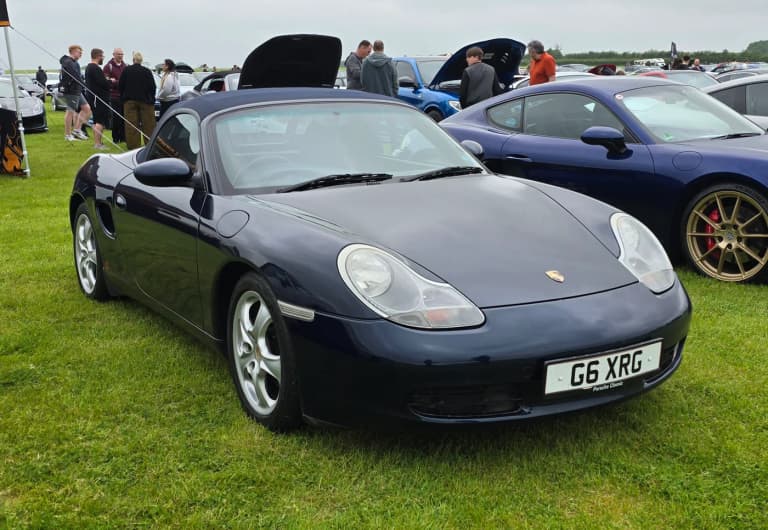
The Porsche 986 is the first-generation Boxster, built from 1996 to 2004, and one of the most accessible ways into a mid-engine Porsche. Age, maintenance history, roof and drain condition, cooling-system health, the exact engine version, and a specialist inspection matter more than chasing a supposedly perfect model year.
In this article, we’ll examine the first-generation Porsche 986 Boxster and how to buy one with confidence. We’ll cover its engine timeline, IMS bearing risk, roof checks, and inspection sequence.
Contents
- 1 Quick Summary
- 2 What 986 Actually Means
- 3 Model-Year and Engine Timeline
- 4 Base Versus S: Which One You Are Actually Looking At
- 5 IMS Context, Without Overclaiming
- 6 Roof, Drain, Cooling, and Chassis Checks
- 7 Inspection Checklist
- 8 What a 986 Actually Costs to Own
- 9 Which 986 Fits Which Buyer
- 10 The First 90 Days With a Purchased 986
- 11 Porsche 986 FAQs
Quick Summary
- Production Span: Built from 1996 to 2004, sold in the US from model year 1997 through 2004
- Base Engine: 2.5-liter flat-six at 204 PS through 1999, growing to a 2.7-liter engine at 220 PS (2000-2002) and 228 PS (2003-2004)
- Boxster S Engine: 3.2-liter flat-six arrived for model year 2000 at 252 PS, rising to 260 PS for 2003-2004, paired with a six-speed manual
- IMS Risk: Every 986 uses the M96 flat-six family, which carries intermediate shaft bearing risk; no independently verified year-by-year failure rate exists
- Roof Change: Early cars used a plastic rear window, replaced by a glass rear window from model year 2003
- Total Production: 164,874 units across the full 1996 to 2004 run, per Porsche’s own retrospective
- Buying Priority: Age, maintenance history, roof and drain condition, cooling-system health, and a specialist inspection matter more than chasing one model year
What 986 Actually Means
986 is Porsche’s internal type number for this generation, not a trim badge. It covers every Boxster built from the car’s launch through the 2004 model year, before the 987 replaced it. The name Boxster itself blends “Boxer,” the flat-six engine layout, with “Speedster,” a nod to Porsche’s open two-seat cars of the 1950s.
The production car followed a concept shown at the Detroit Motor Show in January 1993, designed by Grant Larson and referencing the 550 Spyder and 718 RS 60. Porsche’s own account of that concept car history describes strong public approval leading to a production order. The 986 reached customers in August 1996, the first purpose-built Porsche roadster since the 914 ended production two decades earlier.
For the full history of the nameplate before and after this window, including the 987, 981, and 718 generations, the Boxster guide covers every generation in one place. This page exists to own the 986 specifically: its exact engines, roof and IMS questions, and inspection sequence.
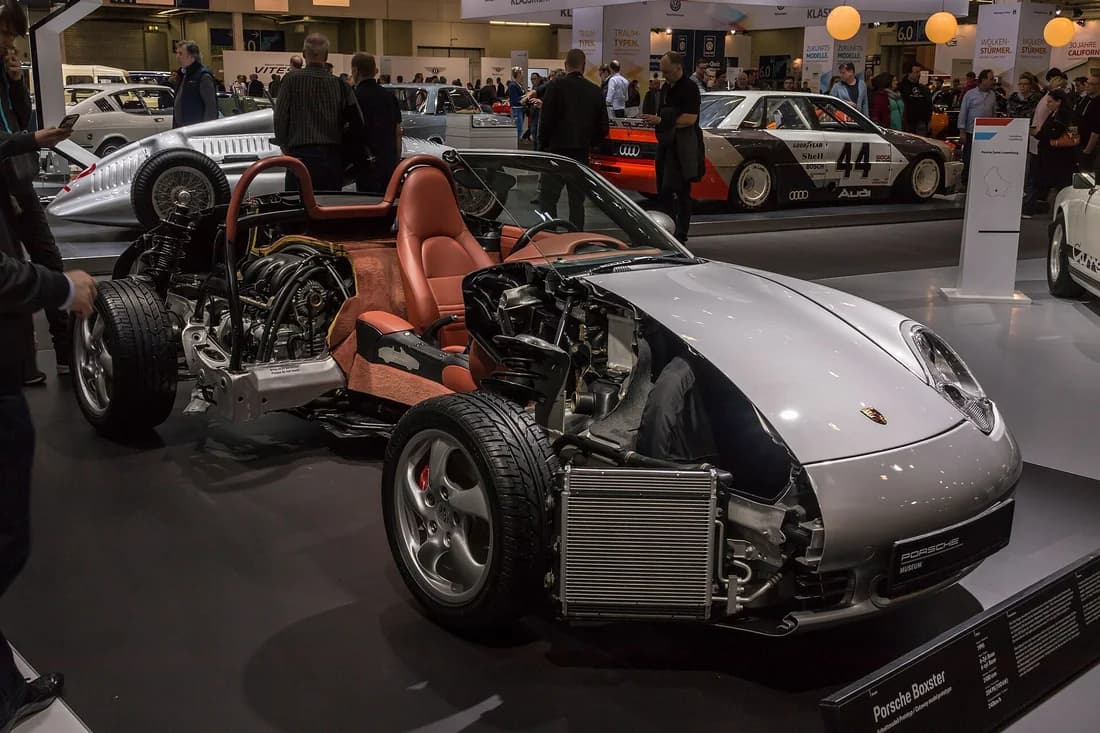
Model-Year and Engine Timeline
The 986 changed more during its eight-year run than its unchanged badge suggests. Treat any spec claim as tied to the exact model year and engine code, not to “the 986” as a whole.
The Base Engine: 2.5 Liters, Then 2.7
The original 1996 Boxster used a 2.5-liter water-cooled flat-six rated at 150 kW or 204 PS, per Porsche’s own 1996 launch specification. For US buyers, that corresponds to model years 1997 through 1999. The 2.7-liter base engine arrived for model year 2000, rated at 220 PS initially and 228 PS after the model-year 2003 revision, per Porsche’s retrospective.
That same Porsche account puts total 986 production at 164,874 units across the full 1996 to 2004 run. Model-year cutovers for European and US-market cars do not always land on the same calendar date, so do not assume a car is pre- or post-facelift from the registration year alone. Confirm the exact build date and engine code instead, stamped on the car and listed on the title paperwork or a Porsche Certificate of Authenticity.
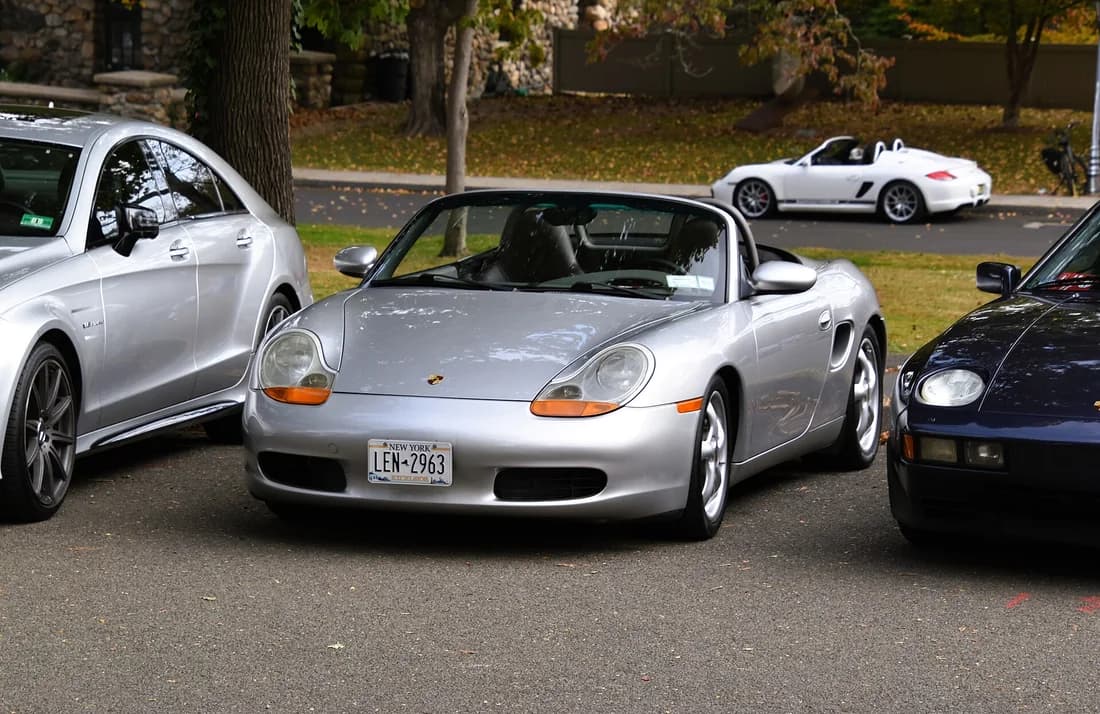
The Boxster S: 3.2 Liters, Two Power Levels
The Boxster S arrived for model year 2000 with a 3.2-liter flat-six and six-speed manual gearbox, rated at 252 PS initially and 260 PS after the model-year 2003 revision, per Porsche’s production retrospective. Those revised cars entered production during calendar year 2002, which is why sources that use calendar years can appear to disagree.
Porsche closed the 986 generation with a numbered special edition, the Boxster S 550 Spyder, marking the original 550 Spyder’s 50th anniversary. It used the 3.2-liter S engine in a fixed exterior and interior specification. The Boxster guide covers that edition’s production count and exact features in more depth.
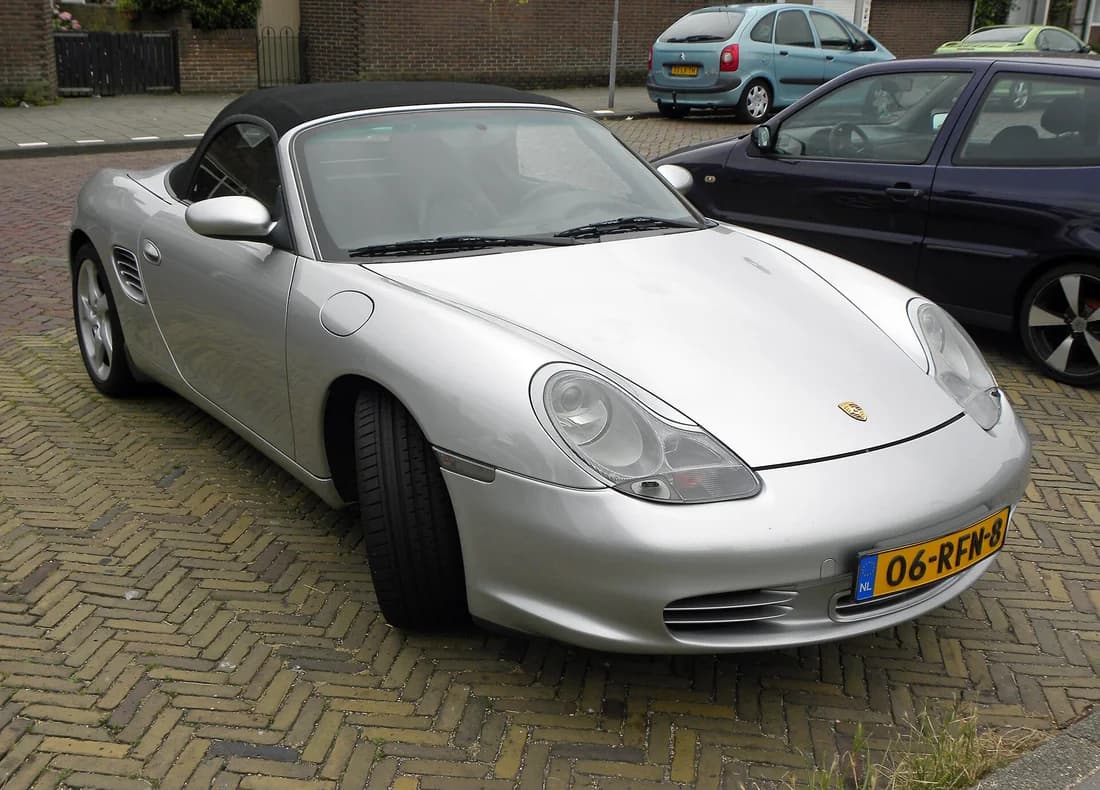
Base Versus S: Which One You Are Actually Looking At
A base 986 and a Boxster S share the same body, chassis, and roof, but the S adds a larger engine and larger brakes. Later S cars also picked up equipment that trickled down over the run, so two S cars from different years are not automatically equipped alike.
| Trait | Base Boxster | Boxster S |
|---|---|---|
| Engine | 2.5L, later 2.7L flat-six | 3.2L flat-six |
| Porsche metric rating | 204 PS, later 220 to 228 PS | 252 PS, later 260 PS |
| Brakes | Smaller standard discs | Larger discs, shared with contemporary 911 parts bins |
| Gearbox | 5-speed manual or 5-speed Tiptronic automatic | 6-speed manual or 5-speed Tiptronic automatic |
The S is the more satisfying car on a winding road. The base car is the more affordable entry point, with the same fundamental mid-engine balance. Neither version changes the IMS question below. Both use the same M96 architecture through the whole run.
Confirming the Exact Car
The clearest way to identify a 986 is by badge and gearbox, not the calendar year on the title. A base Boxster wears “Boxster” script on the decklid and came standard with a five-speed manual, while an “S” badge pairs the larger engine with a six-speed manual. Both were also available with a five-speed Tiptronic automatic, so pedal count alone will not tell you which one you have.
Badges can be swapped, so confirm the car by matching its VIN to the registration and service records. A Porsche specialist can then decode the factory option data recorded with the car rather than trusting the seller’s “base” or “S” description alone.
IMS Context, Without Overclaiming
Every 986 uses Porsche’s water-cooled M96 flat-six, the same engine family used in the contemporary 996-generation 911. The M96 uses an intermediate shaft to help drive the camshaft timing chains, supported at one end by a bearing pressed into the engine case. That bearing, and the risk it can fail and damage the engine, is what people mean by “IMS risk” on this era of car.
That risk is real but not uniform across every 986. Porsche revised the bearing design during the M96 run, and model-year 2000 to 2001 cars can fall within a mixed transition. Build date alone may not identify what is fitted, especially if previous work changed it. No independently verified, Porsche-published failure rate exists for each 986 version, so do not treat an online percentage as a prediction for the car in front of you.
Do not assume every 986 needs an IMS retrofit, and do not assume a 986 is safe just because it has covered many miles without an issue. Ask for a cut-open oil filter check for ferrous debris and an oil analysis history if the seller has one. Get a direct answer on whether any IMS-related work has already been done. Our IMS bearing guide covers the mechanism, inspection methods, and retrofit options in full technical depth. Ask a Porsche specialist to identify the exact bearing generation fitted before deciding anything about risk or retrofit.
Roof, Drain, Cooling, and Chassis Checks
Beyond the engine, three systems age at their own pace on any 986: the folding roof, the cooling system, and the suspension. None are unique defects. They are simply what a car built two to three decades ago needs checked before you buy it.
Roof and Drains
Roof design changed during the run. Porsche’s own service record notes early cars used a plastic rear window, described by material name as Wopavin, while a glass rear window arrived for model year 2003. Inspect the top’s material, seams, rear window, clamshell alignment, and water evidence rather than assuming a later roof is healthy.
Some 986s are sold with a removable hardtop, which does not make the car automatically better, just another component to inspect. Check that it fits and latches correctly, then inspect its seals and mounting points for damage. The full roof and drain cycle to run during a viewing is covered in the inspection checklist below.
Cooling System
The 986’s water-cooled flat-six depends on a healthy cooling system to avoid overheating damage. Have a specialist inspect the radiators, hoses, coolant expansion tank, and water pump for age-related wear rather than assuming any part is due for failure on a fixed schedule. A cooling system that has never been serviced is a bigger warning sign than any single component’s mileage.
The front radiator openings sit low and can collect road debris, leaves, and pollen over a car’s life, so ask a specialist to inspect behind them rather than judging only the visible bumper surface. The side air intakes ahead of the rear wheels should also be checked for damage or blockage, but they serve the engine intake rather than the front cooling radiators.
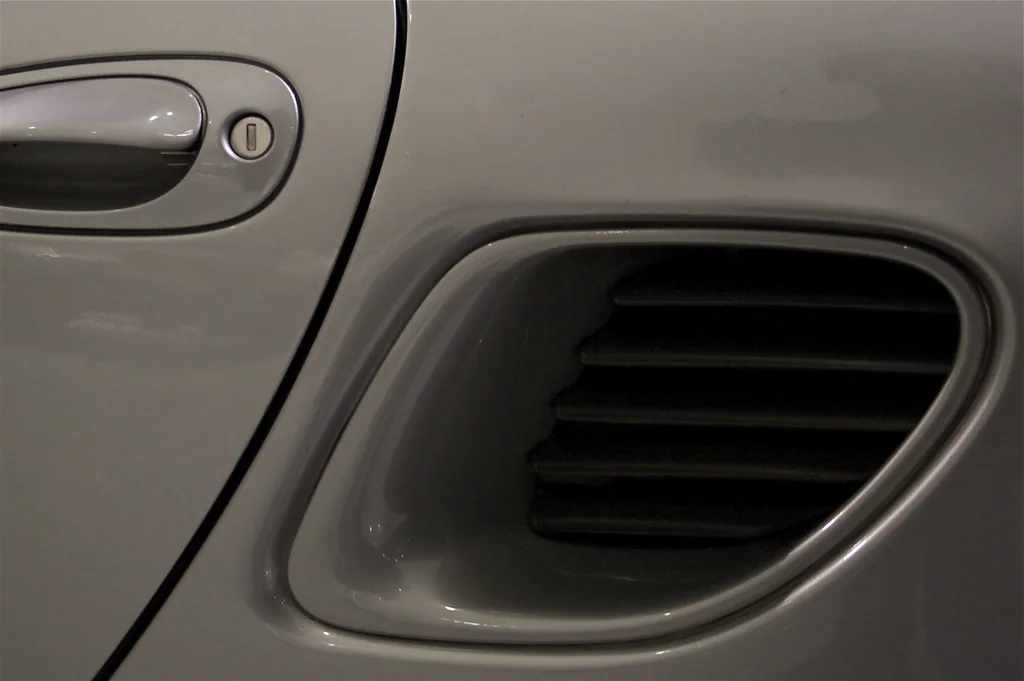
Chassis and Suspension Aging
Suspension bushings, shock absorbers, and other rubber and metal wear items age with time as much as with mileage. Porsche’s own restored 986 needed wishbones, stabilizer bushings, shock absorbers, tension struts, spring struts, and brake discs during a full service refresh. That is a useful preview of what an older, higher-mileage car may need. Budget for a full suspension inspection rather than assuming a low odometer reading means the chassis is untouched by age.
Inspection Checklist
Work through a 986 inspection in order: paperwork first, then a cold start, then the engine bay, then the underside on a lift, then the roof and drains, and finish with a road test. Doing the steps out of order makes it easy to miss evidence, since a warmed-up engine hides cold-start noise and a rushed test drive hides a roof that will not seal.
History and Paperwork
Ask for the complete service history before you view the car. Confirm that routine oil, brake-fluid, and age-based servicing is documented, not just the larger jobs, and whether any IMS-related inspection or retrofit work and roof motor or top fabric replacement is on record. A consistent history from a Porsche specialist is more useful than a stack of unrelated invoices with long gaps.
Run the car’s VIN through the NHTSA recall lookup and confirm any open campaign on that VIN has been completed. Recalls apply to individual VINs within a production run, not every car built in a given year, so check the exact car rather than relying on a model-year assumption.
Cold Start
Ask to see the car cold, before the seller or anyone else has started it that day. Stand where you can hear the engine and listen through the first few seconds for persistent knocking, tapping, or rattling. Smoke that continues once the engine is idling deserves investigation. If the car has already been warmed up before you arrive, treat cold-start evidence as unavailable for this visit rather than assuming it would have been clean.
Engine Bay and Fluid Evidence
The 986’s engine is accessed through service panels rather than a conventional hood. Have a specialist inspect the engine bay and underside for fresh oil or coolant evidence, including the rear luggage compartment around the coolant expansion tank for staining or dampness. A recently cleaned area is not disqualifying by itself, but it removes some of the evidence you would otherwise use to judge a slow leak.
Underside and Lift
Get the car on a lift and look for oil seepage around the rear main seal, the area where the engine and transmission meet, and the areas a specialist would check for IMS-related leaks. Fresh oil low on the bellhousing reads differently from old, dried residue higher up the case, and a specialist can help tell which is which. A cut-open oil filter inspection is worth the extra time on a serious candidate. It is one of the few direct ways to look for early bearing wear without splitting the engine case.
If the car shows persistent smoke, unusual noise, oil-consumption evidence, or another reason for deeper investigation, ask the specialist whether a borescope or compression test is warranted. Do not assume every 986 has bore scoring, and do not accept an uncited failure rate as proof a particular car is safe or doomed. While the car is up, check the exhaust for corrosion and the suspension bushings for age-related cracking.
Roof and Drains
Cycle the roof through a complete opening and closing sequence, ideally once before the drive and once after, and listen for hesitation or unusual motor noise while watching the clamshell alignment. Check the drain channels at each side of the cockpit for debris, and check the storage areas and carpets for damp patches that would point to a blocked drain. If the car has a removable hardtop, ask to see it fitted and removed, and check the seals and latch points for wear rather than assuming a stored hardtop is problem-free.
Road Test
Treat the drive as a sequence of distinct phases rather than one loop, so each phase gives you evidence the others cannot.
- Start the engine cold, as covered above, and let it idle briefly before pulling away.
- At low speed, work through the steering, brakes, and gearchanges in a parking lot or quiet street before joining traffic.
- Keep driving until the engine reaches full operating temperature, since some noises and gasket weeping only show up once components have expanded.
- With the engine warm, judge gearbox behavior: a manual clutch’s engagement point, or a Tiptronic’s response to kickdown and manual shift control.
- Test braking and steering together on a road you can do safely, since a problem in one can mask a problem in the other.
- Watch the temperature gauge over a longer stretch to confirm it holds steady rather than creeping up in slow traffic or sustained speed.
- After you park, look underneath and around the engine bay again for fresh leaks or odors that only a warm engine reveals.
Note how the car rides on roads you know well, since ride quality is easy to judge for yourself without a specialist present.
A pre-purchase inspection from a Porsche specialist lowers your risk and helps you understand what the first year of ownership will actually cost. It cannot guarantee the car, so treat it as one strong data point rather than a final verdict.
How to Commission the PPI
Not every shop offers every test below, so ask what is included before you book. A useful pre-purchase inspection on a 986 typically covers:
- A truly cold start, arranged so the specialist hears the engine before anyone else runs it that day.
- A lift inspection of the underside, bellhousing, and suspension, separate from a quick look at ground level.
- A fault-code scan of the onboard systems, since a stored code can point to something not yet obvious to the driver.
- A cooling-system pressure check, when appropriate given the car’s age and history.
- An oil-filter inspection for ferrous debris, when service timing allows the filter to be opened without wasting a fresh change.
- A full roof and drain cycle test, run more than once if time allows.
- A road test covering the sequence above.
- A written, prioritized findings report, rather than a verbal summary alone.
Ask for that report in writing. A prioritized list separates items that affect safety or reliability from cosmetic notes, which makes the next decision easier.
Turning Findings Into a Decision
A PPI report is only useful if you act on it consistently. Treat any single finding as one input, not a verdict, and weigh it against everything else the inspection turned up.
| What the PPI finds | Reasonable next step |
|---|---|
| Documented maintenance, a clean cold start, no active leaks | Proceed, subject to normal price negotiation |
| Consumable wear, such as tires, brakes, or bushings, with clear records | Negotiate price or plan the repair rather than treating it as disqualifying |
| Active overheating or a cooling system that will not hold temperature | Pause and have the cause diagnosed before proceeding |
| Unexplained metal debris found in the oil filter | Pause and ask for further investigation before proceeding |
| Severe structural damage or evidence of a poor prior repair | Walk away unless an independent specialist can verify the repair’s quality and safety |
| Seller refuses to allow an independent inspection | Walk away; a refusal is itself information |
These are starting points, not fixed rules. A specialist’s judgment on the specific car should always outweigh a general table like this one, and no single symptom by itself proves an engine failure.
What a 986 Actually Costs to Own
Running a 986 costs roughly what you would expect for a two-decades-old Porsche sports car with a folding roof and an engine that needs its IMS status understood. Budget for routine service, tires, brakes, and the possibility of roof or cooling-system work as rubber and plastic parts continue to age. Parts availability remains reasonable, and independent Porsche specialists are common in most markets.
Costs vary sharply by region, condition, and how many age-related items a previous owner has already addressed. Get a quote for the exact car. Include its IMS evaluation and any deferred roof, cooling, brake, tire, or suspension work found during the inspection.
Which 986 Fits Which Buyer
A base 986 suits a buyer who wants the simpler, lower-output version and is comfortable evaluating an older Porsche carefully. A Boxster S adds a larger engine, six-speed manual, and larger brakes for a buyer who prioritizes performance. Condition and service history still matter more than the badge.
Transmission and Driving Character
Every 986 uses a mid-engine layout, with the flat-six sitting behind the seats and ahead of the rear wheels. That layout is a big part of what makes the driving character consistent across the range, regardless of engine or gearbox. Power reaches the road through the rear wheels alone; the 986 was never offered with all-wheel drive.
Gearbox choice affects how that layout feels day to day. A well-sorted manual car rewards a driver who wants direct control over the engine and gearbox. A Tiptronic car suits a buyer who wants a more relaxed daily experience, but test it carefully for hesitation or rough kickdown, since automatic-specific wear shows up differently than manual wear would.
Ride quality on a 986 reflects its age and suspension maintenance history more than engine size. A car with fresh bushings and shocks rides noticeably tighter than one on worn factory parts, regardless of base or S. Judge ride quality on the specific car during your own test drive rather than from spec-sheet numbers alone.
Cross-shop the Porsche 987 before deciding, especially if IMS evaluation is not something you want to manage yourself. A buyer who values the original Boxster shape and is comfortable commissioning the IMS checks above may prefer a 986. A buyer who wants to remove intermediate shaft risk entirely should look specifically at the 987.2, a facelifted version that uses the 9A1 engine family without an intermediate shaft. The earlier 987.1 still uses an M96-derived engine, so it does not resolve the same question on its own.
The First 90 Days With a Purchased 986
What you do right after buying matters almost as much as the inspection itself. Use the first few months to build a clear baseline rather than assuming the PPI already covered everything.
Use the PPI as the starting baseline if it was comprehensive and current. Otherwise, book a baseline visit with a Porsche specialist, and reconcile the paper service history against what the specialist finds, noting any gaps.
Address safety items and any active leaks first. A slow oil or coolant leak that looked minor during a pre-purchase inspection deserves a firm diagnosis once the car is yours and you can watch it over time.
Confirm tire condition, brake wear, fluid condition, and cooling-system health directly, rather than relying only on the PPI’s single-day snapshot. Ownership lets you observe these over normal use in a way a one-time inspection cannot fully replicate.
Cosmetic work, badge issues, or interior trim can wait. Defer it until the mechanical priorities above are settled, so you are not spending on appearance before you know the car is sound.
Porsche 986 FAQs
What years did the Porsche 986 Boxster cover?
The 986 was built from 1996 to 2004 and sold in the United States from model year 1997 through 2004. Within that run the base engine grew from 2.5 to 2.7 liters, while the Boxster S arrived for model year 2000 with a 3.2-liter engine. Model year and calendar year are not interchangeable, so verify the exact car.
Does every 986 Boxster need the IMS bearing fixed?
No. Intermediate shaft bearing risk applies to the M96 engine family used across the 986 run, but the bearing design changed more than once during those eight years, and no independently verified, year-by-year failure rate exists. Treat IMS as a required inspection item on any 986, not as an automatic retrofit for every car.
What is the difference between the 986 Boxster and Boxster S?
The base Boxster used a 2.5-liter flat-six at launch and a 2.7-liter engine from model year 2000. The Boxster S arrived for model year 2000 with a 3.2-liter engine, a six-speed manual gearbox, and larger brakes. Confirm the exact model year, engine, and transmission on the specific car.
Is the 986 Boxster’s soft top reliable?
Roof design changed during the run. Porsche’s own service history for the car notes early cars used a plastic rear window, replaced by a glass rear window from model year 2003. Any 986 you inspect needs a full roof cycle test and a look at the drain channels, regardless of which window it has.
How much does a Porsche 986 cost to maintain?
Costs vary by region, car condition, and how many age-related items are already addressed. Rather than trust a fixed number, get a quote from a Porsche specialist for the exact car, including any overdue IMS inspection, roof service, or cooling-system work found during the pre-purchase inspection.
Should I buy a 986 or wait for a 987?
The 986 rewards a buyer who values the original Boxster shape and is willing to manage IMS risk with a proper inspection. The 987.2 removes that issue by using the 9A1 engine family without an intermediate shaft. Our Porsche 987 buyer’s guide covers that generation’s own version-specific checks.
Images: 2000 Porsche Boxster by Calreyn88, CC BY-SA 4.0; 1999 Porsche Boxster by Charles, CC0; 2003 Porsche 986 Boxster S by Free Photos and Art, CC BY 2.0; Porsche 986 museum cutaway by Matti Blume, CC BY-SA 4.0; and Porsche 986 side intake by Peter Marquardt, CC BY 2.0. Via Wikimedia Commons.