
The Porsche Cayenne Turbo GT is the fastest and sharpest version of the Cayenne SUV. It uses a 650 horsepower 4.0 liter twin-turbo V8, hits 60 mph in 3.1 seconds, and tops out at 190 mph. Porsche sells it only as a Coupe, and it holds the SUV lap record at the Nurburgring Nordschleife.
In this article, we’ll examine the Porsche Cayenne Turbo GT, the lineup’s track-focused SUV. We’ll cover its twin-turbo V8, chassis setup, lap time, and pricing.

Contents
Quick Summary
- Engine: 650 hp twin-turbo 4.0-liter V8 producing 626 lb-ft of torque.
- Performance: 0-60 mph in 3.1 seconds with Sport Chrono, top speed 190 mph.
- Body style: Sold only as a Cayenne Coupe, with no standard-roofline version.
- Nurburgring record: Lapped the Nordschleife in 7:38.925 in June 2021, an SUV-category record set by Lars Kern.
- Standard hardware: Carbon ceramic brakes, rear axle steering, Porsche Dynamic Chassis Control, and a titanium sport exhaust.
- Starting price: Well over $200,000 before options in the US.
- Position in range: Sits above the Cayenne GTS and Turbo E-Hybrid as the fastest, most track-focused Cayenne.
What Is the Porsche Cayenne Turbo GT
The Porsche Cayenne Turbo GT is the range-topping performance version of the Cayenne SUV. Porsche launched it in 2021 as the sharpest, fastest Cayenne it had ever built. It takes the 4.0 liter twin-turbo V8 from the Turbo, adds power, and pairs it with a hardware kit aimed at one thing: track speed.
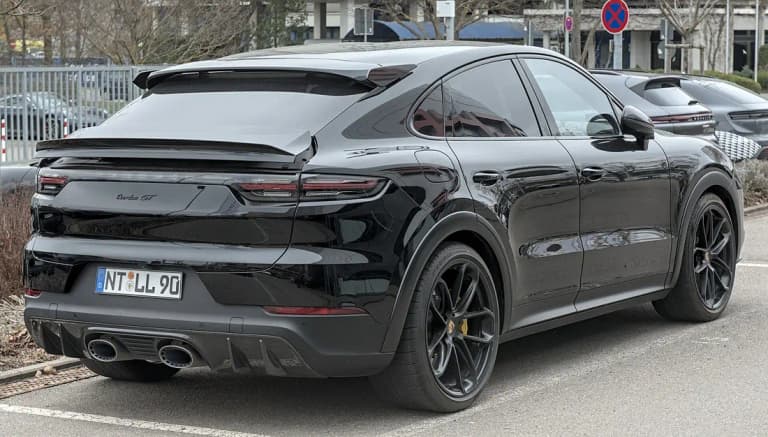
This is a focused machine with real hardware behind the badge. Porsche sells the Turbo GT only as a Coupe, with the lower fastback roofline. It sits lower than a standard Porsche Cayenne, wears a fixed roof spoiler, and rides on wide 22-inch wheels. Every part of it is tuned to make a heavy SUV corner and stop like something far lighter.

Porsche updated the car with the wider Cayenne facelift, known internally as the 9YB. This revised Turbo GT keeps the same mission but gains fresh styling and a small power bump. A current US car makes 650 horsepower, up from the 631 horsepower of the launch version, per Porsche’s US configurator. It remains a low-volume flagship built for buyers who want the most extreme Cayenne on sale.
Engine and Powertrain
The heart of the Turbo GT is a heavily reworked twin-turbo V8. Porsche did not just turn up the boost. The engine gets stronger internals, revised turbochargers, and a specific tune that lifts both power and response over the base Turbo.
| Spec | Cayenne Turbo GT |
|---|---|
| Engine | 4.0L twin-turbo V8 |
| Power | 650 hp |
| Torque | 626 lb-ft |
| 0-60 mph | 3.1 sec |
| Top speed | 190 mph |
| Transmission | 8-speed automatic |
The Twin-Turbo V8
The Turbo GT runs a 4.0 liter V8 with two turbochargers mounted inside the vee. Porsche quotes 650 horsepower and 626 lb-ft of torque for the current US car, per Porsche’s official US site. That makes it the most powerful V8 Cayenne road car in the lineup.
The gains come from real hardware inside the block. Porsche fitted a stronger crankshaft, new pistons and connecting rods, and larger turbos with revised charge cooling. The result is a powerful engine that pulls hard from low revs and keeps building all the way to the redline.
Transmission and All-Wheel Drive
Power runs through an eight-speed Tiptronic S automatic and a permanent all-wheel drive system. Like every Cayenne, it is a front-engine, all wheel drive design, and that traction turns the V8’s torque into savage straight line pace. Porsche recalibrated the gearbox for the Turbo GT with faster, firmer shifts. The car serves up hard upchanges under full throttle and quick, rev-matched downshifts on the brakes.
All-wheel drive is what lets a car this heavy launch so cleanly. The system sends torque to the front axle only when the rears need help, so the Turbo GT feels rear-biased and agile rather than nose-led. Launch control fires it off the line without drama or wheelspin.
Titanium Sport Exhaust
Every Turbo GT wears a standard titanium exhaust with central oval tailpipes. Titanium saves weight over steel and gives the V8 a harder, more metallic edge. It is one of the details that separates the Turbo GT from the regular Cayenne Turbo line.
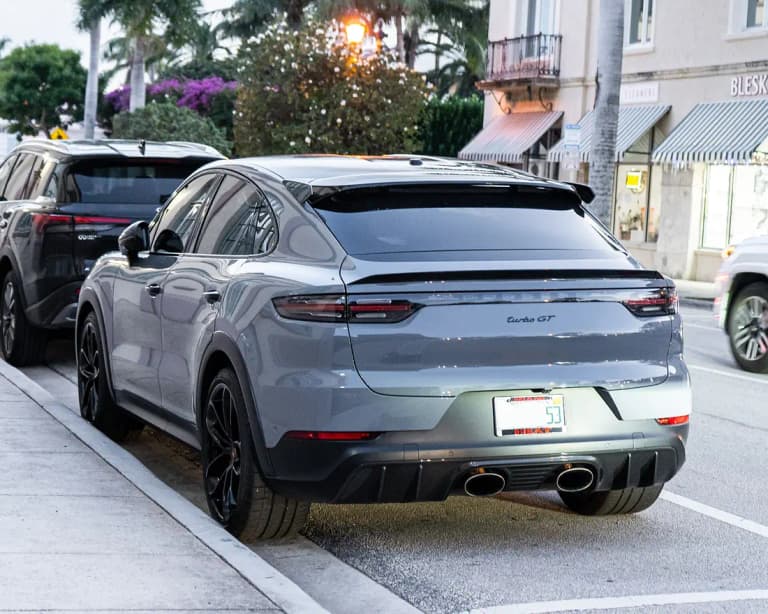
The exhaust note is deliberately louder than a normal Cayenne. In Sport and Sport Plus modes it opens up flaps for a fuller, more aggressive sound. It stays civil in Normal mode, so the car can still do the quiet school run.
Performance and Specs
The numbers are the whole point of the Turbo GT. This is a two-and-a-half-ton SUV that accelerates like a sports car and laps a circuit faster than most of them. Porsche built it to prove how far the Cayenne platform can be pushed.
0-60 mph and Top Speed
The Cayenne Turbo GT reaches 60 mph in 3.1 seconds with the Sport Chrono Package, according to Porsche USA. Top track speed is 190 mph on summer tires. Those are supercar figures from a family-shaped SUV.
Sport Chrono comes fitted on the Turbo GT and unlocks launch control. It also adds the drive-mode dial and the dash-top timer. The car repeats its quoted 0-60 time again and again, which is the mark of a serious launch system rather than a one-off headline.
The Nurburgring SUV Record
The Turbo GT set the production SUV lap record at the Nurburgring Nordschleife. Porsche driver Lars Kern lapped the 20.832 kilometer circuit in 7:38.925 on 14 June 2021, as confirmed by Porsche Newsroom. The record sits in the SUV, off-road vehicle, van, and pickup category.
The record run used the launch-spec Turbo GT on Pirelli P Zero Corsa tires. A lap in the seven-thirties is quick even for a dedicated sports car. That a tall, heavy SUV can do it says a lot about the chassis Porsche wrapped around the V8.
Chassis and Handling
The engine gets the headlines, but the chassis is what makes the Turbo GT special. Porsche lowered the body, stiffened almost everything, and fitted its full suite of active systems as standard. The car changes direction with a flatness that its size and vehicle weight should not allow.

Air Suspension and PDCC
The Turbo GT rides on a three-chamber adaptive air suspension with Porsche Active Suspension Management. Porsche lowered the ride height and retuned the dampers for far tighter body control. The car sits about 18 millimeters lower than a standard Cayenne.
Porsche Dynamic Chassis Control (PDCC) is standard and does the heavy lifting in corners. This active anti-roll system stiffens the bars on demand to keep the body level. Together with the air suspension, it lets the Turbo GT corner nearly flat at speeds that would have a normal SUV leaning hard.
Rear Axle Steering and Torque Vectoring
Rear axle steering, also called rear-wheel steering, is fitted as stock and sharpens the car at both ends of the speed range. At low speed the rear wheels turn opposite the fronts to shrink the turning circle. At higher speed they turn the same way for sharper, more stable direction changes.
Porsche Torque Vectoring Plus works with an electronic rear differential to tighten the line through a corner. It brakes the inside rear wheel and shuffles torque across the axle. The rear axle steering and the vectoring together make a big SUV feel keen and alert in the corners.

Carbon Ceramic Brakes and Tires
The Turbo GT gets Porsche Ceramic Composite Brakes fitted as stock. The front discs measure 440 millimeters and use ten-piston aluminum calipers, with 410 millimeter discs at the rear. These brakes shrug off heat lap after lap and save unsprung weight over steel.
Grip comes from wide 22-inch wheels wrapped in track-focused tires. The launch car ran Pirelli P Zero Corsa rubber sized for serious cornering loads. Big brakes and sticky tires are what let the Turbo GT stop and turn as hard as it accelerates.
Interior and Technology
Inside, the Turbo GT builds on the regular Cayenne Coupe cabin with sportier trim. The facelift brought a fully digital 12.6-inch curved instrument cluster, a central touchscreen, and an optional passenger display. These digital displays keep the key data clear and easy to read at speed. Driver aids like adaptive cruise control and lane keeping sit on the options list.
The Turbo GT adds heavily bolstered sport seats, Alcantara trim, and GT-specific details. A carbon roof and carbon interior accents cut a little weight and mark the car out from lesser Cayennes. Contrast stitching and Turbo GT badging remind you which model you are in.

Despite the track focus, the cabin keeps real luxury and space. It seats five, carries luggage, and runs wireless Apple CarPlay and a strong stereo. The Turbo GT can hammer a circuit in the morning and cover a long highway trip in comfort the same afternoon.
Practicality survives the performance focus better than you might expect. The Turbo GT keeps the Cayenne Coupe’s real cargo hold and a towing capacity that suits a small trailer. It is a super SUV you can genuinely use every day, not a stripped-out track toy.
Design and Exterior
The Turbo GT looks meaner than any other Cayenne, and every change earns its place. The lower stance, wider tracks, and fixed roof spoiler give it a planted, aggressive look. A front lip, side skirts, and a rear diffuser round out the body kit.
The fixed rear wing replaces the adaptive spoiler used on other Coupe models. It adds real downforce at speed rather than styling alone. Combined with the wide rear haunches, it gives the Turbo GT a purposeful, motorsport-inspired rear.
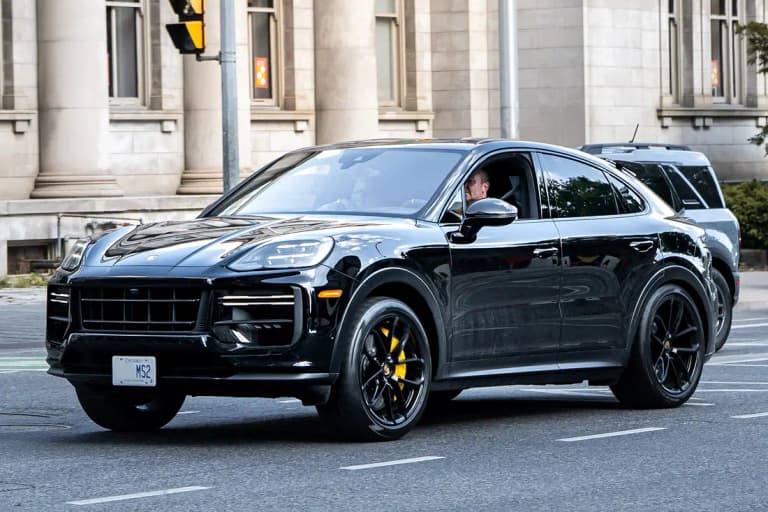
Porsche offers the Turbo GT in a signature Arctic Gray along with the wider color palette. The 22-inch GT Design wheels come in several finishes, including a bronze that has become a Turbo GT signature. Carbon exterior trim and a carbon roof are part of the look.

How the Turbo GT Compares in the Range
The Turbo GT sits at the very top of the Cayenne lineup, above the Cayenne GTS and even the more powerful Turbo E-Hybrid. Each of those cars has a different job. Understanding the split makes the Turbo GT easier to place.
Turbo GT vs GTS and Turbo E-Hybrid
The Cayenne GTS is the value driver’s choice, with a 493 horsepower V8 and a sharper base chassis, per Porsche USA. The Turbo GT costs far more and adds power, carbon brakes, and the full track kit. If you want the sharpest Cayenne and will use it, the Turbo GT is the pick.
The Turbo E-Hybrid actually makes more total power at 729 horsepower, per Porsche USA. It adds an electric motor and a battery for silent town running and huge straight-line punch. The Turbo GT answers with less weight, a fixed focus on the track, and the faster lap time. One is the flagship all-rounder, the other is the circuit weapon.
Turbo GT vs Other Fast SUVs
Among rival super SUVs, the Turbo GT trades on precision rather than raw drama. The Lamborghini Urus shares much of its hardware but leans louder and more flamboyant. The Aston Martin DBX707 and the BMW XM chase similar power figures with different characters.
What sets the Porsche apart is how it drives. The chassis feels tied down and honest, and the steering tells you what the front tires are doing. For a buyer who values how an SUV corners over how it shouts, the Turbo GT is the sharpest tool in the class.
Pricing
The Cayenne Turbo GT is the most expensive Cayenne by a wide margin. US pricing starts well over 200,000 dollars before options, based on Porsche’s US pricing. Options and delivery push most cars higher still.
| Model | Role | Starting price |
|---|---|---|
| Cayenne GTS Coupe | Value driver | ~130,000 USD |
| Turbo E-Hybrid Coupe | Flagship hybrid | ~151,000 USD |
| Turbo GT | Track flagship | 200,000+ USD |
Used prices have started to settle as the first 2021 and 2022 cars age. An early Turbo GT is a lot of performance for the money on the secondary market. A low purchase price says nothing about the cost of keeping one running, so budget carefully.
Ownership and Running Costs
The Turbo GT shares its core mechanicals with the rest of the Cayenne range, so it inherits a solid reliability record for a performance SUV. It is still a complex, high-output German machine. The running costs sit at the top end of what a Cayenne can ask of an owner.
Fuel economy is modest, as you would expect from a 650 horsepower V8. Expect low-to-mid teens in mixed US driving, and less if you use the performance. The V8 rewards a light right foot on a long trip, but this was never built to save fuel.

The consumable costs are where the Turbo GT bites hardest. The 22-inch track tires wear fast and cost a lot to replace. Carbon ceramic brakes last well but are very expensive once worn. If you cross-shop the smaller Porsche SUV, our Cayenne vs Macan comparison and the Cayenne Coupe guide both break the range down further.
Frequently Asked Questions
How much horsepower does the Porsche Cayenne Turbo GT have?
The Cayenne Turbo GT makes 650 horsepower from a 4.0 liter twin-turbo V8, along with 626 lb-ft of torque. That makes it the most powerful Cayenne road car Porsche builds.
How fast is the Porsche Cayenne Turbo GT?
The Turbo GT hits 60 mph in 3.1 seconds with the Sport Chrono Package and reaches a top track speed of 190 mph on summer tires. It is the quickest Cayenne you can buy.
Is the Cayenne Turbo GT only sold as a coupe?
Yes. Porsche only builds the Turbo GT in the sloped-roof Cayenne Coupe body. There is no version with the taller standard Cayenne roofline.
Does the Cayenne Turbo GT hold a Nurburgring record?
Yes. In June 2021 it lapped the Nurburgring Nordschleife in 7:38.925, a record in the SUV, off-road, van, and pickup category. Porsche driver Lars Kern set the time.
How much does a Porsche Cayenne Turbo GT cost?
The Turbo GT starts well over 200,000 US dollars before options, which puts it at the very top of the Cayenne range. Options and delivery push most cars higher.
What is the difference between the Cayenne Turbo GT and the Turbo E-Hybrid?
The Turbo GT is a pure twin-turbo V8 tuned for track speed, while the Turbo E-Hybrid adds an electric motor for more total power and electric-only running. The Turbo GT is lighter, sharper, and faster on a circuit.
Images: Black front and black rear by Alexander-93, CC BY-SA 4.0. Show stand by Alexander Migl, CC BY-SA 4.0. Blue stand by MrWalkr, CC BY-SA 4.0. Gray with bronze wheels by Calreyn88, CC0. Black facelift, gray rear, gray front, indoor front, and indoor rear by OWS Photography, CC BY 4.0. Via Wikimedia Commons.