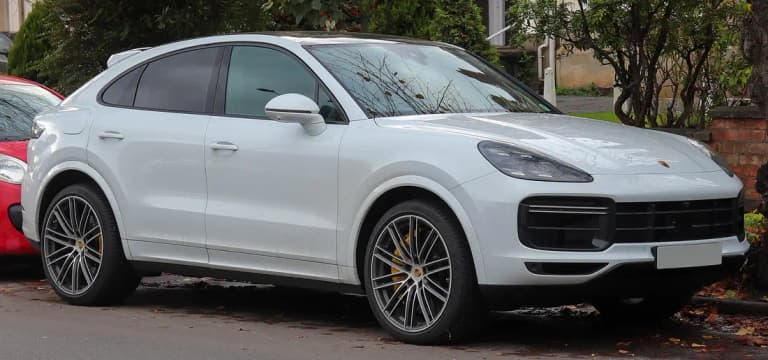
The Porsche Cayenne Coupe is the fastback version of the Cayenne SUV. It keeps the same platform, engines, and five seats as the standard car, but swaps the upright roofline for a lower, faster-dropping rear that ends in an adaptive spoiler. The range runs from a 348 horsepower base V6 up to the 729 horsepower Turbo E-Hybrid, with a 650 horsepower Turbo GT at the top.
In this article, we’ll explain the Porsche Cayenne Coupe, the fastback version of Porsche’s Cayenne SUV. We’ll cover its model lineup, cargo space, the Turbo GT, and pricing.
Contents
Quick Summary
- Body: Fastback version of the Cayenne SUV, sharing platform, engines, and doors with the standard car.
- Engine range: 3.0-liter turbo V6 base car up to the 729 hp Turbo E-Hybrid, with a 650 hp Turbo GT at the top.
- Performance: 0-60 mph from 5.7 seconds (base) down to 3.1 seconds (Turbo GT).
- Seating: Five seats standard, with a no-cost two-seat rear option.
- Cargo space: About 20.9 cubic feet behind the rear seats, up to 53 cubic feet folded.
- Price premium: Roughly $4,000 over the equivalent standard Cayenne trim.
- Starting price: $84,300 for the base Cayenne Coupe before options.
What Is the Porsche Cayenne Coupe
The Porsche Cayenne Coupe is a five-seat performance SUV with a fastback roofline. Porsche launched it in 2019 as a second body style for the third-generation Cayenne, aimed at buyers who wanted the space and pace of the SUV with a sleeker shape. It shares its platform, doors, and engines with the standard car from the windshield forward.
The name is the catch. This is not a two-door car. The Cayenne Coupe is a five-door SUV with a roof that drops earlier and steeper toward the tail, the same idea BMW used on the X6 years before. Porsche reworked the rear doors, fenders, and tailgate so the whole back half looks lower and wider than the regular Cayenne.
Under the skin it is pure Cayenne. Every version uses a front-mounted engine, an eight-speed automatic, and all-wheel drive. What you pay for with the Coupe is the look and a slightly sportier standard chassis tune, not a different car. If you want the full background on the model family, start with our complete Porsche Cayenne guide.
Cayenne Coupe vs Standard Cayenne
The Coupe and the standard Cayenne are mechanically identical under the hood. The differences are all in the body behind the front doors, and they come down to four things: the roof, the rear seats, the cargo hold, and the price.
| Feature | Cayenne Coupe | Standard Cayenne |
|---|---|---|
| Roofline | Lower, fastback | Taller, square |
| Rear spoiler | Adaptive, standard | Fixed roof spoiler |
| Cargo (seats up) | 20.9 cu ft | 27.2 cu ft |
| Price premium | About 4,000 USD | Baseline |
Roofline and Spoiler
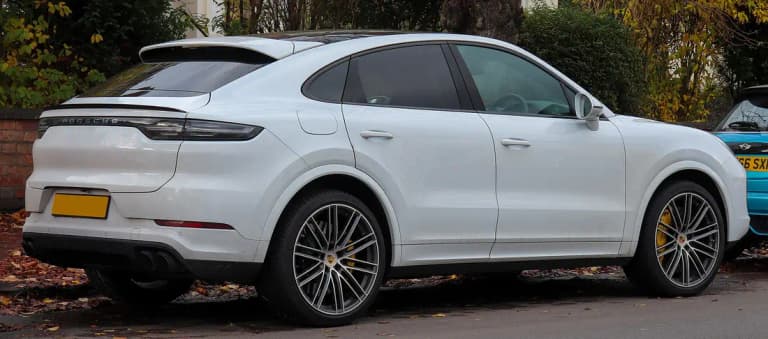
The roof is the whole point of the Coupe. Porsche dropped the roofline by around 20 millimeters and pulled it back into a long, sloping rear window that meets a redesigned tailgate. The effect is a lower, more planted stance that reads more like a fastback than a tall SUV.
Every Cayenne Coupe gets an adaptive rear spoiler as standard. It sits flush at low speed and extends by 135 millimeters above 90 km/h to add downforce and cut lift. The standard Cayenne uses a simpler fixed spoiler at the top of the tailgate, so this is one of the few functional hardware differences between the two bodies.
A large fixed panoramic glass roof comes standard, and a contrasting carbon roof is offered on the sportier trims through the lightweight packages. Both push the visual weight of the car downward, which is exactly the look the Coupe is selling.
Rear Seats and Headroom
The Cayenne Coupe still seats five. The standard layout is a three-person rear bench set about 30 millimeters lower than the standard Cayenne, which claws back some of the headroom the lower roof takes away. Tall adults fit in the back, but they sit closer to the glass than they would in the upright car.
Porsche also offers a no-cost two-seat rear configuration with two sculpted individual seats and a center console. It turns the Coupe into a sporty four-seater and suits buyers who rarely carry a fifth passenger. Either way, the rear bench splits and folds in a 40:20:40 pattern for longer loads.
Cargo and Storage Space
The lower roof costs cargo volume, and this is the clearest practical trade. The Cayenne Coupe holds about 20.9 cubic feet behind the rear seats, against roughly 27.2 cubic feet in the standard Cayenne. Fold the rear seats and the Coupe opens up to about 53 cubic feet of storage space.
For day to day family use the difference rarely bites. A week of luggage, a stroller, or a big grocery run all fit. The gap only shows up when you load tall boxes or flat-pack furniture, where the standard Cayenne’s square tailgate opening wins. Towing capacity is unchanged at up to 7,700 pounds, so the Coupe pulls a trailer just as well.
Price Premium
The Coupe body carries a price premium of roughly 4,000 US dollars over the matching standard Cayenne trim. That figure holds fairly steady up the range, so you pay a similar surcharge whether you buy the base car or the GTS.
What you get for the money is mostly style plus the standard adaptive spoiler and the panoramic roof, both of which are options on parts of the standard range. If those features matter to you, the gap narrows once you spec a comparable standard Cayenne. If they do not, the premium is purely the cost of the silhouette.
Cayenne Coupe Models and Engine Lineup
The Cayenne Coupe comes in the same broad lineup as the standard SUV, from a single-turbo V6 base car to a 729 horsepower plug-in hybrid and a track-focused Turbo GT. Power climbs steadily across the Cayenne Coupe models, and every one drives all four wheels through an eight-speed automatic.
| Model | Engine | Power | 0-60 mph |
|---|---|---|---|
| Cayenne Coupe | 3.0L turbo V6 | 348 hp | 5.7 sec |
| E-Hybrid Coupe | 3.0L V6 plug-in | 463 hp | 4.6 sec |
| S Coupe | 4.0L twin-turbo V8 | 468 hp | 4.4 sec |
| GTS Coupe | 4.0L twin-turbo V8 | 493 hp | 4.2 sec |
| Turbo E-Hybrid | 4.0L V8 plug-in | 729 hp | 3.5 sec |
| Turbo GT | 4.0L twin-turbo V8 | 650 hp | 3.1 sec |
Cayenne Coupe
The base Cayenne Coupe runs a 3.0 liter single-turbo V6 making 348 horsepower and 368 lb-ft of torque. It hits 60 mph in 5.7 seconds, which is plenty quick for a car this size and the right engine for buyers who want the look without the fuel bills of a V8.
This is the volume model and the value pick. It rides on steel springs as standard, with air suspension optional, and it gives up little in real-world pace to the pricier trims unless you are chasing the clock.
Cayenne E-Hybrid Coupe
The Cayenne E-Hybrid Coupe pairs the 3.0 liter V6 with a 174 horsepower electric motor for a combined 463 horsepower. The facelifted car uses a larger 25.9 kWh battery, up from 17.9 kWh, which stretches the electric-only range and makes the plug-in genuinely usable for short commutes.
It runs to 60 mph in about 4.6 seconds and can creep through town in near silence. For owners who can charge at home, this is the cheapest Cayenne Coupe to run day to day while still carrying real performance for the highway.
Cayenne S Coupe
The Cayenne S Coupe is where the V8 returns. Porsche dropped the old V6 S engine and fitted a 4.0 liter twin-turbo V8 making 468 horsepower and 442 lb-ft. It reaches 60 mph in as little as 4.4 seconds with the Sport Chrono Package and tops out at 169 mph.
The S is the sweet spot for many buyers. It brings the deeper V8 soundtrack and a big jump in straight-line punch over the base car, without the price or complexity of the hybrids above it.
Cayenne GTS Coupe
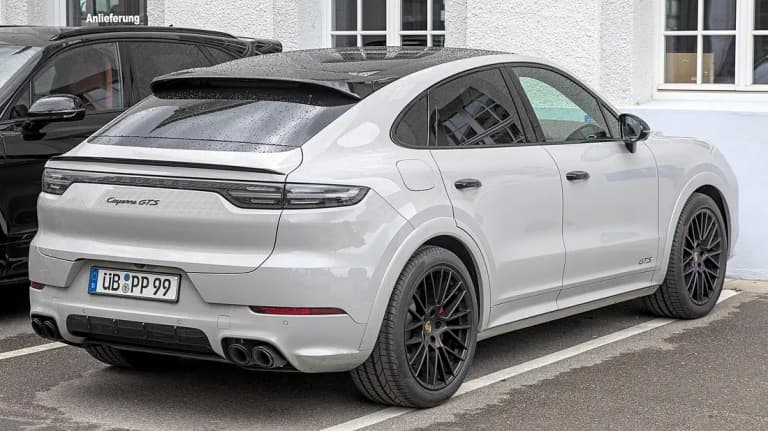
The Cayenne GTS Coupe sharpens the same 4.0 liter twin-turbo V8 to 493 horsepower and sprints to 60 mph in 4.2 seconds. The GTS is the driver’s choice in the range, with a lowered sport air suspension, a louder sport exhaust, and darkened trim as standard.
Porsche tunes the GTS to feel keener and more alert than the S, leaning on a firmer chassis and quicker responses rather than outright power. It is the Cayenne Coupe for someone who actually enjoys the back roads on the way home.
Cayenne Turbo E-Hybrid Coupe
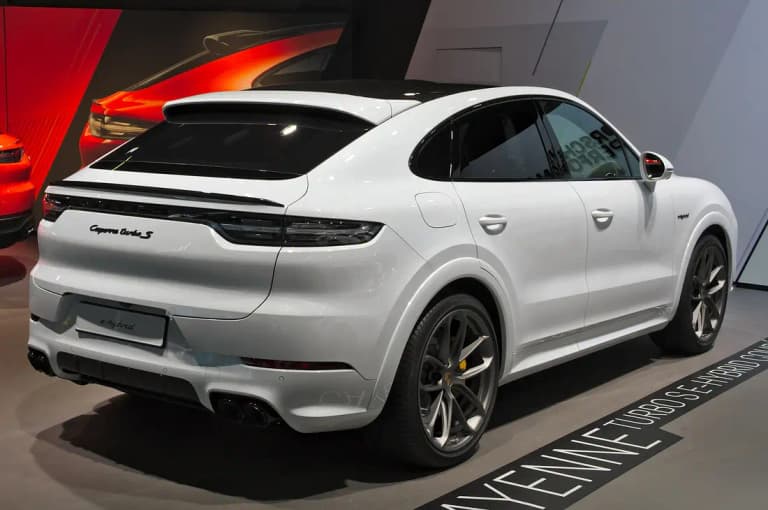
The Cayenne Turbo E-Hybrid Coupe is the most powerful Cayenne you can buy through the normal range. It combines a 591 horsepower 4.0 liter twin-turbo V8 with a 174 horsepower electric motor for a combined 729 horsepower and 700 lb-ft. That launches it to 60 mph in 3.5 seconds and on to 183 mph.
This is the do-everything flagship. It can drive on electric power around town, then deliver supercar acceleration when you ask for it. The 25.9 kWh battery gives it useful electric range, and it carries the full luxury and chassis kit you expect at the top of the lineup.
Cayenne Turbo GT Coupe
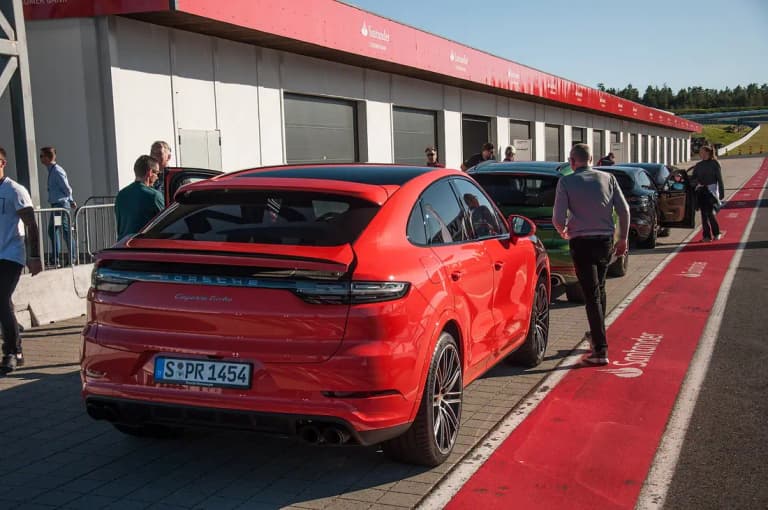
The Cayenne Turbo GT is sold only as a Coupe, and it is the sharpest, fastest version of the lot. Its 4.0 liter twin-turbo V8 makes 650 horsepower, enough for a 3.1 second run to 60 mph and a 189 mph top speed. It also holds a production SUV lap record at the Nurburgring.
The Cayenne Turbo GT gets a unique chassis tune, wider tires, carbon-ceramic brakes, and a fixed rear wing in place of the adaptive spoiler. It is less about luxury and more about how fast a two-and-a-half-ton SUV can really go.
Performance and Chassis
Every Cayenne Coupe drives all four wheels and shares the standard car’s eight-speed Tiptronic automatic. The Coupe body sits on the same chassis hardware as the standard Cayenne, so the way it handles depends far more on which options you choose than on the roof shape.
Air suspension, the Porsche 4D Chassis Control system, and active anti-roll bars are all available, and the higher trims add them as standard. Loaded up, a Cayenne Coupe corners with a flatness and a precision that still surprises people given its size and weight.
Rear Axle Steering and Chassis Control
The most useful handling option is rear axle steering. At low speed the rear wheels turn opposite the fronts to shrink the turning circle, which makes a big SUV easy in car parks. At higher speed they turn the same way for sharper, more stable lane changes.
Porsche Dynamic Chassis Control, the active anti-roll system, keeps the body level through corners by stiffening the bars on demand. Together with the adaptive air suspension, it is what lets a tall, heavy Coupe change direction like something far smaller.
Sport Chrono and Launch Control
The Sport Chrono Package adds a drive-mode dial on the steering wheel, a dash-top timer, and the sharpest engine and gearbox maps. On the V8 cars it also unlocks the quickest quoted 0 to 60 times, which is why the S Coupe’s 4.4 second figure assumes it is fitted.
Sport Chrono also brings launch control, which holds the revs and fires the car off the line for a repeatable, hard launch. It is standard on the GTS and the Turbo models and optional lower down the range.
Interior and Technology
Inside, the Cayenne Coupe is identical to the standard car up front, and the facelifted model brought a major cabin overhaul. The dash now uses a fully digital 12.6 inch curved instrument cluster, a central touchscreen, and an optional 10.9 inch passenger display that the driver cannot see, so a front passenger can watch video on the move.
Material quality is a clear step above most rivals. You get real metal, leather or sustainable alternatives, and a clean layout that moved most climate controls to a touch panel below the screen. The Coupe adds standard sport seats and, on the GTS and Turbo cars, more aggressive bolstering and darker finishes.
The big difference a passenger feels is overhead. The standard panoramic glass roof floods the cabin with light, and rear occupants get a darker, more enclosed feel than in the airy standard Cayenne. Connectivity covers wireless Apple CarPlay and Android Auto, and the higher trims add a Bose or Burmester sound system.
Design and Exterior
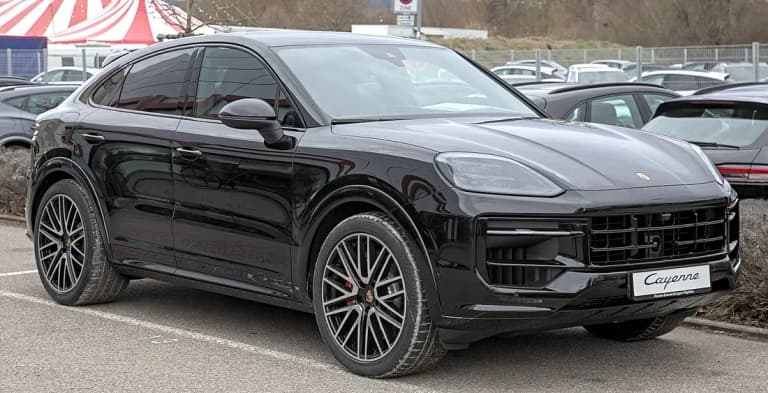
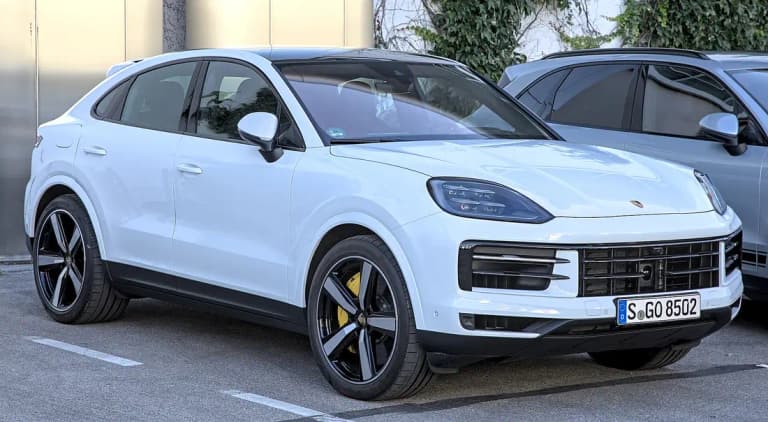
The Cayenne Coupe is the best-looking Cayenne, and that is the entire case for it. The lower roof, the pulled-back glass, and the wider rear haunches give it a stance the upright car cannot match. The 2024 facelift sharpened the nose with new matrix LED headlights and a more sculpted hood.
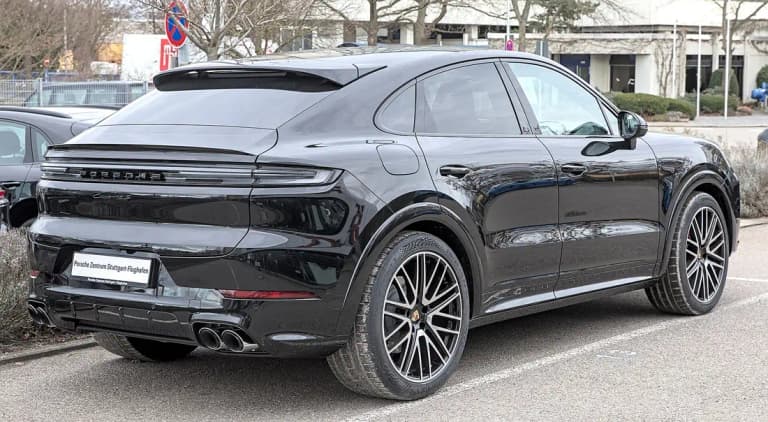
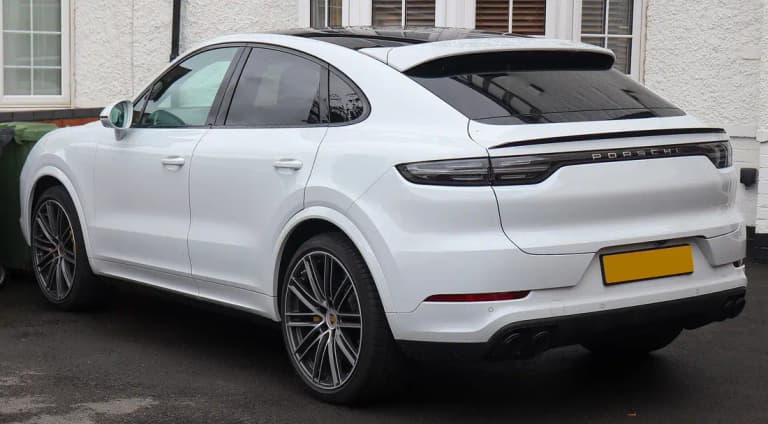
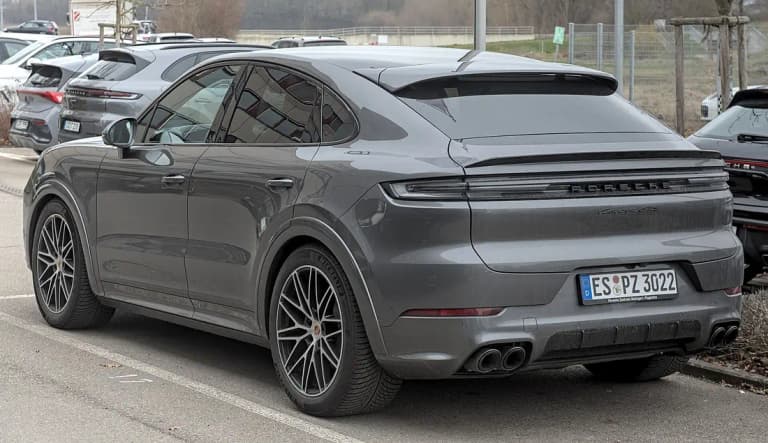
The rear is where the Coupe earns its name. A full-width light bar, the adaptive spoiler, and a steeper tailgate angle make it look planted and fast even standing still. Compared with rivals like the Range Rover Sport or the BMW X6, the Porsche looks the most athletic and the least like a tall hatchback.
Wheels run from 19 inches up to 22 inches, and the sportier trims wear darker trim, larger intakes, and quad exhausts. The Turbo GT goes furthest with a fixed wing, exposed carbon, and a body kit that leaves no doubt about its intent.
Pricing
The Cayenne Coupe slots in just above the matching standard Cayenne trim. These are US starting prices before options and delivery, and Porsche’s options list can add a lot, so most cars leave the showroom well above the base figure. The numbers below come straight from Porsche’s official US configurator.
| Model | Starting MSRP |
|---|---|
| Cayenne Coupe | 84,300 USD |
| E-Hybrid Coupe | 95,700 USD |
| S Coupe | 102,100 USD |
| GTS Coupe | 129,500 USD |
| Turbo E-Hybrid Coupe | 151,400 USD |
| Turbo GT Coupe | ~200,000 USD |
Used prices have softened as the first 2019 to 2022 cars age out of warranty, which makes an early V8 Turbo Coupe a lot of performance for the money. Just remember that a cheap purchase price on a high-power Porsche SUV says nothing about what it costs to keep running.
Ownership and Running Costs
The Cayenne Coupe is mechanically the same as the standard Cayenne, so it inherits the same ownership picture. The third-generation cars have a solid reliability record by performance-SUV standards, but they are still complex German machines with big brakes, big tires, and air suspension that all cost real money over time.
The base V6 is the cheapest to run, the V8 cars drink fuel hard when driven, and the plug-in hybrids reward owners who actually charge them. Tires on the 21 and 22 inch wheels are expensive, and carbon-ceramic brakes on the Turbo GT cost a fortune to replace once worn. Budget for the upkeep, not just the sticker.
If you are cross-shopping the smaller Porsche SUV, our Cayenne vs Macan comparison breaks down the size, price, and cargo differences. If a tighter, more affordable Porsche SUV is on your list, the Macan guide covers that side of the range in full.
Frequently Asked Questions
What is the difference between the Cayenne and the Cayenne Coupe?
The Coupe uses the same platform and engines but adds a lower, faster-sloping roofline, a standard adaptive rear spoiler, and a more raked rear window. You trade some cargo space and rear headroom for a sportier shape.
Does the Porsche Cayenne Coupe have a back seat?
Yes. It seats five as standard with a three-person rear bench, and Porsche offers a no-cost two-seat rear setup. Rear headroom is slightly tighter than the standard Cayenne.
How much is a Porsche Cayenne Coupe?
The base car starts around 84,300 US dollars. The S Coupe is about 102,100, the GTS Coupe is 129,500, and the Turbo E-Hybrid Coupe tops the normal range near 151,400, all before options.
Is the Cayenne Coupe a true coupe?
No. It is a five-door SUV with a coupe-inspired roofline, not a two-door car. Porsche uses the coupe name for the fastback body style.
How much cargo space does the Cayenne Coupe have?
About 20.9 cubic feet behind the rear seats and up to 53 cubic feet with the seats folded. That is less than the standard Cayenne but enough for most family use.
Which Cayenne Coupe is the fastest?
The Turbo GT Coupe, with 650 horsepower and a 3.1 second 0 to 60 time. The Turbo E-Hybrid is close behind at 729 horsepower and 3.5 seconds.
Images: Front view, rear three-quarter, and rear view by Vauxford, CC BY-SA 4.0. Facelift front, Cayenne S rear, Cayenne S front, and GTS by Alexander-93, CC BY-SA 4.0. Facelift GTS and Turbo S E-Hybrid by Alexander Migl, CC BY-SA 4.0. Turbo at track by L.C. Nottaasen, CC BY 2.0. Via Wikimedia Commons.