Quick Answer: Porsche makes several kinds of hybrids. The Cayenne and Panamera E-Hybrid models are plug-ins built for electric commuting and long trips. The 911 Carrera GTS T-Hybrid is a performance hybrid with no charge port. The 918 Spyder and 919 race car showed what Porsche could do when electricity was part of the speed plan.
In this article, we’ll explain Porsche hybrid cars, from the first Cayenne to the new 911. We’ll cover plug-in models, the T-Hybrid system, and what each one is for.
Contents
Quick Summary
- First production hybrid: the 2010 Cayenne S Hybrid.
- Plug-in choice: Cayenne E-Hybrid and Panamera E-Hybrid models can recharge from a charger.
- Performance hybrid: the 911 Carrera GTS T-Hybrid uses electricity to sharpen response, not to run errands on battery power.
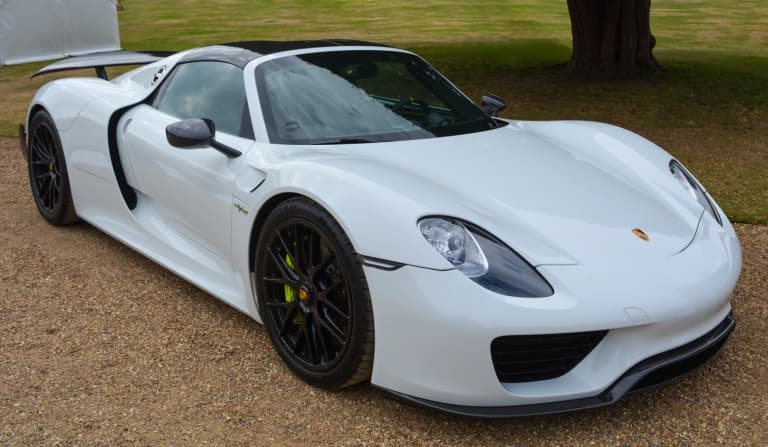
- Halo car: the 918 Spyder paired a V8 with two electric motors for 887 hp.
- Race connection: the 919 Hybrid took Porsche hybrid know-how to Le Mans.
- Buying rule: buy a plug-in only if you can charge it regularly. Otherwise, a gas Porsche is usually the simpler answer.
The Three Types of Porsche Hybrid
Porsche uses the word hybrid for different jobs. That can get confusing fast, especially with the 911 now in the mix.
Plug-in hybrids have a charge port and a battery large enough for useful electric driving. Current Cayenne and Panamera E-Hybrid models fit here. Charge them at home or work, and they can handle short local trips quietly before the gas engine joins in.
Performance hybrids use electric parts to add response and power. The 911 Carrera GTS T-Hybrid is the clear example. It is not a plug-in. Its small battery is charged while driving, so you never plan your route around a public charger.
Halo and race hybrids are where Porsche tests the big ideas. The 918 Spyder brought a plug-in V8 hybrid to the road. The 919 Hybrid did the same job on the race track.
The Early Cayenne and Panamera Hybrids
How the first system worked
Porsche’s first production hybrid was the 2010 Cayenne S Hybrid. It paired a supercharged V6 with an electric motor. The point was not to make a slow economy special. It was to make a big SUV use less fuel without feeling flat when you asked for power.
The Panamera S Hybrid followed in 2011. Porsche rated that car at 380 PS, and it was among the brand’s most efficient cars at the time.
What the early cars proved
Those first systems were a start, not the finished product. They did not offer the electric range or charging flexibility of later E-Hybrid cars. Still, they proved Porsche could put an electric motor in a heavy, quick road car without losing the basic Porsche feel.
Today’s Plug-In Porsche Hybrids
The modern Cayenne E-Hybrid and Panamera E-Hybrid are the easiest Porsche hybrids to understand. Plug them in, start in electric mode when the battery has charge, and let the gas engine handle longer trips or hard acceleration.
The Cayenne is the family and travel choice. The Panamera is the low-slung four-door choice. Both have E-Hybrid versions with different power levels, so check the exact badge rather than assuming every hybrid Cayenne or Panamera has the same hardware.
A plug-in hybrid makes sense when you have reliable charging where the car sleeps. If you rarely plug in, you are carrying the battery weight without getting the main benefit. Be honest about that before paying extra for one.
The 918 Spyder Changed the Conversation
The 918 Spyder was not Porsche’s first hybrid, but it changed the argument. Porsche launched the production car in 2013 with a 4.6-liter naturally aspirated V8 and two electric motors.
Porsche rated the combined system at 887 hp. It could drive on electric power alone, but nobody bought a 918 for silent school runs. The electric motors filled in torque and made the car brutally quick out of corners.
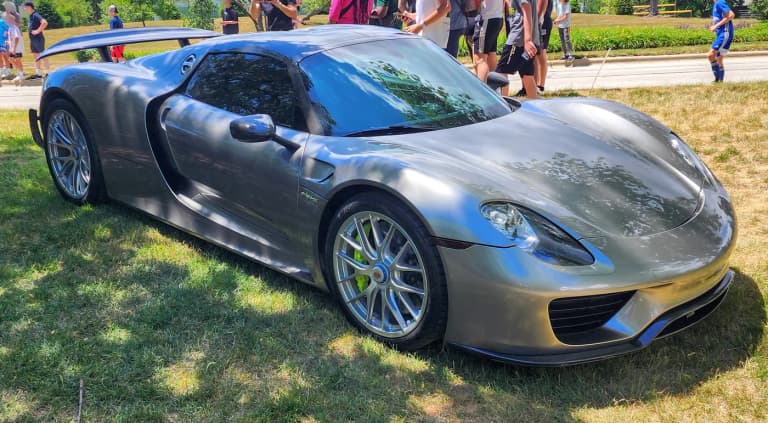
The 918 reset the old hybrid argument. A hybrid did not have to be a compromise. It could be the fast version.
What Racing Changed
Porsche took the same idea to endurance racing with the 919 Hybrid. The prototype combined a turbocharged V4 with energy recovery systems. It won Le Mans overall in 2015, 2016, and 2017 before Porsche retired the program.
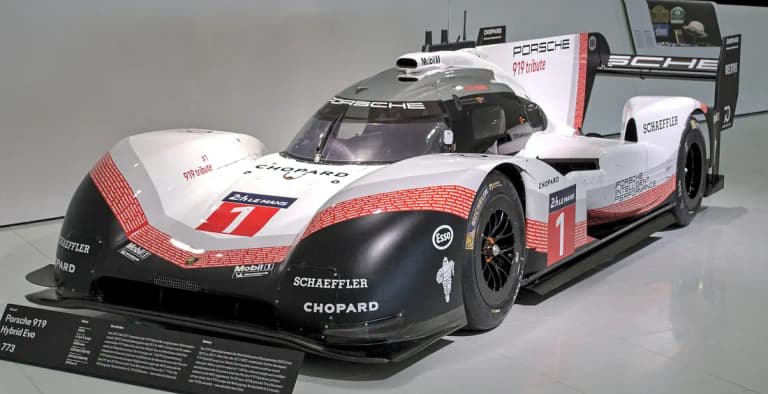
The 919 Hybrid Evo is the track-only follow-up, not a road-car prototype. It showed how much speed the hybrid parts could unlock when efficiency rules were off the table.
For the full race-car story, read our Porsche 919 Hybrid Evo guide. The road-car link is not a direct parts swap. It is the basic approach: use electric power where it makes the gas engine stronger.
The 911 Carrera GTS T-Hybrid
The 2025 911 Carrera GTS brought hybrid power to the 911 for the first time. Porsche calls it T-Hybrid. It uses a new 3.6-liter flat-six, an electric motor inside the eight-speed PDK, and an electrically driven turbocharger.
It is not a plug-in. There is no charge port and no electric-only commute plan. The compact battery is recharged by braking energy and the electrically driven turbocharger. The system is there to sharpen throttle response and add power without the lag that can make a turbo engine feel sleepy.
Porsche rates the current GTS T-Hybrid at 532 hp. The electric hardware makes the car faster. It does not turn a 911 into an appliance. See our 992.2 guide for the wider 911 update.
Choosing the Right Porsche Hybrid
Choose a Cayenne E-Hybrid if you need space and can charge at home. It suits local driving on electric power.
Choose a Panamera E-Hybrid if you want the same plug-in idea in a lower, more road-focused four-door. It is the better fit for a driver who does not need SUV height.
Choose a 911 GTS T-Hybrid if you want a current 911 and care about response more than electric range. You never have to plug it in, but you also cannot use it as an EV.
Choose a 918 Spyder only if your budget is already in hypercar territory. It is a collectible engineering landmark, not a rational way to save fuel.
For a used plug-in, ask for complete service records and test the charging process before you buy. A pre-purchase inspection from a Porsche specialist is cheap insurance on any complex car.
Frequently Asked Questions
Does Porsche make hybrid cars?
Yes, Porsche sells hybrid versions of the Cayenne and Panamera, plus the 911 Carrera GTS T-Hybrid. The Cayenne and Panamera hybrids plug in. The 911 T-Hybrid does not.
Which Porsche hybrid is a plug-in?
Current Porsche Cayenne E-Hybrid and Panamera E-Hybrid models are plug-in hybrids. The 918 Spyder was also a plug-in hybrid. The 911 Carrera GTS T-Hybrid uses a small battery and cannot be plugged in.
Is the Porsche 911 hybrid a plug-in hybrid?
No, the Porsche 911 Carrera GTS T-Hybrid is not a plug-in hybrid. Its battery is charged by braking energy and the exhaust-gas turbocharger, not by a charge port.
What was Porsche’s first hybrid?
The 2010 Porsche Cayenne S Hybrid was Porsche’s first production hybrid. The Panamera S Hybrid followed in 2011.
Is the Porsche 918 Spyder a hybrid?
Yes, the Porsche 918 Spyder is a plug-in hybrid hypercar with a naturally aspirated V8 and two electric motors. Porsche rated the combined system at 887 hp.
Images: Porsche 918 Spyder by Chelsea Jay, CC BY-SA 4.0. Porsche 918 Spyder on the road by UltraTech66, CC BY-SA 4.0. Porsche 919 Hybrid Evo in the Porsche Museum by Alexander Migl, CC BY-SA 4.0. Via Wikimedia Commons.