Quick Answer: Porsche racing history started with small-displacement cars punching above their weight. It grew into overall Le Mans wins, turbocharged monsters, customer racing, and hybrid prototypes. The thread is simple: Porsche kept racing to make its road cars and race cars better.
In this article, we’ll explain Porsche racing history and the thread connecting its race cars. We’ll cover the early underdog years, the big prototype eras, and the road-car racing legacy.
Contents
Quick Summary
- Early win: a Porsche 356 SL took a class victory at Le Mans in 1951.
- Big breakthrough: the 917 gave Porsche its first overall Le Mans win in 1970.
- Endurance peak: the 956 and 962 owned Group C and IMSA in the 1980s.
- Road-car link: the 911 kept winning rallies, GT races, and one-make series.
- Hybrid era: the 919 Hybrid won Le Mans overall from 2015 through 2017.
- Current prototype: the 963 brought Porsche back to the top endurance class in 2023.
The Start: Small Cars, Big Races
Porsche started racing under its own name in 1948, when the 356/1 won the Innsbruck City Race. At its first Le Mans appearance in 1951, a lightweight 356 SL won the 1.1-liter class. That class win was Porsche’s first Le Mans success.
The early Porsche formula
That early approach shaped the company. Porsche did not arrive with the biggest engine or the biggest budget. It built light cars, made them durable, and kept finishing. The 550 Spyder, 718 RSK, and later 908 turned that idea into overall wins in sports-car racing.
The 911 gave the company a second racing path. It was never designed as a pure prototype, but it worked in rallying, touring-car racing, GT racing, and one-make cups. That is why a Porsche racing history is not just a timeline of exotic prototypes.
The 917 Changes Everything
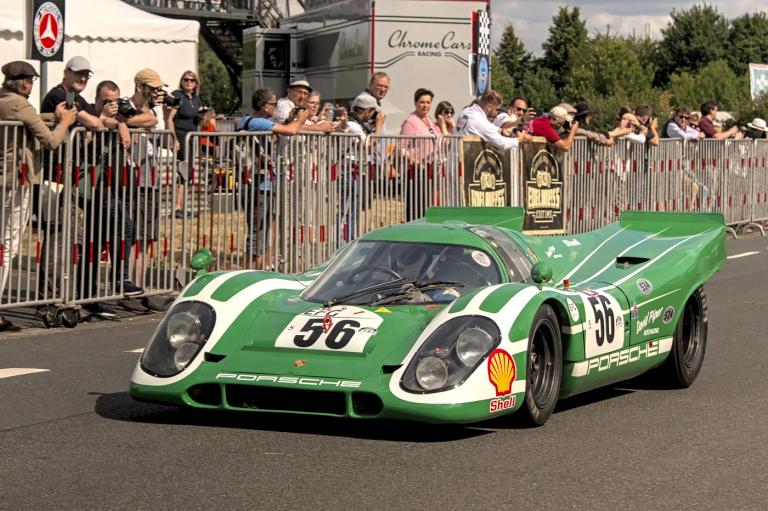
The Porsche 917 was the moment Porsche stopped being the clever smaller-car entrant and became the team to beat. In 1970, Hans Herrmann and Richard Attwood gave Porsche its first overall Le Mans victory in a 917K. The 917 and 908/03 won nine of ten possible races that season.
The 917 was fast, but it was not instantly easy. Porsche had to refine its aerodynamics and give drivers a car they could trust at full speed. The short-tail 917K became the reliable answer for most races. It won Le Mans again in 1971.
When rules changed, Porsche moved the 917 into Can-Am and added turbocharging. The 917/10 and 917/30 became the loud, violent proof that Porsche understood forced induction before it reached road cars. For the full rabbit hole, read our 917 guide.
Turbo Power, 911s, and Formula 1
Porsche carried racing lessons into the 911 Turbo and the 935, then kept the 911 busy everywhere from rallies to endurance grids. The same basic rear-engine car could be a road car, a customer race car, or a serious works weapon. That flexibility is a big reason the 911 has lasted so long.
Porsche also raced in Formula 1 as a constructor in the early 1960s. The later story was more successful. The TAG-Porsche turbo V6 for McLaren won 25 Grands Prix and three titles through 1986.
Formula 1 put turbocharging, cooling, materials, and data under relentless pressure. A race can end because of one weak part.
The 956 and 962 Era
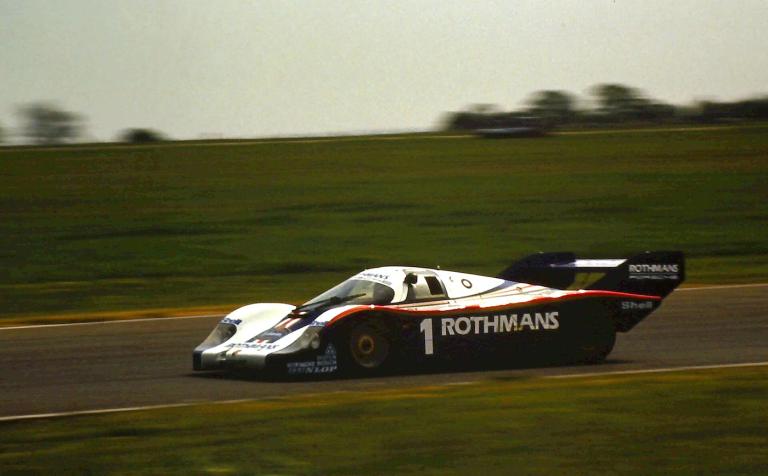
The 956 was Porsche’s Group C answer in 1982. It paired a turbo flat-six with ground-effect aerodynamics and a monocoque chassis. The new car took a Le Mans triple victory in its first season.
The related 962 adapted the idea for IMSA and other rules. Together, the 956 and 962 made Porsche the reference point for endurance racing in the 1980s. They also gave customer teams a platform that stayed competitive for years, which made the wins spread well beyond the factory garage.
Customer teams carry the flag
That customer-racing habit is a real part of the record. Porsche did not just build a fast car for itself. It sold cars, parts, and support so private teams could win too. You still see that model with the 911 GT3 R today.
RS Spyder, 919, and 963
After the 1990s, Porsche returned to prototypes with the RS Spyder. IMSA records 25 class victories for the car between 2005 and 2010, including overall wins against faster LMP1 entries. It showed Porsche could build a sharp modern prototype without losing the discipline that made the older cars work.
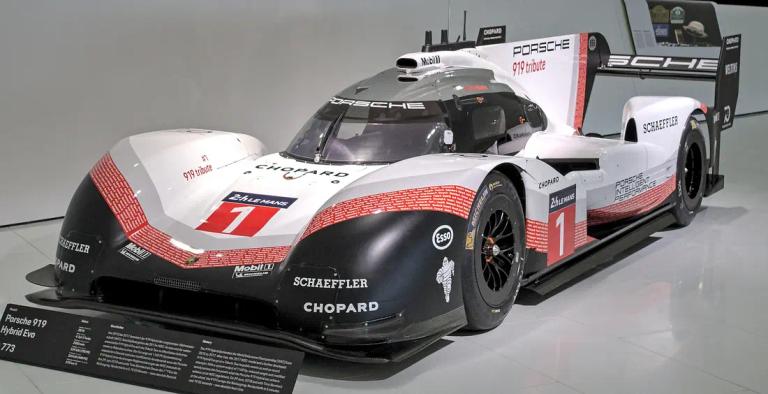
The 919 Hybrid took that idea into the hybrid era. Porsche won Le Mans overall in 2015, 2016, and 2017. The 2015 car ran in the top 8-megajoule energy-recovery class. Porsche then turned the retired platform into the wild 919 Hybrid Evo, which you can read about in our 919 Hybrid Evo guide.
The 963 arrived for the new LMDh rules in 2023. It continues the prototype line, but it is not a remake of the 962. It is a modern hybrid built for both the World Endurance Championship and IMSA. The number is a nod to the older cars, not a promise that racing has stood still.
Why Porsche Keeps Racing
Racing gives Porsche three things: a test bed, a customer community, and a story that means something to owners. A 911 GT3 does not need to be a race car to benefit from the people who build and run them.
It also keeps the brand honest. A badge is cheap. Finishing an endurance race, supporting a customer team, and returning with a better car are harder. Porsche’s record came from repeating that work over decades.
Start with Porsche at Le Mans. Then go into the 917, 956, 962, and 963 guides. That is the fun bit, my guy.
Frequently Asked Questions
When did Porsche start racing?
Porsche started racing under its own name in 1948, when the 356/1 won the Innsbruck City Race. Its first Le Mans appearance came in 1951, with a 356 SL class win.
What was Porsche’s first overall Le Mans win?
Porsche’s first overall Le Mans win came in 1970, when Hans Herrmann and Richard Attwood won in a Porsche 917K.
Which Porsche race car was the most successful?
The Porsche 956 and 962 were Porsche’s most successful endurance-racing platform. They dominated Group C and IMSA through the 1980s.
Did Porsche race in Formula 1?
Yes, Porsche raced in Formula 1 as a constructor in 1961 and 1962. It later supplied McLaren with TAG-Porsche turbo engines that won Formula 1 titles in the 1980s.
What does Porsche race today?
Porsche races the 963 prototype in top-class endurance racing and runs 911 GT3 R cars in GT competition. It also competes in Formula E with the 99X Electric.
Images: Porsche 917K by Alexander Migl, CC BY-SA 4.0. Porsche 956 at Silverstone by Martin Lee, CC BY-SA 2.0. Porsche 919 Hybrid Evo by Alexander Migl, CC BY-SA 4.0. Via Wikimedia Commons.