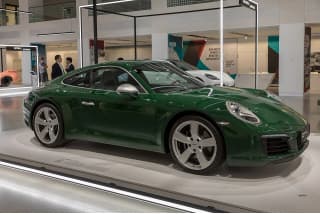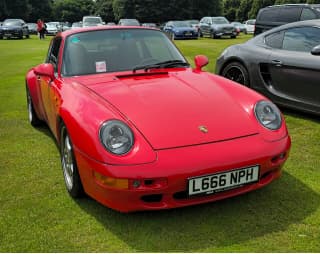
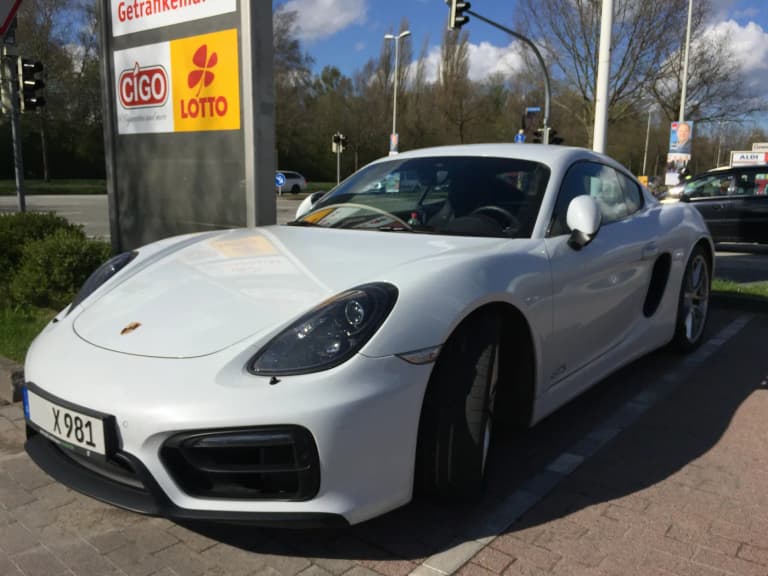
The Porsche 981 is the second-generation Cayman and third-generation Boxster, sold roughly from 2013 to 2016. Both bodies use naturally aspirated flat-six engines with direct fuel injection, the last generation to do so before the turbocharged 718 arrived. Both also moved from hydraulic to electro-mechanical power steering for the first time. Reliability here is less about a single headline risk and more about age-appropriate wear, service history, and checking a specific VIN against open recalls.
In this article, we’ll examine the Porsche 981 Cayman and Boxster generation and how to buy one carefully. We’ll cover its engines and steering, trim lineup, recalls, and inspection checks.
Contents
- 1 Quick Summary
- 2 What “981” Actually Means
- 3 The 981 Timeline: Cayman and Boxster
- 4 Engines and Gearboxes
- 5 Base, S, and GTS: Where the Trim Lines Sit
- 6 Boxster Spyder and Cayman GT4
- 7 Steering and Chassis: Hydraulic Out, Electro-Mechanical In
- 8 Problems, Wear Items, and Recalls
- 9 How to Inspect a 981 Before You Buy
- 10 What a 981 Actually Costs to Own
- 11 Which 981 Fits Which Buyer
- 12 Porsche 981 FAQs
Quick Summary
- Type Number: 981 is Porsche’s internal code for the second-generation Cayman and third-generation Boxster, sold roughly 2013 to 2016
- US Launch: Boxster arrived as a 2013 model; Cayman followed as a 2014 model
- Base Engine: 2.7-liter flat-six, 265 hp in the Boxster and 275 hp in the Cayman
- S Engine: 3.4-liter flat-six, 315 hp in the Boxster S and 325 hp in the Cayman S
- Steering: First Boxster/Cayman generation to switch from hydraulic to electro-mechanical power steering
- IMS Risk: None. The 9A1 engine family has no intermediate shaft, and every 981 base and S engine uses direct fuel injection.
- Recalls: Certain 2013-2015 Boxster and 2014-2015 Cayman-family cars fall under NHTSA campaign 21V679000 for a rear axle carrier issue
What “981” Actually Means
981 is Porsche’s internal type number for this generation, not a trim level. Porsche’s explanation of its model names identifies 981 as the third Boxster type number. It follows the 987 and identifies the platform era shared by the Boxster and Cayman.
Porsche presented the 981 Boxster in 2012, and it reached the US as a 2013 model. The Cayman followed as a 2014 US model. Porsche’s official Boxster history places the 981 between the 987 and the later 718. If you want the full history of either nameplate, the Cayman guide and the Boxster guide cover every generation.
Porsche’s own explanation of its naming system describes the type number as an internal designation, used the same way across the lineup regardless of trim or market.
The 981 Timeline: Cayman and Boxster
The 981 was a full redesign rather than a facelift of the 987. Porsche’s official Boxster history describes a new lightweight body and a completely revised chassis. Exact dimensions and weight changes differ by body, trim, gearbox, and equipment, so use the model-specific sheets below for numbers.
981 Cayman
Porsche introduced the second-generation Cayman in late 2012, and the production car reached the US as a 2014 model. It picked up styling cues from the contemporary 911, a longer wheelbase, and a redesigned interior. The base car used the 2.7-liter flat-six and the S used the 3.4-liter, as documented in Porsche’s 2014 US Cayman specification sheet.
The 981 also introduced a redesigned cabin with a raised center console. Infotainment, seat, trim, and audio equipment vary by model year, market, and options, so verify the build sheet and test every fitted feature.
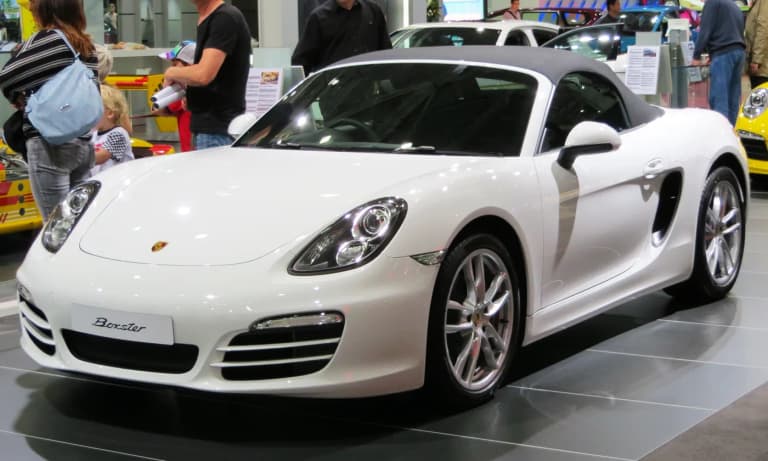
981 Boxster
The 981 Boxster launched roughly a model year ahead of the Cayman in the US, going on sale as a 2013 model. It carried the new platform under the roadster’s folding fabric top. Its 2.7-liter base and 3.4-liter S engines are documented in Porsche’s 2013 US Boxster specification sheet.
Porsche added a GTS trim to the Boxster range in 2014, and the Boxster Spyder followed in 2015 as the range-topping variant of this generation.
Engines and Gearboxes
Every 981 base and S engine is a naturally aspirated flat-six with direct fuel injection. This is the last Boxster and Cayman generation built entirely this way before the 718 switched the base and S models to turbocharged four-cylinder engines.
The 2.7 Base Flat-Six
Porsche’s 2013 US Boxster specification sheet lists the base 2.7-liter flat-six at 265 horsepower at 6,700 rpm and 206.5 lb-ft of torque. The 2014 US Cayman sheet lists the same-displacement base engine at 275 horsepower at 7,400 rpm and 213 lb-ft. The Cayman and Boxster therefore do not share identical output simply because the displacement matches.
The 3.4 S Flat-Six
The Boxster S uses a 3.4-liter flat-six rated at 315 horsepower at 6,700 rpm and 266 lb-ft of torque, per the same 2013 US document. The Cayman S uses the same displacement rated at 325 horsepower at 7,400 rpm and 272 lb-ft, per the 2014 US Cayman sheet. Both S engines use direct fuel injection, the same as the base engines. Unlike the 987, there is no fuel-system split to watch for within the 981 range.
Six-Speed Manual and Seven-Speed PDK
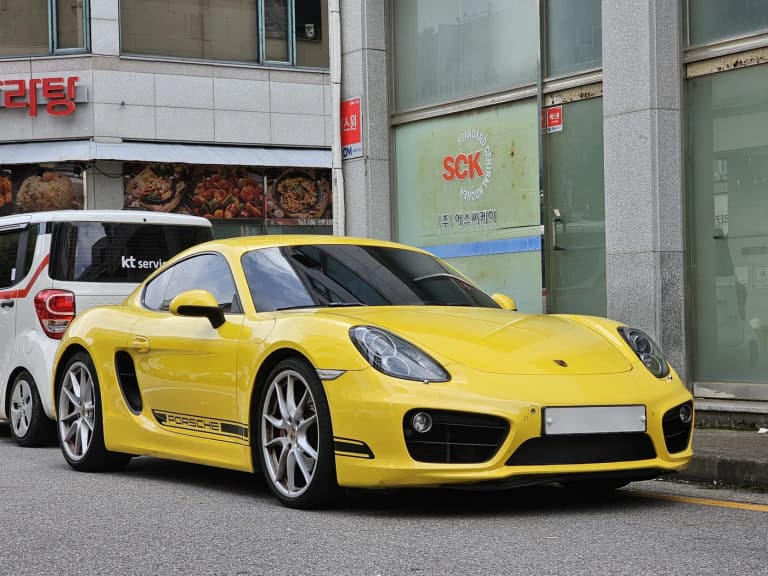
Both bodies and both trims offer a six-speed manual as standard, with a seven-speed PDK dual-clutch as the option. Both gearboxes are confirmed on the 2013 Boxster and 2014 Cayman specification sheets.
In everyday traffic, PDK shifts more smoothly and never asks for a clutch leg in stop-and-go conditions. A well-sorted manual still holds the strongest following among drivers who bought a 981 specifically to row their own gears. If you are deciding between the two gearboxes, our manual versus PDK guide covers the tradeoffs for daily use versus outright engagement.
Base, S, and GTS: Where the Trim Lines Sit
Base
The base 981 carries the smaller engine while retaining the generation’s core mid-engine layout and chassis design. It is the least expensive entry point into the range and gives buyers a clear reason to test whether they actually need the S model’s extra power.
S
The S adds the larger 3.4-liter engine, larger brakes, and a firmer suspension setup as standard. It is the natural step up for a buyer who wants meaningfully more power without moving into the GTS, GT4, or Spyder territory.
Porsche Active Suspension Management, Sport Chrono, Porsche Torque Vectoring, seat type, and exhaust equipment depend on model year, market, and options rather than the S badge alone. Check the build sheet and verify that every fitted system works.
GTS, and What This Guide Will Not Claim
Porsche gave the Boxster GTS and Cayman GTS their world premiere in April 2014. They sat above the S with more standard equipment, unique styling details, and a modest power increase. Porsche’s official launch record confirms the timing, while its separate technical sheet binds output to the exact body and market.
Treat any GTS specification you see elsewhere as something to confirm against the exact car, and check the equipment list closely since it varies by year and market.
Boxster Spyder and Cayman GT4
Both of these sit apart from the rest of the 981 range. They are a different kind of car with their own engine and chassis story. This guide only covers where they fit; the deep dive on each lives on its own page.
Boxster Spyder
Porsche unveiled the 981 Boxster Spyder at the 2015 New York Auto Show. It was a lightweight, manual-only variant using a 3.8-liter flat-six shared with the Cayman GT4 and the 911 Carrera S. Porsche positioned it as the purist, lightweight roadster at the top of the Boxster range. It is covered in more depth, alongside its 987 and 718 siblings, in our 718 Spyder guide, which traces the full Spyder lineage.
Cayman GT4
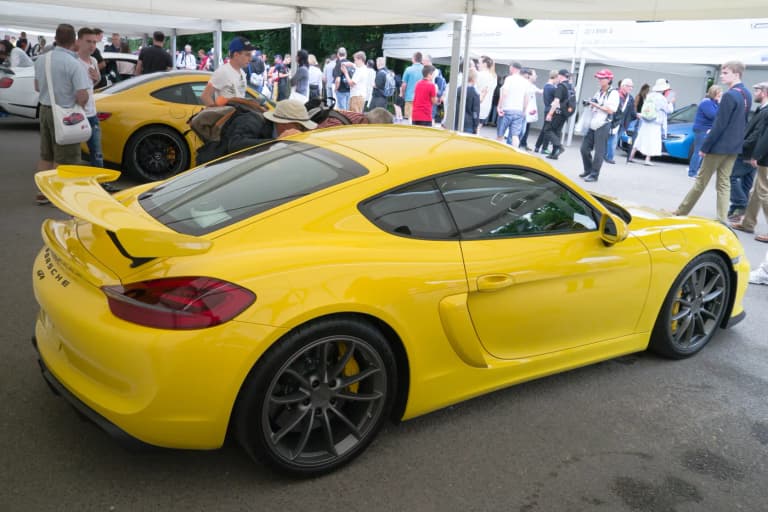
The 981 Cayman GT4 made its world premiere in 2015 with a 3.8-liter flat-six rated at 385 horsepower and a six-speed manual. Porsche’s GT4 launch material documents its place as the first Cayman-based member of Porsche’s GT family. Full coverage lives in our GT4 guide.
Steering and Chassis: Hydraulic Out, Electro-Mechanical In
The 981 was the first Boxster and Cayman generation to use electro-mechanical power steering in place of the hydraulic system used by the 986 and 987. This is the change enthusiasts debate most. The Porsche Club of America argues that the calibration preserved much of the mid-engine car’s distinctive feel.
Other longtime hydraulic-steering owners still say they can feel a small gap in road feedback at the limit compared to a well-sorted 987.
Neither view is right or wrong; it is a matter of personal preference and what you are used to. If steering feel matters a great deal to you, drive a 987 and a 981 back to back before deciding. The only useful answer is to compare a healthy example of each generation on the same roads and decide which system you prefer.
Problems, Wear Items, and Recalls
Age and Mileage Wear Items
Budget for the same maintenance any 10-to-13-year-old Porsche needs: tires, brakes, suspension bushings, coolant hoses, the water pump, and the battery. Manual cars will eventually need a clutch. None of this reflects a defect specific to the 981; it is ordinary upkeep for a car of this age and mileage.
Some of these items can be costly once labor is included. A car that has skipped several of them is a bigger concern than one documented recent repair, and a pre-purchase inspection should identify what is already due.
Owner-Reported Patterns
Use reported ownership patterns as inspection prompts, not failure-rate claims. Check for warnings from Porsche Active Drivetrain Mounts where fitted, verify PDK service records, inspect interior door panels and the headliner for separation, and test every switch and latch. On a Boxster, operate the roof through a full cycle and check the carpets and storage areas for moisture that could point to blocked drains.
Also inspect the cooling system for seepage, listen for water-pump noise, and check suspension bushings and dampers for age-related wear. Service history is the strongest reliability signal you can verify. No credible public dataset establishes a fixed percentage for these owner-reported items.
Verified Recalls and How to Check a VIN
NHTSA campaign 21V679000 covers certain 2013 to 2015 Boxster and 2014 to 2015 Cayman-family cars, including GTS variants. The rear-axle carrier side section on an affected car may fracture. Other campaigns in this period covered narrower groups, which is why the VIN lookup matters more than a model-year list.
Recalls apply to specific VINs within a model year, not to every car built that year. Run the VIN of the exact car you are considering through the NHTSA recall lookup and confirm the work was completed before you buy.
How to Inspect a 981 Before You Buy
History and VIN
Start with the paperwork. Pull a full service history, check the VIN against the NHTSA recall database, and ask specifically whether any open recall on that VIN has been completed. A seller who cannot produce records or answer VIN questions directly is a bigger red flag than any single mechanical concern.
Drive Branch
Drive the car with the audio off so you can hear the engine, the gearbox, and any unusual noise from the suspension. On a manual car, check that the clutch engages smoothly without shuddering. If steering feel matters to you, pay close attention here since this is the generation where that changed most.
Use the drive to check 981-specific systems. Cycle PDK through automatic, manual, and Sport modes if fitted; check for drivetrain-mount, PASM, or steering warnings; and confirm that the electric steering centers consistently. On a Boxster, operate the roof through a full cycle and inspect the carpets again after the drive.
On the Lift, and When to Escalate
Get the car on a lift and check for fluid seepage and worn bushings. Also look for any sign of prior accident repair around the rear axle carrier area covered by the recall above. A pre-purchase inspection lowers your risk and helps you price your first year of ownership. It cannot guarantee a car, so use it alongside the history check rather than in place of it.
What a 981 Actually Costs to Own
A 981 costs roughly what you would expect for a ten-to-thirteen-year-old Porsche sports car in regular use. Budget for routine service, tires, brakes, and occasional larger items as rubber and electronic components age. Independent Porsche specialists are common in most markets and typically cost less than dealer service for routine work.
Tires tend to be the largest recurring cost, since the staggered front and rear fitments wear as a set. Buy the best tire you can afford. It is the single component that most directly affects how the car handles and stops.
Costs vary widely by region, by trim, and by the individual car’s condition. Treat any specific figure you see elsewhere with caution, and get a quote for the exact car in front of you.
Which 981 Fits Which Buyer
The base 981 is the sweet spot for a buyer who wants the sharpest possible handling for the least money, without needing the extra power of the S. The S suits a buyer who wants more performance without stepping up to GTS, GT4, or Spyder pricing. The GT4 and Spyder sit in a different budget conversation from the base and S. The Cayman GT4 is the track-focused model, while the Boxster Spyder is the lightweight purist roadster.
Body style is mostly a matter of taste rather than a different reliability class. A Boxster and Cayman of the same trim share the basic engine family, gearbox choices, and steering system, but their factory output can differ. Buyers who want the fixed roof pick the Cayman; buyers who want to drop the top pick the Boxster.
If you are cross-shopping the older 987, that generation trades this car’s electric steering for hydraulic feel and carries its own version-specific engine risks. Our Porsche 987 guide covers that generation the same way this one covers the 981.
Porsche 981 FAQs
What years did the Porsche 981 cover?
The 981 Boxster launched in the US as a 2013 model. The 981 Cayman followed as a 2014 model, with its production version introduced in the spring of 2013. Porsche built the 981 generation through the 2016 model year before replacing it with the turbocharged 718.
Is the 981’s electric steering worse than the 987’s hydraulic steering?
It depends who you ask. Some enthusiasts and reviewers, including the Porsche Club of America, say the calibration is close enough that most drivers cannot tell the difference. Others who grew up on hydraulic Porsches say they still feel a gap in road feel at the limit. Neither view is a defect; it is a preference worth confirming with a test drive.
Does the 981 have IMS bearing risk?
No. The 981 uses the 9A1 engine family introduced in the 987.2, and that family does not use an intermediate shaft. Unlike the port-injected 987.2 base 2.9, every 981 base and S engine uses direct fuel injection. IMS risk belongs to the earlier 987.1 and older M96/M97-era cars, not the 981.
Was my 981 Boxster or Cayman recalled?
Possibly, but recalls apply to specific VINs within a model year, not to every car built that year. Certain 2013 to 2015 Boxster and 2014 to 2015 Cayman-family cars were recalled for a rear axle carrier issue under NHTSA campaign 21V679000. Run your own VIN through the NHTSA recall lookup to confirm whether your specific car was affected and whether the work was completed.
What is the difference between the 981 S and the GTS?
The S adds the larger 3.4-liter engine over the base car. The GTS sits above the S with more standard equipment and a small additional power bump. It is positioned as the best-equipped version of the naturally aspirated 981 short of the GT4 or Spyder. This guide does not carry full GTS specifications; treat GTS output figures as something to confirm on the specific car.
Should I buy a 981 base, S, or wait for the GT4?
The base 981 is the least expensive route into this generation, while the S adds the larger 3.4-liter engine. The Cayman GT4 is the track-focused choice. The Boxster Spyder is the lighter, purist roadster. Both sit in a different pricing and ownership tier from the base and S.
Images: Featured photo: Porsche Cayman 981 GTS Front by KarleHorn, CC BY 3.0. Boxster: OSX, public domain. Cayman S: Damian B Oh, CC BY-SA 4.0. Cayman GT4: Edvvc, CC BY 2.0. Local copies were resized and converted to WebP.