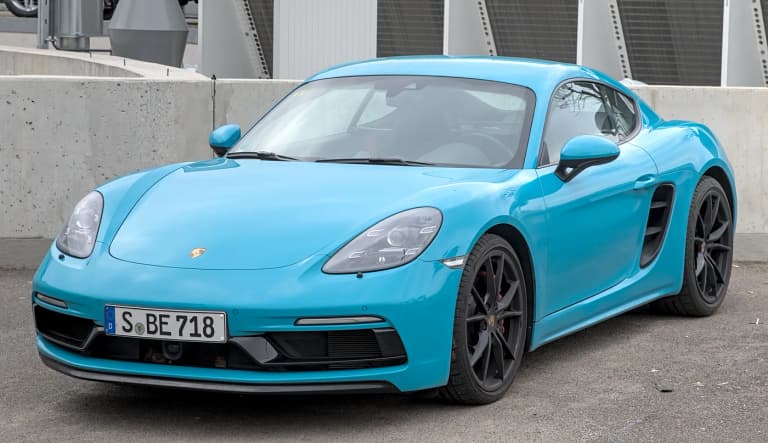
The Porsche 718 Cayman is the third combustion generation of Porsche’s mid-engine coupe, sold as US model years 2017 through 2025. Porsche announced it in October 2015 and rolled it out during 2016. Engines run from a 300 hp turbocharged 2.0 liter flat-four up to the 493 hp naturally aspirated 4.0 liter flat-six in the GT4 RS. Production of every combustion 718 ended in October 2025.
In this article, we’ll explain every Porsche 718 Cayman model and what to check before buying one. We’ll cover its model range, engines, model-year changes, and reliability.
Contents
- 1 Quick Summary
- 2 What Is the Porsche 718 Cayman
- 3 Why It Is Called 718
- 4 718 Cayman Model Range
- 5 Engines: Turbo Flat-Four and the 4.0 Flat-Six
- 6 718 Cayman Specs
- 7 Model Year Changes 2017 to 2025
- 8 Buying a Used 718 Cayman
- 9 Reliability, Recalls, and Ownership Costs
- 10 The End of Production and What Comes Next
- 11 Frequently Asked Questions
Quick Summary
- Production Years: US-market 718 Cayman ran 2017 to 2025, with combustion production ending in October 2025
- Engine Range: 300 hp turbocharged 2.0-liter flat-four up to the 493 hp naturally aspirated 4.0-liter in the GT4 RS
- Enthusiast Pick: the 4.0-liter six-cylinder models (GTS 4.0, GT4, GT4 RS) over the cheaper, still-quick four-cylinder cars
- Gearbox: manual and PDK availability varies by model; the GT4 RS is PDK only
- IMS Risk: None. The turbocharged flat-four does not use the intermediate shaft bearing design.
- Buying Checks: open recalls by VIN, full service history, and a specialist pre-purchase inspection
What Is the Porsche 718 Cayman
The 718 Cayman is a two-seat mid-engine coupe, internally the 982 generation, and the third Cayman Porsche built. Its engine sits behind the seats and ahead of the rear axle. The fixed roof separates it from the Boxster.
What changed was the engine. Porsche announced the 718 Boxster and 718 Cayman on October 12, 2015 and said both would get turbocharged four-cylinder flat engines. That single decision defines the generation and still drives what these cars are worth.
The dates confuse people, so it helps to separate them. Porsche introduced the cars over the course of 2016, European deliveries began that year, and US cars are titled as 2017 through 2025 model years. If you want the 987 and 981 story instead, our full Cayman guide covers all three generations.
Why It Is Called 718
The number belongs to a race car. Porsche’s 718 of the late 1950s was a small, light, four-cylinder sports racer that beat cars with far bigger engines. Porsche says the 718 won the Targa Florio three times between 1959 and 1960. A 142 hp 718 RSK also won its class at Le Mans in 1958.
So when Porsche put four-cylinder engines back into the mid-engine road cars, it reached for that history to explain the move. Porsche described the new model series as a continuation of the four-cylinder concept. Enthusiasts argued about the engines anyway, but the naming logic was consistent.
718 Cayman Model Range
Eight versions of the 718 Cayman reached buyers, and they split cleanly into four-cylinder cars and six-cylinder cars. Here is what each one is.
718 Cayman (2.0 turbo)
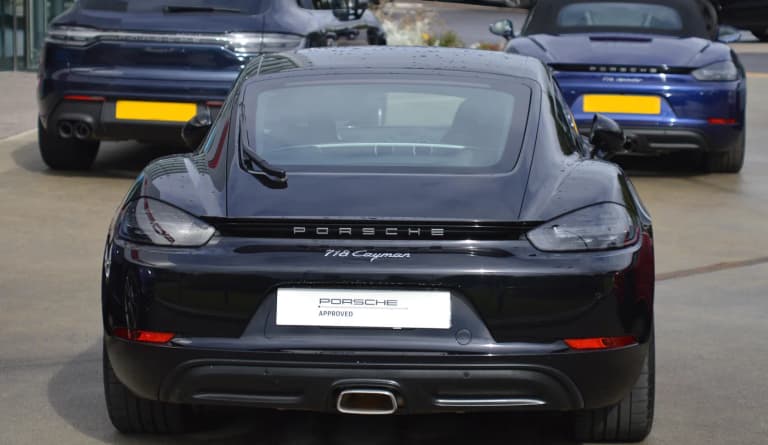
The base car uses a turbocharged 2.0 liter flat-four rated at 300 hp with 280 lb-ft of torque. Porsche quotes 4.9 seconds to 60 mph with the manual and 4.5 seconds with PDK and Sport Chrono. It is the cheapest way into the generation and the most common car on the used market.
718 Cayman S (2.5 turbo)
The S steps up to a 2.5 liter turbo flat-four with 350 hp. Porsche quotes 4.0 seconds to 60 mph for a car with PDK and the Sport Chrono Package, and a top track speed of 177 mph. It also brings bigger brakes and a sport exhaust into easier reach.
718 Cayman T
The T is a trim rather than an engine. It keeps the 300 hp 2.0 liter and adds PASM sport suspension with a lower ride height. A mechanical limited-slip differential, Porsche Torque Vectoring, and the Sport Chrono Package are also standard. Porsche launched it in the US as a 2020 model year car and quotes 4.5 seconds to 60 mph with PDK and launch control.
718 Cayman GTS (2.5 turbo, 2018 to 2019)
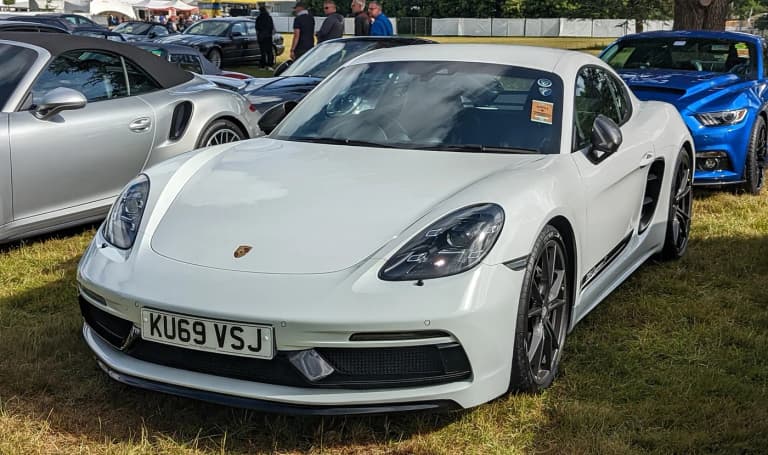
The first 718 GTS used a reworked 2.5 liter four making 365 hp and up to 317 lb-ft, which Porsche described as 15 horsepower more than the S. With PDK and Sport Chrono it reached 60 mph in 3.9 seconds and ran to 180 mph. It is the quickest four-cylinder 718 Cayman.
718 Cayman GTS 4.0
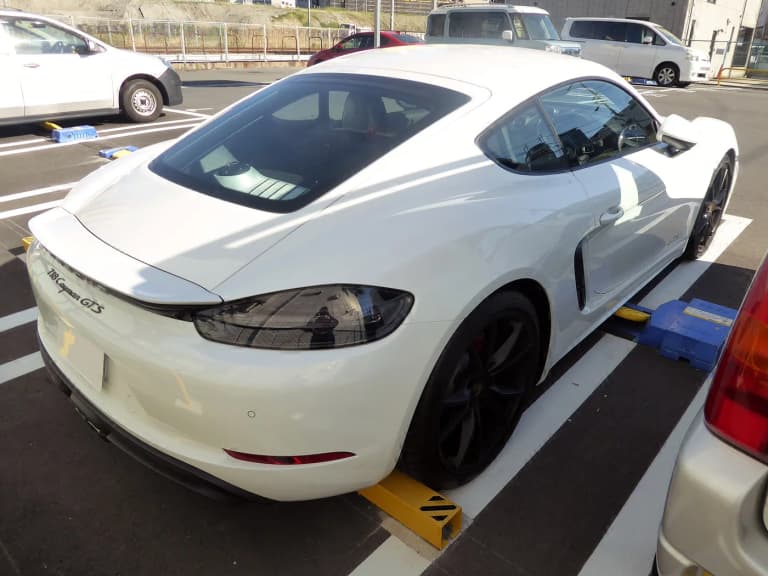
This is the car that changed the generation’s reputation. Porsche dropped a naturally aspirated 4.0 liter flat-six into the GTS, rated at 394 hp, with 4.3 seconds to 60 mph and a 182 mph top track speed. Porsche listed the 2021 718 Cayman GTS 4.0 at $86,800 before delivery.
718 Cayman Style Edition
The Style Edition is an appearance package on the base 2.0 liter car, announced for the 2023 model year. It adds 20-inch 718 Spyder wheels in high-gloss black, black sport tailpipes, a heated multifunction steering wheel, and black leather with contrasting Chalk stitching. Power stays at 300 hp.
GT4, GT4 RS, and the Spyder
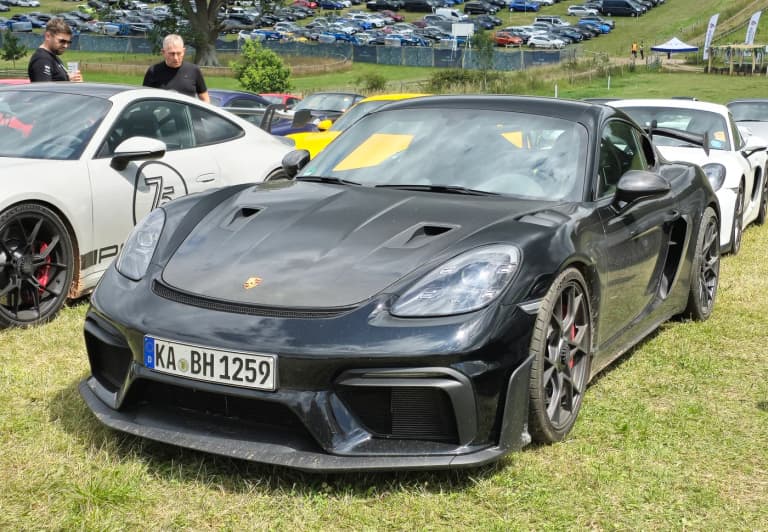
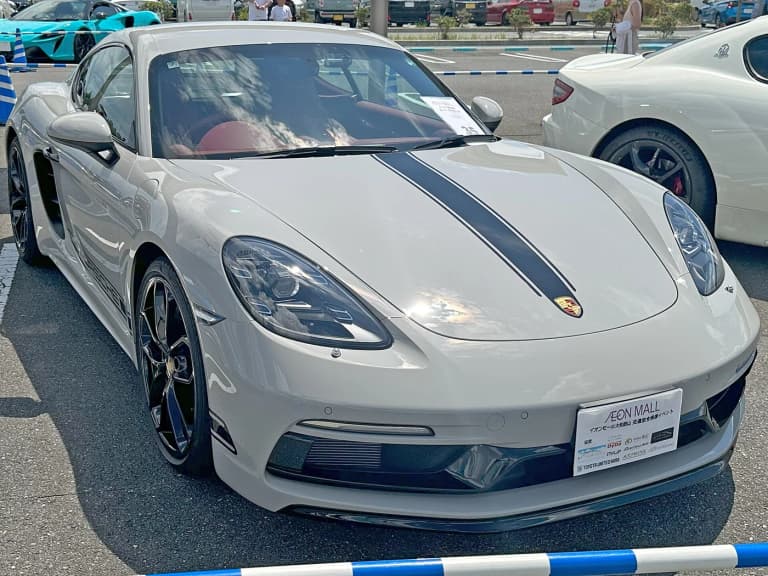
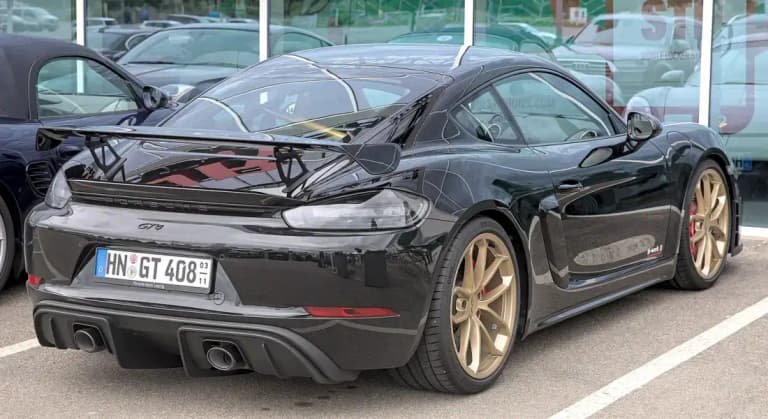
Above the GTS 4.0 sit the GT cars. The 414 hp 718 Cayman GT4 and 493 hp GT4 RS come from Porsche’s GT department. The GT4 RS revs to 9,000 rpm, and both cars have their own full guides. The open-top 718 Spyder shares the GT4 engine and chassis in a Boxster body, so it is covered there rather than here.
Engines: Turbo Flat-Four and the 4.0 Flat-Six
Three engines cover the whole range. The 2.0 liter turbo four powers the base car, the T, and the Style Edition. The 2.5 liter turbo four powers the S and the 2018 to 2019 GTS. The naturally aspirated 4.0 liter flat-six powers the GTS 4.0, the GT4, and the GT4 RS.
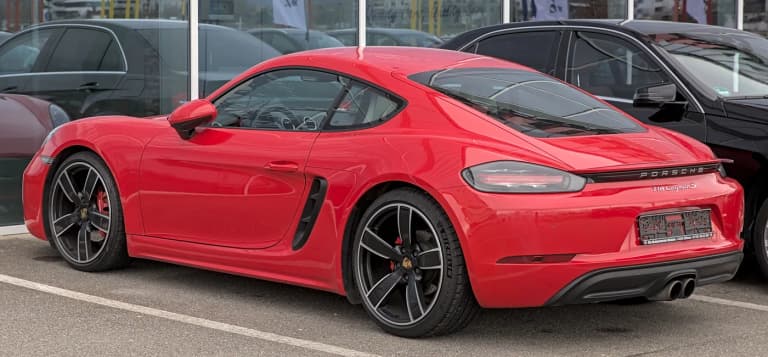
The turbo fours are the practical compromise of this generation. They pull hard from low revs, they use less fuel, and in the S and GTS they are quick enough to embarrass much more expensive cars. What they do not do is sound like a Porsche flat-six, and that is the complaint that stuck.
The 4.0 liter six answers it. It revs cleanly to the top, responds instantly, and gives the car the voice buyers expected. Our flat-six engine guide explains the layout. See the 718 vs 911 comparison for the four-versus-six question. The Cayman vs Boxster comparison covers the coupe against its open-top twin.
Gearboxes are simpler. Most cars offer a six-speed manual or a seven-speed PDK. The GT4, Spyder, and GTS 4.0 launched as manuals only. Porsche added PDK to all three for the 2021 model year. Our PDK vs manual guide covers which one suits which car.
718 Cayman Specs
Power figures below are US horsepower as published by Porsche Cars North America. Porsche quotes the same engines in PS in European material, so you will see slightly different numbers on European spec sheets for the same car.
| Variant | Engine | Power | 0-60 mph |
|---|---|---|---|
| 718 Cayman | 2.0 turbo flat-four | 300 hp | 4.9 s manual, 4.5 s PDK with Sport Chrono |
| 718 Cayman T | 2.0 turbo flat-four | 300 hp | 4.5 s PDK with launch control |
| 718 Cayman S | 2.5 turbo flat-four | 350 hp | 4.0 s PDK with Sport Chrono |
| 718 Cayman GTS (2.5) | 2.5 turbo flat-four | 365 hp | 3.9 s PDK with Sport Chrono |
| 718 Cayman GTS 4.0 | 4.0 flat-six | 394 hp | 4.3 s |
| 718 Cayman GT4 | 4.0 flat-six | 414 hp | about 4.2 s manual |
| 718 Cayman GT4 RS | 4.0 flat-six | 493 hp | 3.2 s |
Top track speeds follow the same order. Porsche quotes 177 mph for the S, 180 mph for the 2.5 liter GTS, and 182 mph for the GTS 4.0. The GT4 RS makes its 493 hp at 8,400 rpm with 331 lb-ft at 6,250 rpm, and Porsche puts its maximum engine speed at 9,000 rpm.
Model Year Changes 2017 to 2025
The 718 Cayman had no mid-life facelift, so the changes are additions to the range rather than redesigns. This is the order they arrived in.
- 2017: the 718 Cayman and 718 Cayman S reach US buyers with the new turbo flat-fours, a revised chassis, and a new dash.
- 2018: the 365 hp 718 Cayman GTS joins, announced by Porsche in October 2017.
- 2020: the 718 Cayman T arrives in the US, and the 414 hp GT4 returns with the naturally aspirated 4.0 liter six.
- 2021: Porsche adds PDK as an option on the GT4, Spyder, and GTS 4.0, and lists the GTS 4.0 at $86,800.
- 2022: the GT4 RS reaches customers after its November 2021 premiere at the Los Angeles Auto Show.
- 2023: the Style Edition appears on the base car.
- 2025: the final year. Production of every combustion 718 ended that October.
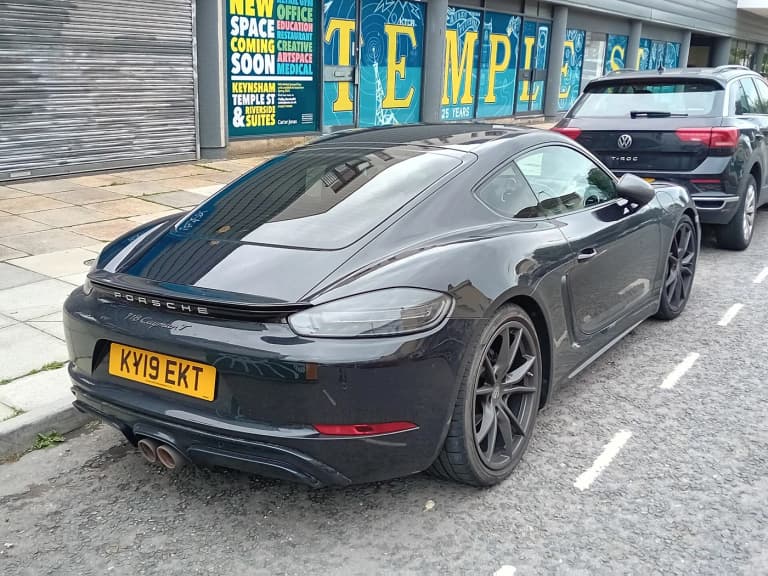
For a used buyer the useful boundary is 2020. Before it, every 718 Cayman is a turbo four. From 2020 on, the 4.0 liter six is on the menu, and that is where the money now sits.
Buying a Used 718 Cayman
Prices for this generation have not settled into a neat table, and they move differently by variant, so treat any single number you read as a snapshot. The pattern is easier to describe than the figures. Four-cylinder base and S cars depreciated normally and are the value entry point, sitting near the top of our list of the cheapest ways into a Porsche. The 4.0 liter cars did not follow them down.
Three things move a 718 Cayman’s value more than mileage. The engine comes first, because a GTS 4.0 or a GT4 trades in a different market from an S. The gearbox comes second, and manuals command a premium on the six-cylinder cars. Options come third, with bucket seats, carbon ceramic brakes, and Sport Chrono all adding real money on resale.
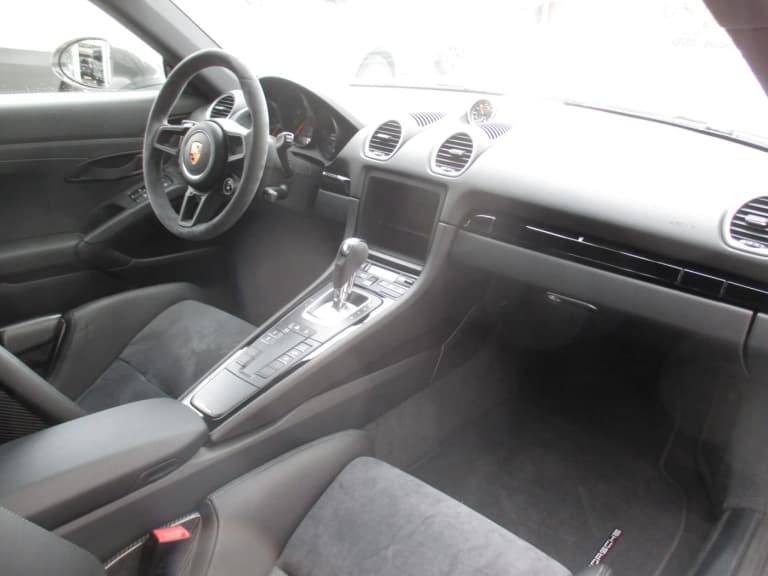
On the car itself, check the usual mid-engine coupe items. Look for curbed wheels and tired tires, which are cheap to spot and not cheap to fix on 20-inch rubber. Ask for the service history, since these cars are new enough that gaps have no excuse. On any GT car, ask about track use and check brake and tire condition against the seller’s story. A pre-purchase inspection at a Porsche specialist is still the best money you will spend.
Reliability, Recalls, and Ownership Costs
The good news comes first. No 718 has the intermediate shaft bearing that worries buyers of early water-cooled Porsches, because the design left the Cayman line at the 2009 facelift. If you are cross-shopping older cars and want to understand that risk, our IMS bearing guide explains what it is and which cars carry it.
Recalls are model-year specific rather than generation-wide. NHTSA lists two campaigns for the 2018 718 Cayman. Campaign 19V179000 covers side airbag impact sensors that may not have been tightened correctly. Campaign 19V113000 covers a crossmember that could detach in a crash and cause a fuel leak.
Those campaigns apply to that year’s cars. Check the car by VIN on the NHTSA site rather than assuming the whole generation is affected.
Running costs are ordinary Porsche costs. Tires, brakes, and scheduled service are the recurring items, and the 4.0 liter cars ask for more of all three if you drive them the way they invite. Condition and service history matter more than a generation-wide label, and none of these cars are cheap to run.
The End of Production and What Comes Next
Porsche stated it plainly in its 2025 delivery figures: production ended in October 2025. The 718 line delivered 18,612 cars that year, down 21 percent as the phase-out ran its course.
What follows is less settled. Porsche has publicly developed an electric 718, and that is the direction the company has confirmed. Reports of a combustion or hybrid version continuing alongside it are reporting, not confirmation, so treat them that way until Porsche says otherwise.
For buyers the practical effect is simple. Production of the 982-generation combustion Cayman is over, including its naturally aspirated 4.0 liter variants. Collector demand for the six-cylinder models is real, and their prices have held up. Nobody can tell you what any of these cars will be worth in five years. If you want the coupe against the flagship instead, our Cayman vs 911 comparison is the place to go.
Frequently Asked Questions
What does 718 mean on a Porsche Cayman?
The 718 name comes from Porsche’s four-cylinder race cars of the late 1950s. Porsche says the 718 won the Targa Florio three times between 1959 and 1960. A 142 hp 718 RSK also scored a class win at Le Mans in 1958. Porsche revived the number when it moved the Boxster and Cayman to turbocharged flat-four engines for 2016.
What years did the 718 Cayman run?
Porsche announced the 718 Cayman on October 12, 2015 and introduced it during 2016. European deliveries started in 2016, while US model years run from 2017 to 2025. Production of the combustion 718 ended in October 2025.
Is the 718 Cayman discontinued?
Yes. Porsche confirmed that combustion 718 Boxster and Cayman production ended in October 2025. The company delivered 18,612 cars from the 718 line during that phase-out year. Porsche has publicly developed an electric 718. Treat reports about a combustion or hybrid follow-up as unconfirmed.
Which 718 Cayman engine is best?
Buyers chase the naturally aspirated 4.0-liter flat-six in the GTS 4.0, GT4, and GT4 RS. It revs higher and sounds far better than the turbo four. The 2.0- and 2.5-liter flat-fours cost less and warm up faster in traffic. They remain genuinely quick and suit buyers who value pace and running costs over engine noise.
Is the four-cylinder 718 Cayman reliable?
The turbocharged flat-four does not use the intermediate shaft bearing associated with some early water-cooled Porsche sixes. Reliability still depends on the individual car, so check its VIN for open recalls, review its service history, and get a specialist inspection before buying.
Image Credits
Images: blue 718 Cayman GTS by Alexander-93, CC BY-SA 4.0. black 2018 718 Cayman by 多多123, CC BY 4.0. red 718 Cayman S by Alexander-93, CC BY-SA 4.0. 718 Cayman GT4 RS by Calreyn88, CC BY-SA 4.0. white 718 Cayman T by Calreyn88, CC BY-SA 4.0. black 718 Cayman T by Hugh Llewelyn, CC BY-SA 2.0. 718 Cayman Style Edition and white 718 Cayman GTS rear by Tokumeigakarinoaoshima, CC BY-SA 4.0. 718 Cayman T interior by Sokrates 399, CC BY-SA 4.0. black 718 Cayman GT4 by Alexander Migl, CC BY-SA 4.0. Via Wikimedia Commons.